


惯性聚合 高效追踪和阅读你感兴趣的博客、新闻、科技资讯
阅读原文 在惯性聚合中打开

推荐订阅源

T
Threatpost
aimingoo的专栏
aimingoo的专栏
OSCHINA 社区最新新闻
OSCHINA 社区最新新闻
T
Tailwind CSS Blog
J
Java Code Geeks
博客园_首页
Google Online Security Blog
Hugging Face - Blog
Hugging Face - Blog
C
CXSECURITY Database RSS Feed - CXSecurity.com
I
Intezer
P
Palo Alto Networks Blog
V
Vulnerabilities – Threatpost
雷峰网
雷峰网
O
OpenAI News
SecWiki News
SecWiki News
小众软件
小众软件
酷 壳 – CoolShell
酷 壳 – CoolShell
美团技术团队
N
News | PayPal Newsroom
Project Zero
Project Zero
Forbes - Security
Forbes - Security
IT之家
IT之家
A
Arctic Wolf
WordPress大学
WordPress大学
Jina AI
Jina AI
T
Tor Project blog
博客园 - 三生石上(FineUI控件)
S
Secure Thoughts
Google DeepMind News
Attack and Defense Labs
博客园 - 聂微东
Exploit-DB.com RSS Feed
P
Privacy International News Feed
Cloudbric
Cloudbric
G
GRAHAM CLULEY
博客园 - 叶小钗
H
Hacker News: Front Page
腾讯CDC
量子位
Help Net Security
Help Net Security
人人都是产品经理
人人都是产品经理
C
Cyber Attacks, Cyber Crime and Cyber Security
月光博客
月光博客
奇客Solidot–传递最新科技情报
奇客Solidot–传递最新科技情报
宝玉的分享
宝玉的分享
爱范儿
爱范儿
L
Lohrmann on Cybersecurity
Hacker News - Newest:
Hacker News - Newest: "LLM"
Recorded Future
Recorded Future
C
CERT Recently Published Vulnerability Notes

The Eclectic Light Company

Apple has released an update to XProtect for all macOS Hero or hooligan: Theseus’ later years BSD flags are incompatible with iCloud Drive Apple has released macOS Tahoe 26.5.1 In memoriam Mary Cassatt: 1, 1868-1880 Solutions to Saturday Mac riddles 362 What Location Services do in macOS Eclectic paintings of Joseph Stella: 2 European myths Last Week on My Mac: Razzle and dazzle Eclectic paintings of Joseph Stella: 1 American landscapes Saturday Mac riddles 362 Protect files with the Locked or Immutable flag Reading Visual Art: 252 Dragonfly What happens in the log when an app crashes as it starts up? Portraits of trees: Introduction On Reflection: Conclusions and contents Which tasks require mains power? Medium and message: Vast canvases Online reference to external displays for Apple silicon Macs What’s in that phishing email? Hero or hooligan: Theseus and Ariadne Solutions to Saturday Mac riddles 361 How to search document versions Rubens’ Consequences of War Rubens’ Peace and War Saturday Mac riddles 361 How to search Time Machine backups? Naturalists: Contents and artists On Reflection: Extending the image Tackle QuickLook problems Medium and message: Pottery Hero or hooligan: Theseus and the sandals How QuickLook provides thumbnails and previews Last Week on My Mac: Syncing metadata in iCloud Drive Paintings of visits to India 1778-1877 Saturday Mac riddles 360 Naturalists: Sorolla and Zorn On Reflection: Pierre Bonnard 1909-1946 SpotTest 1.2 can display Spotlight metadata directly On Reflection: Pierre Bonnard 1899-1908 How to preserve versions, and how to create versioned PDFs What gets synced in iCloud Drive? Hero or hooligan: Perseus 2 Solutions to Saturday Mac riddles 359 Last Week on My Mac: snapshots, the elephant in APFS Paintings of Beatrice Portinari: to 1862 Saturday Mac riddles 359 Naturalists: Into the 20th century How to check whether Spotlight is getting the right metadata On Reflection: Mirror play Hero or hooligan: Perseus 1 The bicentenary of Frederic Edwin Church: 1857-77 Solutions to Saturday Mac riddles 358 macOS virtual machines and audio-video syncing A walk in the parks of Rome, Vienna, Manhattan and Brooklyn Saturday Mac riddles 358 Naturalists: Photography Use Finder tags for categories Control what gets written to the log Medium and message: Tapestry Virtualisation on Apple silicon Macs is different Jerusalem Delivered: Overview and contents The bicentenary of Frederic Edwin Church: 1849-57 Solutions to Saturday Mac riddles 357 Painting Pandora and her box: 1883-1919 Painting Pandora and her box: 1550-1882 Saturday Mac riddles 357 Reading Visual Art: 250 Winged sandals The secret life of the xattr The macOS Natural Language framework and Nalaprop Medium and Message: Stained glass The MACL extended attribute Jerusalem Delivered: 13 Leading characters Solutions to Saturday Mac riddles 356 Privacy: How locations are protected Painting Spring blossom 2 Last Week on My Mac: Don’t be a victim of fraud Painting Spring blossom 1 Saturday Mac riddles 356 Explainer: Recovery Reading Visual Art: 249 Mask Naturalists: Urban poverty On Reflection: Cézanne Privacy: Which folders are protected in Tahoe? Medium and Message: Mosaic Jerusalem Delivered: 12 Delivery Solutions to Saturday Mac riddles 355 Centaurs 2: Revenge Centaurs 1: Fights Saturday Mac riddles 355 Explainer: sandboxes Naturalists: The modern meal Why you can’t trust Privacy & Security Apple has just released an update to macOS Tahoe, to version 26.4.1 On Reflection: Divisionism Please help update CPU frequencies for Apple silicon Macs Commemorating the centenary of the death of John Ferguson Weir Privacy: Files & Folders or Full Disk Access? Jerusalem Delivered: 11 Into Jerusalem Privacy: protected folders
Medium and message: Sculpture
hoakley · 2026-05-12 · via The Eclectic Light Company

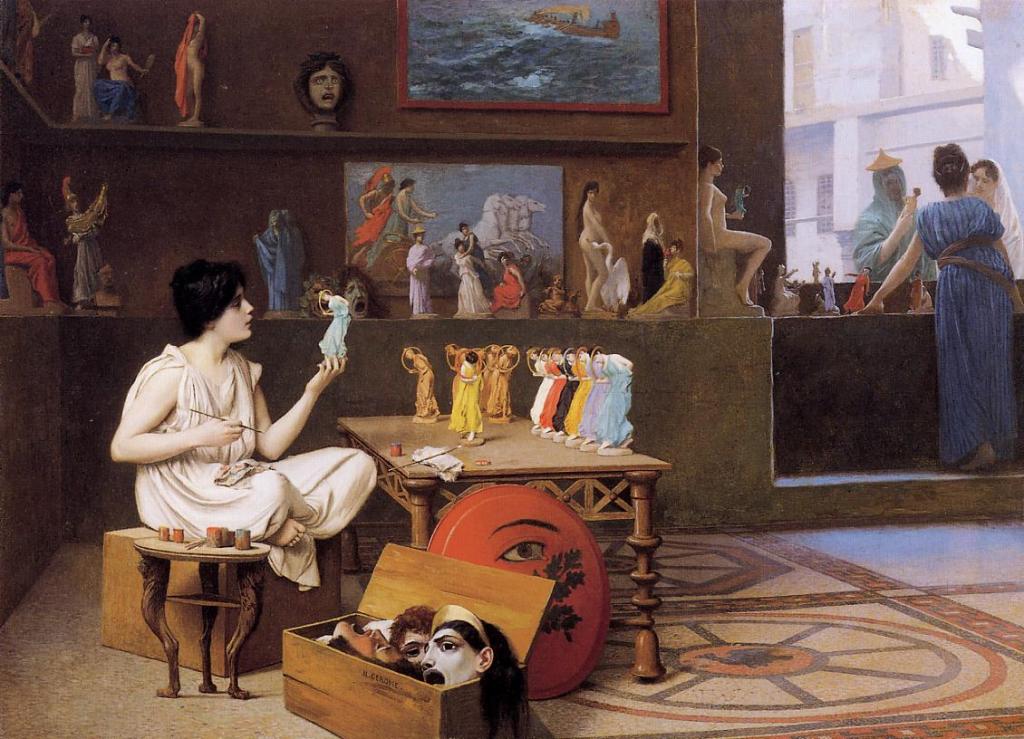
Jean-Léon Gérôme (1824–1904), Sculpturae Vitam Insufflat Pictura (Painting Breathes Life into Sculpture (1893), oil on canvas, 50.2 x 69.2 cm, Art Gallery of Ontario, Toronto. Wikimedia Commons.

Many of the great buildings, their friezes and statues of classical times, and in the Middle Ages, were painted, a practice known as polychrome. This article looks at some more modern examples made by those who also painted flat surfaces.

almatademaphidiasshowingfrieze
Lawrence Alma-Tadema (1836–1912), Phidias Showing the Frieze of the Parthenon to his Friends (1868), oil on canvas, 72 × 110.5 cm, Birmingham Museum and Art Gallery, Birmingham, England. Wikimedia Commons.

Lawrence Alma-Tadema’s beautiful painting of Phidias Showing the Frieze of the Parthenon to his Friends from 1868 shows a group including Pericles (at the right), Aspasia, Alcibiades and Socrates, admiring this famous frieze in the glory of its original colours.

biberachwkshplastjudgement
Master of the Biberach Holy Kinship (fl. 1520), Workshop of, The Last Judgement (c 1520), polychrome predella on limewood, 55 x 172 cm, Musée des Beaux-Arts, Lyon, France. Wikimedia Commons.

This magnificent polychrome limewood sculpture shows The Last Judgement (c 1520) as an outbreak of plague, and may be based on descriptions of the Black Death.

Much of the output from the workshops of Spanish painters during the seventeenth century wasn’t two-dimensional painting, but polychrome wood carvings destined for religious use.

demesaimmaculata
Juan de Mesa (1583–1627), The Immaculate Conception (c 1610-15), polychrome wood carving, dimensions not known, Matthiesen Gallery, London. Wikimedia Commons.

Juan de Mesa (1583–1627) was a Cordoban sculptor who trained and worked in Seville from 1606 to his death there in 1627. He was responsible for many of the processional effigies which were – and some still are – featured in the celebrations of Holy Week in Seville. The Immaculate Conception is a fine example of his work from about 1610-15.

Many painters have also sculpted, but one specialised in polychrome figures, Jean-Léon Gérôme. Not only that, but he made paintings of him working on his sculptures, and of polychrome sculptures more generally.

IF
Jean-Léon Gérôme (1824–1904), The End of the Pose (1886), oil on canvas, 48.3 x 40.6 cm, Private collection. Wikimedia Commons.

Gérôme’s The End of the Pose (1886) is the first of a series of unusual compound paintings, which are at once self-portraits of Gérôme as a sculptor, studies in the relationship between a model and their sculpted double, and forays into issues of what is seen, visual revelation, and truth.

Here, while Gérôme cleans up, his model is seen covering up her sculpted double with sheets, as she remains completely naked. Apart from various diversionary entertainments, including a couple of stuffed birds and a model boat, there is a single red rose on the wooden platform on which the model and statue stand.

It’s not far from here to the myth of the perfect sculptor, Pygmalion, whose creation was given life, turning statue into lover, which was Gérôme’s next step in 1890.

geromepygmaliongalatea
Jean-Léon Gérôme (1824–1904), Pygmalion and Galatea (c 1890), oil on canvas, 88.9 x 68.6 cm, Metropolitan Museum of Art, New York, NY. Wikimedia Commons.

Gérôme’s finished Pygmalion and Galatea (c 1890) just managed to stay on the right side of what in the day was deemed decent. His attention to detail is, as always, delightful, with two masks against the wall at the right, Cupid ready with his bow and arrow, an Aegis bearing the head of Medusa, and a couple of statues about looking and seeing.
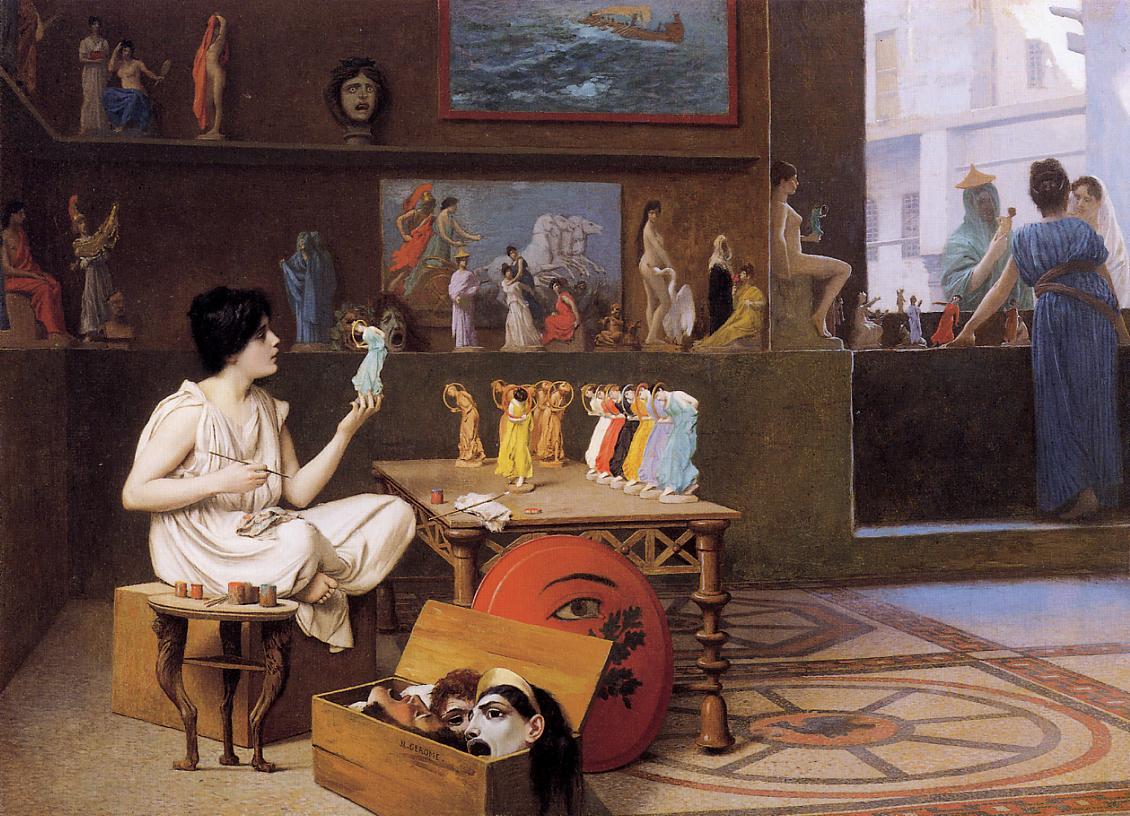
geromepaintingbreatheslifesculpture
Jean-Léon Gérôme (1824–1904), Sculpturae Vitam Insufflat Pictura (Painting Breathes Life into Sculpture) (1893), oil on canvas, 50.2 x 69.2 cm, Art Gallery of Ontario, Toronto. Wikimedia Commons.

In 1874, archaeologists discovered large numbers of polychrome cast terracotta figurines in the Boeotian town of Tanagra. These dated from Greek civilisations active there during the late fourth century BCE, and their quantity and quality impressed many, including Gérôme.

Having painted the story of Pygmalion and Galatea in 1890, Gérôme moved on to two works in which he built imaginary worlds around the Tanagra figurines. Sculpturae Vitam Insufflat Pictura (Painting Breathes Life into Sculpture) (1893) combines his own love of polychrome sculpture with a celebration of those archaeological discoveries.

In doing so, Gérôme progresses his long-running theme of visual revelation and truth, with these painted miniature humans, mimicking reality, and the wooden box of masks in the foreground. Several of the figurines refer to his own painting and sculpture.
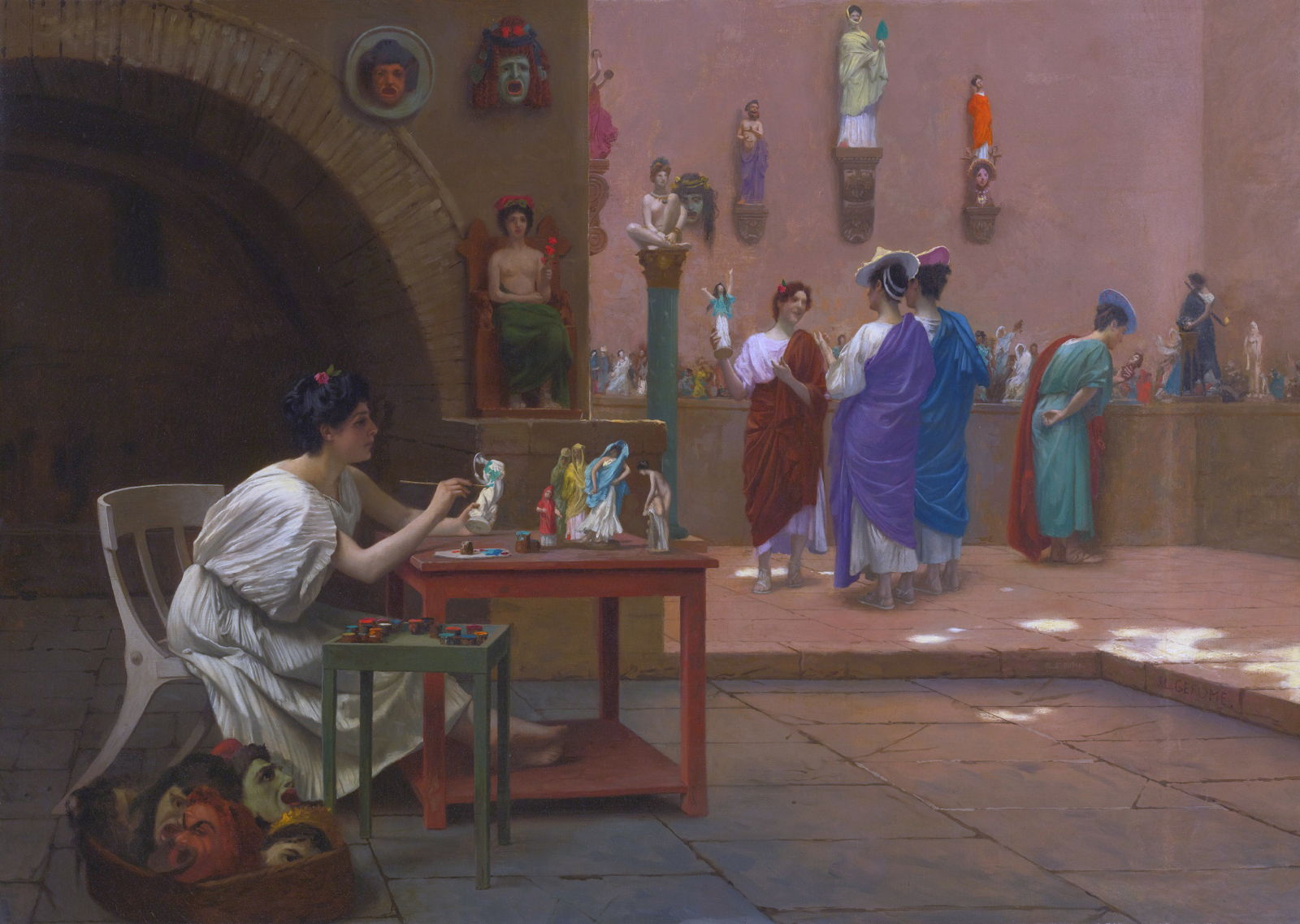
geromeateliertanagra
Jean-Léon Gérôme (1824–1904), Atelier of Tanagra (1893), oil on canvas, 65.1 x 91.1 cm, Private collection. Wikimedia Commons.

As a painting, I don’t think that his Atelier of Tanagra (1893) is as effective and convincing as the previous work, but its wider range of figurines gives deeper insight into what Gérôme was thinking about. Several of the figurines shown here are his own polychrome sculptures, most obviously that of the naked woman sitting on the top of a blue pillar, in the centreline of the painting.

geromeworkingmarble
Jean-Léon Gérôme (1824–1904), The Artist’s Model (1895), oil on canvas, 50.8 x 39.6 cm, Dahesh Museum of Art, New York, NY. Wikimedia Commons.

In The Artist’s Model (1895), Gérôme paints himself at work on his marble figure Tanagra (1890), currently in the Musée d’Orsay, which he had already included among the figurines in his Sculpturae Vitam Insufflat Pictura. He thus painted himself making a sculpture which he had previously painted in a painting as a sculpture. Scattered in the image are reminders of gladiatoral armour and other props used for his paintings, one of his paintings of Pygmalion and Galatea, together with one of his polychrome sculptures of a woman with a hoop, at the right edge.

geromesarahbernhardt
Jean-Léon Gérôme (1824–1904), Sarah Bernhardt (1894-1901), polychrome marble, Musée d’Orsay, Paris. Wikimedia Commons.

In 1894, Jean-Léon Gérôme started work on this polychrome marble head of the famous actor Sarah Bernhardt (1894-1901), which he completed in 1901. He bequeathed it to the French nation.

geromeselfportrait1902
Jean-Léon Gérôme (1824–1904), Self-Portrait Painting The Ball Player (c 1902), oil on canvas, 61 x 50 cm, Musée Georges-Garret, Vesoul, France. The Athenaeum.

In about 1902 Gérôme returned to his series of paintings of himself as a sculptor. His Self-Portrait Painting The Ball Player is a fascinating variation of the traditional form of self-portrait, in that he is here applying the colour to one of his polychrome sculptures, a figure of a ball player, who closely resembles those seen earlier in his paintings of sculptures, including Pygmalion and Galatea.

Georges Lacombe was the sculptor among the Nabis, who painted Breton motifs and sculptures he created in wood.

lacombeisis
Georges Lacombe (1868–1916), Isis (c 1895), mahogany wood sculpture, 111.5 x 62 cm, Musée d’Orsay, Paris. Wikimedia Commons.

Some of Lacombe’s sculptures are stunning: this wood carving in mahogany with added colour shows the goddess Isis, and was made in about 1895. It’s now in the Musée d’Orsay. Lacombe’s symbolism here may refer to the role of this Egyptian goddess in producing and protecting the heir to Osiris, Horus.