



惯性聚合 高效追踪和阅读你感兴趣的博客、新闻、科技资讯
阅读原文 在惯性聚合中打开

推荐订阅源

量子位
freeCodeCamp Programming Tutorials: Python, JavaScript, Git & More
WordPress大学
WordPress大学
G
Google Developers Blog
博客园 - 三生石上(FineUI控件)
Last Week in AI
Last Week in AI
IT之家
IT之家
博客园_首页
钛媒体:引领未来商业与生活新知
钛媒体:引领未来商业与生活新知
爱范儿
爱范儿
大猫的无限游戏
大猫的无限游戏
博客园 - Franky
U
Unit 42
Security Archives - TechRepublic
C
Cisco Blogs
S
Schneier on Security
T
Threatpost
阮一峰的网络日志
阮一峰的网络日志
Microsoft Security Blog
The Cloudflare Blog
博客园 - 聂微东
C
Cybersecurity and Infrastructure Security Agency CISA
Cyber Security Advisories - MS-ISAC
Blog — PlanetScale
Blog — PlanetScale
Threat Intelligence Blog | Flashpoint
Engineering at Meta
Engineering at Meta
M
MIT News - Artificial intelligence
aimingoo的专栏
aimingoo的专栏
博客园 - 叶小钗
Cisco Talos Blog
Cisco Talos Blog
P
Palo Alto Networks Blog
MongoDB | Blog
MongoDB | Blog
cs.CL updates on arXiv.org
V
V2EX
L
Lohrmann on Cybersecurity
Latest news
Latest news
小众软件
小众软件
有赞技术团队
有赞技术团队
Know Your Adversary
Know Your Adversary
Simon Willison's Weblog
B
Blog
雷峰网
雷峰网
K
Kaspersky official blog
美团技术团队
D
Darknet – Hacking Tools, Hacker News & Cyber Security
C
Check Point Blog
Recorded Future
Recorded Future
博客园 - 【当耐特】
Microsoft Azure Blog
H
Help Net Security

The Eclectic Light Company

Apple has released an update to XProtect for all macOS Hero or hooligan: Theseus’ later years BSD flags are incompatible with iCloud Drive Apple has released macOS Tahoe 26.5.1 In memoriam Mary Cassatt: 1, 1868-1880 Solutions to Saturday Mac riddles 362 What Location Services do in macOS Eclectic paintings of Joseph Stella: 2 European myths Last Week on My Mac: Razzle and dazzle Eclectic paintings of Joseph Stella: 1 American landscapes Saturday Mac riddles 362 Protect files with the Locked or Immutable flag Reading Visual Art: 252 Dragonfly What happens in the log when an app crashes as it starts up? Portraits of trees: Introduction On Reflection: Conclusions and contents Which tasks require mains power? Medium and message: Vast canvases Online reference to external displays for Apple silicon Macs What’s in that phishing email? Hero or hooligan: Theseus and Ariadne Solutions to Saturday Mac riddles 361 How to search document versions Rubens’ Consequences of War Rubens’ Peace and War Saturday Mac riddles 361 How to search Time Machine backups? Naturalists: Contents and artists On Reflection: Extending the image Tackle QuickLook problems Medium and message: Pottery Hero or hooligan: Theseus and the sandals How QuickLook provides thumbnails and previews Last Week on My Mac: Syncing metadata in iCloud Drive Paintings of visits to India 1778-1877 Saturday Mac riddles 360 Naturalists: Sorolla and Zorn On Reflection: Pierre Bonnard 1909-1946 SpotTest 1.2 can display Spotlight metadata directly On Reflection: Pierre Bonnard 1899-1908 How to preserve versions, and how to create versioned PDFs Medium and message: Sculpture What gets synced in iCloud Drive? Hero or hooligan: Perseus 2 Solutions to Saturday Mac riddles 359 Last Week on My Mac: snapshots, the elephant in APFS Saturday Mac riddles 359 Naturalists: Into the 20th century How to check whether Spotlight is getting the right metadata On Reflection: Mirror play Hero or hooligan: Perseus 1 The bicentenary of Frederic Edwin Church: 1857-77 Solutions to Saturday Mac riddles 358 macOS virtual machines and audio-video syncing A walk in the parks of Rome, Vienna, Manhattan and Brooklyn Saturday Mac riddles 358 Naturalists: Photography Use Finder tags for categories Control what gets written to the log Medium and message: Tapestry Virtualisation on Apple silicon Macs is different Jerusalem Delivered: Overview and contents The bicentenary of Frederic Edwin Church: 1849-57 Solutions to Saturday Mac riddles 357 Painting Pandora and her box: 1883-1919 Painting Pandora and her box: 1550-1882 Saturday Mac riddles 357 Reading Visual Art: 250 Winged sandals The secret life of the xattr The macOS Natural Language framework and Nalaprop Medium and Message: Stained glass The MACL extended attribute Jerusalem Delivered: 13 Leading characters Solutions to Saturday Mac riddles 356 Privacy: How locations are protected Painting Spring blossom 2 Last Week on My Mac: Don’t be a victim of fraud Painting Spring blossom 1 Saturday Mac riddles 356 Explainer: Recovery Reading Visual Art: 249 Mask Naturalists: Urban poverty On Reflection: Cézanne Privacy: Which folders are protected in Tahoe? Medium and Message: Mosaic Jerusalem Delivered: 12 Delivery Solutions to Saturday Mac riddles 355 Centaurs 2: Revenge Centaurs 1: Fights Saturday Mac riddles 355 Explainer: sandboxes Naturalists: The modern meal Why you can’t trust Privacy & Security Apple has just released an update to macOS Tahoe, to version 26.4.1 On Reflection: Divisionism Please help update CPU frequencies for Apple silicon Macs Commemorating the centenary of the death of John Ferguson Weir Privacy: Files & Folders or Full Disk Access? Jerusalem Delivered: 11 Into Jerusalem Privacy: protected folders
Paintings of Beatrice Portinari: to 1862
hoakley · 2026-05-09 · via The Eclectic Light Company

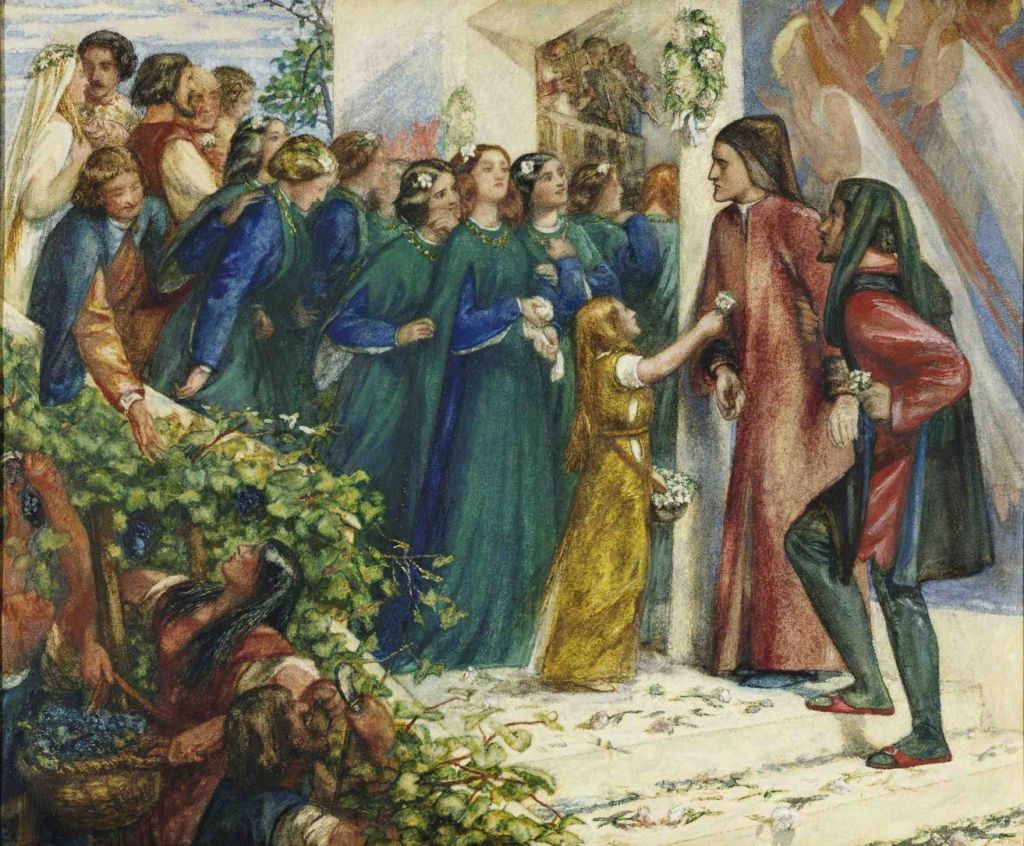
Dante Gabriel Rossetti (1828–1882), Beatrice Meeting Dante at a Marriage Feast, Denies Him Her Salutation (1852), watercolour and gouache on paper, 35.1 x 42.5 cm, Art Gallery of New South Wales, Sydney, Australia. Wikimedia Commons.

On 11 February 1862, Lizzie, wife of the leading Pre-Raphaelite artist and writer Dante Gabriel Rossetti, died of an overdose of laudanum (tincture of opium) at the age of only 32. A couple of years later, Rossetti embarked on an unusual post-mortem portrait of her in the role of Dante’s beloved Beatrice. Although Dante never revealed her true identity, many have believed her to represent Beatrice di Folco Portinari, who had died even younger almost six hundred years earlier, at the age of only 25. Beata Beatrix is one of Rossetti’s major paintings.

Beata Beatrix c.1864-70 by Dante Gabriel Rossetti 1828-1882
Dante Gabriel Rossetti (1828–1882), Beata Beatrix (c 1864–70), oil on canvas, 86.4 x 66 cm, The Tate Gallery (Presented by Georgiana, Baroness Mount-Temple in memory of her husband, Francis, Baron Mount-Temple 1889), London. Photographic Rights © Tate 2018, CC-BY-NC-ND 3.0 (Unported), https://www.tate.org.uk/art/artworks/rossetti-beata-beatrix-n01279

The strangest thing about Rossetti’s Beata Beatrix (c 1864–70) is that it represents a woman who, beyond Dante’s writing, is almost unknown, yet she’s become one of the most painted women in history. This weekend’s two articles look at some of the better-known paintings of Beatrice, from before Rossetti’s image, and afterwards, spanning some of Europe’s most visionary artists, from William Blake to Odilon Redon.

Dante wrote about Beatrice in two of his most popular works: his youthful Vita Nuova, and in two of the three books in his Divine Comedy. Early commentators don’t appear to have made any association between his literary figure and a real person, let alone a married woman who, at best, only met Dante twice before her early death. Many scholars believe Dante’s figure is symbolic rather than physical, which is more likely in her role in the Divine Comedy. Nevertheless, she has proved a popular subject, particularly during the nineteenth century.

allstonbeatrice
Washington Allston (1779–1843), Beatrice (1819), oil on canvas, 76.8 x 64.4 cm, Museum of Fine Arts Boston, Boston, MA. Wikimedia Commons.

The American Romantic artist and poet Washington Allston shows her in a straightforward portrait of Beatrice from 1819. He makes no literary allusions, although this is most likely to refer to Vita Nuova.

It was William Blake’s paintings for his unfinished illustrated edition of the Divine Comedy that started to explore her in the context of Dante’s narrative.
blakebeatriceoncar
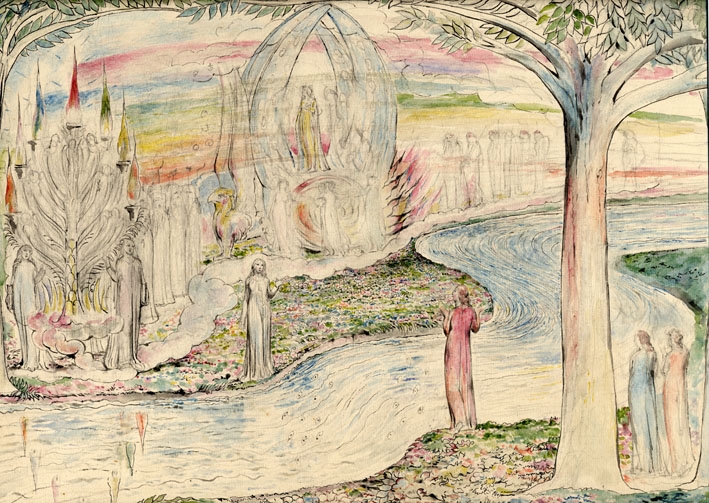
William Blake (1757–1827), Beatrice on the Car (Dante’s ‘Divine Comedy’, ‘Purgatorio”, Canto 29) (1824-7), watercolour over graphite on paper, 36.7 x 52 cm, The British Museum, London. Courtesy of and © Trustees of the British Museum.

Beatrice on the Car, from 1824-27, shows her appearing in a chariot or ‘car’ in the midst of a religious procession, which takes place in the earthly paradise on the summit of the island-mountain of Purgatory.

Beatrice Addressing Dante from the Car 1824-7 by William Blake 1757-1827
William Blake (1757–1827), Beatrice Addressing Dante from the Car (Dante’s ‘Divine Comedy’) (1824–7), ink and watercolour on paper, 37.2 x 52.7 cm, The Tate Gallery (Purchase with assistance of grants and donations 1919), London. © The Tate Gallery and Photographic Rights © Tate (2016), CC-BY-NC-ND 3.0 (Unported), http://www.tate.org.uk/art/artworks/blake-beatrice-addressing-dante-from-the-car-n03369

Blake’s best-developed painting of her, Beatrice Addressing Dante from the Car, from the same few years prior to his death, shows her admonishing Dante for his recent straying from the path of righteousness. This is rich with symbols and graphic devices, such as its vortex of heads and eyes, and the marvellous gryphon pulling Beatrice’s chariot.

Dante’s works enjoyed a revival during the nineteenth century, bringing other artists to use them as themes for their paintings, with the Divine Comedy the more common.

oesterelydantebeatrice
Carl Wilhelm Friedrich Oesterley (1805–1891), Dante and Beatrice (1845), further details not known. Wikimedia Commons.

Carl Wilhelm Friedrich Oesterley’s conventional and Romantic view of Beatrice and her chariot follows Dante’s description literally, even down to the colours of her clothing.
pierinidantebeatrice
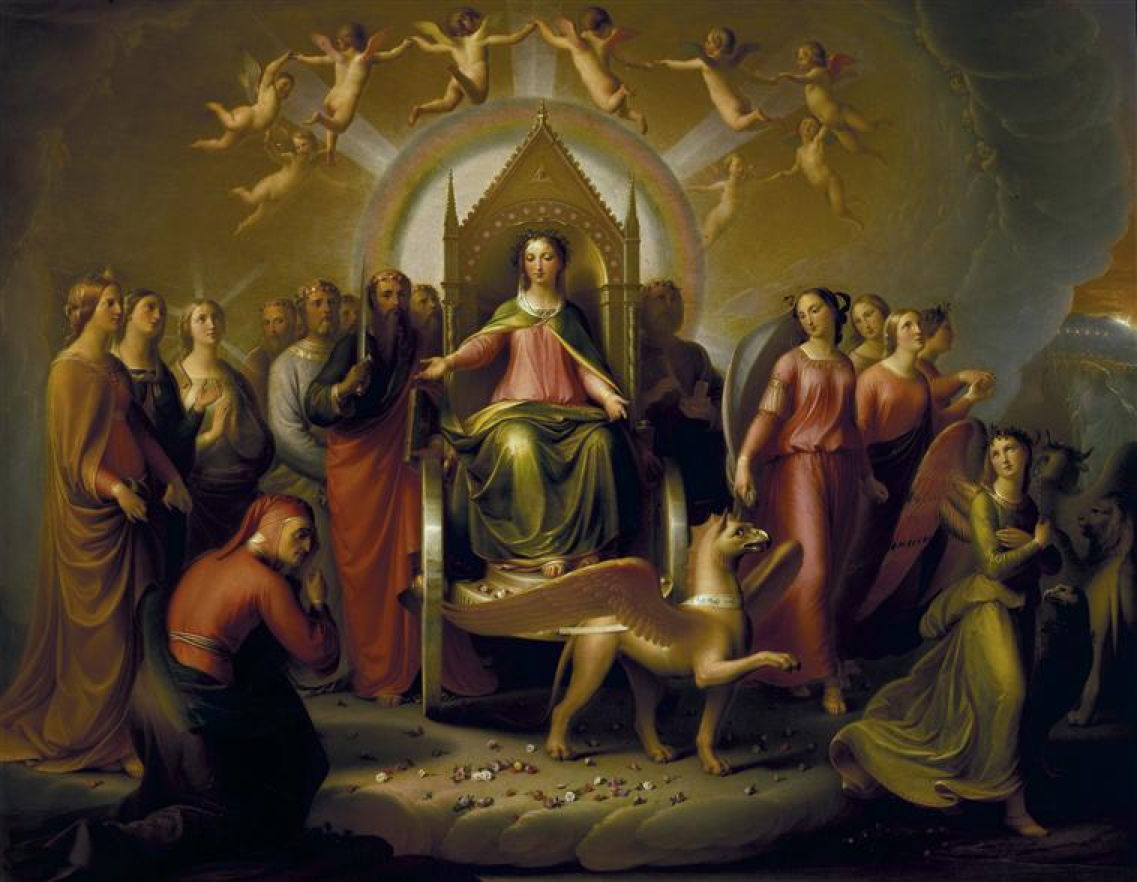
Andrea Pierini (1798–1858), The Meeting of Dante and Beatrice in Purgatory (1853), oil on canvas, 141 x 179 cm, Galleria d’arte moderna, Florence, Italy. Wikimedia Commons.

Andrea Pierini’s curiously antiquated version from 1853 is also literal in its detail.

Dyce, William, 1806-1864; Beatrice
William Dyce (1806–1864), Beatrice (1859), oil on panel, 65.2 x 49.4 cm, Aberdeen Art Gallery & Museums, Aberdeen, Scotland. Wikimedia Commons.

William Dyce returned to portraiture style for his painting of Beatrice in 1859, when Rossetti was peaking in his obsession with her. Dyce had considerable exposure to paintings of the Divine Comedy: when he was in Rome in 1827-28, he is thought to have been friends with Friedrich Overbeck, the Nazarene artist who had just been painting frescoes of Tasso’s Jerusalem Delivered alongside others of the Divine Comedy, in the Casa Massimo. When he returned to London, Dyce was responsible for introducing the Pre-Raphaelites, including Rossetti, to the influential critic John Ruskin.
Dante's First Meeting with Beatrice 1859-63 by Simeon Solomon 1840-1905
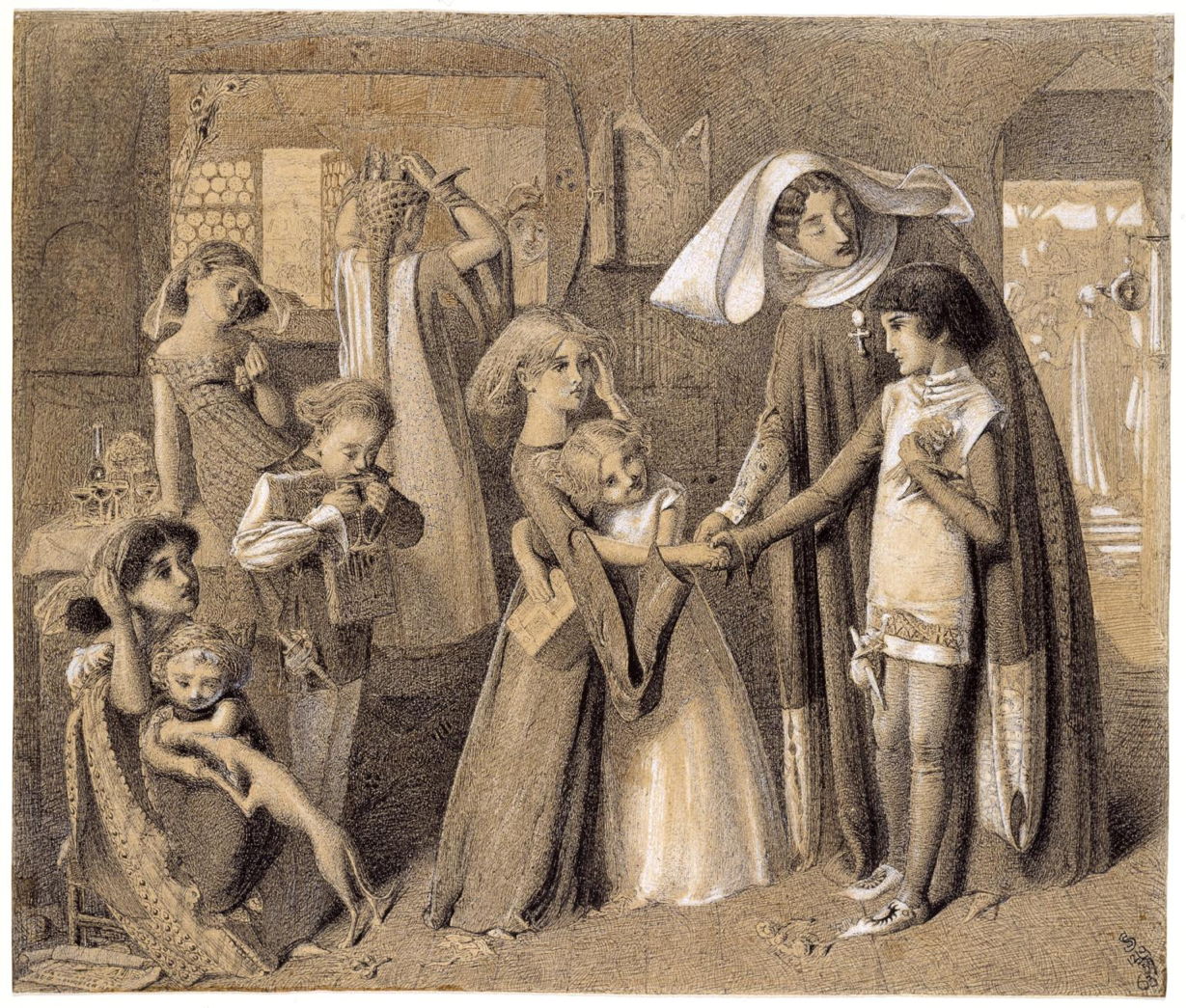
Simeon Solomon (1840–1905), Dante’s First Meeting with Beatrice (1859–63), ink, watercolour and gouache on paper, 19.4 x 22.9 cm, The Tate Gallery (Bequeathed by Robert Ross through the Art Fund 1919), London. Photographic Rights © Tate 2018, CC-BY-NC-ND 3.0 (Unported), https://www.tate.org.uk/art/artworks/solomon-dantes-first-meeting-with-beatrice-n03409

Others involved with the Pre-Raphaelites also adopted Beatrice as a theme. Simeon Solomon’s ink and watercolour painting of Dante’s First Meeting with Beatrice (1859–63) is taken from Vita Nuova, and its description of the two nine year-olds meeting in about 1274.

Dante Gabriel Rossetti had started to become obsessed with his name-sake and Beatrice soon after his early success as a Pre-Raphaelite painter. In December 1849, he wrote a short story titled Hand and Soul which was published the following month in the first issue of the Germ, the movement’s magazine, edited by Rossetti’s brother William Michael.

His story tells of courtly love, artistic and religious fervour of an imaginary mediaeval painter in the Italian city of Arezzo, who is in a strictly Platonic relationship with “his mystical lady, now hardly in her ninth year”, the same age as Beatrice was when Dante claimed to have met her.

Shortly afterwards, Rossetti started sketching for a painting of their meeting in Purgatory.
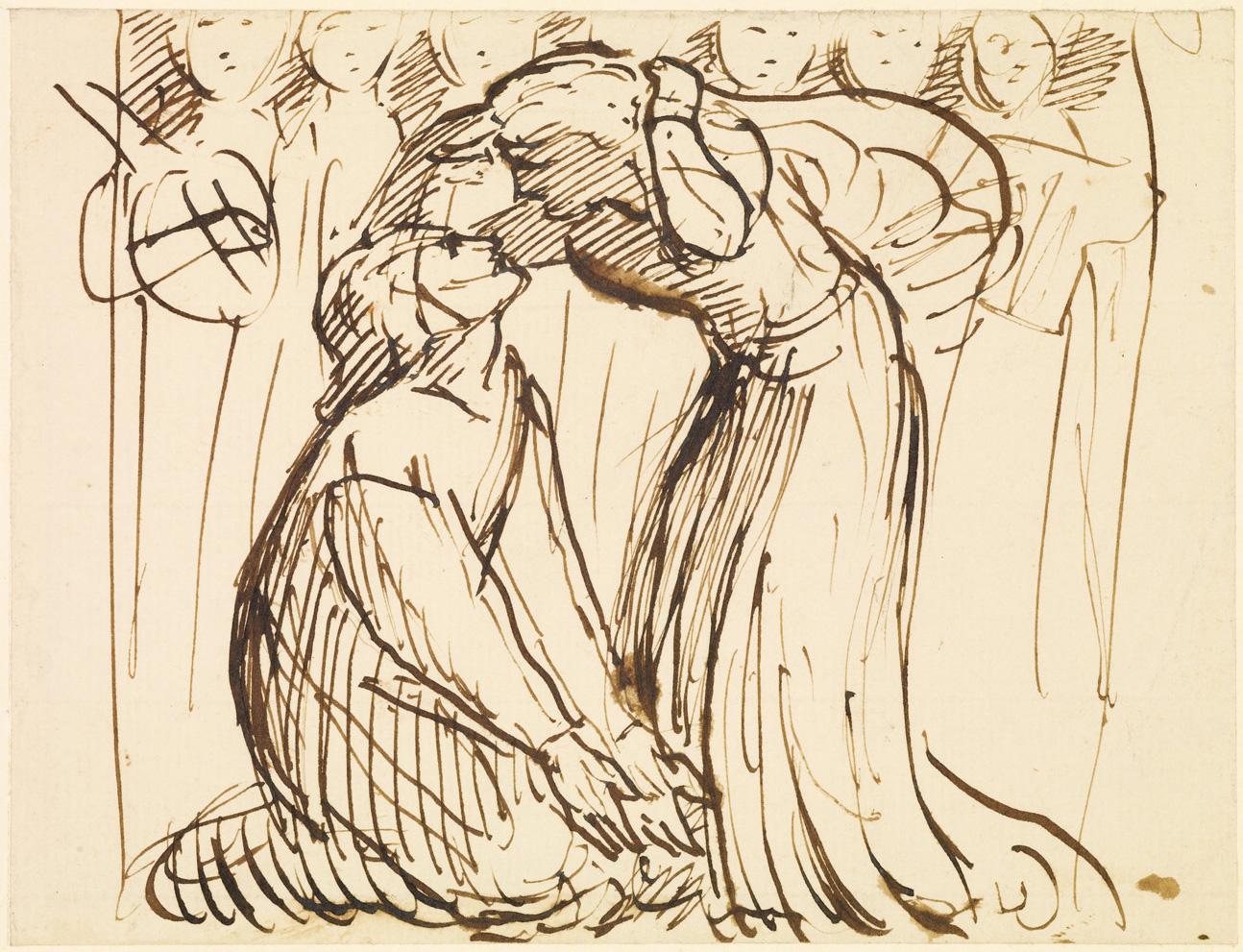
rossettidantebeatricepurgatorysketch
Dante Gabriel Rossetti (1828–1882), The Meeting of Dante and Beatrice in Purgatory – Figure Sketch (1852), pen and ink on laid paper, 11.3 x 14.8 cm, Birmingham Museum and Art Gallery, Birmingham, England. Wikimedia Commons.

In this figure sketch for The Meeting of Dante and Beatrice in Purgatory, made in 1852, Dante is on his knees as his beloved Beatrice admonishes him for straying from the path of righteousness.
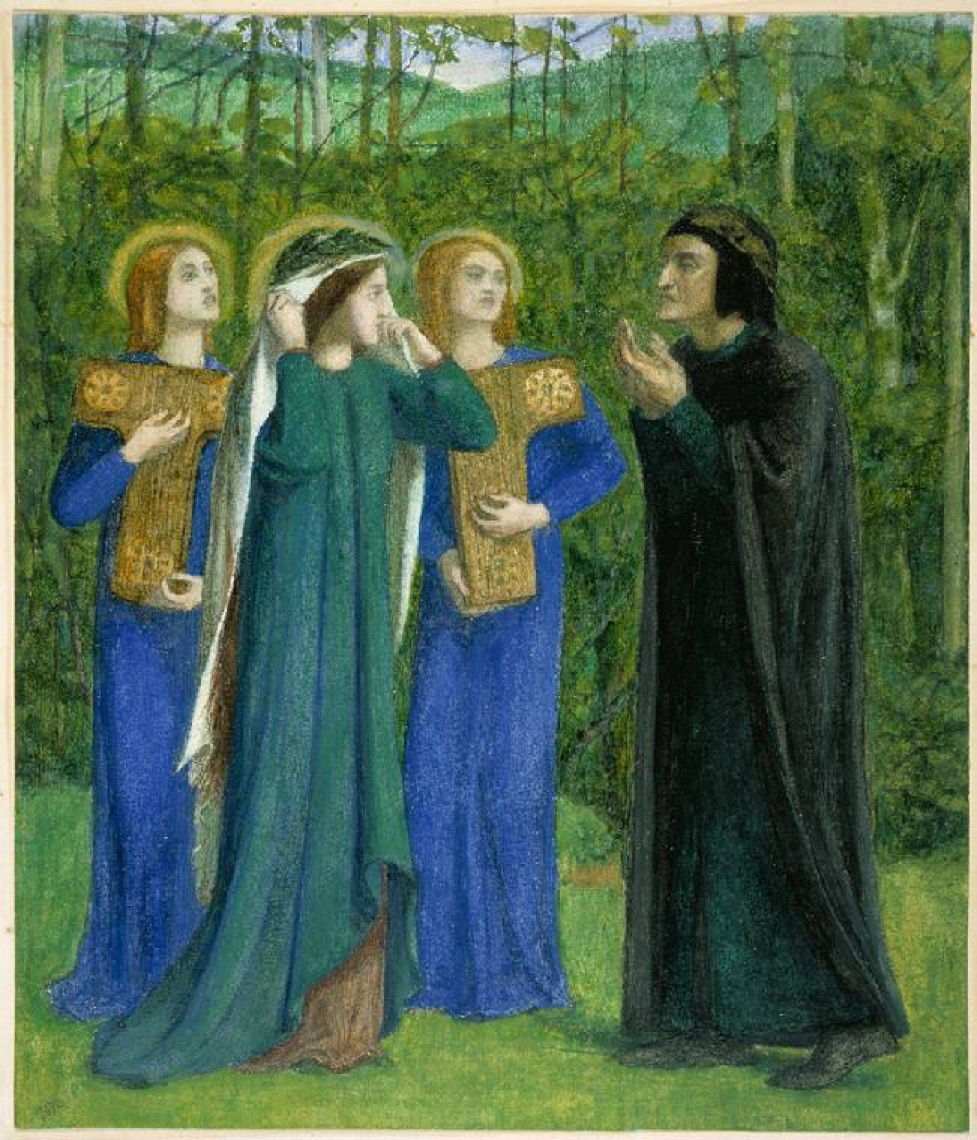
rossettidantebeatriceparadise1853
Dante Gabriel Rossetti (1828–1882), Dante and Beatrice Meeting in Purgatory (1853-54), bodycolour, pen and ink on paper, 29.2 x 25.1 cm, The Fitzwilliam Museum, Cambridge, England. Wikimedia Commons.

Rossetti had second thoughts, and in 1853-54 painted this more conventional composition, showing Dante in full spate, and Beatrice flanked by angels carrying golden crosses. His details are at odds with Dante’s account, though.

rossettibeatricedeniessalutation
Dante Gabriel Rossetti (1828–1882), Beatrice Meeting Dante at a Marriage Feast, Denies Him Her Salutation (1852), watercolour and gouache on paper, 35.1 x 42.5 cm, Art Gallery of New South Wales, Sydney, Australia. Wikimedia Commons.

At about the same time, Rossetti was working on a more narrative watercolour of another meeting between the two, this time based on the Vita Nuova, in Beatrice Meeting Dante at a Marriage Feast, Denies Him Her Salutation (1852). Dante, dressed in his traditional red, is here being ignored by his beloved, after they had bumped into one another at a wedding. This is thought to be Rossetti’s first painting in which Elizabeth ‘Lizzie’ Siddall is the model for Beatrice.

Lizzie was about 22 at that time. A working class woman, who initially worked at a milliner’s shop in London, she couldn’t have been further from the minor nobility and affluence of Beatrice Portinari. Neither was Lizzie noted for her beauty: she first modelled in around 1849 for Walter Deverell, who chose her for her plainness. Lizzie continued to model for Pre-Raphaelites, and in 1851-52 achieved fame as the model for John Everett Millais’ Ophelia.

Lizzie became an artist in her own right, although her paintings are now sadly neglected. In 1852, she moved in to live with Rossetti, but her health started to deteriorate, probably as a result of tuberculosis.

rossettifirstanndeathbeatrice
Dante Gabriel Rossetti (1828–1882), The First Anniversary of the Death of Beatrice (1853), watercolour, 41.9 x 60.9 cm, Ashmolean Museum, Oxford, United Kingdom. Wikimedia Commons.

Rossetti then went on to a more fictionalised watercolour of The First Anniversary of the Death of Beatrice (1853), showing Dante being comforted as he is drawing an angel on that day of remembrance for his beloved. This is situated in central Florence according to the view through the window at the right, but there’s an incongruous country garden seen through the door at the left.

rossettisalutationbeatrice1859
Dante Gabriel Rossetti (1828–1882), The Salutation of Beatrice (1859-63), oil and gold leaf on conifer wood, frame designed and painted by the artist, panels each 74.9 x 80 cm, National Gallery of Canada Musée des beaux-arts du Canada, Ottawa, Canada. Wikimedia Commons.

As Lizzie’s health declined, Rossetti created more ornate and icon-like paintings of Beatrice. The Salutation of Beatrice from 1859-63 uses oil and gold leaf on conifer wood, set in a frame Rossetti designed and painted himself. It brings together the literary Beatrice from Vita Nuova on the left, with the spiritual Beatrice from the Divine Comedy at the right, where they meet in earthly paradise atop Purgatory. On the frame are inscriptions taken from the respective works, and in the middle is the date and time (on a sundial) of Beatrice Portinari’s death in 1290.

When the couple married in Hastings in 1860, she had to be carried around the corner to attend the church. She became depressed, and was addicted to laudanum (tincture of opium). In 1861, she had a stillborn daughter, and later that year became pregnant a second time. She died on 11 February 1862, as a result of what was almost certainly a deliberate overdose of laudanum.