





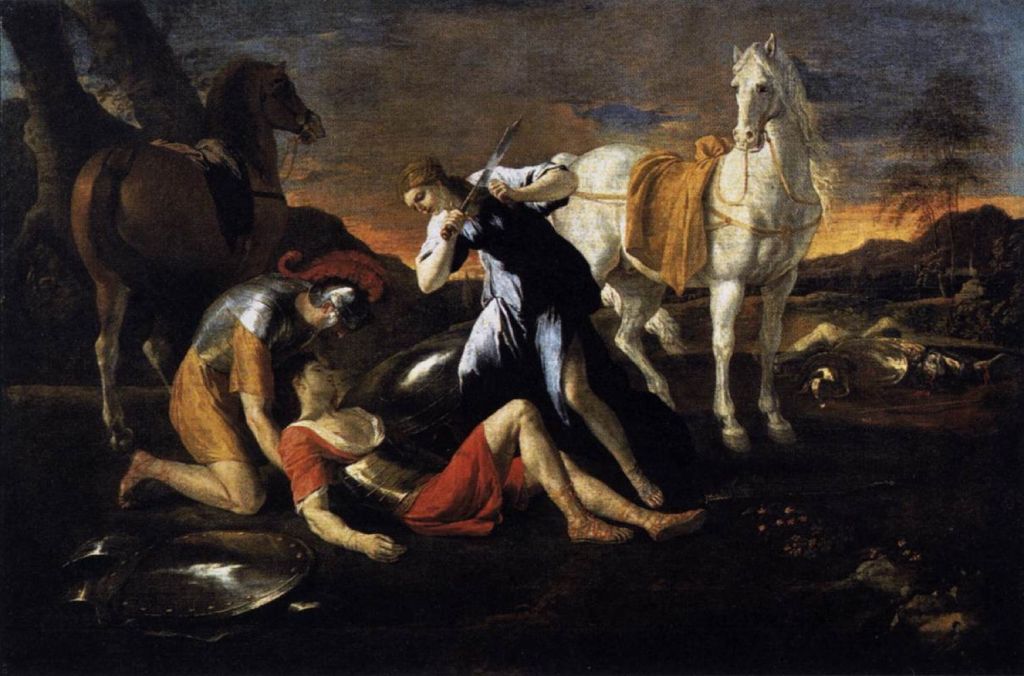
 Nicolas Poussin (1594–1665), Tancred and Erminia (c 1631), oil on canvas, 98 x 147 cm, Hermitage Museum Государственный Эрмитаж, Saint Petersburg, Russia. Wikimedia Commons.
Armida has been abandoned by Rinaldo so he could return to the siege of Jerusalem, and has joined the massed army of the King of Egypt. One of its leaders, Adrastus, has promised to rip Rinaldo’s heart out, and present his head to Armida, to satisfy her lust for vengeance.
Rinaldo, Charles and Ubaldo return in their magic ship, and land on Judea’s shore. Waiting nearby is an old man guarding Rinaldo’s new suit of armour, specially forged and crafted to protect him. His shield bears figures demonstrating its heroic roots, and Rinaldo is presented with the predestined sword that had been owned by Sven, the late Prince of Denmark. The three are then whisked through the night sky in the old man’s chariot to rejoin the crusaders in their camp near Jerusalem.
At the start of Canto eighteen, Rinaldo and Godfrey of Bouillon are re-united: the knight says he is ready to redeem himself, and Godfrey throws his arms around him. The leader then explains to Rinaldo the problem they have with the enchanted wood, which is stopping them from felling trees to replace their siege engines and towers so they can resume their assault on the city.
Rinaldo accepts Godfrey’s challenge and, with the encouragement of Peter the Hermit, he sets off alone for the wood, where all is still and calm. He seeks a place to cross the river, and a bridge of gold appears, sees him across, then vanishes again. In front of him, the trunk of an oak splits open to give birth to a fully-grown nymph resembling Armida.
Rinaldo ignores the nymph’s overtures, draws his sword, and goes to cut down some myrtle. The nymph intervenes, and transforms into a monster with many arms bearing swords. Then there is lightning and thunder, and heavy rain, but Rinaldo persists and cuts through a black walnut tree. This instantly dispels the enchantment, and the wood returns to normal.
Rinaldo goes back to the camp and tells of his success. Crusaders and their expert engineers swarm out to the woods to fell trees and build new siege machines. In no time they build three great towers to place against the city’s walls, replacing those burnt to the ground by Clorinda before her death.
There is frantic work going on inside Jerusalem to repair and reinforce the city’s walls, build their own towers, and create inflammable weapons using mixtures of sulphur and bitumen.
Some French crusaders then spot a messenger pigeon, which is attacked by a hawk. The pigeon lands on Godfrey, who discovers the message it’s carrying. This is from the Egyptian forces expecting to arrive at Jerusalem in four or five days. Godfrey knows how little time he has left to capture the city, and calls on his commanders to prepare to assault its walls.
In their meeting, Raymond nominates his polyglot valet Vafrine to be a spy on the approaching army from Egypt. The valet agrees, and promises to bring back full details of their forces and disposition.
The day before their intended assault they spend in prayer, confession and celebrating Mass. The crusaders then move their siege towers to a well-armed gate to mislead the enemy. Overnight they shift them again to where they intend to use them, catching the defenders of the city off guard.
Soon after dawn, with their host of smaller engines brought into play, the crusaders start their massed assault. The air is filled with arrows tipped with poison, then stones hurled from the walls. The knights and soldiers approach under cover, and Rinaldo has a high ladder placed against the wall so he can lead many others also scaling its heights.
The crusaders swarm up using ladders and the three towers, taking casualties from missiles and heavy objects dropped upon them. Then balls of fire start to rain upon them, as if from hell. As the soldiers try to control fires burning in their wooden towers, the wind suddenly changes and blows the flames back at those defending the city. This sets alight woollen materials they had been using as protection, and the defenders are scorched away.
Ismen takes two of his neophytes out to try to cast spells, but a stone flung from one of the towers kills all three in a single shot.
As Soliman takes to leading the defence, the Archangel Michael appears to Godfrey, and reveals a whole army of angels in support. This inspires Godfrey to challenge Soliman. Rinaldo makes a way for his leader to plant a holy Cross on the top of the city’s wall, bringing cheers from the crusaders, who push onward and upward. Tancred too storms over the wall, raising his banner of the Cross in victory over Argante’s men.
Finally, the nearby gate is opened, and the whole crusader army enters Jerusalem. The wrath of their victory is immediate, and the city’s streets are soon awash with blood and piled high with corpses.
Canto nineteen opens within the conquered city, where only Argante the Circassian fights on. He is met by Tancred, and the two agree to conclude their previous combat alone, outside the city. Argante has no shield, and stands higher by his head against his opponent. They swing their swords at one another, inflicting wounds, but fight on. Taunting one another, they grapple and wrestle so forcefully that both fall to the ground.
Argante is the slower to get up, and they continue slashing through their armour into flesh. But Argante is now bleeding badly from his arm, and Tancred offers to call a halt. The Circassian responds by wounding Tancred viciously in the shoulder and ribs. Argante then falls to the ground, opening up his wounds. Still he won’t give up, and Tancred has to drive his blade into Argante’s skull to finish him off.
Tancred may be the victor, but is himself badly wounded, and struggles to walk. He sits down, trembling, and as night falls he lapses into unconsciousness.
While Argante and Tancred have been engaged in their duel to the death, slaughter has continued in the captured city. Rinaldo will only kill those who remain armed. Many of the citizens are packed into the shelter of the Temple of Solomon, whose doors are quickly battered in, leading to mass murder of the occupants.
Aladine and Soliman find their way to the Tower of David, where they barricade themselves in, armed with a steel mace. When Count Raymond of Toulouse tries to break into them, he is knocked senseless and dragged in as a hostage. Rinaldo is just about to enter when Godfrey sounds the retreat for the night, leaving the storming of the tower for the following morning.
Meanwhile Vafrine has been sizing up the Egyptian forces during the day. He has spoken freely within their camp, gleaned details of strengths and plans, even learning of the soldier who has been designated to kill Godfrey. He found Armida, and her suitors who have vowed to kill Rinaldo for her hand. There he bumps into a beautiful woman who recognises him: it is Erminia, who asks him to take her back with him.
Erminia tells Vafrine how the death of Godfrey has been planned using subterfuge. His killers will be dressed as crusaders, bearing the red cross on white to ensure they can get close to him, with just a small sign on their helmets to distinguish them as ‘pagans’.
By dusk, Erminia and Vafrine are nearing the crusader camp, when they spot Argante’s corpse, and a little beyond it the unconscious Tancred, who at first appears dead. When Erminia, who is in love with Tancred, recognises his faint voice, she leaps from her horse and weeps over him. Vafrine tells her that there is still time to cure his wounds and save his life, and removes Tancred’s armour.
Erminia has nothing to use as bandages to bind Tancred’s wounds, so cuts her hair off and uses that. Tancred regains consciousness, and recognises Vafrine. Others who have been searching for Tancred arrive, and start to carry him back to camp. Tancred insists on two things, though: that Argante is given a proper burial, and that he is carried into the city of Jerusalem to rest.
It is this last section that has been painted most often, and by great masters.
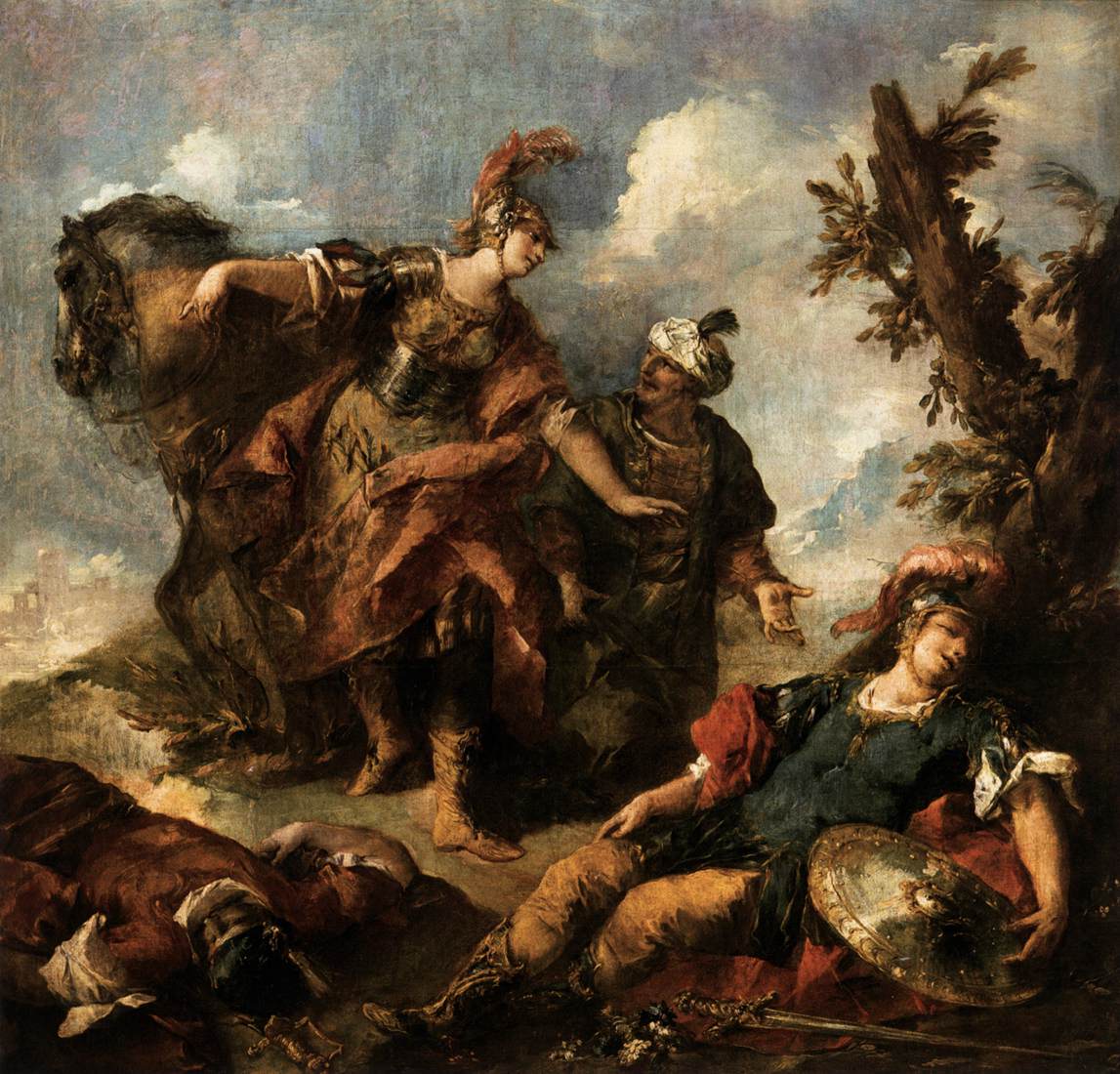
Giovanni Antonio Guardi’s Herminia and Vafrine Find the Wounded Tancred from about 1750-55 shows the start of the sequence, just after Erminia has leapt from her horse. The corpse of Argante is in the lower left corner, Tancred’s sword still impaling its head.
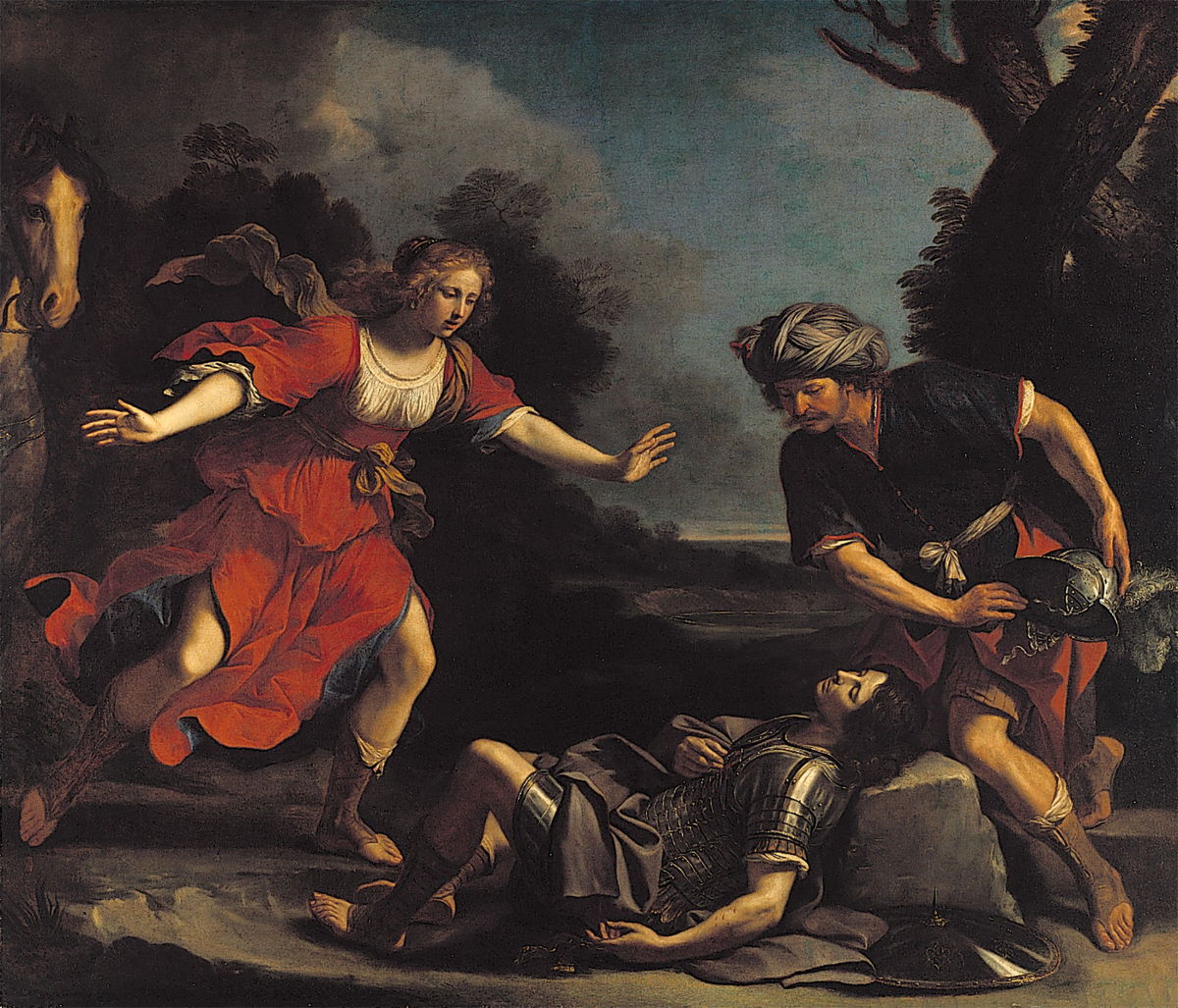
Guercino’s Erminia Finding the Wounded Tancred from about 1650 shows the scene slightly later, as Erminia rushes over to minister to the ailing Tancred, still uncertain whether he is alive or dead. This painting was originally commissioned by the Papal Legate of Bologna, but he let the Duke and Duchess of Mantua buy it from its creator in 1652.

Much earlier in his career, Guercino had painted a few moments further into the story, in Erminia Finds the Wounded Tancred from 1618-19. Vafrine has now removed Tancred’s armour, and they are trying to work out how to bandage his wounds.
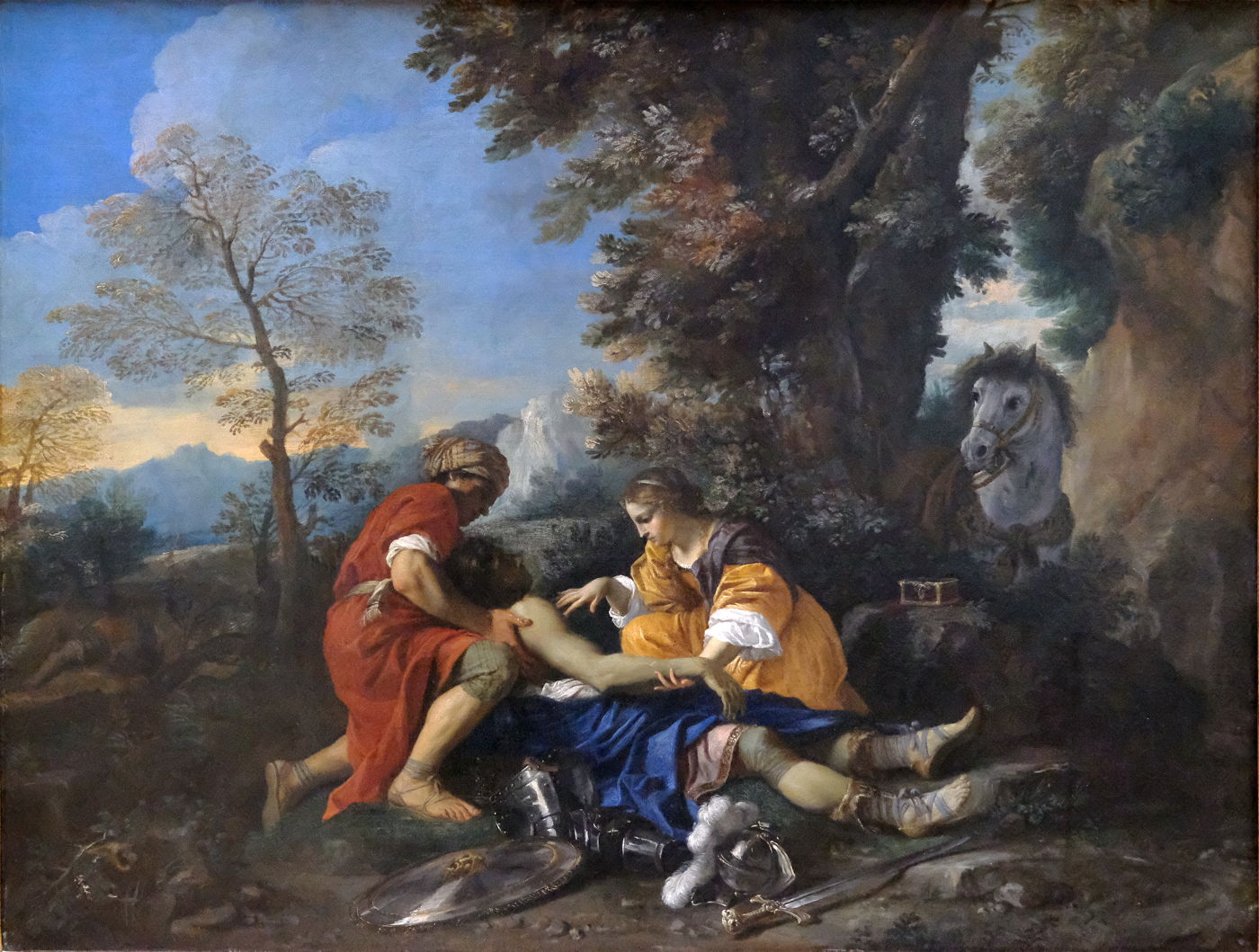
Pier Francesco Mola’s Erminia and Vafrine Tending the Wounded Tancred After the Battle with Argante from about 1650-60 shows a similar scene, with Vafrine cradling the knight’s head and upper body, and the body of Argante at the far left.
There are three great paintings depicting the strange climax, when Erminia cuts her tresses to form bandages.

Alessandro Turchi’s Erminia Finds the Wounded Tancred is thought to have been painted in about 1630. Erminia is using Tancred’s sword to cut her hair, a detail omitted from Tasso’s text. Argante’s body is behind them.
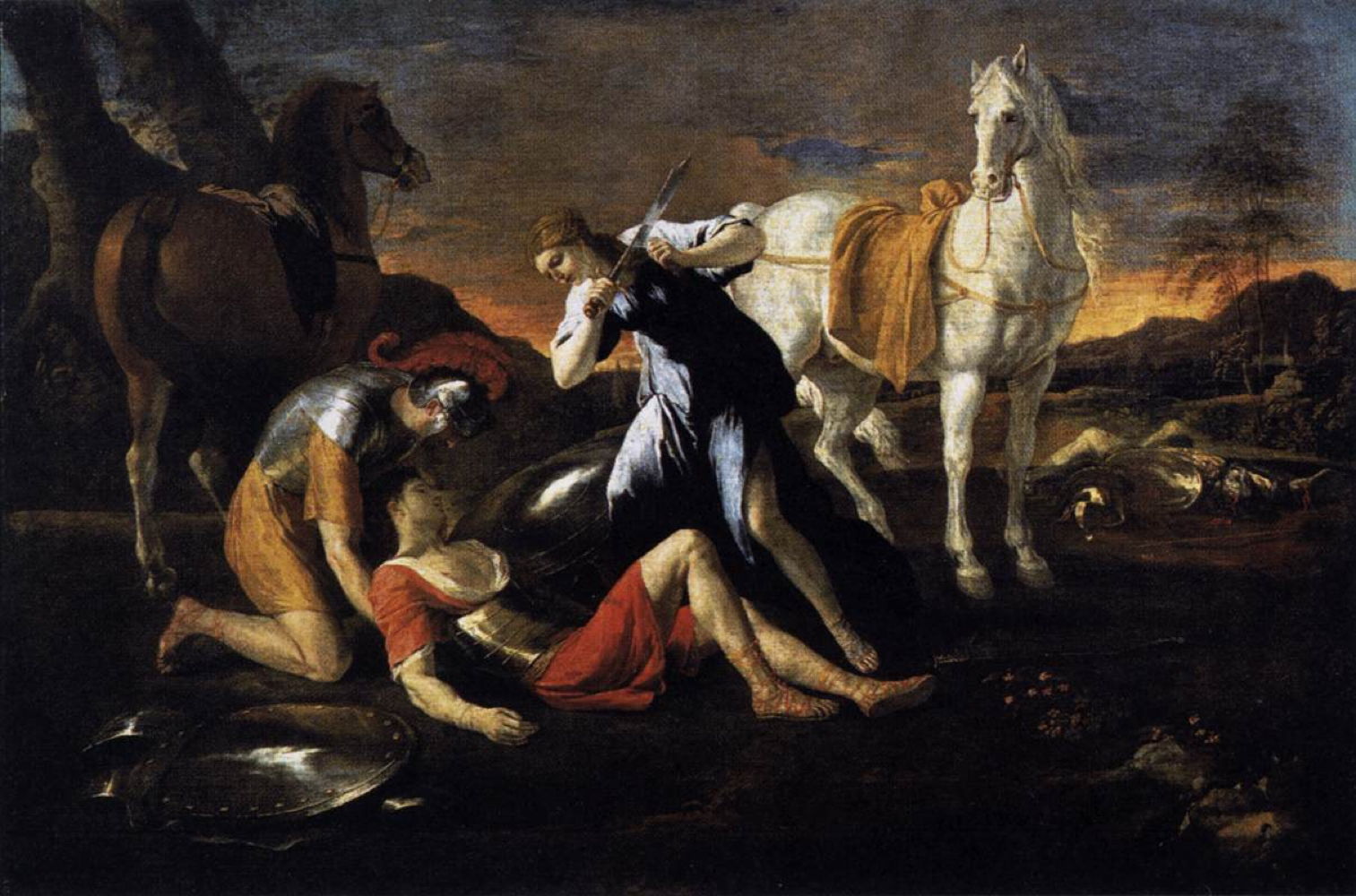
At about the same time, Nicolas Poussin was painting this first version of Tancred and Erminia (c 1631), now in the Hermitage. It contains the same elements, even back to Argante’s body, but in a more open composition dominated by Erminia and her white horse.
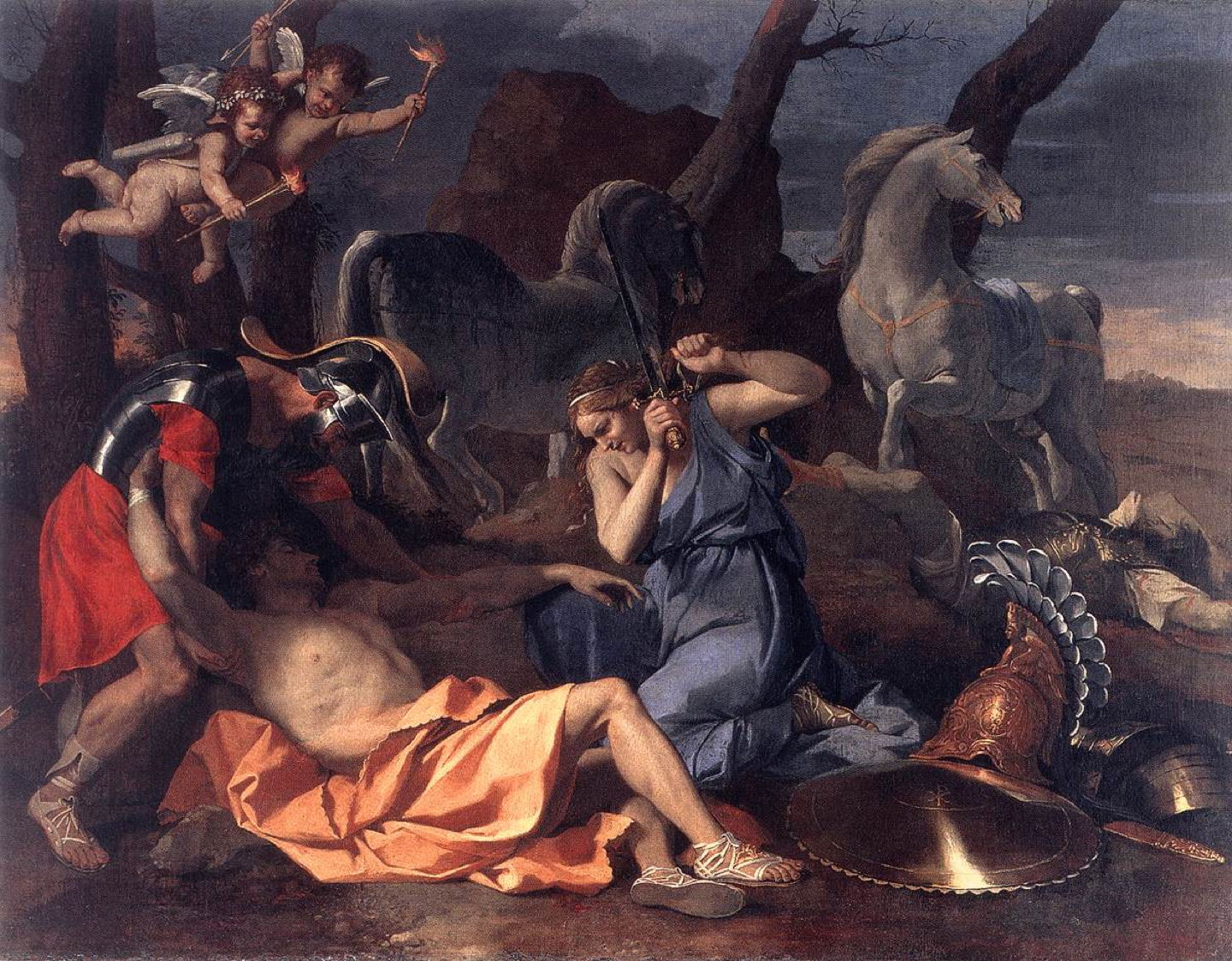
This slightly later version by Poussin is thought to date from about 1634, and has a more powerful close-in composition. Erminia’s arms are in a similar position, also using Tancred’s sword, but she is now kneeling at Tancred’s side. The love between Erminia and Tancred is also made clear in the pair of cupids, and the two horses are anticipating the arrival of other crusaders to carry Tancred away.
It is now night, and Vafrine has a lot to brief Godfrey about, as the crusaders prepare to complete their conquest of Jerusalem then defend it from the approaching Egyptian army.
References
Wikipedia on Jerusalem Delivered.
Wikipedia on Torquato Tasso.
Project Gutenberg (free) English translation (Fairfax 1600).
Librivox audiobook of the Fairfax (1600) English translation (free).
Thomas Asbridge (2004) The First Crusade, A New History, Free Press, ISBN 978 0 7432 2084 2.
Anthony M Esolen, translator (2000) Torquato Tasso, Jerusalem Delivered, Gerusalemme Liberata, Johns Hopkins UP. ISBN 978 0 801 863233. A superb modern translation into English verse.
John France (1994) Victory in the East, a Military History of the First Crusade, Cambridge UP. ISBN 978 0 521 589871.
Joanthan Riley-Smith, ed (1995) The Oxford Illustrated History of the Crusades, Oxford UP. ISBN 978 0 192 854285.
Jonathan Riley-Smith (2014) The Crusades, A History, 3rd edn., Bloomsbury. ISBN 978 1 4725 1351 9.
Johathan Unglaub (2006) Poussin and the Poetics of Painting, Pictorial Narrative and the Legacy of Tasso, Cambridge UP. ISBN 978 0 521 833677.
此内容由惯性聚合(RSS阅读器)自动聚合整理,仅供阅读参考。 原文来自 — 版权归原作者所有。