


惯性聚合 高效追踪和阅读你感兴趣的博客、新闻、科技资讯
阅读原文 在惯性聚合中打开

推荐订阅源

N
News and Events Feed by Topic
V
V2EX
博客园 - 【当耐特】
Vercel News
Vercel News
雷峰网
雷峰网
爱范儿
爱范儿
WordPress大学
WordPress大学
云风的 BLOG
云风的 BLOG
S
Securelist
Threat Intelligence Blog | Flashpoint
Microsoft Azure Blog
F
Full Disclosure
有赞技术团队
有赞技术团队
Hugging Face - Blog
Hugging Face - Blog
NISL@THU
NISL@THU
www.infosecurity-magazine.com
Attack and Defense Labs
Application and Cybersecurity Blog
Hacker News - Newest:
Hacker News - Newest: "LLM"
Microsoft Security Blog
腾讯CDC
P
Proofpoint News Feed
B
Blog
CTFtime.org: upcoming CTF events
K
Kaspersky official blog
I
InfoQ
Google Online Security Blog
L
LINUX DO - 最新话题
Project Zero
Project Zero
Engineering at Meta
Engineering at Meta
V
Visual Studio Blog
AI
AI
Schneier on Security
B
Blog RSS Feed
T
Tor Project blog
H
Help Net Security
H
Hackread – Cybersecurity News, Data Breaches, AI and More
L
LINUX DO - 热门话题
阮一峰的网络日志
阮一峰的网络日志
S
Security @ Cisco Blogs
T
Threat Research - Cisco Blogs
freeCodeCamp Programming Tutorials: Python, JavaScript, Git & More
C
Cyber Attacks, Cyber Crime and Cyber Security
G
Google Developers Blog
Google DeepMind News
V2EX - 技术
V2EX - 技术
让小产品的独立变现更简单 - ezindie.com
A
Arctic Wolf
Webroot Blog
Webroot Blog
Recent Commits to openclaw:main

Peter Steinberger

OpenClaw, OpenAI and the future | Peter Steinberger Shipping at Inference-Speed | Peter Steinberger The Signature Flicker | Peter Steinberger Just Talk To It - the no-bs Way of Agentic Engineering | Peter Steinberger Claude Code Anonymous | Peter Steinberger Live Coding Session: Building Arena | Peter Steinberger My Current AI Dev Workflow | Peter Steinberger Essential Reading for Agentic Engineers - August 2025 | Peter Steinberger Just One More Prompt | Peter Steinberger Poltergeist: The Ghost That Keeps Your Builds Fresh | Peter Steinberger Don't read this Startup Slop | Peter Steinberger Essential Reading for Agentic Engineers - July 2025 | Peter Steinberger Self-Hosting AI Models After Claude's Usage Limits | Peter Steinberger Logging Privacy Shenanigans | Peter Steinberger VibeTunnel's first AI-anniversary | Peter Steinberger Making AppleScript Work in macOS CLI Tools: The Undocumented Parts | Peter Steinberger Peekaboo 2.0 – Free the CLI from its MCP shackles | Peter Steinberger Command your Claude Code Army, Reloaded | Peter Steinberger Essential Reading for Agentic Engineers | Peter Steinberger Slot Machines for Programmers: How Peter Builds Apps 20x Faster with AI | Peter Steinberger My AI Workflow for Understanding Any Codebase | Peter Steinberger stats.store: Privacy-First Sparkle Analytics | Peter Steinberger Showing Settings from macOS Menu Bar Items: A 5-Hour Journey | Peter Steinberger VibeTunnel: Turn Any Browser into Your Mac's Terminal | Peter Steinberger llm.codes: Make Apple Docs AI-Readable | Peter Steinberger Automatic Observation Tracking in UIKit and AppKit: The Feature Apple Forgot to Mention | Peter Steinberger Peekaboo MCP – lightning-fast macOS screenshots for AI agents | Peter Steinberger Migrating 700+ Tests to Swift Testing: A Real-World Experience | Peter Steinberger Commanding Your Claude Code Army | Peter Steinberger Code Signing and Notarization: Sparkle and Tears | Peter Steinberger Vibe Meter: Monitor Your AI Costs | Peter Steinberger Claude Code is My Computer | Peter Steinberger Stop Over-thinking AI Subscriptions | Peter Steinberger Introducing Demark: HTML in. MD out. Blink-fast. | Peter Steinberger The Future of Vibe Coding: Building with AI, Live and Unfiltered | Peter Steinberger MCP Best Practices | Peter Steinberger Finding My Spark Again | Peter Steinberger Top-Level Menu Visibility in SwiftUI for macOS | Peter Steinberger Fixing keyboardShortcut in SwiftUI | Peter Steinberger Supporting Both Tap and Long Press on a Button in SwiftUI | Peter Steinberger On Using Apple Silicon Mac Mini for Continuous Integration | Peter Steinberger Apple Silicon M1: A Developer's Perspective | Peter Steinberger Gardening Your Twitter: Curating Your Timeline | Peter Steinberger Gardening Your Twitter: Growing Your Followers | Peter Steinberger Forbidden Controls in Catalyst: Optimize Interface for Mac | Peter Steinberger Disabling Keyboard Avoidance in SwiftUI's UIHostingController | Peter Steinberger The State of SwiftUI | Peter Steinberger Logging in Swift | Peter Steinberger Building with Swift Trunk Development Snapshots | Peter Steinberger Calling Super at Runtime in Swift | Peter Steinberger zld — A Faster Version of Apple's Linker | Peter Steinberger How to Fix LLDB: Couldn't IRGen Expression | Peter Steinberger Updating macOS on a Hackintosh | Peter Steinberger InterposeKit — Elegant Swizzling in Swift | Peter Steinberger The Great Mac Catalyst Text Input Crash Hunt | Peter Steinberger Jailbreaking for iOS Developers | Peter Steinberger Network Kernel Core Dump | Peter Steinberger How to macOS Core Dump | Peter Steinberger Kernel Panics and Surprise boot-args | Peter Steinberger The LG UltraFine 5K, kernel_task, and Me | Peter Steinberger Let's Try This Again | Peter Steinberger How We Work at PSPDFKit | Peter Steinberger Swizzling in Swift | Peter Steinberger WWDC for First-Timers, 2019 Edition | Peter Steinberger Challenges of Adopting Drag and Drop | Peter Steinberger Marzipan: Porting iOS Apps to the Mac | Peter Steinberger How to Use Slack and Not Go Crazy | Peter Steinberger Hardcore Debugging - Heavy Weapons for Hard Bugs | Peter Steinberger Binary Frameworks in Swift | Peter Steinberger Even Swiftier Objective-C | Peter Steinberger The Case for Deprecating UITableView | Peter Steinberger Running tests with Clang Address Sanitizer | Peter Steinberger UI testing on iOS, without busy waiting | Peter Steinberger Hiring a distributed team | Peter Steinberger Writing Good Bug Reports | Peter Steinberger Real-time collaboration, Apple, and you | Peter Steinberger Converting Xcode Test Runs to JUnit, the Fast Way | Peter Steinberger Efficient iOS Version Checking | Peter Steinberger Investigating Thread Safety of UIImage | Peter Steinberger Swifty Objective-C | Peter Steinberger Running UI Tests on iOS With Ludicrous Speed | Peter Steinberger A Pragmatic Approach to Cross-Platform | Peter Steinberger Surprises with Swift Extensions | Peter Steinberger Using ccache for Fun and Profit | Peter Steinberger UITableViewController designated initializer woes | Peter Steinberger Researching ResearchKit | Peter Steinberger The curious case of rotation with multiple windows on iOS 8 | Peter Steinberger UIKit Debug Mode | Peter Steinberger Retrofitting containsString: on iOS 7 | Peter Steinberger A Story About Swizzling "the Right Way™" and Touch Forwarding | Peter Steinberger Hacking with Aspects | Peter Steinberger Fixing UITextView On iOS 7 | Peter Steinberger Fixing What Apple Doesn't | Peter Steinberger How To Inspect The View Hierarchy Of Third-Party Apps | Peter Steinberger Fixing UISearchDisplayController On iOS 7 | Peter Steinberger Smart Proxy Delegation | Peter Steinberger Adding Keyboard Shortcuts To UIAlertView | Peter Steinberger How To Center Content Within UIScrollView | Peter Steinberger UIAppearance for Custom Views | Peter Steinberger Hacking Block Support Into UIMenuItem | Peter Steinberger
Vibe Meter 2.0: Calculating Claude Code Usage with Token Counting | Peter Steinberger
Peter Steinberger · 2025-06-16 · via Peter Steinberger

TL;DR: Built Vibe Meter 2.0 to track Claude Code subscription usage by parsing JSON-L files and counting tokens with a SIMD-accelerated BPE tokenizer. No official API exists, so I approximated usage by counting every token. The project grew to 47K lines of Swift with 92% test coverage, all written with CC using “thinking” triggers and modern Swift idioms.

The Shock: How Much Am I Actually Using?

What started as a simple idea to explain vibe coding to new people is slowly growing up. With version 2 of Vibe Meter, I added full support for Anthropic’s subscription. While v1 only focused on cost display for Cursor, for version 2 I wanted to add support for CC. This turned out to be much more of an adventure than I initially thought.

The Problem: Flying Blind Without APIs

Anthropic has both API endpoints with straightforward pricing. They also offer subscriptions where especially in the max version you get around 900 requests in a 5-hour window. I was curious:

  • A) How much that would actually cost if it would be API calls
  • B) How many requests you actually have open in that 5-hour window
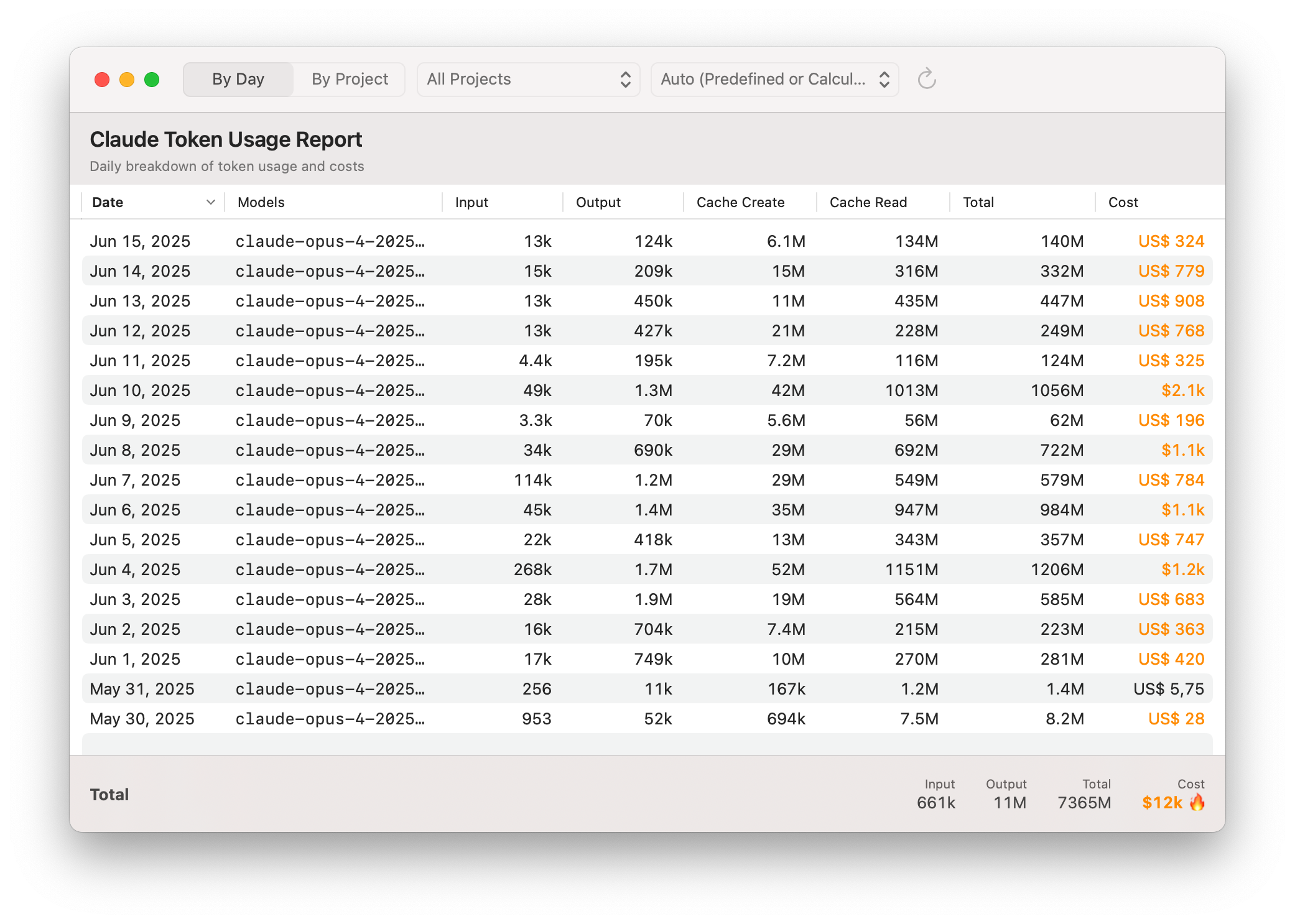
Claude Code Usage Report showing token counts and cost calculations

Well, turns out this is not easy at all. There is no API for that, there’s no cost control, there’s not even a hidden private API or something on the website that you could look at. The only way literally is to count the individual tokens that are sent to the LLM and then approximate how much is left. We also have to approximate when a window starts. As you can see, this was the start of a little adventure.

The Solution Journey: From Collaboration to SIMD

Luckily, I wasn’t alone. There were other people that were already curious and interested in that idea, so I could learn from various open source projects like ccusage, which pioneered the approach of parsing Claude’s JSON-L files. Counting tokens also is not as simple as you would think. Claude Code writes all interactions with their server into so-called JSON-L files which can be in the hundreds of megabytes large. So I spent a lot of time tweaking the parser, or dare I say me and Claude did.

SIMD Operations for Performance

During the process I even started using SIMD operations, something which I only darkly remember got support in Swift but now it’s crucial to offer a speedy parsing that doesn’t bog down your CPU.

The most impressive optimization is the vectorized lookup table that uses SIMD16 (16-byte vectors) for fast pattern matching:

// VibeMeter/Core/Utilities/Tiktoken/CoreBPESIMD.swift:222-281
private struct VectorizedBytePairLookup {
    // Pre-computed SIMD vectors for common byte pairs
    private let pairVectors: [SIMD16<UInt8>: [(length: Int, rank: Int)]]

    init(bytePairRanks: [Data: Int]) {
        // Build SIMD lookup table for byte sequences
        for (data, rank) in bytePairRanks {
            if data.count > 16 { continue } // Skip sequences longer than SIMD width

            // Create a SIMD vector padded with zeros
            var vector = SIMD16<UInt8>(repeating: 0)
            data.withUnsafeBytes { (bytes: UnsafeRawBufferPointer) in
                for i in 0 ..< min(data.count, 16) {
                    vector[i] = bytes[i]
                }
            }
            vectors[vector]?.append((length: data.count, rank: rank))
        }
    }
}

This approach allows us to compare 16 bytes at once instead of doing byte-by-byte comparisons, dramatically speeding up the token counting process.

Token Counting with BPE

As a basis, I used the open source TikToken BPE tokenizer that is actually from OpenAI. There’s no public tokenizer project from Anthropic. However, the tokens are similar enough that we can use this project and still get fairly accurate results.

BPE (Byte Pair Encoding) is a compression algorithm adapted for tokenization in NLP. It breaks text into subword units (tokens), often capturing whole words or common prefixes/suffixes. Instead of just splitting on whitespace or characters, BPE builds a vocabulary of frequently seen pairs of characters or subwords. This allows models to handle unknown words, rare terms, and typos more gracefully.

Key Insights: Thinking Triggers and Fresh Context

Agentic engineering, as I prefer to say, requires even more clear thinking. I evolved my approach where I would use Claude Code and ask it to think hard about the problem. The thinking keyword is key because it triggers how much token Claude uses to actually think about the problem. There are various levels how you can trigger thinking, with Ultra Think being the highest level.

As I work more with Claude Code, I tend to slow down, ask it to plan, present options, ultrathink, and then pick the best one. And always using a fresh context. Much better results.

Look at these examples:

Took a few planning prompts each but then the code one-shots and works perfect.

Pro Tip: One trick to get better results in Claude Code is to use the various “thinking” triggers, with ultrathink being the boss. Check out the extended thinking tips in the Anthropic documentation for more details.

🚀 Side Quest: The Birth of llm.codes

While building Vibe Meter 2.0, I ran into a weird issue where Claude would argue with me that one cannot build nice toolbars in SwiftUI. This ultimately inspired me to build llm.codes, a way to feed Claude up-to-date information so it produces better code. You can read more about this journey in my post: llm.codes: Transform Your Developer Docs into LLM-Optimized References.

Modern Swift Refactoring

In the 2.0 refactor, I also put a better effort on using modern Swift idioms, and most I did that by Claude teaching modern Swift via a new Markdown file that I fed to him and asked him to refactor my codebase using modern Swift idioms. I shared this and many other knowledge files in my new agent rules repository.

The Results: 47K Lines, 92% Coverage

VibeMeter has grown into a substantial project:

  • App code: 24,529 lines
  • Test code: 22,560 lines
  • Total: 47,089 lines across 218 Swift files
  • Test coverage ratio: 92% (tests are nearly as large as the app itself!)

With this release, I also added support for macOS 141 which was quite simple.

Get Vibe Meter 2.0

Note: Vibe Meter is still on the pre-release channel for now, there’s a few edge-cases I wanna get right before making it 2.0 official, but it’s close!

Get it here and switch update channel for the preview!

  1. The only issue was with automatic observation tracking, which is macOS 15+ only. Learn more about this hidden gem in my post: Automatic Observation Tracking in UIKit and AppKit. ↩