Picture a kitchen you can't see into. Orders go in, plates come out, and when a customer sends a dish back, you're stuck guessing what went wrong.
LLM-powered apps have the same problem: a prompt goes in, text comes out, and when something breaks or degrades, you're left wondering why.
AI observability tools puts glass walls on that kitchen. They captures every request, response, and the steps in between, recording traces, token usage, latency, and more. They also often go beyond tracing and performance monitoring, helping you evaluate output quality – was the response actually accurate and relevant?
In this article, we compare the top 9 AI observability tools through features, pricing, and honest trade-offs, so you can pick the right one for your stack.
Every solid LLM observability tool should clear this minimum bar:
The best go further:
One more thing worth checking early: integration method. A proxy sits on your request path and adds some latency; an SDK wraps your LLM client; and an OTel-native tool emits standard OpenTelemetry spans that many engineering teams already pipe into their existing observability stack.
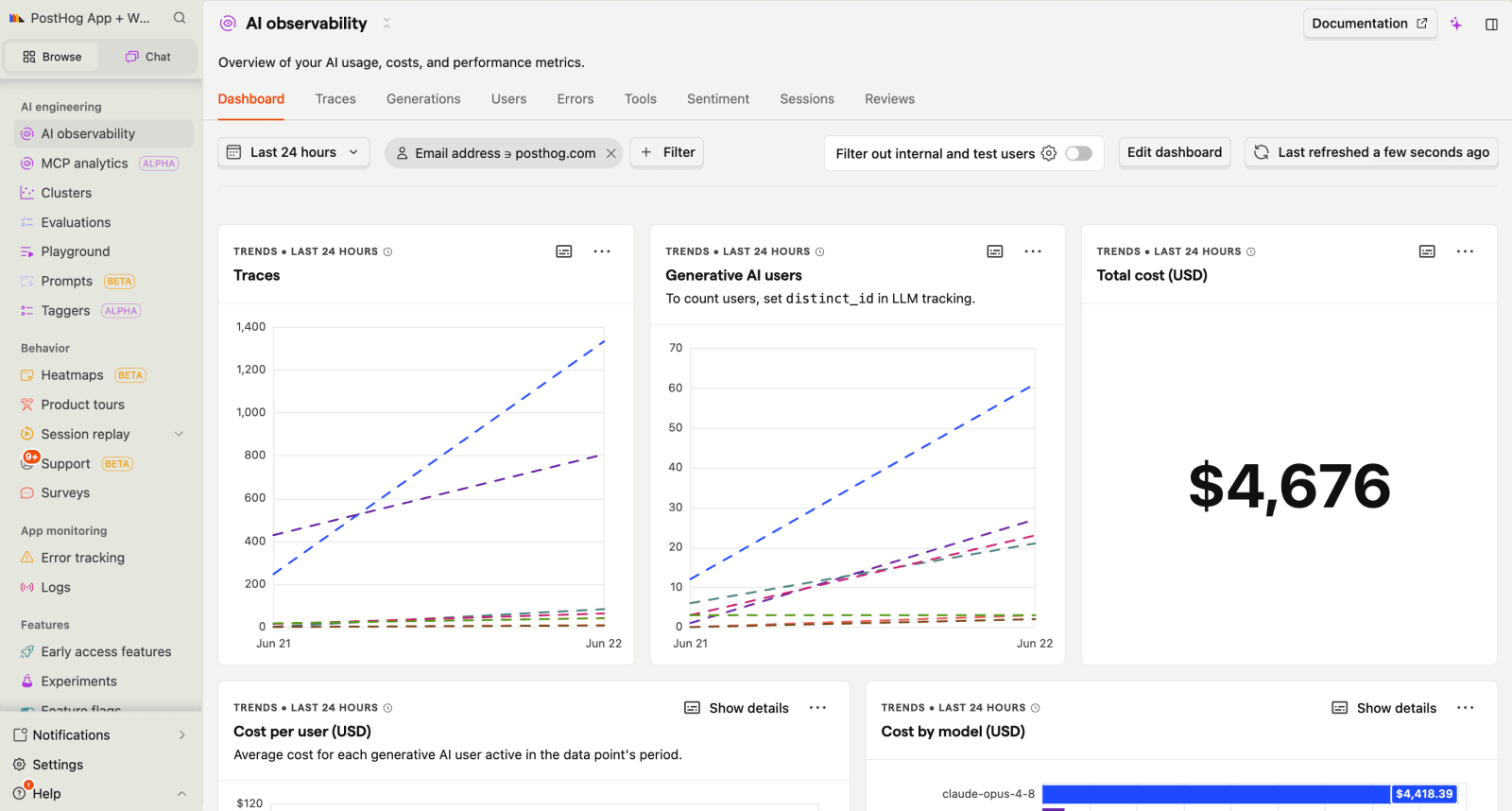
PostHog is the leading platform for self-driving products. You can use our desktop (Code), web, Slack, and MCP products to leverage tool like AI observability, product analytics, session replay, feature flags, experiments, error tracking, logs, and more.
Its AI Observability tool captures every instrumented LLM call: prompts, responses, token usage, cost, latency, and traces.
Beyond that, two features stand out for teams iterating on LLM apps:
PostHog is free to start: 100k AI observability events per month, no credit card needed. Beyond that, pricing is usage-based and fully transparent.
Product engineers and startups who want AI observability connected to the rest of their product data, in one self-serve platform, instead of buying and wiring up a separate tool.
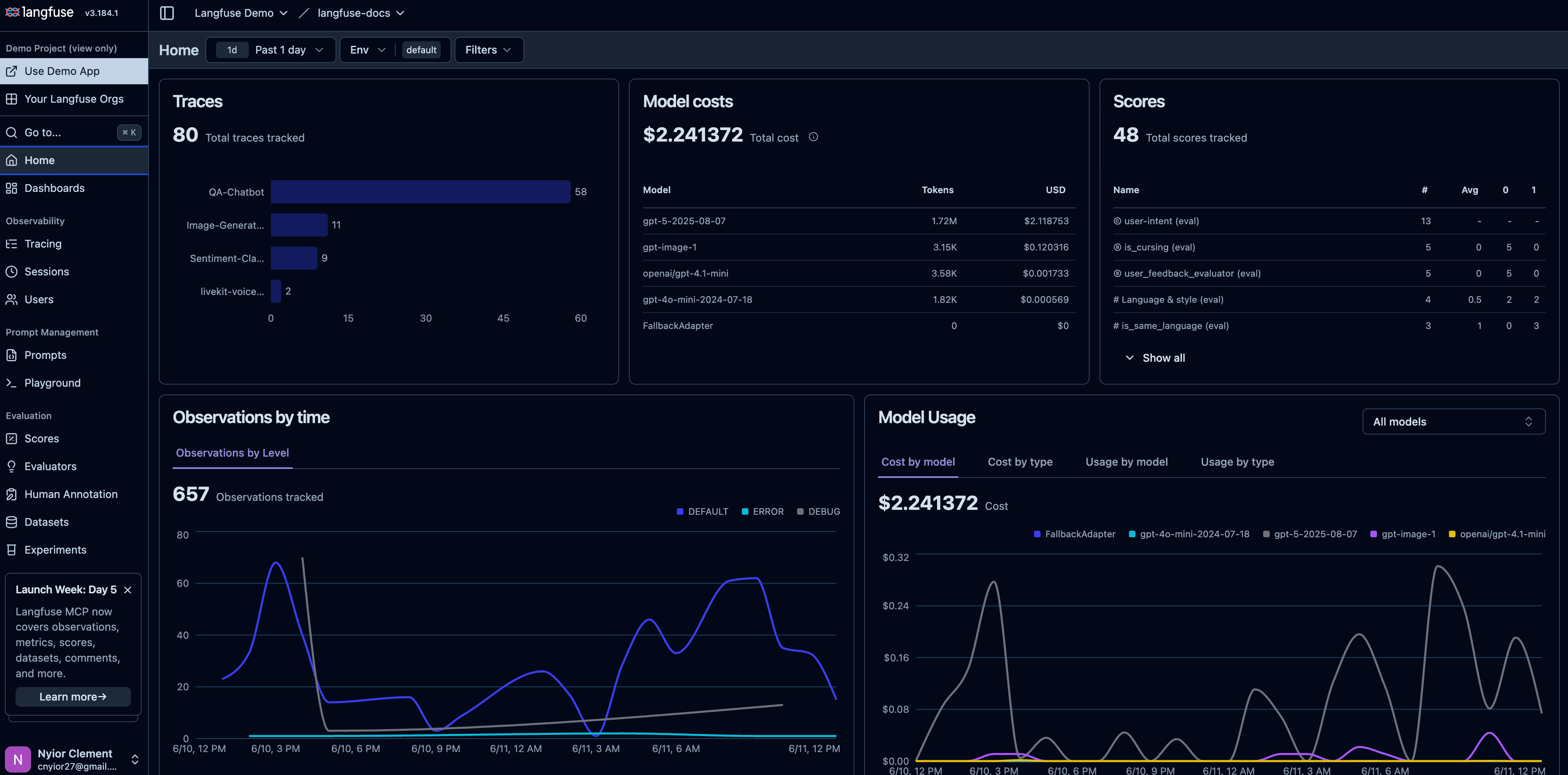
Langfuse is a fully featured open-source LLM observability platform. It covers the entire workflow: tracing, prompt management, evaluation, datasets, and more. Langfuse can ingest OTLP traces by acting as an OpenTelemetry backend, enabling it to fit into existing observability stacks.
Langfuse is free to self-host. The managed cloud is free up to 50k units per month (30-day retention), then $29/month for 100k units, with additional units at $8 per 100k.
Teams that want the most complete open-source LLM observability platform and are happy to self-host or pay for the managed cloud.
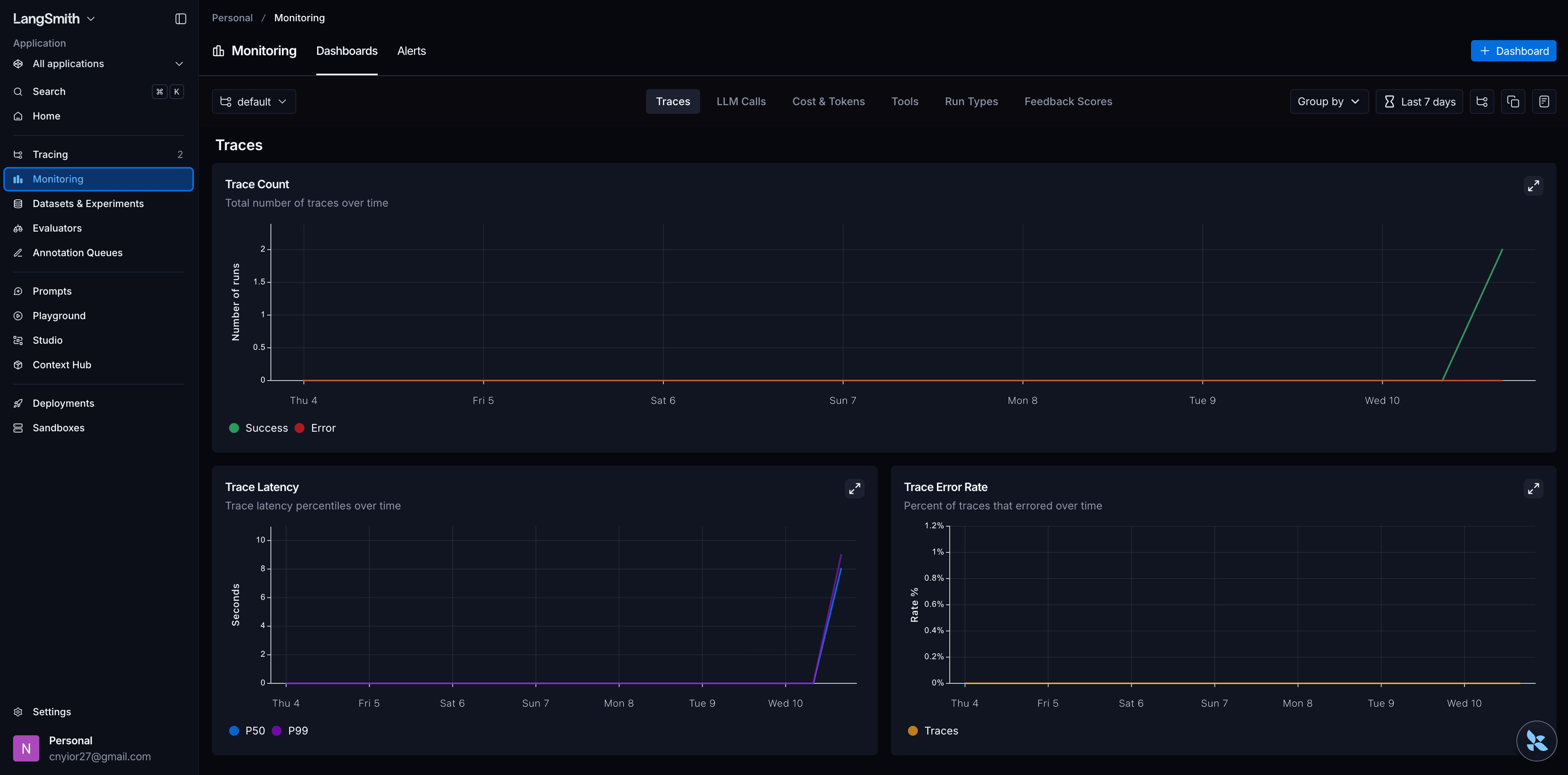
LangSmith is the observability and evaluation platform from the LangChain team.
The framework integration is the deepest available for LangChain and LangGraph applications: native traces, annotation queues, and minimal instrumentation overhead. LangSmith also ships a full OpenTelemetry endpoint, so it's usable outside the LangChain world too, though the experience is best inside it.
LangSmith is proprietary (the LangChain framework is open source, the platform isn't), and self-hosting is reserved for Enterprise. The free tier permits 5k base traces/mo, 14-day retention, and 1 seat, then pay as you go (with an added cost of $39 per seat per month).
Teams building primarily on LangChain or LangGraph who want native, near-zero config tracing and don't mind a proprietary, per-seat platform.
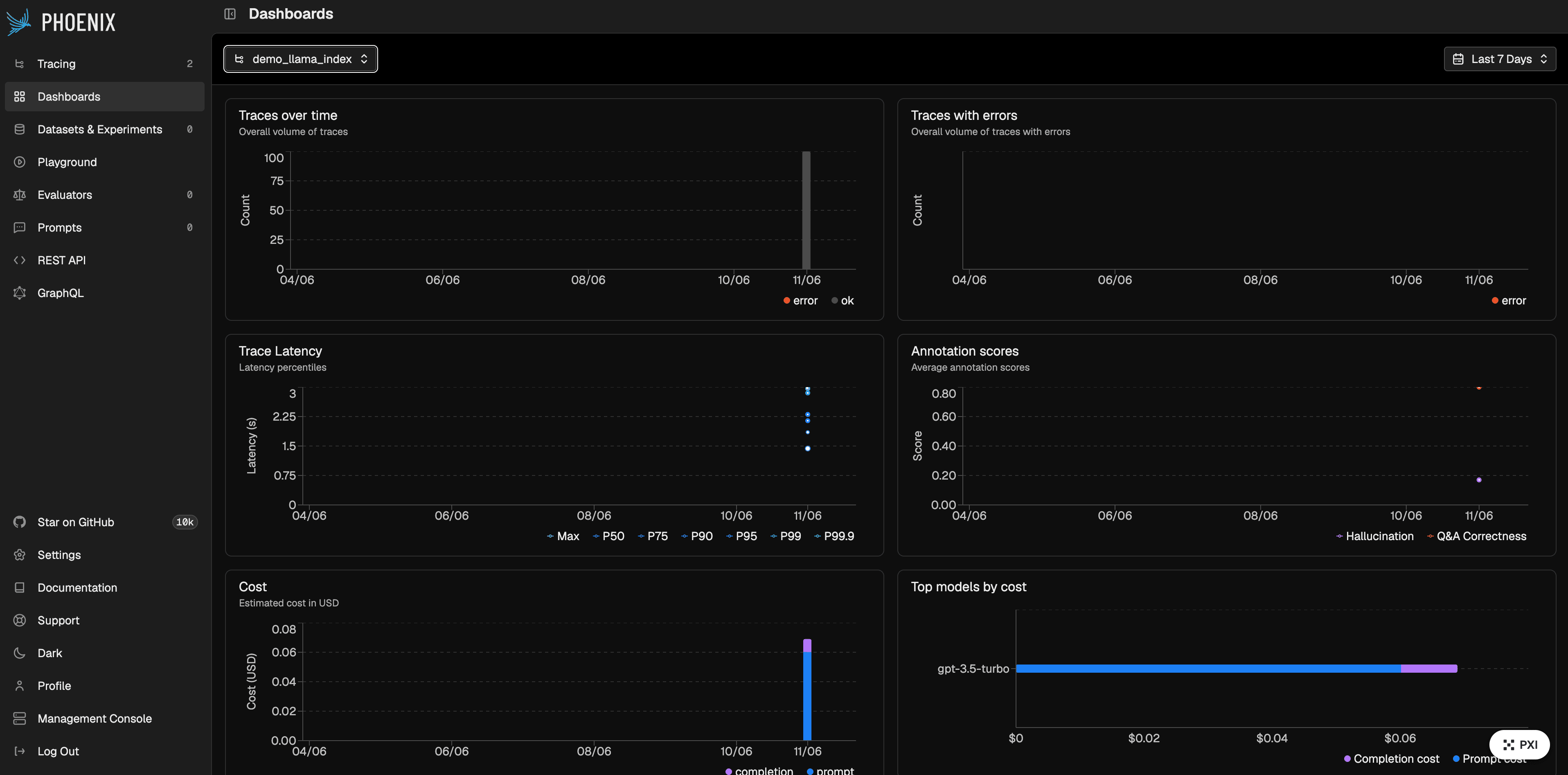
Phoenix is an open-source AI observability platform built by Arize AI, and it's the pick for teams that want machine-learning-grade rigor.
It provides tracing, evaluation, experiments, and prompt management, works out of the box with frameworks like LlamaIndex and LangChain, and is OpenTelemetry-native, so it slots into an existing telemetry stack with minimal friction.
It's released under the Elastic License 2.0 (source-available rather than strict OSI open source) and is free to self-host.
Arize offers managed cloud tiers through Arize AX: a free AX Free tier covers 25,000 spans a month (15-day retention), and AX Pro is $50 per month for 50,000 spans, 30-day retention, and 10 GB of ingestion volume.
Phoenix itself stays free to self-host with no usage caps. What makes Arize's broader platform distinct is its heritage in classical ML and computer vision observability, which is useful if you're debugging more than just LLMs.
Arize Phoenix is best for...
Platform and ML engineers who want OpenTelemetry-native, standards-based observability with rigorous evals, and who may also monitor non-LLM models.
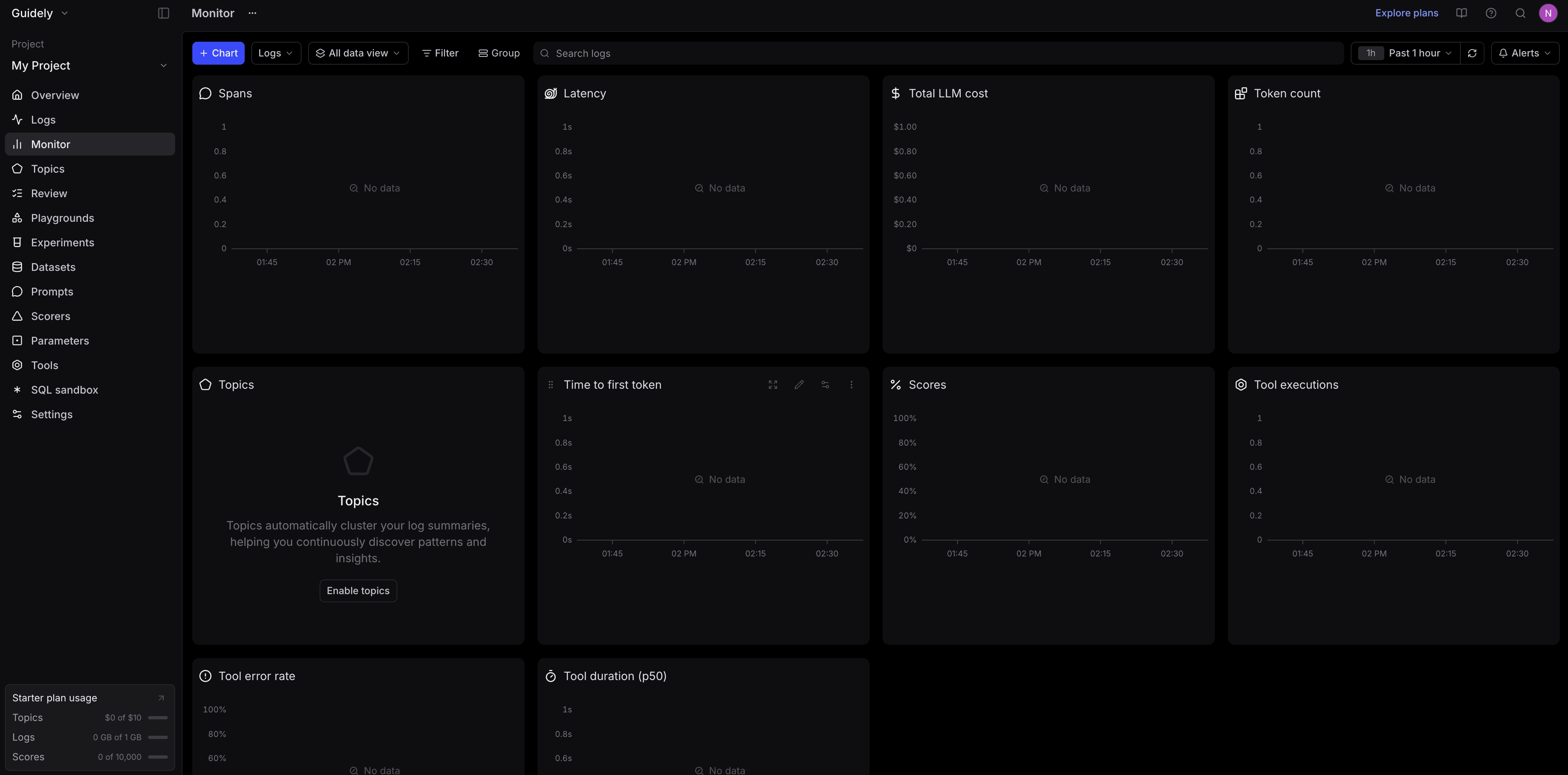
Braintrust takes an opinionated stance on observability: it shouldn't be separate from evaluation, and evals should gate what reaches production.
It's best described as an observability platform built around evaluation-driven development, with evaluation workflows that can be integrated into CI/CD pipelines to block releases when quality drops.
Braintrust charges no per-seat fees. Its pricing is a flat platform fee plus data-based overages, with a free Starter tier that includes 1 GB of processed data, 10,000 evaluation scores, and unlimited users.
The trade-off is focus, since Braintrust leans more toward evaluation than deep production tracing. Self-hosting is also enterprise-only.
Braintrust is best for...
Teams that ship LLM features fast and want evaluation to determine what reaches production, with deployment gating and team-wide pricing.
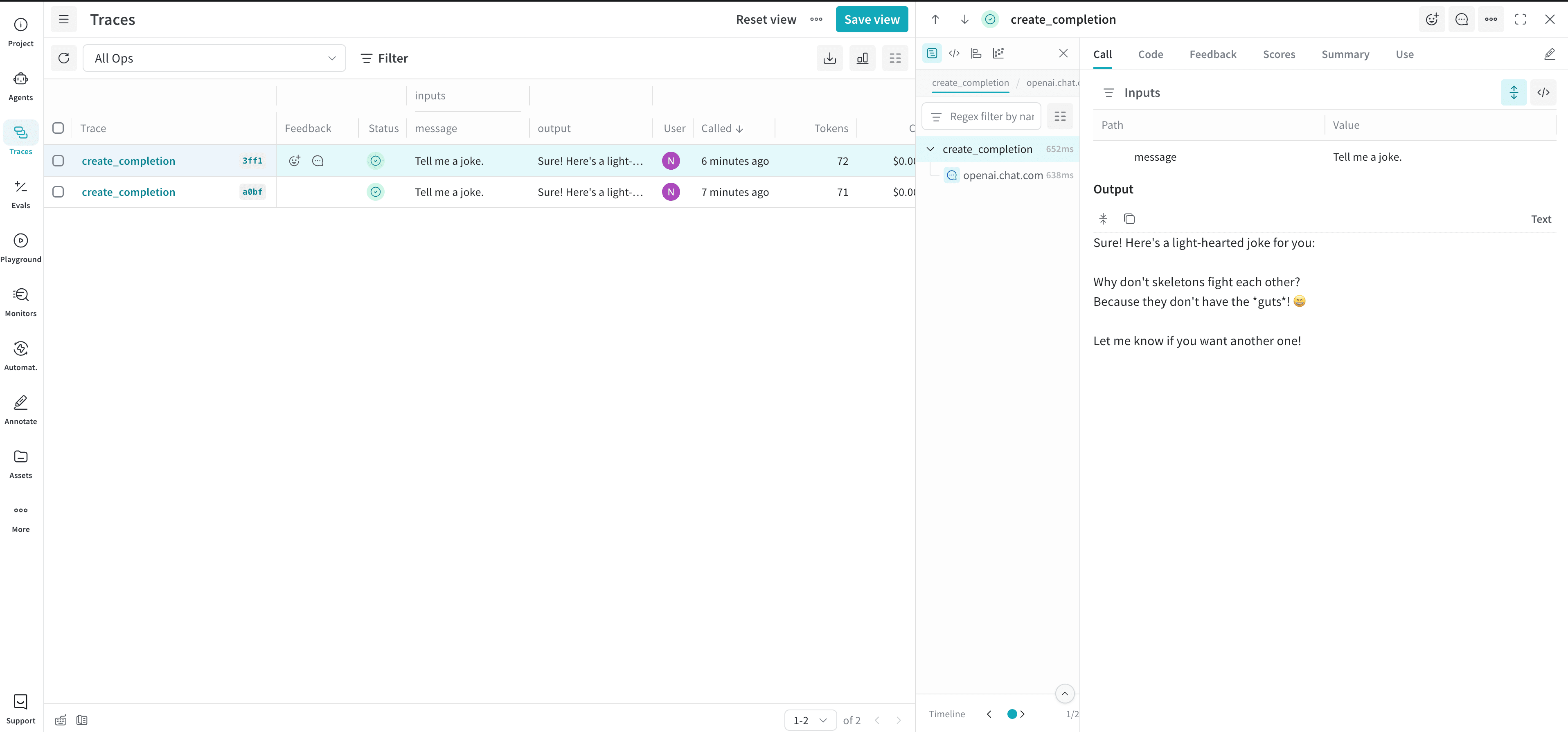
Weave is the LLM observability product from Weights & Biases, and it's the natural choice for teams already living in W&B for model training. You instrument calls with a simple @weave.op decorator, and it captures inputs, outputs, traces, latency, and cost information for supported model providers.
Weave has matured into a serious observability and evaluation platform, with built-in scorers for common risks such as toxicity, PII exposure, and hallucinations, plus a playground for testing prompts against production traces.
Weave's client library is open source, but the platform itself is a proprietary SaaS, with on-prem reserved for Enterprise. Pricing combines seat-based plans (Pro starts at $60 a month) with usage-based billing on the bytes you ingest into Weave – Pro includes 1.5 GB of Weave ingestion a month, then $0.10 per MB beyond that. That ingestion overage, more than seat count, is usually what drives a Weave bill.
Weights & Biases Weave is best for...
Teams already using Weights & Biases for model training who want LLM observability and evals in the same platform they already know.
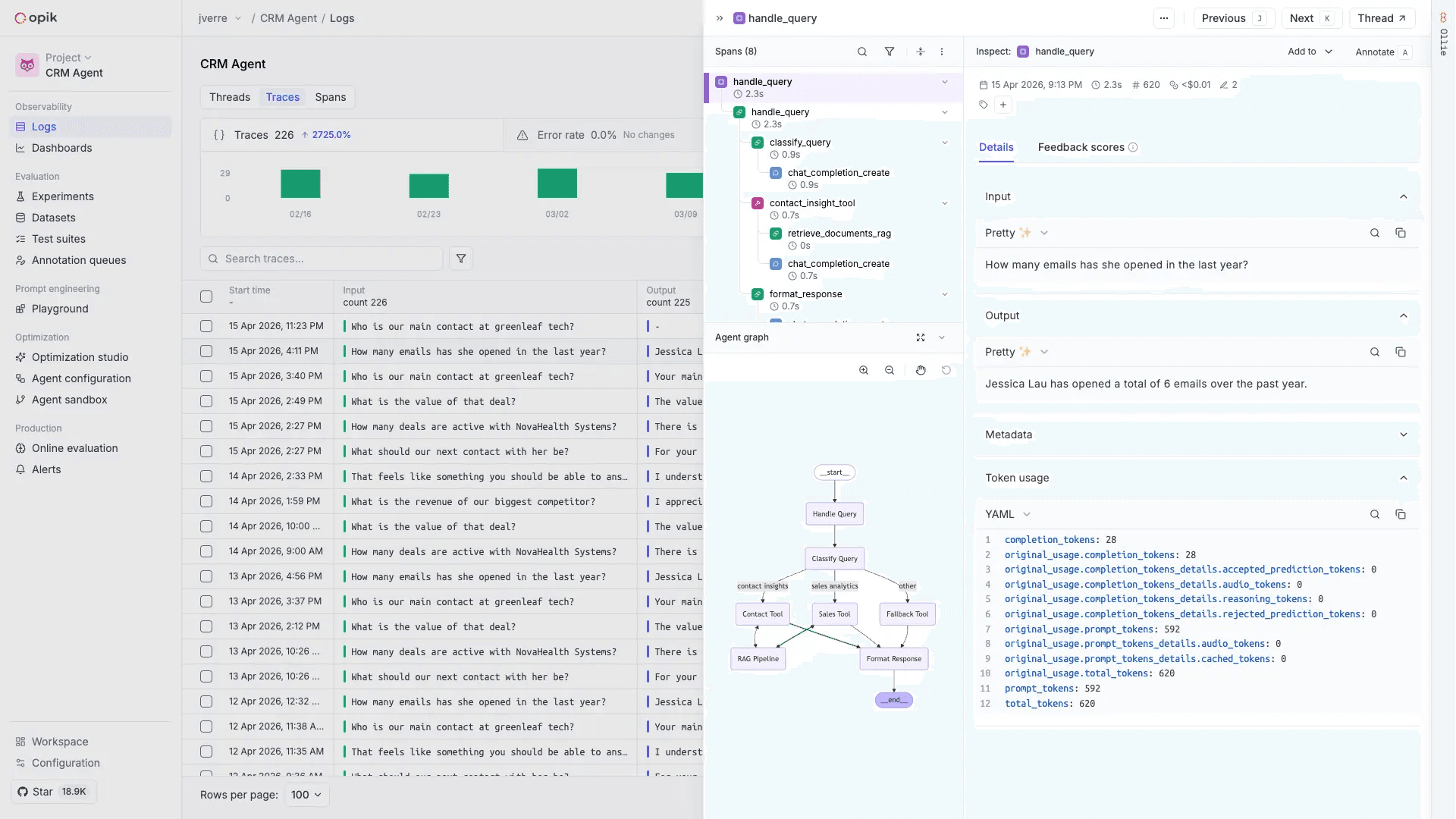
Opik is an open-source platform for evaluating, testing, and monitoring LLM apps, built by Comet.
It provides tracing, annotations, a prompt and model playground, and evaluation, and with around 19,500 GitHub stars it has strong adoption for an open-source tool. It's Apache 2.0-licensed with a free hosted plan of 25,000 spans per month, 10 team members, and 60-day retention.
What makes Opik distinct is its connection to Comet's broader MLOps and experiment-tracking platform. Like W&B Weave, it appeals to teams training and hosting their own models, not just teams calling LLM provider APIs – but Opik is open source, where Weave is proprietary. If your work spans model training and LLM apps, Opik covers both.
Teams that train or fine-tune their own models as well as build LLM apps, and want open-source observability and evals that cover both.
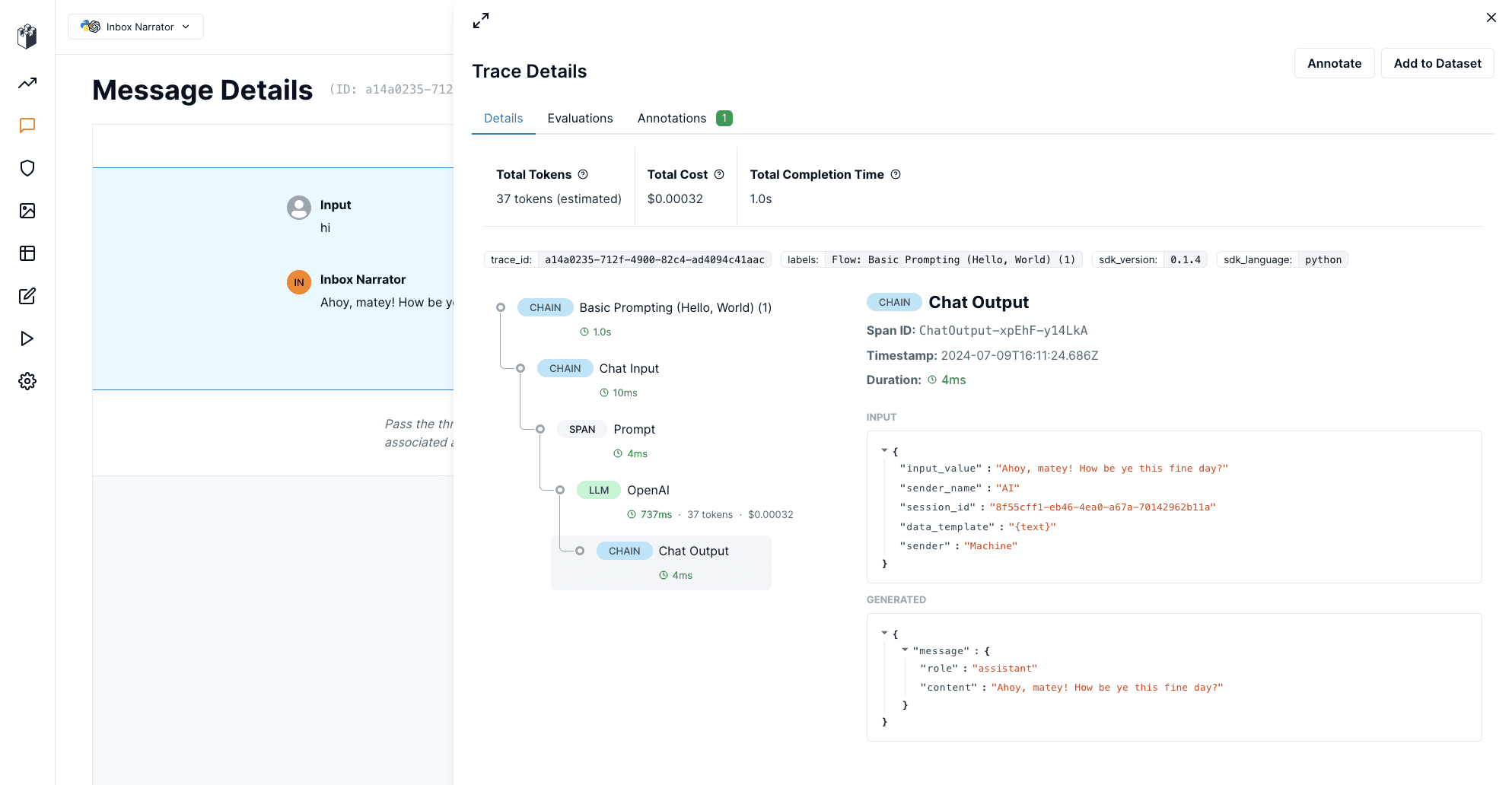
LangWatch is an open-source LLMOps platform that's OpenTelemetry-native and framework-agnostic, with support for LangGraph, DSPy, Vercel AI SDK, and others.
It covers traces, evaluations, prompt management, and datasets, but its standout features are agent simulation testing (run a simulated user against your agent across realistic scenarios before production) and automatic prompt optimization via Stanford's DSPy framework, meaning prompts are improved through structured, data-driven experimentation, not guesswork. Setup takes about five minutes, often a single environment variable.
It's a newer entrant than the leaders here, but it's actively developed and occupies a genuinely differentiated niche. Its free plan includes 50,000 events a month, 14-day data retention, and up to 2 users. The Growth plan is €29 per core seat per month, with 200,000 events included, pay-as-you-go overage at €0.00005 per event, and 30-day data retention.
Agent simulation testing, a forward-looking capability few competitors offer.
OpenTelemetry-native and framework-agnostic, so you avoid lock-in.
Auto-prompt optimization via DSPy, built into the platform.
Teams building complex agents who want open-source observability with agent simulation testing and prompt optimization, not just passive tracing.
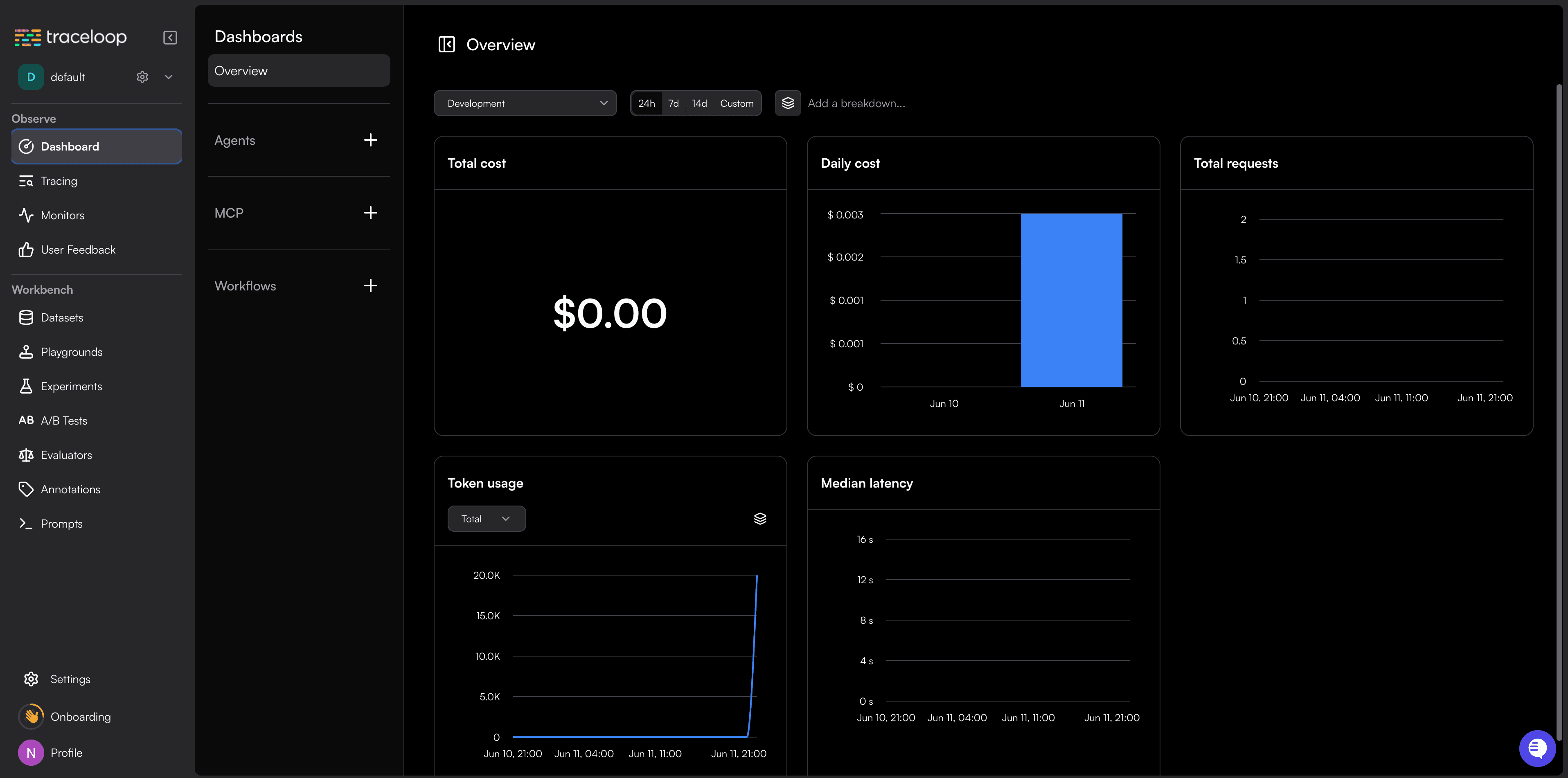
OpenLLMetry is an open-source set of extensions to OpenTelemetry, built by Traceloop. It's the pick for teams that already run OpenTelemetry and want LLM instrumentation to fit their existing stack rather than introduce a new platform.
It captures data from a wide range of LLM providers, vector databases, and frameworks, then sends it to whatever backend you already use, from Datadog to New Relic to Honeycomb. It's Apache 2.0-licensed, and its conventions directly seeded the OpenTelemetry GenAI SIG – now the upstream standard for LLM observability, though still in experimental status as of 2026.
One thing to factor in: Traceloop was acquired by ServiceNow in March 2026 to power its AI Control Tower governance platform. The platform's roadmap and pricing are now shaped by a large enterprise vendor rather than an independent startup; worth knowing before you build a dependency on it.
OpenLLMetry is instrumentation, not a full platform, so it isn't where you go for prompt management. Traceloop, the company behind it, adds an evaluation and dashboard layer; its free tier covers 50,000 spans per month with 24-hour data retention.
OpenLLMetry is best for...
Teams already invested in OpenTelemetry who want LLM tracing to flow into the APM backend they already run.
The free tier is not a good indicator of how your cost would scale. What actually decides your bill is the pricing model, because each one gets expensive in a different way. Here's what each tool charges on:
| Tool | Pricing model | What spikes the bill |
|---|---|---|
| PostHog | Usage-based per event, no seat fees | Event volume above the free tier |
| Langfuse | Free self-host, or per-observation cloud | Observation volume on the cloud plan |
| LangSmith | Per seat + per trace | Team size and trace volume, together |
| Arize Phoenix | Free self-host; Arize AX usage-based | Span volume on the cloud (AX) plan |
| Braintrust | Flat fee + data, no seats | Data volume and score count above your tier |
| W&B Weave | Per seat + data ingestion | Seats plus ingested bytes |
| Opik | Usage-based per span | Span volume |
| LangWatch | Per seat + event-based overage | Seat plus event volume |
| OpenLLMetry | Free library, backend billed separately | Your backend's storage costs |
Two patterns cause most of the bill shock. Per-seat pricing punishes team growth. Per-span, per-observation, or per-event pricing punishes agents, because a single agent run can emit ten or more spans, so your volume balloons faster than your traffic does.
The exception is per-trace pricing (LangSmith): one trace covers a whole request no matter how many calls are nested inside, so an agent's fan-out doesn't inflate the count – there, the cost drivers are seats and request volume instead.
Here's a concrete example. Say you're a five-engineer team running an LLM feature in production. It handles 100,000 user requests a month, but each request is an agent making around five model calls plus two tool calls – roughly seven spans/operations per request, so about 700,000 spans a month across 100,000 top-level requests.
Let's see how much this would cost, across different platforms:
PostHog (usage-based per event): the first 100,000 LLM analytics events each month are free, then you pay a $0.00006 per-event rate with no seat fees. Each generation and span is an event, so this workload is roughly 700,000 events; you'd pay for the ~600,000 above the free tier = ~$36.
LangSmith (per seat + per trace): one trace typically represents an entire user request, regardless of how many spans or model calls happen inside it. In this example, 100,000 requests produce 100,000 billable traces. With five seats at $39/month (Plus plan), that's $195 in seat costs. After the 10,000 included traces (Plus plan), the remaining 90,000 traces cost about $225 in overages ($0.0025/trace), bringing the total to roughly $420/month. The important thing is that the bill grows with request volume, not with the number of spans inside each request.
Braintrust (flat fee, no seats): the free Starter tier includes 1GB of processed data (roughly 1 million spans at typical payload sizes), so this ~700,000-span workload still fits inside the free tier at $0. If you outgrow it, Pro is a flat $249 a month with unlimited users and data-based overages. Adding engineers costs nothing.
Langfuse cloud (per observation): a note on terminology first – Langfuse's billable unit is anything you send it: traces, observations (spans, generations), and scores. If 100,000 user requests create 100,000 traces and about 700,000 observations, the workload is about 800,000 billable units. On the Core plan, that means $29 for the first 100,000 units, plus $56 for the remaining 700,000 units, or about $85/month.
Self-hosting (PostHog, Langfuse, Phoenix, Opik, LangWatch, or OpenLLMetry): no per-observation or per-seat fee at all. You trade that for the infrastructure and the engineering time to run it. At high volume, this is usually the cheapest path if you have the people to maintain it.
Takeaway: if your team is growing, avoid per-seat models. If your app is agent-heavy, watch per-span pricing closely. And if you have the ops capacity, self-hosting an open-source tool is the most predictable bill at scale.
The framework above is the quick answer. Here's the detailed version, by the kind of team you're on.
You want free, fast, and low-maintenance, and you don't want a sales call? PostHog gives you 100,000 LLM events free a month plus everything else in the platform, Langfuse is free to self-host or 50,000 observations on the cloud, and Opik offers 25,000 spans with 60 day retention.
Avoid per-seat tools – you're paying for capacity you don't need. If your side project is an agent specifically, AgentOps is a lightweight honorable mention with time-travel debugging and session replay across Python and TypeScript SDKs.
You want a generous free tier, room to grow without re-platforming, and ideally observability that sits next to your product analytics so you can see how features land? PostHog is built for exactly this, since LLM observability is one app among many you'll grow into.
Langfuse is the strongest dedicated open-source option, and Braintrust is compelling thanks to its 1GB data (~1M spans) free tier and the absence of any seat tax as your team grows.
Both your team and your traffic are growing, which makes per-seat pricing painful and evaluation discipline essential? Lean toward tools with no seat charges and real eval workflows: Braintrust for CI/CD gating, PostHog for usage-based pricing with no seat fees, Langfuse if you want to self-host and own the data, and LangWatch if you're shipping complex agents that need simulation testing before release.
You need compliance, SSO, and on-prem or VPC deployment? Arize, Braintrust (Enterprise), LangSmith (Enterprise and hybrid), and W&B Weave (on-prem) all serve this tier.
PostHog is open source and its cloud is SOC 2 Type II compliant. For a compliance-first shop that wants it out of the box, HoneyHive is an honorable mention with SOC 2 Type II, HIPAA, and GDPR built in, though it's enterprise-priced and sales-led rather than self-serve.
AI observability is the practice of monitoring and understanding how your LLM-powered app behaves in production. It captures individual LLM calls (inputs, outputs, latency, token usage), aggregates metrics across requests, and gives you tools to debug issues and improve performance. It's like traditional application observability, but focused on the things that make LLMs different: non-deterministic outputs, high token costs, prompt sensitivity, and the difficulty of judging whether an answer is actually good.
There's no single best LLM observability tool, only the best for your situation. PostHog is best if you want observability connected to your product analytics, session replays, and feature flags in one platform. Langfuse is the most complete open-source option. LangSmith is best inside LangChain. Braintrust and LangWatch are strongest when evaluation quality is your real problem. Match the tool to your stack and your bottleneck rather than chasing a universal winner.
Traditional observability tools like Datadog track infrastructure: latency, error rates, uptime, and throughput. Those are mostly binary, since something either worked or it didn't.
LLM observability adds a quality dimension. A model call can return a perfectly valid response that's also wrong, biased, or off-topic, and a normal monitor would call that a success. LLM observability tools capture the actual prompts and outputs, and many add evaluations to measure whether responses are good, which traditional APM tools don't do.
Yes, if real users are involved. Calling OpenAI's API directly still leaves you blind to which prompts cause bad answers, where your token spend is going, and how latency behaves under load. Even a simple setup benefits from capturing requests and costs. Tools like PostHog and Langfuse can start logging your OpenAI calls with very little setup, so there's little reason to fly blind.
Langfuse is the most complete open-source LLM observability platform, with tracing, prompt management, evals, and datasets under an MIT license. PostHog (MIT), Opik (Apache 2.0), Arize Phoenix (Elastic License 2.0), LangWatch, Helicone (Apache 2.0), and OpenLLMetry (Apache 2.0) are all open source too. We compare the field in depth in our guide to the best open-source LLM observability tools.
By raw volume, Braintrust leads with 1 GB of data (~1 million trace spans) free per month and no per-seat charges, which is enough for real production workloads. PostHog offers 100,000 LLM events free monthly, and self-hosting Langfuse, Phoenix, or Opik is effectively unlimited since you only pay for infrastructure. The most generous tier depends on whether you measure by spans, events, or the freedom to self-host.
Braintrust is the most eval-focused tool, with CI/CD gating that can block a release when output quality drops. LangWatch is strong on evaluation too, with agent simulation testing and prompt optimization. Langfuse, Arize Phoenix, and Opik all have solid built-in evals, and PostHog's evaluations let you score outputs to track whether they're actually good over time.
Yes, especially if you already run OpenTelemetry for the rest of your stack. OpenLLMetry and Arize Phoenix are OpenTelemetry-native, and LangWatch, Langfuse, and LangSmith all support it. The big advantage is no lock-in: instrument once with OpenTelemetry and you can switch backends later without re-instrumenting your app. Given how fast this space is consolidating, that flexibility is worth a lot.
Subscribe to our newsletter
Read by 100,000+ founders and builders
We'll share your email with Substack
此内容由惯性聚合(RSS阅读器)自动聚合整理,仅供阅读参考。 原文来自 — 版权归原作者所有。