惯性聚合 高效追踪和阅读你感兴趣的博客、新闻、科技资讯
阅读原文 在惯性聚合中打开

推荐订阅源

The Last Watchdog
The Last Watchdog
freeCodeCamp Programming Tutorials: Python, JavaScript, Git & More
GbyAI
GbyAI
Y
Y Combinator Blog
CTFtime.org: upcoming CTF events
The GitHub Blog
The GitHub Blog
博客园_首页
小众软件
小众软件
I
InfoQ
J
Java Code Geeks
月光博客
月光博客
S
Secure Thoughts
Microsoft Security Blog
V
Visual Studio Blog
Hacker News - Newest:
Hacker News - Newest: "LLM"
钛媒体:引领未来商业与生活新知
钛媒体:引领未来商业与生活新知
Stack Overflow Blog
Stack Overflow Blog
cs.CV updates on arXiv.org
N
News and Events Feed by Topic
Exploit-DB.com RSS Feed
Threat Intelligence Blog | Flashpoint
The Cloudflare Blog
T
Threat Research - Cisco Blogs
A
About on SuperTechFans
H
Help Net Security
MongoDB | Blog
MongoDB | Blog
博客园 - 聂微东
人人都是产品经理
人人都是产品经理
H
Hackread – Cybersecurity News, Data Breaches, AI and More
Recent Commits to openclaw:main
Latest news
Latest news
G
GRAHAM CLULEY
IT之家
IT之家
C
Cisco Blogs
Last Week in AI
Last Week in AI
Engineering at Meta
Engineering at Meta
L
LangChain Blog
The Register - Security
SecWiki News
SecWiki News
M
MIT News - Artificial intelligence
NISL@THU
NISL@THU
T
Tenable Blog
博客园 - Franky
美团技术团队
I
Intezer
U
Unit 42
雷峰网
雷峰网
cs.AI updates on arXiv.org
S
SegmentFault 最新的问题
C
Cyber Attacks, Cyber Crime and Cyber Security

PostHog's RSS Feed

Training our own AI models - PostHog From 270GB RAM to 5GB: Moving local flag evaluation from Django to Rust The best analytics stack for vibe-coded apps The do's and don'ts of minimum viable product marketing - PostHog The best MCP servers for startups, by workflow 4,063 errors closed without a human opening PostHog – here's what we learned - PostHog PostHog Code and the self-driving product - PostHog Why attacking your competitors online is dumb - PostHog The best real-time analytics platforms for developers, compared DuckDB vs ClickHouse: Why we use both at PostHog - PostHog PostHog's next chapter - PostHog Making Claude Cowork actually useful - PostHog PostHog vs Matomo in-depth tool comparison You're doing lifecycle emails wrong Untangling Tokio and Rayon in production: From 2s latency spikes to 94ms flat The best HIPAA-compliant A/B testing tools - PostHog A beginner's guide to testing AI agents - PostHog I hate the standup bot (so I built an agent to do it for me) - PostHog The best CDPs for developers, compared The best error tracking tools for developers, compared The best feature flag software for developers, compared 7 best session replay tools for mobile apps 7 best free open source business intelligence tools right now 7 best free and open source LLM observability tools PostHog vs LogRocket in-depth tool comparison The most popular PostHog alternatives, compared Open source (and self-hosted) session replay tools - PostHog The 9 best GA4 alternatives for apps and websites - PostHog PostHog vs Google Analytics 4 in-depth tool comparison How we built automatic clustering for LLM traces - PostHog The 7 best HIPAA-compliant analytics tools 8 best open source analytics tools you can self-host - PostHog The best product analytics tools for startups, compared PostHog vs FullStory in-depth tool comparison The best in-app survey tools for product teams, compared The 7 best mobile app analytics tools PostHog vs Hotjar in-depth tool comparison The 8 best free and open-source feature flag services - PostHog The 5 best free and open-source A/B testing tools - PostHog The best mobile app A/B testing tools, compared What is a feature flag? Feature Flags vs Remote Config vs A/B Testing PostHog is now available in Vercel’s v0 The best Heap alternatives & competitors, compared PostHog vs Heap in-depth tool comparison PostHog vs Pendo in-depth tool comparison PostHog × Vercel: feature flags, minus the plumbing Your logs' final destination is in GA. You always end up here anyway Behind the scenes of a PostHog hackathon - PostHog The most popular Mixpanel alternatives & competitors, compared PostHog vs Mixpanel in-depth tool comparison The 9 best GDPR-compliant analytics tools How we use Logs at PostHog The best web analytics tools for developers, compared Stop AI slop: Run evals with LLM-as-a-Judge - PostHog You product data just got a job: Workflows is now out App onboarding: How to fix drop-off points Meet Logs (beta) – logs with all the tools you’re already using Why small teams crush tiger teams How we built user behavior analysis with multi-modal LLMs (in 5 not-so-easy steps) - PostHog The best Contentsquare alternatives & competitors, compared 8 learnings from 1 year of agents – PostHog AI - PostHog Why we killed our AI product assistant Workflows graduate to beta! Product data, meet automation The best Rollbar alternatives & competitors, compared Workflows are now in Alpha and I already broke mine - PostHog I've consistently underestimated how important communication is as a CEO - PostHog How we made feature flags even faster and more reliable The best session replay tools for developers, compared What I learned attending my first ever hackathon - PostHog Did you know AI is answering our community questions? - PostHog How not to be boring - PostHog We built an internal tool to generate changelog images for social media - PostHog What we built at our windswept Mykonos hackathon - PostHog How we built our onboarding email flow (with actual performance data) - PostHog We're building a better PostHog community by closing our public Slack - PostHog Introducing Notebooks for PostHog - PostHog Why we've launched PostHog user surveys - PostHog How we made feature flags faster and more reliable - PostHog In-depth: ClickHouse vs Redshift - PostHog Introducing HouseWatch: An open-source toolkit for ClickHouse - PostHog Introducing HogQL: Direct SQL access for PostHog - PostHog What we built at our sun-kissed Aruba hackathon - PostHog In-depth: ClickHouse vs BigQuery - PostHog In-depth: ClickHouse vs Elasticsearch - PostHog HogMail #22: Why do companies over-hire?" - PostHog Our simpler goal: Help engineers to be better at product - PostHog In-depth: ClickHouse vs Snowflake - PostHog HogMail #21: Avoiding the "Product Death Cycle" - PostHog Sunsetting Kubernetes support for PostHog - PostHog Why 'Product Engineer' is the most fun role I've had in tech - PostHog HogMail #20: Why do startups fail? - PostHog The best Google Optimize alternatives for apps and websites - PostHog Array 1.43.0: Massive performance improvements! - PostHog In-depth: ClickHouse vs Druid - PostHog HogMail #19: Which meetings should you kill? - PostHog CEO diary: The things I learned in 2022 - PostHog The essential tools used by product engineers - PostHog HogMail #18: What can SaaS learn from the New York Times? - PostHog What is a product engineer? - Product Engineer Handbook - PostHog Array 1.42.0: Get beta features via our roadmap! - PostHog
Permissions and projects in PostHog, explained - PostHog
Joe Martin · 2022-10-10 · via PostHog's RSS Feed

So, you’ve installed your snippet and started tracking data in PostHog. What’s next?

Before forging ahead into the heady world of insights, session recordings, experimentation and feature flags, we suggest taking a second to invite your teammates to join you. After all, PostHog is better with friends and the more collaborators you have, the more value you can get from your data!

Inviting teammates to join you is easy, but because the data you’re dealing with may be sensitive it’s worth taking a second to learn about organizations, projects and user permissions first…

Starting at the top, organizations are the highest level of abstraction within PostHog — most commonly consisting of an entire company. Everyone who uses PostHog is part of an organization, even if the organization only has one person in it.

Apart from the FOSS version, all versions of PostHog enable you to belong to and create multiple organizations. To collaborate with someone on PostHog, it’s best to invite them to join your organization. If you’ve joined multiple organizations, you can switch between them using the user setting menu accessed by clicking your profile picture in the top right corner of your PostHog instance.
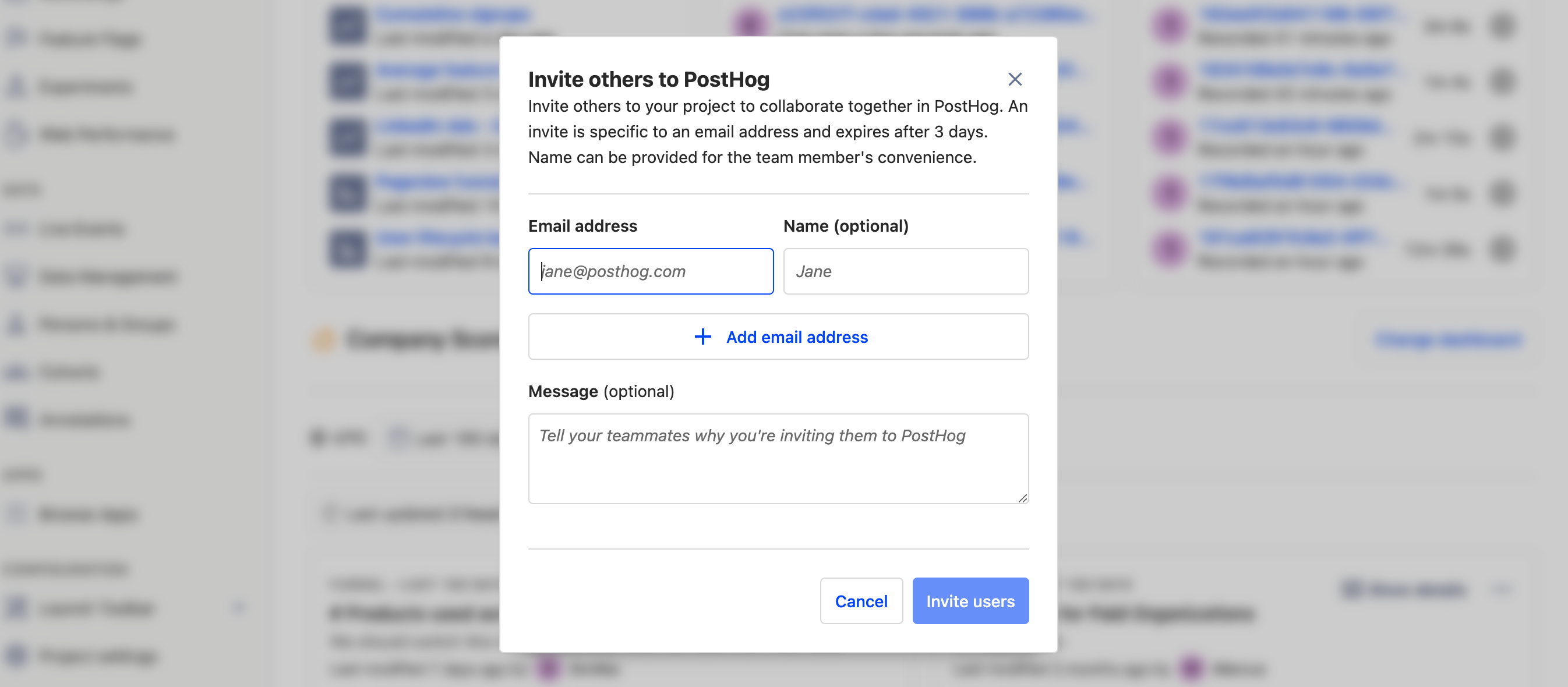
How to invite a colleague to your organization in PostHog

how to invite someone to posthog

Everyone in an organization has the ability to add new members to that organization by sending them an invitation. To send an invitation to a colleague, simply log into your PostHog instance, select your user settings by clicking your profile picture in the top right and select ‘+ Invite members’. We’ll send them an email automatically.

If you haven’t configured email on your PostHog instance, you’ll need to share invite links yourself.

A step down from organizations, projects are where the real magic happens and is best defined as where PostHog groups data and queries. Any information in a project is limited to that project and can’t be accessed in another project.

Projects are also nested within organizations and, while there are several ways to organize projects, the most common approach is to have one project per unlinked project within an organization. One exception to this however would be if you only have one product and one marketing website — in which case we recommend compiling both into a single project.

How to create private projects

Normally, when a user joins an organization they get access to all projects within it. But what if you want to keep some things a secret? That’s when private projects are useful.

Users with Administrator or Owner permissions can make any existing project private via the ’Access Control’ section of ‘Project Settings’.

In PostHog, because of the sensitive data available, not all user permissions are created equally — and when you add a new user it’s important to consider how much power you want them to have. Every user is either a Member, Administrator, or Owner.

Each organization can only have one owner, and new users are added as members by default.

PermissionMember (base level)AdministratorOwner
Viewing and querying project data
Inviting new members
Billing management
Project creation and deletion
Project settings management (incl. project-specific memberships)
Organization settings management (incl. memberships)
Leaving the organization
Transferring ownership
Organization deletion

How to alter permissions and remove users in PostHog

how to remove users posthog

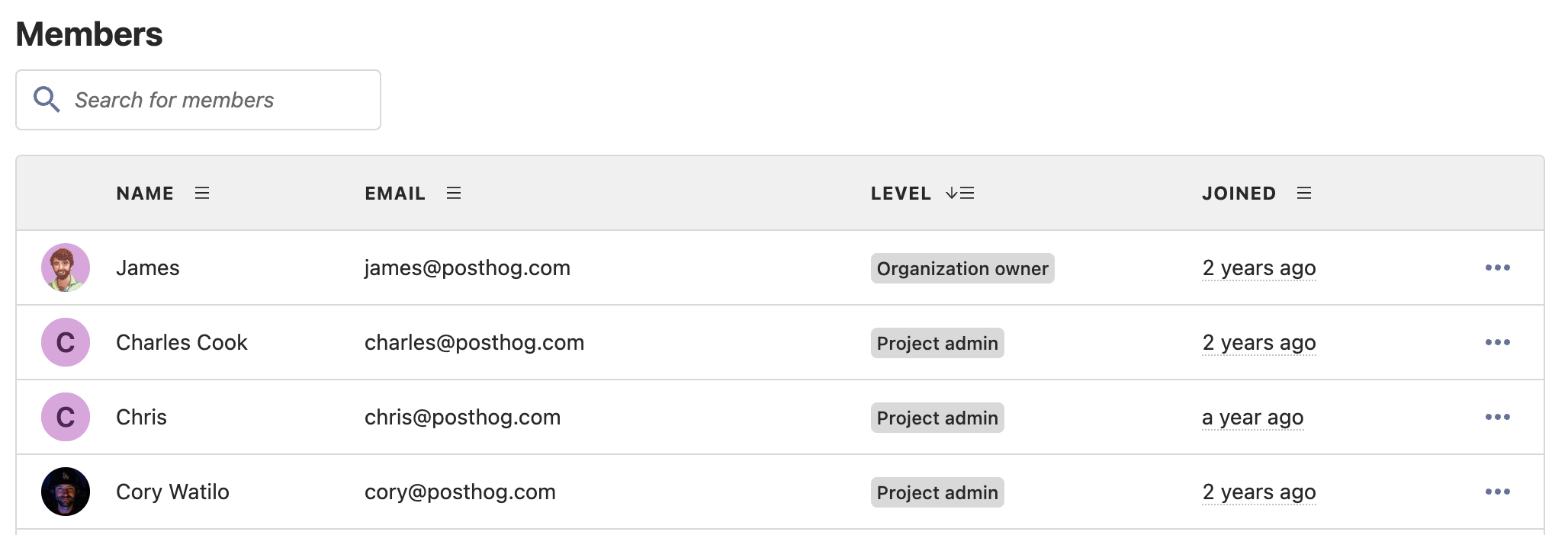
Whether someone has left your (actual) organization or joined your (PostHog) organization, sometimes you’ll undoubtedly need to change access rights — or remove a user entirely. In such cases, just head to the Project settings page of your PostHog instance, via the main menu.

It’s worth noting that users with member-level access cannot make changes to other users and can only choose to leave an organization themselves. Deleting users entirely can only be done by those with administrator privileges, or above.

Subscribe to our newsletter

Product for Engineers

Read by 100,000+ founders and builders

We'll share your email with Substack