

惯性聚合 高效追踪和阅读你感兴趣的博客、新闻、科技资讯
阅读原文 在惯性聚合中打开

推荐订阅源

U
Unit 42
罗磊的独立博客
爱范儿
爱范儿
Apple Machine Learning Research
S
Schneier on Security
V
Vulnerabilities – Threatpost
T
Tenable Blog
博客园 - 【当耐特】
博客园 - 聂微东
I
Intezer
S
Securelist
C
Cisco Blogs
腾讯CDC
T
The Exploit Database - CXSecurity.com
NISL@THU
NISL@THU
P
Proofpoint News Feed
Cyberwarzone
Cyberwarzone
Security Archives - TechRepublic
D
Darknet – Hacking Tools, Hacker News & Cyber Security
美团技术团队
P
Proofpoint News Feed
M
MIT News - Artificial intelligence
AWS News Blog
AWS News Blog
A
About on SuperTechFans
Last Week in AI
Last Week in AI
Cloudbric
Cloudbric
S
Secure Thoughts
PCI Perspectives
PCI Perspectives
The Last Watchdog
The Last Watchdog
奇客Solidot–传递最新科技情报
奇客Solidot–传递最新科技情报
B
Blog RSS Feed
Recorded Future
Recorded Future
大猫的无限游戏
大猫的无限游戏
C
CERT Recently Published Vulnerability Notes
酷 壳 – CoolShell
酷 壳 – CoolShell
G
Google Developers Blog
The Register - Security
博客园 - 叶小钗
博客园 - 司徒正美
博客园_首页
Google DeepMind News
Hacker News: Ask HN
Hacker News: Ask HN
Spread Privacy
Spread Privacy
雷峰网
雷峰网
I
InfoQ
The Hacker News
The Hacker News
T
Threat Research - Cisco Blogs
H
Hackread – Cybersecurity News, Data Breaches, AI and More
Schneier on Security
OSCHINA 社区最新新闻
OSCHINA 社区最新新闻

PostHog's RSS Feed

Training our own AI models - PostHog From 270GB RAM to 5GB: Moving local flag evaluation from Django to Rust The best analytics stack for vibe-coded apps The do's and don'ts of minimum viable product marketing - PostHog The best MCP servers for startups, by workflow 4,063 errors closed without a human opening PostHog – here's what we learned - PostHog PostHog Code and the self-driving product - PostHog Why attacking your competitors online is dumb - PostHog The best real-time analytics platforms for developers, compared DuckDB vs ClickHouse: Why we use both at PostHog - PostHog PostHog's next chapter - PostHog Making Claude Cowork actually useful - PostHog PostHog vs Matomo in-depth tool comparison You're doing lifecycle emails wrong Untangling Tokio and Rayon in production: From 2s latency spikes to 94ms flat The best HIPAA-compliant A/B testing tools - PostHog A beginner's guide to testing AI agents - PostHog I hate the standup bot (so I built an agent to do it for me) - PostHog The best CDPs for developers, compared The best error tracking tools for developers, compared The best feature flag software for developers, compared 7 best session replay tools for mobile apps 7 best free open source business intelligence tools right now 7 best free and open source LLM observability tools PostHog vs LogRocket in-depth tool comparison The most popular PostHog alternatives, compared Open source (and self-hosted) session replay tools - PostHog The 9 best GA4 alternatives for apps and websites - PostHog PostHog vs Google Analytics 4 in-depth tool comparison How we built automatic clustering for LLM traces - PostHog The 7 best HIPAA-compliant analytics tools 8 best open source analytics tools you can self-host - PostHog The best product analytics tools for startups, compared PostHog vs FullStory in-depth tool comparison The best in-app survey tools for product teams, compared The 7 best mobile app analytics tools PostHog vs Hotjar in-depth tool comparison The 8 best free and open-source feature flag services - PostHog The 5 best free and open-source A/B testing tools - PostHog The best mobile app A/B testing tools, compared What is a feature flag? Feature Flags vs Remote Config vs A/B Testing PostHog is now available in Vercel’s v0 The best Heap alternatives & competitors, compared PostHog vs Heap in-depth tool comparison PostHog vs Pendo in-depth tool comparison PostHog × Vercel: feature flags, minus the plumbing Your logs' final destination is in GA. You always end up here anyway Behind the scenes of a PostHog hackathon - PostHog The most popular Mixpanel alternatives & competitors, compared PostHog vs Mixpanel in-depth tool comparison The 9 best GDPR-compliant analytics tools How we use Logs at PostHog The best web analytics tools for developers, compared Stop AI slop: Run evals with LLM-as-a-Judge - PostHog You product data just got a job: Workflows is now out App onboarding: How to fix drop-off points Meet Logs (beta) – logs with all the tools you’re already using Why small teams crush tiger teams How we built user behavior analysis with multi-modal LLMs (in 5 not-so-easy steps) - PostHog The best Contentsquare alternatives & competitors, compared 8 learnings from 1 year of agents – PostHog AI - PostHog Why we killed our AI product assistant Workflows graduate to beta! Product data, meet automation The best Rollbar alternatives & competitors, compared Workflows are now in Alpha and I already broke mine - PostHog I've consistently underestimated how important communication is as a CEO - PostHog How we made feature flags even faster and more reliable The best session replay tools for developers, compared What I learned attending my first ever hackathon - PostHog Did you know AI is answering our community questions? - PostHog How not to be boring - PostHog We built an internal tool to generate changelog images for social media - PostHog What we built at our windswept Mykonos hackathon - PostHog How we built our onboarding email flow (with actual performance data) - PostHog We're building a better PostHog community by closing our public Slack - PostHog Introducing Notebooks for PostHog - PostHog Why we've launched PostHog user surveys - PostHog How we made feature flags faster and more reliable - PostHog In-depth: ClickHouse vs Redshift - PostHog Introducing HouseWatch: An open-source toolkit for ClickHouse - PostHog Introducing HogQL: Direct SQL access for PostHog - PostHog What we built at our sun-kissed Aruba hackathon - PostHog In-depth: ClickHouse vs BigQuery - PostHog In-depth: ClickHouse vs Elasticsearch - PostHog HogMail #22: Why do companies over-hire?" - PostHog Our simpler goal: Help engineers to be better at product - PostHog In-depth: ClickHouse vs Snowflake - PostHog HogMail #21: Avoiding the "Product Death Cycle" - PostHog Sunsetting Kubernetes support for PostHog - PostHog Why 'Product Engineer' is the most fun role I've had in tech - PostHog HogMail #20: Why do startups fail? - PostHog The best Google Optimize alternatives for apps and websites - PostHog Array 1.43.0: Massive performance improvements! - PostHog In-depth: ClickHouse vs Druid - PostHog HogMail #19: Which meetings should you kill? - PostHog CEO diary: The things I learned in 2022 - PostHog The essential tools used by product engineers - PostHog HogMail #18: What can SaaS learn from the New York Times? - PostHog What is a product engineer? - Product Engineer Handbook - PostHog Array 1.42.0: Get beta features via our roadmap! - PostHog
Collaboration sucks, but PMs and PMMs need each other - PostHog
Sara Miteva · 2026-05-28 · via PostHog's RSS Feed

When I joined PostHog, most product teams had never worked with a product marketer. Marketing was something separate products got when someone had spare time for it. So, one of my first challenges was to figure out how to start working with teams who didn't know they needed me.

Something you learn quickly at PostHog is that collaboration sucks. You're the driver and you need to ship your own stuff. Collaborate only when necessary.
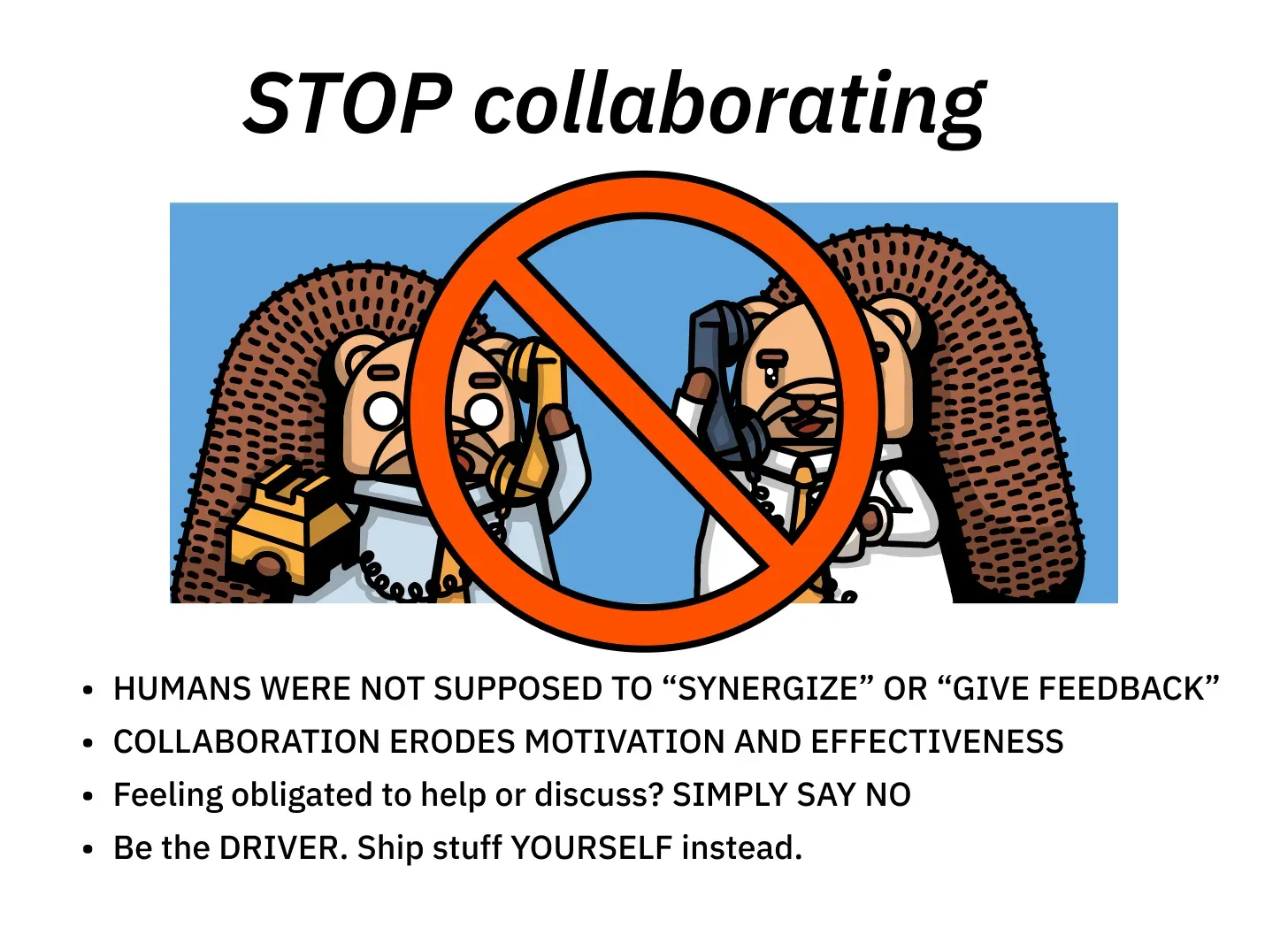
collaboration sucks

Well, the relationship between product managers and product marketers is one of those necessary situations when you need to collaborate to successfully launch and grow your products. I wanted to share some ways I've learned to do this at PostHog.

At the beginning of this quarter, I started to support the Error Tracking team. None of the team members, including the product manager, Cory, had ever worked with a product marketer before.

I decided I had to make myself visible and prove I could be valuable. So, I made first contact by scheduling a call with Cory, rather than waiting for them to come to me.

Here's what we talked about:

  • What is the current revenue of the product, and what is the revenue goal (for the quarter, year, etc.)?
  • What is a bigger gap - activation or retention?
  • Do you know if there were any previous marketing efforts around this product?
  • Where do most users come from?
  • Do you see any obvious marketing opportunities that I should focus on first?

I also asked for a customer interview bank, any competitive research they might have, or any other resources that could be helpful for this particular product.

Since async is the default way of working in PostHog, I was very careful with scheduling meetings at first. However, the team got very excited when I announced that I would be supporting their product, and were very eager to meet and give me as much information as they could.

collaborating with PMs

At PostHog, every team has a dedicated Slack channel, and this is the most important place I check every day. I'm looking for feature updates, messages from the sales people, customer feedback; literally anything that could give me ideas for the next product digest or inspire me to change something in the comms.

The product managers and the engineers might not always know which feature is marketable. I can ask the team for updates but they might not remember to always give me the features I can actually talk about. Sometimes, I see potential where they don't. I'm the one following the Slack threads and picking what to add to the comms.

For example, this month, I started doing a monthly product digest for each of my products, where I list things the team has been working on. I had been collecting updates from the team channel for a while, and when I had enough, I started a thread with the Error Tracking team to make sure I wasn't missing anything.
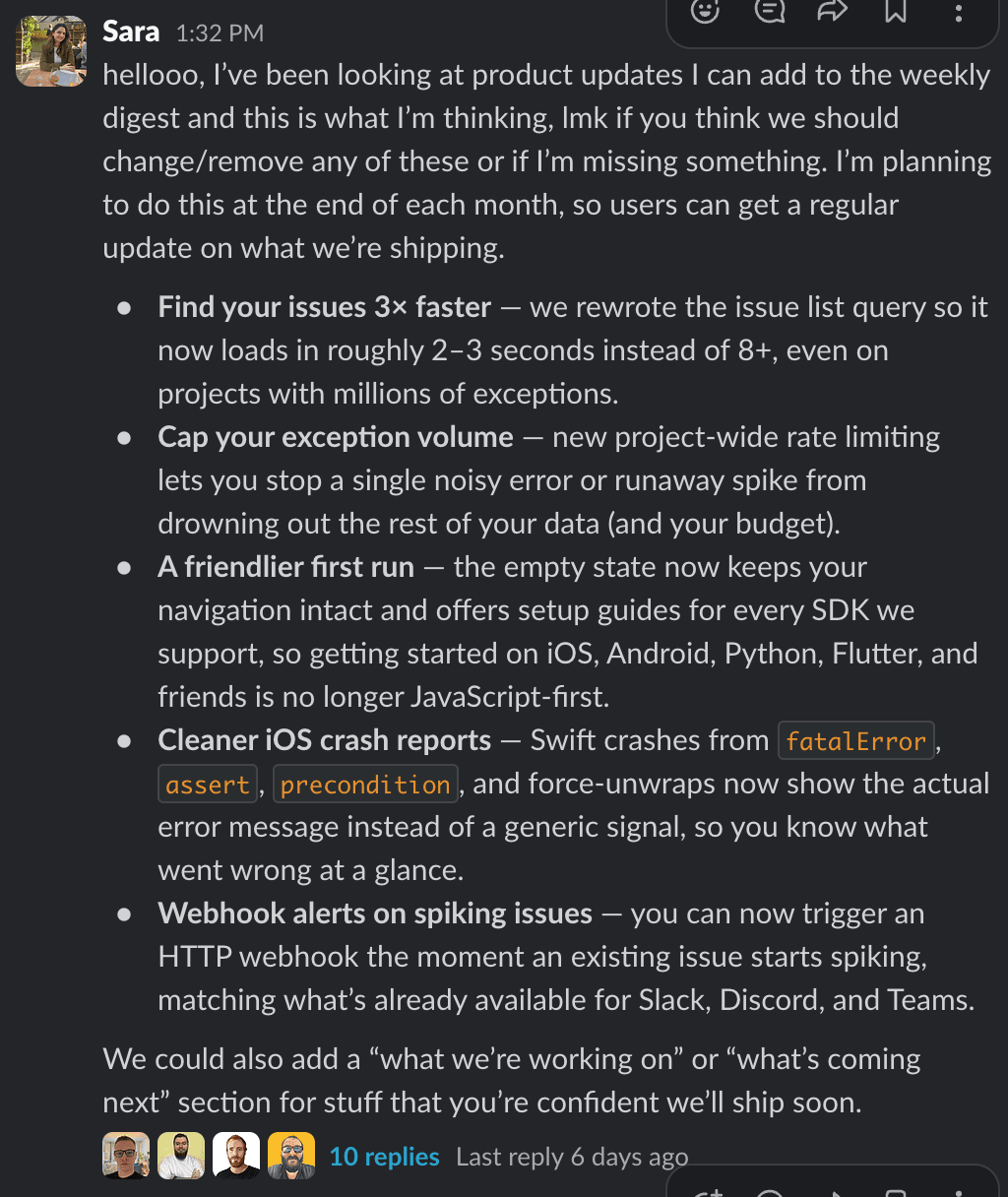
error tracking weekly digest thread

I try to jump in wherever I think there's an opportunity, and the team almost always gets excited that I want to show users what they've been working on.

PostHog is fully remote, so you usually only meet teammates a couple of times a year. This year we went to Barbados, and I booked some dedicated time with both of my product managers to do a growth review and discuss the parts of the product we want to focus on next. The meetings included:

  • Any feedback we have for each other, if we're happy with the collab, and if there's anything we want to change moving forward
  • Looking at the product metrics from the past few months
  • Figuring out whether we want to focus on acquisition, activation, retention, etc.
  • Big launches coming in the next few months and how we want to approach them

In addition to the in-person gatherings, I tend to join my teams' sprint planning meetings. Sometimes, they can be too technical for me, but I still want to show up and be present. I think that the team should see that I'm interested in what they're working on.

Also, this is the place where I can ask questions about the product, what they're working on, get more technical details, etc. The engineers treat me like an equal and don't roll their eyes when I ask a stupid question (yes, yes, I know there are no stupid questions, but I've experienced many different reactions in the past), which I really appreciate. They are very invested in explaining technical concepts in simple words to me, because if I understand it and present it well to the user, we all win. Sometimes, I also use these meetings to give them a short overview of the marketing efforts we are doing around their product.

At PostHog, most of us create an individual quarterly planning issue. I regularly send this issue to my PMs to get their thoughts on the things I'm planning to do in the upcoming quarter, related to their product. This is a great way to see if I'm focusing on the right things and if I'm missing anything.

Also, I regularly send them my campaign plans, creative directions, blogs, etc. The core assets are non-negotiable: the PM should always take a look at the product page, launch email, and launch blog.

For example, before I sent a product digest for the Logs users a few weeks I go, I sent the email preview to Abe, the Logs product manager. This is the feedback he had for me:
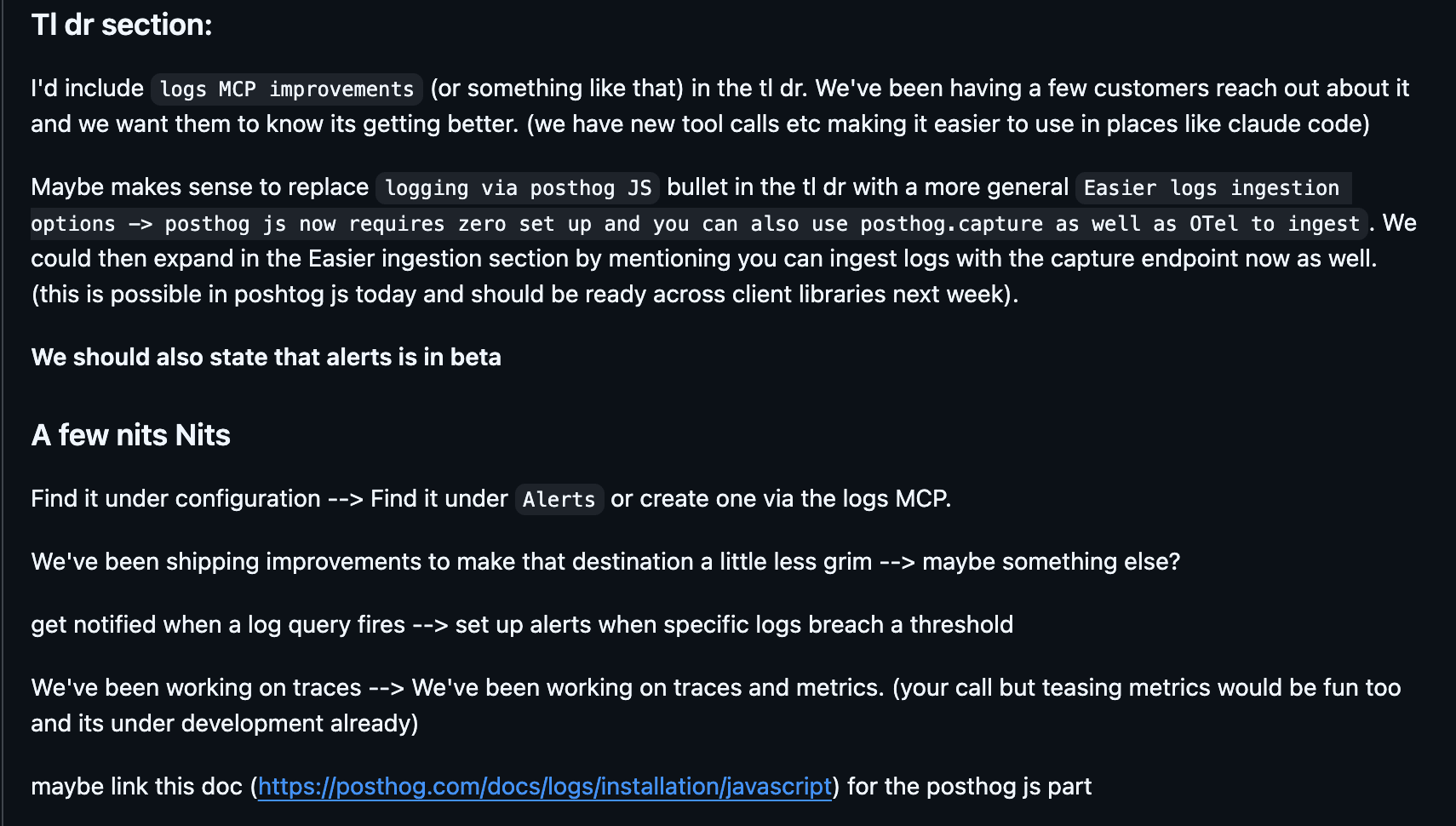
abe logs email feedback

You can also look at the full issue here.

Recently, we started doing monthly 1:1 meetings with product managers where we go through the product growth for the last month and try to identify the biggest gaps. Product managers typically do the review on their own in post it in their team channel. Then, I meet them to discuss the numbers and see what to do next. Some things we cover during these meetings:

  • How's the product doing?
  • Where are users coming from?
  • Should we pull in the demand gen people and run more ads? Is this product even a good candidate for ads?
  • Are users dropping of? If yes, where? What should we do?

For example, the growth review for Logs, one of the products I'm working on, showed that a lot of users were interested to get started, but the retention was lower than expected. There were a lot of feature requests, and users didn't know what the team was working on. That's when I decided to start with the product digest and tell users what's new and what's coming in the product they're using. Yes, we have a platform-wide changelog digest, but that one only includes the bigger launches, and sometimes small fixes make a big difference for users.

There’s a lot you can automate with AI. Claude has become my go-to spot when I need to know the status of a certain product development, thanks to the Slack MCP. I ask it about feature status, team updates, etc. I do still go to Slack channels, but it’s much easier for me to surface all the context via a prompt. Here are some prompts I’ve used recently:
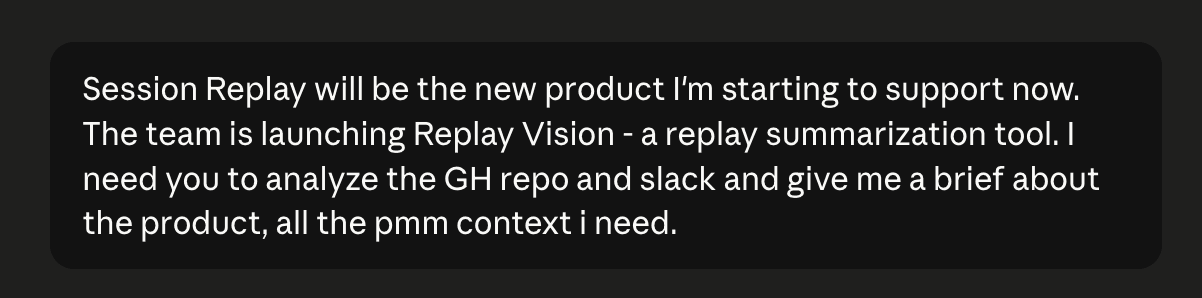

claude prompt 1

claude prompt 2

Also, scheduled tasks are pretty good for product updates. My most useful scheduled task is my Weekly product digest, where Claude collects everything that happened in the past week in the channels and GitHub PRs related to the products I work on. Here's a prompt you can use to schedule it yourself with Cowork:

This scheduled task can help you stay on top of everything that's going on with your product, without having to scroll through endless Slack messages or analyze PRs.

I hope these tips help you, fellow PMM. Don't forget, we're in this together. Whatever you're struggling with, there are at least 100 PMMs out there who have the same problem. Happy collaborating!