惯性聚合 高效追踪和阅读你感兴趣的博客、新闻、科技资讯
阅读原文 在惯性聚合中打开

推荐订阅源

Know Your Adversary
Know Your Adversary
D
Docker
奇客Solidot–传递最新科技情报
奇客Solidot–传递最新科技情报
人人都是产品经理
人人都是产品经理
V
V2EX
V
Visual Studio Blog
J
Java Code Geeks
博客园 - 【当耐特】
罗磊的独立博客
量子位
W
WeLiveSecurity
博客园 - 聂微东
Hugging Face - Blog
Hugging Face - Blog
The Cloudflare Blog
O
OpenAI News
PCI Perspectives
PCI Perspectives
The Last Watchdog
The Last Watchdog
S
Schneier on Security
博客园 - Franky
WordPress大学
WordPress大学
T
Tor Project blog
freeCodeCamp Programming Tutorials: Python, JavaScript, Git & More
cs.AI updates on arXiv.org
D
Darknet – Hacking Tools, Hacker News & Cyber Security
Recent Commits to openclaw:main
Security Latest
Security Latest
Cisco Talos Blog
Cisco Talos Blog
腾讯CDC
美团技术团队
博客园 - 叶小钗
www.infosecurity-magazine.com
月光博客
月光博客
S
Secure Thoughts
Engineering at Meta
Engineering at Meta
T
Tailwind CSS Blog
TaoSecurity Blog
TaoSecurity Blog
Google DeepMind News
CTFtime.org: upcoming CTF events
Last Week in AI
Last Week in AI
aimingoo的专栏
aimingoo的专栏
G
Google Developers Blog
D
DataBreaches.Net
Project Zero
Project Zero
S
SegmentFault 最新的问题
C
Cisco Blogs
H
Help Net Security
Google Online Security Blog
A
About on SuperTechFans
F
Fortinet All Blogs
博客园 - 司徒正美

PostHog's RSS Feed

Training our own AI models - PostHog From 270GB RAM to 5GB: Moving local flag evaluation from Django to Rust The best analytics stack for vibe-coded apps The do's and don'ts of minimum viable product marketing - PostHog The best MCP servers for startups, by workflow 4,063 errors closed without a human opening PostHog – here's what we learned - PostHog PostHog Code and the self-driving product - PostHog Why attacking your competitors online is dumb - PostHog The best real-time analytics platforms for developers, compared DuckDB vs ClickHouse: Why we use both at PostHog - PostHog PostHog's next chapter - PostHog Making Claude Cowork actually useful - PostHog PostHog vs Matomo in-depth tool comparison You're doing lifecycle emails wrong Untangling Tokio and Rayon in production: From 2s latency spikes to 94ms flat The best HIPAA-compliant A/B testing tools - PostHog A beginner's guide to testing AI agents - PostHog I hate the standup bot (so I built an agent to do it for me) - PostHog The best CDPs for developers, compared The best error tracking tools for developers, compared The best feature flag software for developers, compared 7 best session replay tools for mobile apps 7 best free open source business intelligence tools right now 7 best free and open source LLM observability tools PostHog vs LogRocket in-depth tool comparison The most popular PostHog alternatives, compared Open source (and self-hosted) session replay tools - PostHog The 9 best GA4 alternatives for apps and websites - PostHog PostHog vs Google Analytics 4 in-depth tool comparison How we built automatic clustering for LLM traces - PostHog The 7 best HIPAA-compliant analytics tools 8 best open source analytics tools you can self-host - PostHog The best product analytics tools for startups, compared PostHog vs FullStory in-depth tool comparison The best in-app survey tools for product teams, compared The 7 best mobile app analytics tools PostHog vs Hotjar in-depth tool comparison The 8 best free and open-source feature flag services - PostHog The 5 best free and open-source A/B testing tools - PostHog The best mobile app A/B testing tools, compared What is a feature flag? Feature Flags vs Remote Config vs A/B Testing PostHog is now available in Vercel’s v0 The best Heap alternatives & competitors, compared PostHog vs Heap in-depth tool comparison PostHog vs Pendo in-depth tool comparison PostHog × Vercel: feature flags, minus the plumbing Your logs' final destination is in GA. You always end up here anyway Behind the scenes of a PostHog hackathon - PostHog The most popular Mixpanel alternatives & competitors, compared PostHog vs Mixpanel in-depth tool comparison The 9 best GDPR-compliant analytics tools How we use Logs at PostHog The best web analytics tools for developers, compared Stop AI slop: Run evals with LLM-as-a-Judge - PostHog You product data just got a job: Workflows is now out App onboarding: How to fix drop-off points Meet Logs (beta) – logs with all the tools you’re already using Why small teams crush tiger teams How we built user behavior analysis with multi-modal LLMs (in 5 not-so-easy steps) - PostHog The best Contentsquare alternatives & competitors, compared 8 learnings from 1 year of agents – PostHog AI - PostHog Why we killed our AI product assistant Workflows graduate to beta! Product data, meet automation The best Rollbar alternatives & competitors, compared Workflows are now in Alpha and I already broke mine - PostHog I've consistently underestimated how important communication is as a CEO - PostHog How we made feature flags even faster and more reliable The best session replay tools for developers, compared What I learned attending my first ever hackathon - PostHog Did you know AI is answering our community questions? - PostHog How not to be boring - PostHog We built an internal tool to generate changelog images for social media - PostHog What we built at our windswept Mykonos hackathon - PostHog How we built our onboarding email flow (with actual performance data) - PostHog We're building a better PostHog community by closing our public Slack - PostHog Introducing Notebooks for PostHog - PostHog Why we've launched PostHog user surveys - PostHog How we made feature flags faster and more reliable - PostHog In-depth: ClickHouse vs Redshift - PostHog Introducing HouseWatch: An open-source toolkit for ClickHouse - PostHog Introducing HogQL: Direct SQL access for PostHog - PostHog What we built at our sun-kissed Aruba hackathon - PostHog In-depth: ClickHouse vs BigQuery - PostHog In-depth: ClickHouse vs Elasticsearch - PostHog HogMail #22: Why do companies over-hire?" - PostHog Our simpler goal: Help engineers to be better at product - PostHog In-depth: ClickHouse vs Snowflake - PostHog HogMail #21: Avoiding the "Product Death Cycle" - PostHog Sunsetting Kubernetes support for PostHog - PostHog Why 'Product Engineer' is the most fun role I've had in tech - PostHog HogMail #20: Why do startups fail? - PostHog The best Google Optimize alternatives for apps and websites - PostHog Array 1.43.0: Massive performance improvements! - PostHog In-depth: ClickHouse vs Druid - PostHog HogMail #19: Which meetings should you kill? - PostHog CEO diary: The things I learned in 2022 - PostHog The essential tools used by product engineers - PostHog HogMail #18: What can SaaS learn from the New York Times? - PostHog What is a product engineer? - Product Engineer Handbook - PostHog Array 1.42.0: Get beta features via our roadmap! - PostHog
How (and why) to track your website with PostHog - PostHog
Joe Martin · 2022-10-10 · via PostHog's RSS Feed

PostHog may have been built for product analytics, but that doesn’t mean you can only deploy it on your core product — you can also use it to gather analytics from your marketing website too. Internally at PostHog this is exactly what we do, tracking analytics from both the product and this very website within a single project.

Using PostHog to gather analytics in this way isn’t just an excuse for us to ‘dogfood’ our own product. It’s also a best practice that we strongly recommend to other organizations for several reasons...

Want to track your website with PostHog? Check out our web analytics tool, or get started straight away by integrating PostHog immediately!

1. Get better data

Web analytics tools, such as Google Analytics, are all well and good — but if your tracking stops as soon as a user logs in to your platform then can you really track their entire user journey?

Deploying PostHog across both your website and product enables you not only to track their entire journey, but also to unlock important insights into how your marketing site is performing. You can compare pageviews to purchases, for example, to understand your conversion rate with a funnel insight — and you can use a path insight to visualize that journey completely.

Ultimately, PostHog can do almost everything that Google Analytics can do and more. And, speaking of Google Analytics…

2. Simplify your stack (and get rid of Google Analytics)

Reducing your stack can have a few overlooked benefits, including greater data consistency. No two analytics tools are the same and each can be impacted by adblockers differently – so if you’re using Google Analytics on your website and PostHog on your product then it can be tough to get comparable results.

Even if data consistency isn’t a concern, there are still plenty of reasons to consider moving away from Google Analytics. Recent GDPR rulings within the EU have bought the legality of Google Analytics into question, for example, and prompted many organizations to look for a self-hosted alternative.

Worried about GDPR but don’t want to self-host? We recently, we offer PostHog Cloud EU where all your data (and the product itself) is hosted in the EU, making it the perfect alternative to GA4.

Need analytics hosted in the EU?
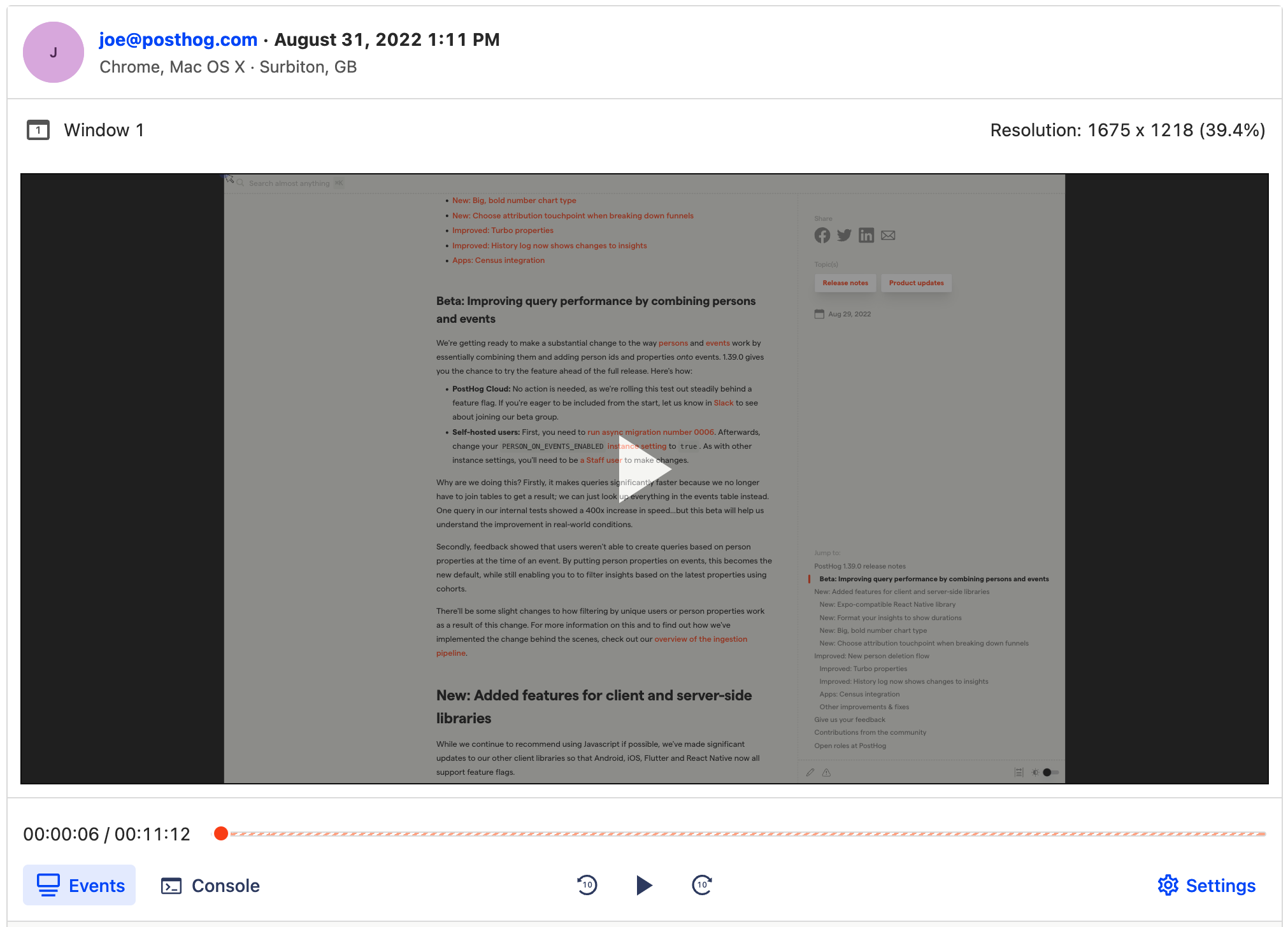

3. Session recording and more!

session recording on posthog

We’ve built PostHog to be an all-in-one developer platform that, unlike tools such as Amplitude or Mixpanel, doesn’t force you to use other tools to plug feature gaps. Using PostHog across your marketing site therefore enables you to benefit from these tools, including session recording, heatmaps and apps.

Session recording in particular is useful on a marketing website, as it lets you filter by events to find actual recordings of users who complete certain actions. Want to literally watch how a successful lead differs from an unsuccessful one, or how users navigate your documentation? Now you can.

Apps too are an important part of the PostHog-for-websites toolkit, enabling you to shape, filter and enhance user data as it is ingested before exporting to other platforms. Marketing teams in particular can benefit from the ability to sync PostHog with other tools in their marketing stack!

How to track website traffic with PostHog

If you’re on board and want to move ahead with tracking your marketing site with PostHog, it couldn’t be easier. All you need to do is copy the snippet below (which is also available in the ‘Project settings’ of your PostHog instance) into your website’s HTML. Ideally, put it just above the </head> tag to get the best results.

It’s worth noting that you’ll need to add this snippet to all pages you want to track, and that the snippet above uses Javascript. Don’t want to use Javascript? There are plenty of other options!

Subscribe to our newsletter

Product for Engineers

Read by 100,000+ founders and builders

We'll share your email with Substack