


惯性聚合 高效追踪和阅读你感兴趣的博客、新闻、科技资讯
阅读原文 在惯性聚合中打开

推荐订阅源

C
Check Point Blog
H
Help Net Security
B
Blog RSS Feed
Microsoft Security Blog
阮一峰的网络日志
阮一峰的网络日志
Engineering at Meta
Engineering at Meta
The Register - Security
U
Unit 42
Hugging Face - Blog
Hugging Face - Blog
雷峰网
雷峰网
酷 壳 – CoolShell
酷 壳 – CoolShell
IT之家
IT之家
云风的 BLOG
云风的 BLOG
腾讯CDC
钛媒体:引领未来商业与生活新知
钛媒体:引领未来商业与生活新知
D
Docker
T
The Blog of Author Tim Ferriss
Recorded Future
Recorded Future
月光博客
月光博客
H
Hackread – Cybersecurity News, Data Breaches, AI and More
罗磊的独立博客
G
Google Developers Blog
Jina AI
Jina AI
P
Proofpoint News Feed
J
Java Code Geeks
I
InfoQ
博客园 - 司徒正美
D
DataBreaches.Net
博客园 - 叶小钗
F
Fortinet All Blogs
The GitHub Blog
The GitHub Blog
Google DeepMind News
L
LangChain Blog
博客园_首页
Cyber Security Advisories - MS-ISAC
S
SegmentFault 最新的问题
Apple Machine Learning Research
博客园 - Franky
人人都是产品经理
人人都是产品经理
V
V2EX
F
Full Disclosure
A
About on SuperTechFans
Stack Overflow Blog
Stack Overflow Blog
Martin Fowler
Martin Fowler
MongoDB | Blog
MongoDB | Blog
让小产品的独立变现更简单 - ezindie.com
freeCodeCamp Programming Tutorials: Python, JavaScript, Git & More
奇客Solidot–传递最新科技情报
奇客Solidot–传递最新科技情报
美团技术团队
V
Visual Studio Blog

PostHog's RSS Feed

Training our own AI models - PostHog From 270GB RAM to 5GB: Moving local flag evaluation from Django to Rust The best analytics stack for vibe-coded apps The do's and don'ts of minimum viable product marketing - PostHog The best MCP servers for startups, by workflow 4,063 errors closed without a human opening PostHog – here's what we learned - PostHog Why attacking your competitors online is dumb - PostHog The best real-time analytics platforms for developers, compared DuckDB vs ClickHouse: Why we use both at PostHog - PostHog PostHog's next chapter - PostHog Making Claude Cowork actually useful - PostHog PostHog vs Matomo in-depth tool comparison You're doing lifecycle emails wrong Untangling Tokio and Rayon in production: From 2s latency spikes to 94ms flat The best HIPAA-compliant A/B testing tools - PostHog A beginner's guide to testing AI agents - PostHog I hate the standup bot (so I built an agent to do it for me) - PostHog The best CDPs for developers, compared The best error tracking tools for developers, compared The best feature flag software for developers, compared 7 best session replay tools for mobile apps 7 best free open source business intelligence tools right now 7 best free and open source LLM observability tools PostHog vs LogRocket in-depth tool comparison The most popular PostHog alternatives, compared Open source (and self-hosted) session replay tools - PostHog The 9 best GA4 alternatives for apps and websites - PostHog PostHog vs Google Analytics 4 in-depth tool comparison How we built automatic clustering for LLM traces - PostHog The 7 best HIPAA-compliant analytics tools 8 best open source analytics tools you can self-host - PostHog The best product analytics tools for startups, compared PostHog vs FullStory in-depth tool comparison The best in-app survey tools for product teams, compared The 7 best mobile app analytics tools PostHog vs Hotjar in-depth tool comparison The 8 best free and open-source feature flag services - PostHog The 5 best free and open-source A/B testing tools - PostHog The best mobile app A/B testing tools, compared What is a feature flag? Feature Flags vs Remote Config vs A/B Testing PostHog is now available in Vercel’s v0 The best Heap alternatives & competitors, compared PostHog vs Heap in-depth tool comparison PostHog vs Pendo in-depth tool comparison PostHog × Vercel: feature flags, minus the plumbing Your logs' final destination is in GA. You always end up here anyway Behind the scenes of a PostHog hackathon - PostHog The most popular Mixpanel alternatives & competitors, compared PostHog vs Mixpanel in-depth tool comparison The 9 best GDPR-compliant analytics tools How we use Logs at PostHog The best web analytics tools for developers, compared Stop AI slop: Run evals with LLM-as-a-Judge - PostHog You product data just got a job: Workflows is now out App onboarding: How to fix drop-off points Meet Logs (beta) – logs with all the tools you’re already using Why small teams crush tiger teams How we built user behavior analysis with multi-modal LLMs (in 5 not-so-easy steps) - PostHog The best Contentsquare alternatives & competitors, compared 8 learnings from 1 year of agents – PostHog AI - PostHog Why we killed our AI product assistant Workflows graduate to beta! Product data, meet automation The best Rollbar alternatives & competitors, compared Workflows are now in Alpha and I already broke mine - PostHog I've consistently underestimated how important communication is as a CEO - PostHog How we made feature flags even faster and more reliable The best session replay tools for developers, compared What I learned attending my first ever hackathon - PostHog Did you know AI is answering our community questions? - PostHog How not to be boring - PostHog We built an internal tool to generate changelog images for social media - PostHog What we built at our windswept Mykonos hackathon - PostHog How we built our onboarding email flow (with actual performance data) - PostHog We're building a better PostHog community by closing our public Slack - PostHog Introducing Notebooks for PostHog - PostHog Why we've launched PostHog user surveys - PostHog How we made feature flags faster and more reliable - PostHog In-depth: ClickHouse vs Redshift - PostHog Introducing HouseWatch: An open-source toolkit for ClickHouse - PostHog Introducing HogQL: Direct SQL access for PostHog - PostHog What we built at our sun-kissed Aruba hackathon - PostHog In-depth: ClickHouse vs BigQuery - PostHog In-depth: ClickHouse vs Elasticsearch - PostHog HogMail #22: Why do companies over-hire?" - PostHog Our simpler goal: Help engineers to be better at product - PostHog In-depth: ClickHouse vs Snowflake - PostHog HogMail #21: Avoiding the "Product Death Cycle" - PostHog Sunsetting Kubernetes support for PostHog - PostHog Why 'Product Engineer' is the most fun role I've had in tech - PostHog HogMail #20: Why do startups fail? - PostHog The best Google Optimize alternatives for apps and websites - PostHog Array 1.43.0: Massive performance improvements! - PostHog In-depth: ClickHouse vs Druid - PostHog HogMail #19: Which meetings should you kill? - PostHog CEO diary: The things I learned in 2022 - PostHog The essential tools used by product engineers - PostHog HogMail #18: What can SaaS learn from the New York Times? - PostHog What is a product engineer? - Product Engineer Handbook - PostHog Array 1.42.0: Get beta features via our roadmap! - PostHog HogMail #17: The personal traits that can't be taught - PostHog
PostHog Code and the self-driving product - PostHog
Cleo Lant · 2026-05-05 · via PostHog's RSS Feed

Today, PostHog Code enters beta.

It's a desktop app that runs coding agents on top of your product data. The obvious stuff ships itself. The tricky stuff shows up as a prioritized to-do list for you to steer.

We built it to chase one idea: self-driving product development.

A self-driving product can prompt itself.

It understands your codebase, your data, and your users. It proposes and ships work on its own, inside of guardrails you set.

The self in self-driving isn't autonomy from the engineer. It's autonomy from user instruction as the starting point.

Complexity pyramid

A self-driving product puts the 1% gains on cruise control: the bugs, UX issues, paper cuts, and conversion tweaks. The things that drain engineering hours, but rarely need strategic input.

This is where product data does the heavy lifting. In a typical week, PostHog customers generate 100,000+ failed queries and ~1.5 million new error tracking issues. Each one is a signal an agent could act on.

Acting on signals takes more than writing code. Claude Code, Codex, and others already do that part well. To make them self-driving, we add 5 things on top: tools, skills, signals, memory, and evaluation.

Our AI engineering handbook goes deep on each. Here's the short version.

1. Tools – what the agent can do

Tools are small, specific actions the agent can take. At PostHog we treat them as atomic capabilities – things like create_insight or read_taxonomy. The latter does a lot of heavy lifting. It lets the agent check what events and properties actually exist before it writes a query or an instrumentation PR.

2. Skills – how to get the job done

If tools are the fork and knife, skills are the recipe. A skill ties tools, docs, and rules into a playbook. You can see the gap in our own data: docs-search is the most-called tool on PostHog's MCP server, at ~28K calls a month.

PostHog Code has skills for the workflows we see most – instrumenting events, auditing flags, adding error tracking. Writing a skill feels like writing a doc, and most engineers would rather ship the feature than document it. But for an agent, the skill is the feature.

3. Signals – when the work should happen

Tools and skills cover the what. Signals cover the when. PostHog Code sits on top of your product data, so the pattern itself is the prompt. Raw observations get grouped, enriched, and turned into concrete plans. You open a pre-framed to-do list instead of triaging a noisy inbox.

4. Memory – what the agent already knows

Signals say something's happening now. Memory says what happened last time. Without it, the agent re-runs work it's already done and re-opens the same PR every Tuesday.

5. Evaluation – did it actually work?

The loop doesn't close without this. Testing AI agents looks nothing like testing normal software, and "it runs without erroring" is not a pass.

PostHog Code schedules evals as long-running Temporal jobs, so the check runs hours or days after the PR merges. The same dashboard, funnel, experiment, or LLM-as-a-judge eval that fired the signal gets re-queried.

If the metric didn't move – or moved the wrong way – the agent reverts or reopens the work.

Stitch all that together, and you get a loop we like to call product autonomy: Collect data → cluster signals → check memory → notify workers → do work → review and ship → evaluate → write back to memory.

Loop diagram

You can't run this reliably inside a general-purpose coding agent because the critical signals live somewhere else. For a lot of companies, that somewhere else is PostHog.

How this works in PostHog Code:

Errors, replays, and external signals flow into the signals pipeline and are clustered into signal reports.

Each task that lands in your inbox is ranked by urgency, and links to relevant context and research done by background agents.

Signals

You pick the tasks worth working on, and the model and harness that fit each one.

The split-screen Command Center handles up to nine agents in parallel – our engineers call it dopamine mode (you'll understand why).

Long jobs run in the cloud, so your laptop stays free.
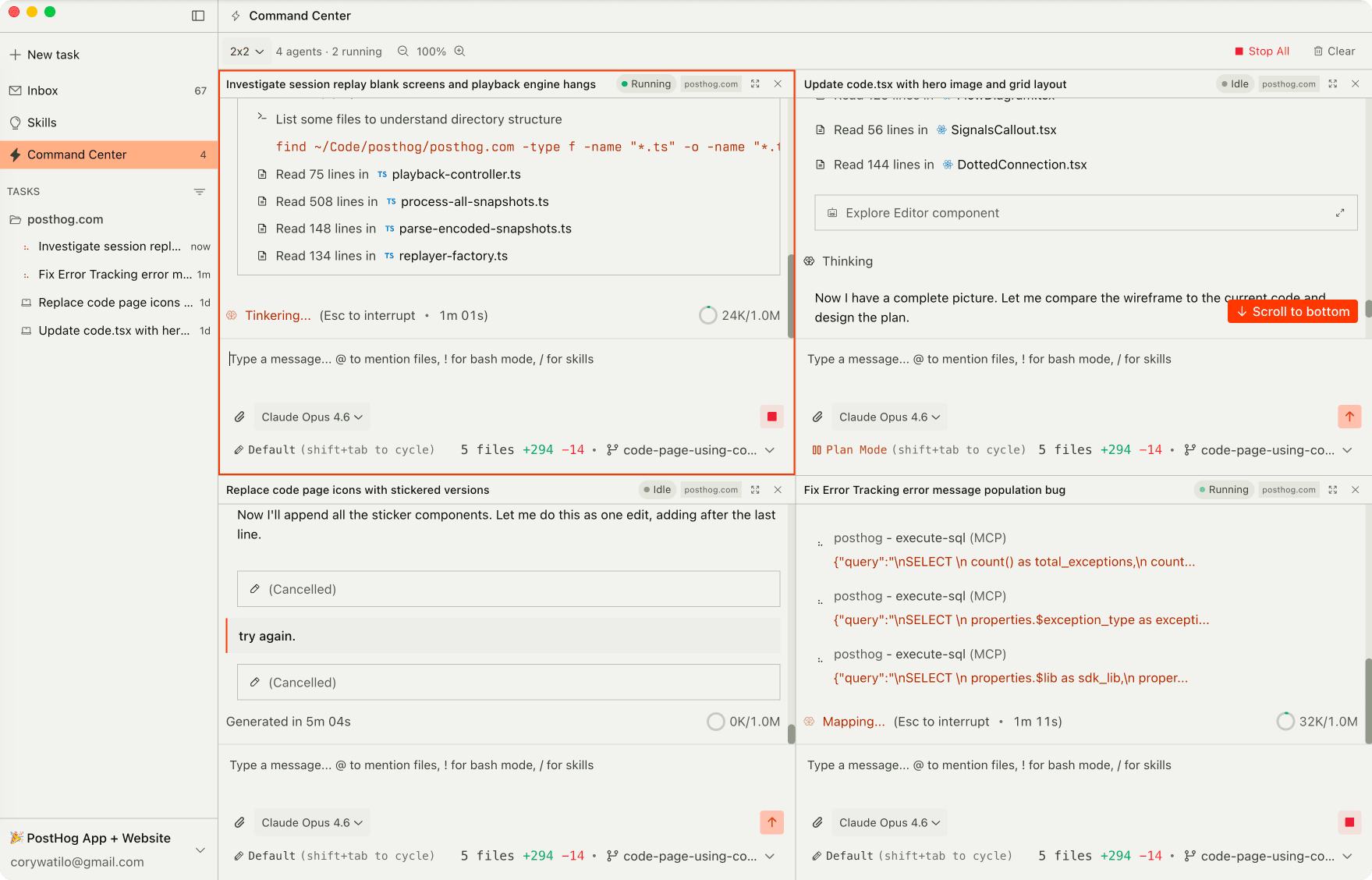
Command Center

The PostHog side is wired in by default. One-click instrumentation drops events, flags, and experiments into your code without you typing the boilerplate.

The PostHog MCP handles impact measurement, error debugging, and dashboard building.

Plug in other MCP servers to take more actions, or pull in extra context as you build.

With the routine work automated, you get more room for the big stuff. Prompt your own tasks, build with full product-data context, and keep shipping new features alongside the self-driving work.

Try PostHog Code

Product engineers keep telling us this is the missing piece – an agent that understands your codebase and your product.

We're not fully self-driving yet, but we're getting closer every week, and you get to watch it happen from the driver's seat.

Want to take it for a test drive?

PostHog Code is in Beta. Join the waitlist to get early access.