
惯性聚合 高效追踪和阅读你感兴趣的博客、新闻、科技资讯
阅读原文 在惯性聚合中打开

推荐订阅源

Project Zero
Project Zero
Security Archives - TechRepublic
C
Cyber Attacks, Cyber Crime and Cyber Security
Security Latest
Security Latest
Scott Helme
Scott Helme
Threat Intelligence Blog | Flashpoint
V
Vulnerabilities – Threatpost
C
CERT Recently Published Vulnerability Notes
S
Schneier on Security
G
GRAHAM CLULEY
L
Lohrmann on Cybersecurity
D
Darknet – Hacking Tools, Hacker News & Cyber Security
I
Intezer
cs.CL updates on arXiv.org
F
Full Disclosure
T
The Exploit Database - CXSecurity.com
P
Proofpoint News Feed
WordPress大学
WordPress大学
Microsoft Azure Blog
H
Help Net Security
大猫的无限游戏
大猫的无限游戏
MyScale Blog
MyScale Blog
Hacker News: Ask HN
Hacker News: Ask HN
G
Google Developers Blog
H
Heimdal Security Blog
O
OpenAI News
Hugging Face - Blog
Hugging Face - Blog
cs.AI updates on arXiv.org
L
LangChain Blog
C
Cisco Blogs
云风的 BLOG
云风的 BLOG
IT之家
IT之家
Cyberwarzone
Cyberwarzone
cs.CV updates on arXiv.org
Know Your Adversary
Know Your Adversary
博客园 - 聂微东
The Cloudflare Blog
C
Check Point Blog
K
Kaspersky official blog
C
CXSECURITY Database RSS Feed - CXSecurity.com
月光博客
月光博客
T
Tor Project blog
T
Threat Research - Cisco Blogs
T
Tailwind CSS Blog
P
Proofpoint News Feed
K
KPMG report finds enterprise disconnect between AI and its ROI | CIO
A
About on SuperTechFans
小众软件
小众软件
Cloudbric
Cloudbric
A
Arctic Wolf

PostHog's RSS Feed

Training our own AI models - PostHog From 270GB RAM to 5GB: Moving local flag evaluation from Django to Rust The best analytics stack for vibe-coded apps The do's and don'ts of minimum viable product marketing - PostHog The best MCP servers for startups, by workflow 4,063 errors closed without a human opening PostHog – here's what we learned - PostHog PostHog Code and the self-driving product - PostHog Why attacking your competitors online is dumb - PostHog The best real-time analytics platforms for developers, compared DuckDB vs ClickHouse: Why we use both at PostHog - PostHog PostHog's next chapter - PostHog Making Claude Cowork actually useful - PostHog PostHog vs Matomo in-depth tool comparison You're doing lifecycle emails wrong Untangling Tokio and Rayon in production: From 2s latency spikes to 94ms flat The best HIPAA-compliant A/B testing tools - PostHog A beginner's guide to testing AI agents - PostHog I hate the standup bot (so I built an agent to do it for me) - PostHog The best CDPs for developers, compared The best error tracking tools for developers, compared The best feature flag software for developers, compared 7 best session replay tools for mobile apps 7 best free open source business intelligence tools right now 7 best free and open source LLM observability tools PostHog vs LogRocket in-depth tool comparison The most popular PostHog alternatives, compared Open source (and self-hosted) session replay tools - PostHog The 9 best GA4 alternatives for apps and websites - PostHog PostHog vs Google Analytics 4 in-depth tool comparison How we built automatic clustering for LLM traces - PostHog The 7 best HIPAA-compliant analytics tools 8 best open source analytics tools you can self-host - PostHog The best product analytics tools for startups, compared PostHog vs FullStory in-depth tool comparison The best in-app survey tools for product teams, compared The 7 best mobile app analytics tools PostHog vs Hotjar in-depth tool comparison The 8 best free and open-source feature flag services - PostHog The 5 best free and open-source A/B testing tools - PostHog The best mobile app A/B testing tools, compared What is a feature flag? Feature Flags vs Remote Config vs A/B Testing PostHog is now available in Vercel’s v0 The best Heap alternatives & competitors, compared PostHog vs Heap in-depth tool comparison PostHog vs Pendo in-depth tool comparison PostHog × Vercel: feature flags, minus the plumbing Your logs' final destination is in GA. You always end up here anyway Behind the scenes of a PostHog hackathon - PostHog The most popular Mixpanel alternatives & competitors, compared PostHog vs Mixpanel in-depth tool comparison The 9 best GDPR-compliant analytics tools How we use Logs at PostHog The best web analytics tools for developers, compared Stop AI slop: Run evals with LLM-as-a-Judge - PostHog You product data just got a job: Workflows is now out App onboarding: How to fix drop-off points Meet Logs (beta) – logs with all the tools you’re already using Why small teams crush tiger teams How we built user behavior analysis with multi-modal LLMs (in 5 not-so-easy steps) - PostHog The best Contentsquare alternatives & competitors, compared 8 learnings from 1 year of agents – PostHog AI - PostHog Why we killed our AI product assistant Workflows graduate to beta! Product data, meet automation The best Rollbar alternatives & competitors, compared Workflows are now in Alpha and I already broke mine - PostHog I've consistently underestimated how important communication is as a CEO - PostHog How we made feature flags even faster and more reliable The best session replay tools for developers, compared What I learned attending my first ever hackathon - PostHog Did you know AI is answering our community questions? - PostHog How not to be boring - PostHog We built an internal tool to generate changelog images for social media - PostHog What we built at our windswept Mykonos hackathon - PostHog How we built our onboarding email flow (with actual performance data) - PostHog We're building a better PostHog community by closing our public Slack - PostHog Introducing Notebooks for PostHog - PostHog Why we've launched PostHog user surveys - PostHog How we made feature flags faster and more reliable - PostHog In-depth: ClickHouse vs Redshift - PostHog Introducing HouseWatch: An open-source toolkit for ClickHouse - PostHog Introducing HogQL: Direct SQL access for PostHog - PostHog What we built at our sun-kissed Aruba hackathon - PostHog In-depth: ClickHouse vs BigQuery - PostHog In-depth: ClickHouse vs Elasticsearch - PostHog HogMail #22: Why do companies over-hire?" - PostHog Our simpler goal: Help engineers to be better at product - PostHog In-depth: ClickHouse vs Snowflake - PostHog HogMail #21: Avoiding the "Product Death Cycle" - PostHog Sunsetting Kubernetes support for PostHog - PostHog Why 'Product Engineer' is the most fun role I've had in tech - PostHog HogMail #20: Why do startups fail? - PostHog The best Google Optimize alternatives for apps and websites - PostHog Array 1.43.0: Massive performance improvements! - PostHog In-depth: ClickHouse vs Druid - PostHog HogMail #19: Which meetings should you kill? - PostHog CEO diary: The things I learned in 2022 - PostHog The essential tools used by product engineers - PostHog HogMail #18: What can SaaS learn from the New York Times? - PostHog What is a product engineer? - Product Engineer Handbook - PostHog Array 1.42.0: Get beta features via our roadmap! - PostHog
Introducing Collaboration for PostHog - PostHog
Paolo D'Amic · 2022-03-24 · via PostHog's RSS Feed

PostHog is better with teammates. You only have to create a dashboard once, but it becomes more valuable every time you invite someone from your organization to view it. And this isn't just some vague truism: it's a measurable fact.

Our data shows organizations with multiple teammates retain 30%+ better than those with a single user. Better collaboration also powers our main Product metric: insight discoveries. Our conservative estimates suggest we could increase discoveries by 20% by improving collaboration workflows 1, so that's what we've done.

Over the past few months, we've worked hard to make collaboration in PostHog as easy as possible, particularly for larger teams. That work will never end, but we want to show you what we have today and share our roadmap for the future.

The most basic collaborative action for an analytics product is sharing insights. This is critical because, in larger teams, there are usually multiple stakeholders making or influencing product decisions. In order to make solid decisions, you have to share context - such as letting your Marketing team see their impact through metrics such as high quality signups.

To address the above we introduced robust permalinks to insights that can easily be shared across multiple mediums. These links can now be used to send a specific insight (with all configurations) to a colleague, even if you are working across multiple projects.
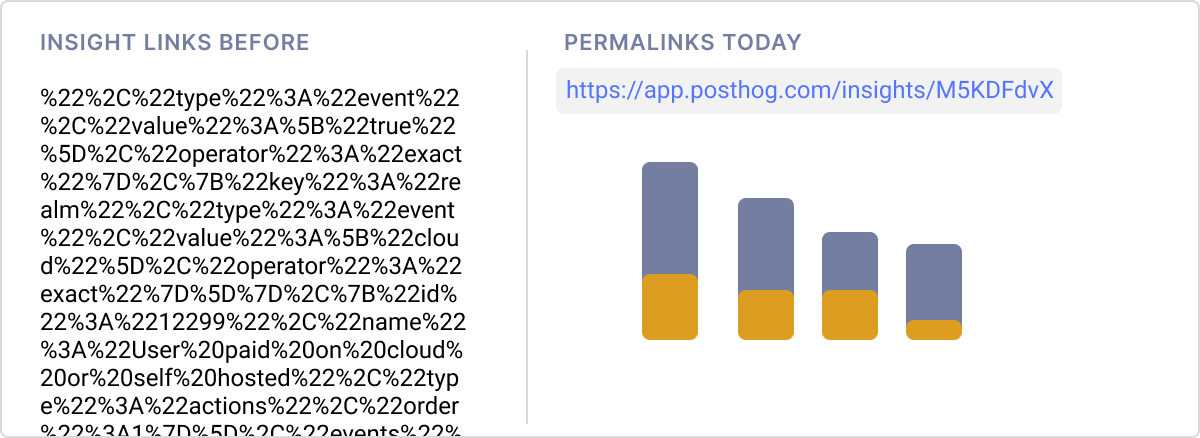
Concept of how insight links changed to permalinks today

You can share dashboards easily too. Even if you share a link to a dashboard in a different project, recipients will be automatically switched to the correct project if they have access

In small teams it's common for a single person to own the analytics process, but feedback from larger clients demonstrated this wasn't the case for them. In response, we've introduced granular permissions to give users full control over who can edit their dashboards. This makes it easier for larger teams to work together, without stepping on each others toes.
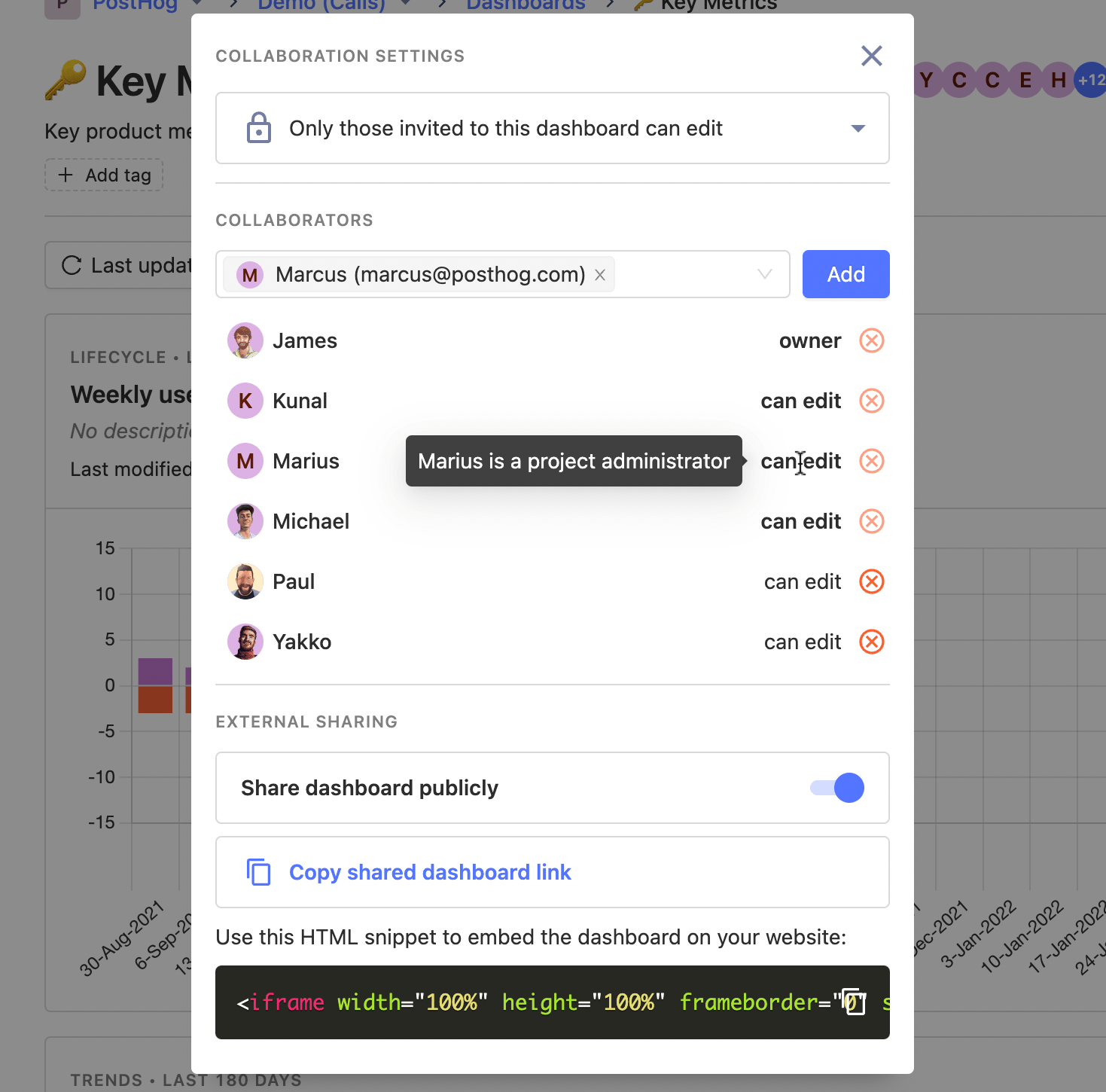
Screenshot of dashboard permissions

Exploring data speculatively

Sometimes you don't know what you're looking for, or you don't know where to start. There are many different avenues to improving your product. For example, we recently discovered users seldom use our Paths advanced features and these could introduce mental burden to users.

To aid serendipitous discoveries, we've created a project homepage to surface helpful insights you may not have considered. By making it the default page on PostHog, our aim is to help users make quick discoveries. We'll surface your most important product and company metrics here as well as popular insights, and we're leveraging social proof from what other teammates are doing in your app to help you discover more product improvements.

In addition, if your team uses the Session Recording feature, we'll also surface the most recent recordings here. We've found that users who return to Session Recordings make 3x more discoveries than other users (more context in issue #8595). This should also help drive qualitative discoveries about your product.
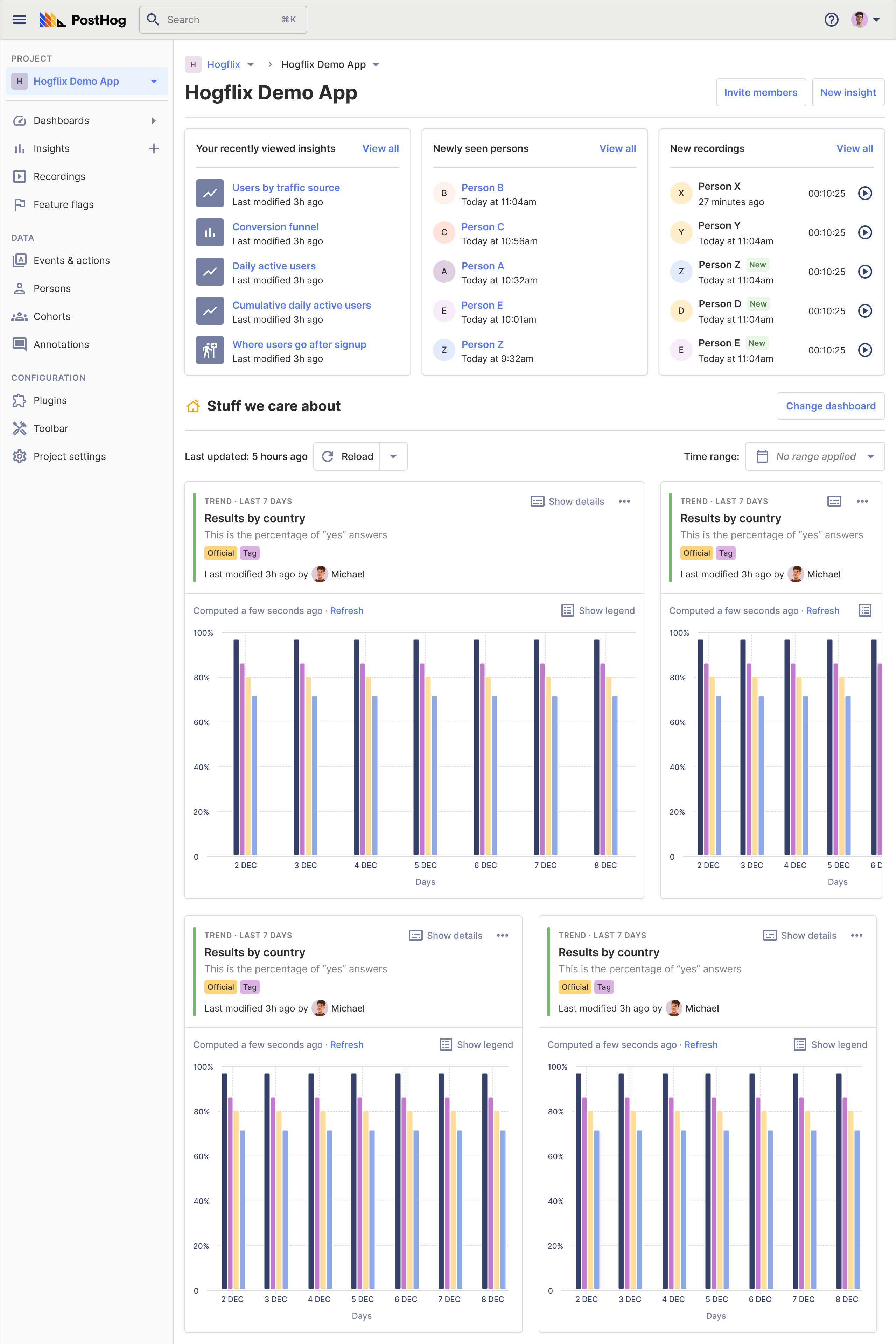
Concept of project home page

We find there are two general profiles for PostHog users:

  1. People who are naturally curious and whose job leads them to discover insights all the time and across multiple dimensions.
  2. People who use PostHog to answer specific questions as they arise.

For people who create insights, we've introduced one-click saving and automatic insight naming. This means people who create lots of insights don't have spend time documenting their work, while their colleagues can easily understand what they're looking at.
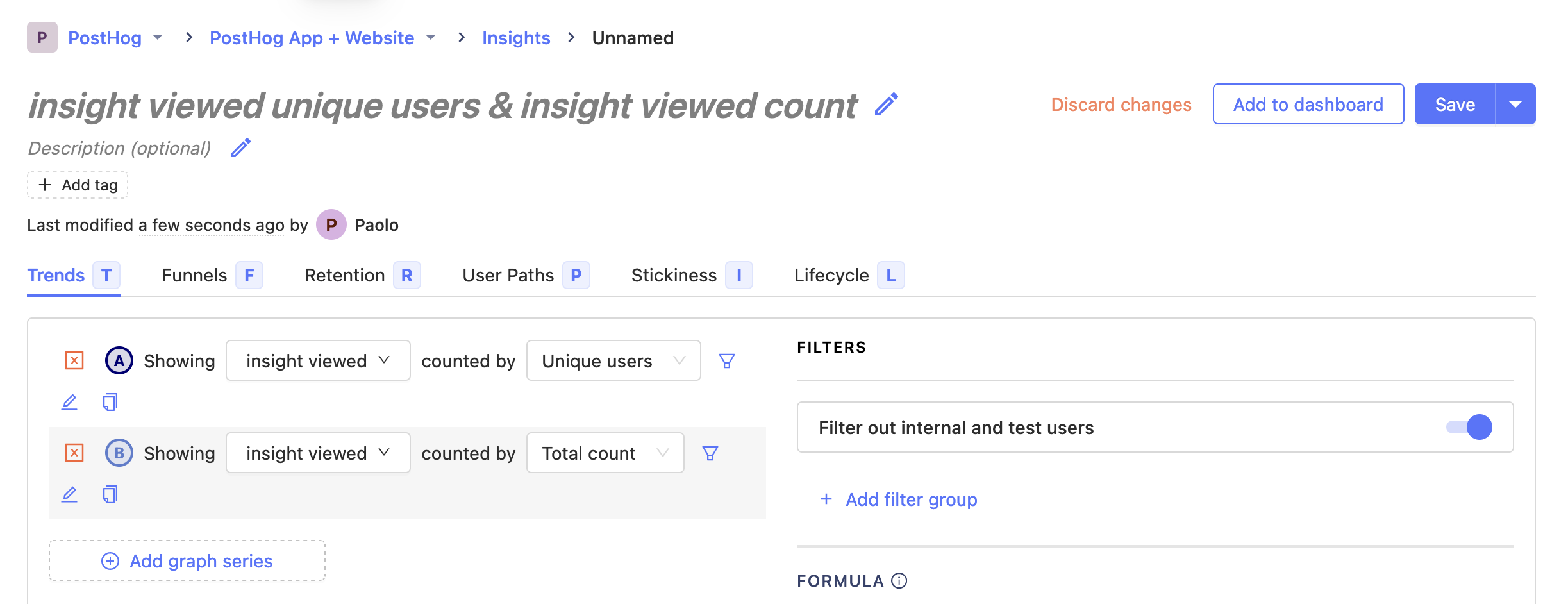
Screenshot of automatic insight naming

And for people who love discovering insights that others made, we've made it easier to search and find saved insights.
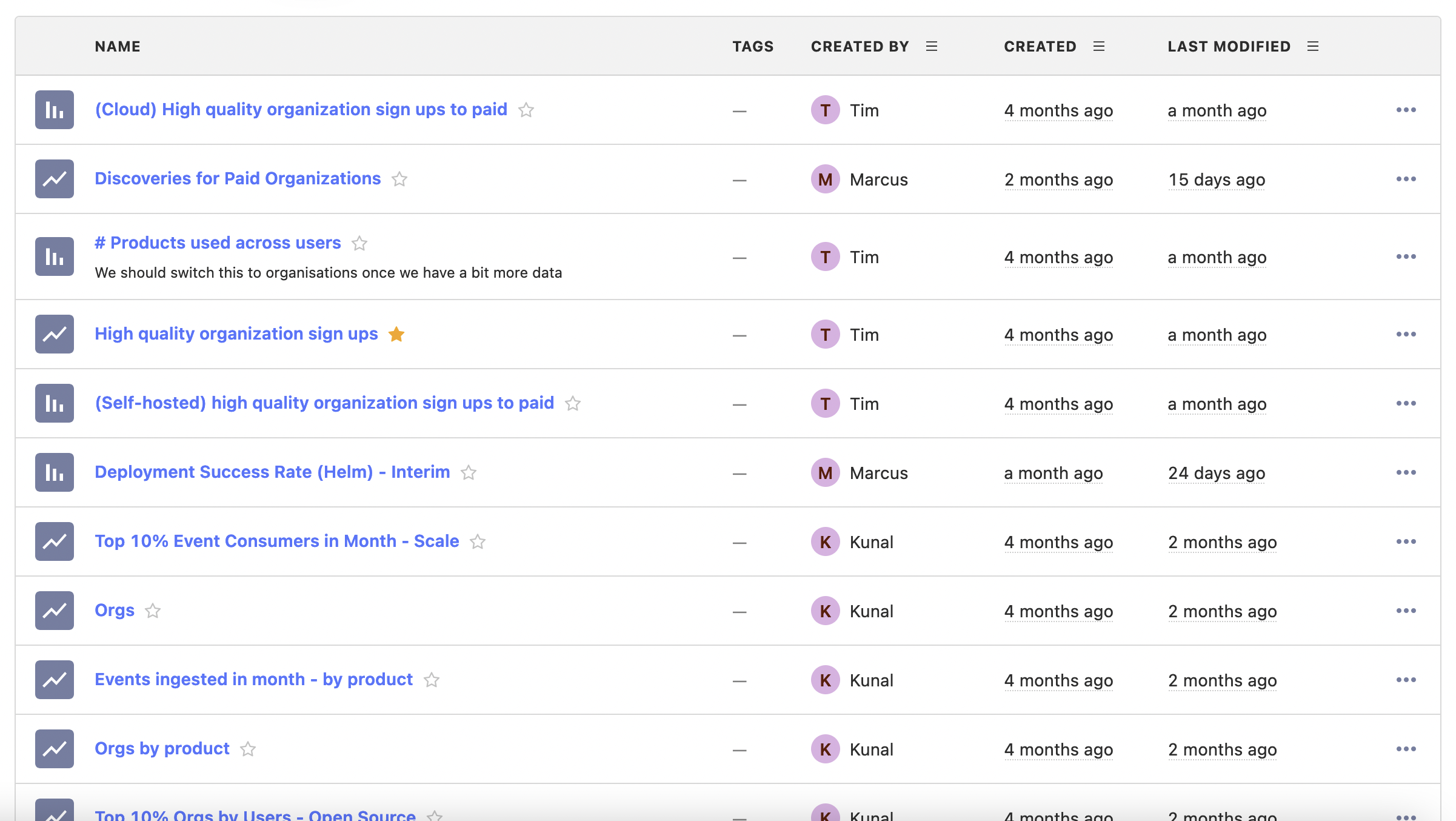
Screenshot of saved insights

To support this work, we also introduced the new Data Management feature, which brings together all the context on how your product is instrumented. Now there's no need to ask an Engineer or Product Manager which event you should use to answer a question, which both parties will appreciate!

We're continuing to actively work on improving collaboration throughout the product and we have some specific plans in our short term roadmap.

However, we're a fast moving company and we continuously reprioritize based on feedback, market needs, etc., so the way we tackle this problem may change.

With the disclaimer above in mind, here's some exciting stuff we hope to ship soon.

Slack Previews

Almost every team uses some sort of Instant Messaging tool (think Slack, Discord, Teams, ...) and in particular, it's a place for discussions. We believe that adding more context when you share a link to a PostHog insight or dashboard will speed up discussions (e.g. a screenshot of the graph, general details, recent changes, ...). We're starting with Slack to test drive this concept, but if successful, expanding to other tools will make sense.

Email subscriptions to dashboards and insights

As we analyzed dashboard usage in PostHog, we discovered it's quite common for teams to have one or two dashboards that represent their critical metrics, such as number of sales for an e-commerce company or retention for a pre-Product-Market-Fit startup.

A very user-friendly way of keeping users updated on these metrics is by integrating with their current workflows, such as email. Soon you'll be able to start your Mondays (or any other day) with a digest of how your product and company are doing.

Embeddable graph images

You've seen the typical Medium post with a graph, well we have too and we hate they're not PostHog graphs. But aside from that superficial argument, teams have different workflows and tools where product context is shared (e.g. an intranet, Notion, Google Docs, code repositories, blog posts). Usually product decisions are at least data-informed (and we do hope this will help drive this behavior further), so we want to make sure that the context from product data is properly shared, accessible and preserved. In particular, we also want to make sure these context remains up-to-date.

As always, we welcome and highly encourage you to share any feedback you may have about this or any other feature. Give us a shout in our community page or join us directly for a call with our Product or Engineering team.

PostHog is an open source developer platform that helps people build successful products. We help you debug and ship your product faster.

Want to just try it already?

(Sorry for the shameless CTA.)