



惯性聚合 高效追踪和阅读你感兴趣的博客、新闻、科技资讯
阅读原文 在惯性聚合中打开

推荐订阅源

AI
AI
小众软件
小众软件
让小产品的独立变现更简单 - ezindie.com
月光博客
月光博客
云风的 BLOG
云风的 BLOG
Recorded Future
Recorded Future
Apple Machine Learning Research
F
Fortinet All Blogs
罗磊的独立博客
爱范儿
爱范儿
GbyAI
GbyAI
Stack Overflow Blog
Stack Overflow Blog
MongoDB | Blog
MongoDB | Blog
D
Docker
C
CXSECURITY Database RSS Feed - CXSecurity.com
Spread Privacy
Spread Privacy
Recent Announcements
酷 壳 – CoolShell
酷 壳 – CoolShell
G
GRAHAM CLULEY
A
About on SuperTechFans
C
Cisco Blogs
The Register - Security
OSCHINA 社区最新新闻
OSCHINA 社区最新新闻
B
Blog
Project Zero
Project Zero
V
V2EX
K
Kaspersky official blog
P
Privacy International News Feed
博客园 - 叶小钗
I
Intezer
T
Threatpost
The GitHub Blog
The GitHub Blog
CTFtime.org: upcoming CTF events
V
Vulnerabilities – Threatpost
D
Darknet – Hacking Tools, Hacker News & Cyber Security
C
Cybersecurity and Infrastructure Security Agency CISA
Cyberwarzone
Cyberwarzone
Microsoft Azure Blog
N
Netflix TechBlog - Medium
Application and Cybersecurity Blog
博客园 - 【当耐特】
P
Proofpoint News Feed
L
Lohrmann on Cybersecurity
S
Schneier on Security
cs.AI updates on arXiv.org
F
Full Disclosure
The Cloudflare Blog
P
Palo Alto Networks Blog
K
KPMG report finds enterprise disconnect between AI and its ROI | CIO
T
Tenable Blog

PostHog's RSS Feed

Training our own AI models - PostHog From 270GB RAM to 5GB: Moving local flag evaluation from Django to Rust The best analytics stack for vibe-coded apps The do's and don'ts of minimum viable product marketing - PostHog The best MCP servers for startups, by workflow PostHog Code and the self-driving product - PostHog Why attacking your competitors online is dumb - PostHog The best real-time analytics platforms for developers, compared DuckDB vs ClickHouse: Why we use both at PostHog - PostHog PostHog's next chapter - PostHog Making Claude Cowork actually useful - PostHog PostHog vs Matomo in-depth tool comparison You're doing lifecycle emails wrong Untangling Tokio and Rayon in production: From 2s latency spikes to 94ms flat The best HIPAA-compliant A/B testing tools - PostHog A beginner's guide to testing AI agents - PostHog I hate the standup bot (so I built an agent to do it for me) - PostHog The best CDPs for developers, compared The best error tracking tools for developers, compared The best feature flag software for developers, compared 7 best session replay tools for mobile apps 7 best free open source business intelligence tools right now 7 best free and open source LLM observability tools PostHog vs LogRocket in-depth tool comparison The most popular PostHog alternatives, compared Open source (and self-hosted) session replay tools - PostHog The 9 best GA4 alternatives for apps and websites - PostHog PostHog vs Google Analytics 4 in-depth tool comparison How we built automatic clustering for LLM traces - PostHog The 7 best HIPAA-compliant analytics tools 8 best open source analytics tools you can self-host - PostHog The best product analytics tools for startups, compared PostHog vs FullStory in-depth tool comparison The best in-app survey tools for product teams, compared The 7 best mobile app analytics tools PostHog vs Hotjar in-depth tool comparison The 8 best free and open-source feature flag services - PostHog The 5 best free and open-source A/B testing tools - PostHog The best mobile app A/B testing tools, compared What is a feature flag? Feature Flags vs Remote Config vs A/B Testing PostHog is now available in Vercel’s v0 The best Heap alternatives & competitors, compared PostHog vs Heap in-depth tool comparison PostHog vs Pendo in-depth tool comparison PostHog × Vercel: feature flags, minus the plumbing Your logs' final destination is in GA. You always end up here anyway Behind the scenes of a PostHog hackathon - PostHog The most popular Mixpanel alternatives & competitors, compared PostHog vs Mixpanel in-depth tool comparison The 9 best GDPR-compliant analytics tools How we use Logs at PostHog The best web analytics tools for developers, compared Stop AI slop: Run evals with LLM-as-a-Judge - PostHog You product data just got a job: Workflows is now out App onboarding: How to fix drop-off points Meet Logs (beta) – logs with all the tools you’re already using Why small teams crush tiger teams How we built user behavior analysis with multi-modal LLMs (in 5 not-so-easy steps) - PostHog The best Contentsquare alternatives & competitors, compared 8 learnings from 1 year of agents – PostHog AI - PostHog Why we killed our AI product assistant Workflows graduate to beta! Product data, meet automation The best Rollbar alternatives & competitors, compared Workflows are now in Alpha and I already broke mine - PostHog I've consistently underestimated how important communication is as a CEO - PostHog How we made feature flags even faster and more reliable The best session replay tools for developers, compared What I learned attending my first ever hackathon - PostHog Did you know AI is answering our community questions? - PostHog How not to be boring - PostHog We built an internal tool to generate changelog images for social media - PostHog What we built at our windswept Mykonos hackathon - PostHog How we built our onboarding email flow (with actual performance data) - PostHog We're building a better PostHog community by closing our public Slack - PostHog Introducing Notebooks for PostHog - PostHog Why we've launched PostHog user surveys - PostHog How we made feature flags faster and more reliable - PostHog In-depth: ClickHouse vs Redshift - PostHog Introducing HouseWatch: An open-source toolkit for ClickHouse - PostHog Introducing HogQL: Direct SQL access for PostHog - PostHog What we built at our sun-kissed Aruba hackathon - PostHog In-depth: ClickHouse vs BigQuery - PostHog In-depth: ClickHouse vs Elasticsearch - PostHog HogMail #22: Why do companies over-hire?" - PostHog Our simpler goal: Help engineers to be better at product - PostHog In-depth: ClickHouse vs Snowflake - PostHog HogMail #21: Avoiding the "Product Death Cycle" - PostHog Sunsetting Kubernetes support for PostHog - PostHog Why 'Product Engineer' is the most fun role I've had in tech - PostHog HogMail #20: Why do startups fail? - PostHog The best Google Optimize alternatives for apps and websites - PostHog Array 1.43.0: Massive performance improvements! - PostHog In-depth: ClickHouse vs Druid - PostHog HogMail #19: Which meetings should you kill? - PostHog CEO diary: The things I learned in 2022 - PostHog The essential tools used by product engineers - PostHog HogMail #18: What can SaaS learn from the New York Times? - PostHog What is a product engineer? - Product Engineer Handbook - PostHog Array 1.42.0: Get beta features via our roadmap! - PostHog HogMail #17: The personal traits that can't be taught - PostHog
4,063 errors closed without a human opening PostHog – here's what we learned - PostHog
Sara Miteva · 2026-05-07 · via PostHog's RSS Feed

Last month, our customers deployed AI agents to PostHog projects to try and solve 6,124 errors in their products. They resolved 4,063 issues. They suppressed 1,751 more. They routed 310 to the right team. Almost none of those agents opened the PostHog UI to do it.

The numbers track with our bet on self-driving products – the more agents understand your codebase and your data, the more of the routine work they take off your plate, and triage is one of the first places that shift becomes visible.

We were obviously interested to find out what types of problems users were addressing with the MCP.

Here's what we found.

We grouped 30 days of MCP-driven error triage actions, and they sorted cleanly into three buckets:

Resolve a.k.a. "We fixed it." This is the headline number. Over 4,000 issues were marked as done by an agent after either generating a fix, confirming a fix had shipped, or tracing the root cause and concluding the issue had already self-resolved.

Suppress a.k.a. "Stop showing me this." About 1,750 issues marked as known noise – third-party SDK warnings, expected exceptions, the canonical browser garbage you've seen a thousand times (Script error., ResizeObserver loop completed..., Object Not Found Matching Id). Agents are quietly maintaining the noise filter you keep meaning to maintain yourself.

Route a.k.a. "Wrong owner." Over 300 issues reassigned to a different person or team – sometimes alongside a freshly-created Linear ticket so the new owner has a place to track the work.

Three different outcomes, three different reasons users invoked the tool. Our initial perception of the agent doing only triage was too coarse. What actually happened is more like "the agent does whatever needs to be done and then marks the issue accordingly."

A few things stood out from watching agent-driven triage in the wild.

Smaller, sharper tools win

When we first shipped MCP support for error tracking, error-tracking-query-issue was one combined endpoint covering several jobs at once. Watching agents in practice, we kept seeing them want those jobs separately. In late April we split the tool into three – issues-list, issue, and issue-events. Bulk-triage flows got noticeably smoother right after.

Triage isn't one motion

We started thinking about MCP triage as a single workflow – "the agent updates the issue." In practice, three distinct things are happening: things get fixed and resolved, things get filtered as known noise, and things get rerouted to the right owner. These are three different jobs with three different prompts and three different definitions of success. The next round of skills we ship will treat them that way.

Errors are starting points, not endings

When agents engage with an error, they rarely stop at the issue. They drill into the surrounding events, pull the affected users, check which feature flags were on, and follow into session recordings. The MCP is most powerful when it carries an investigation across products without anyone having to context-switch.

Search behaviour told us something we didn't expect

About half of the searches we see look like what you'd expect – error strings, exception types, common JS patterns. The other half are organised by business surface: checkout, billing, auth, embed. People aren't just hunting "the latest TypeErrors." They're asking "what's broken in checkout this week." That's a clear signal that business-surface filtering needs to be as easy as exception-type filtering, and it's now on our short list.

Bulk work is the real win

Single-issue debugging was always doable in the UI. What MCP-driven triage does best is the kind of bulk operation that used to take an hour of clicking – "suppress every variant of this third-party noise across the last 90 days" or "route every iOS crash to the mobile team." One sentence, and it's done. That's where the time savings actually live.

Here are some fun facts too:
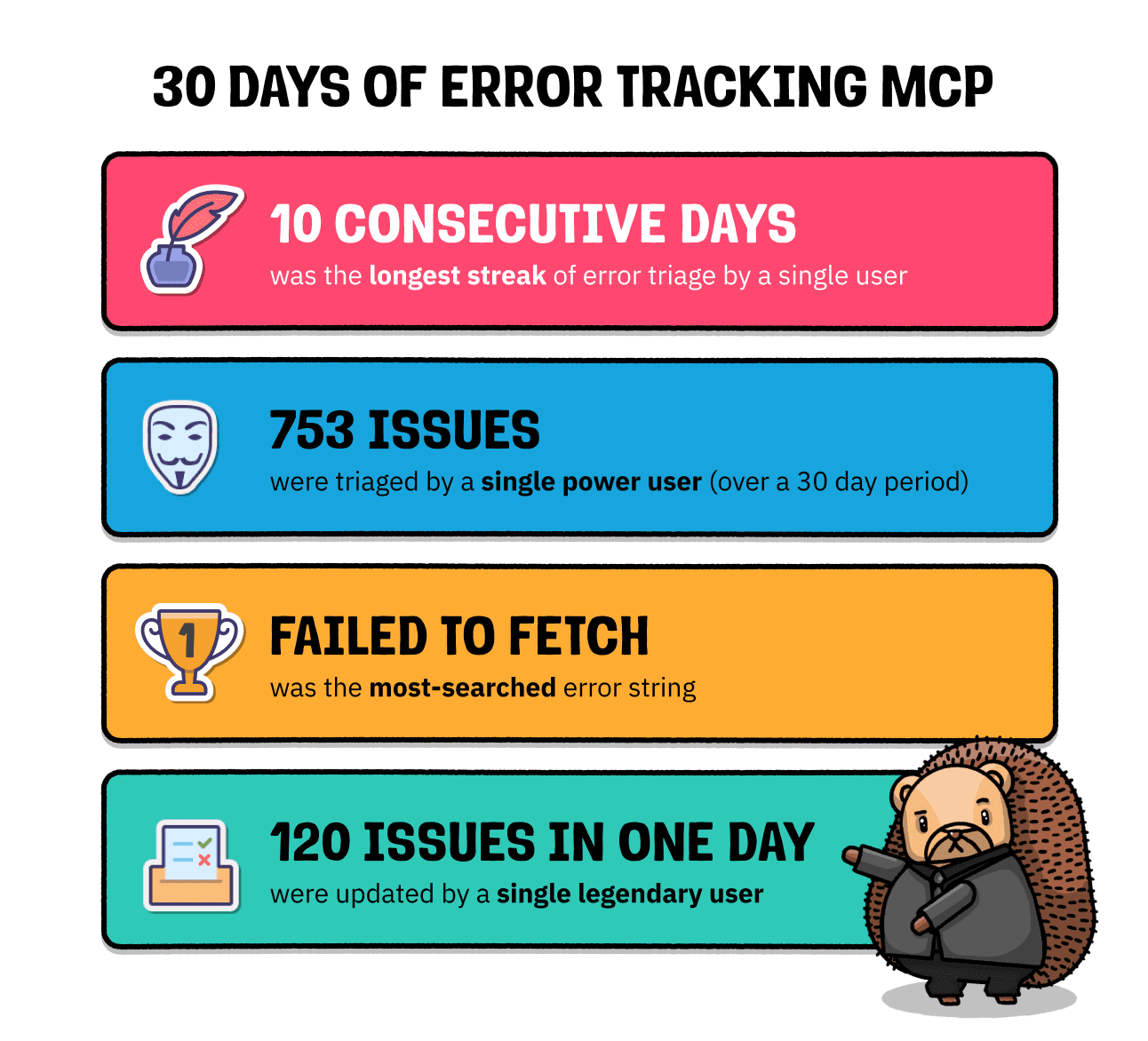
error tracking mcp fun facts

There are four categories where MCP-driven triage really earns its keep.

Frontend noise that everyone has and nobody cleans up

Browser quirks, deprecated SDK warnings, third-party tracker exceptions. The "we know about it, it doesn't matter" pile that grows until your dashboard becomes unreadable. Try:

Try it with PostHogAI

Network and auth errors that need filtering, not fixing

Failed to fetch, AuthRetryableFetchError, timeout exceptions – usually transient, often best handled by suppression combined with alerting on real spikes. Try:

Try it with PostHogAI

Business-area errors that need routing

TypeError in your checkout flow, ChunkLoadError after a deploy, payment webhook failures. Group by route or service and reassign to the team that owns the surface. Try:

Try it with PostHogAI

Platform-specific crashes

iOS, Android, server-side errors that only some teammates can investigate. Try:

Try it with PostHogAI

Once your agent is connected to PostHog Error Tracking, these prompts map onto real work people are already doing.

For weekly cleanup

  • "Show me the top 10 errors from the last 7 days. For each, tell me whether it's growing, stable, or shrinking."
  • "Resolve any issues that haven't fired in the last 30 days."
  • "Suppress every error matching the patterns I'll list below."

For incident triage

  • "What errors started spiking in the last hour? Show me the full stack trace for the top three."
  • "Find any errors that began appearing after my latest deploy."
  • "Which user is most affected by this error, and what were they doing right before it happened?"

For routing and ownership

  • "Create an assignment rule that sends all TypeError exceptions to the frontend team."
  • "Any error containing stripe should route to the payments team."
  • "For every active issue tagged mobile, create a Linear ticket and assign it to the mobile owner."

For root-cause investigation

  • "For this error, find the matching session recordings and summarise what the user did before it fired."
  • "What changed in our codebase right before this error started appearing?"
  • "Show me which feature flags were on for the users hitting this error."

Install the MCP server in your preferred client – the AI wizard handles setup for Claude, Cursor, Windsurf, VS Code, and others:

Or configure it manually.