

惯性聚合 高效追踪和阅读你感兴趣的博客、新闻、科技资讯
阅读原文 在惯性聚合中打开

推荐订阅源

cs.CV updates on arXiv.org
云风的 BLOG
云风的 BLOG
aimingoo的专栏
aimingoo的专栏
Vercel News
Vercel News
T
The Blog of Author Tim Ferriss
F
Full Disclosure
A
About on SuperTechFans
C
Check Point Blog
让小产品的独立变现更简单 - ezindie.com
量子位
Know Your Adversary
Know Your Adversary
K
Kaspersky official blog
L
LINUX DO - 热门话题
Recorded Future
Recorded Future
C
Cisco Blogs
M
MIT News - Artificial intelligence
T
Tenable Blog
G
GRAHAM CLULEY
月光博客
月光博客
Recent Announcements
V
Visual Studio Blog
IT之家
IT之家
T
The Exploit Database - CXSecurity.com
The GitHub Blog
The GitHub Blog
T
Threat Research - Cisco Blogs
D
DataBreaches.Net
P
Privacy International News Feed
P
Proofpoint News Feed
I
Intezer
博客园 - 叶小钗
C
CXSECURITY Database RSS Feed - CXSecurity.com
The Hacker News
The Hacker News
Cyber Security Advisories - MS-ISAC
博客园 - Franky
SecWiki News
SecWiki News
宝玉的分享
宝玉的分享
P
Palo Alto Networks Blog
Last Week in AI
Last Week in AI
小众软件
小众软件
Hacker News - Newest:
Hacker News - Newest: "LLM"
O
OpenAI News
N
News and Events Feed by Topic
Microsoft Security Blog
Security Archives - TechRepublic
N
News and Events Feed by Topic
The Cloudflare Blog
Spread Privacy
Spread Privacy
酷 壳 – CoolShell
酷 壳 – CoolShell
Exploit-DB.com RSS Feed
B
Blog RSS Feed

PostHog's RSS Feed

Training our own AI models - PostHog From 270GB RAM to 5GB: Moving local flag evaluation from Django to Rust The best analytics stack for vibe-coded apps The do's and don'ts of minimum viable product marketing - PostHog The best MCP servers for startups, by workflow 4,063 errors closed without a human opening PostHog – here's what we learned - PostHog PostHog Code and the self-driving product - PostHog Why attacking your competitors online is dumb - PostHog The best real-time analytics platforms for developers, compared DuckDB vs ClickHouse: Why we use both at PostHog - PostHog PostHog's next chapter - PostHog Making Claude Cowork actually useful - PostHog PostHog vs Matomo in-depth tool comparison You're doing lifecycle emails wrong Untangling Tokio and Rayon in production: From 2s latency spikes to 94ms flat The best HIPAA-compliant A/B testing tools - PostHog A beginner's guide to testing AI agents - PostHog I hate the standup bot (so I built an agent to do it for me) - PostHog The best CDPs for developers, compared The best error tracking tools for developers, compared The best feature flag software for developers, compared 7 best session replay tools for mobile apps 7 best free open source business intelligence tools right now 7 best free and open source LLM observability tools PostHog vs LogRocket in-depth tool comparison The most popular PostHog alternatives, compared Open source (and self-hosted) session replay tools - PostHog The 9 best GA4 alternatives for apps and websites - PostHog PostHog vs Google Analytics 4 in-depth tool comparison How we built automatic clustering for LLM traces - PostHog The 7 best HIPAA-compliant analytics tools 8 best open source analytics tools you can self-host - PostHog The best product analytics tools for startups, compared PostHog vs FullStory in-depth tool comparison The best in-app survey tools for product teams, compared The 7 best mobile app analytics tools PostHog vs Hotjar in-depth tool comparison The 8 best free and open-source feature flag services - PostHog The 5 best free and open-source A/B testing tools - PostHog The best mobile app A/B testing tools, compared What is a feature flag? Feature Flags vs Remote Config vs A/B Testing PostHog is now available in Vercel’s v0 The best Heap alternatives & competitors, compared PostHog vs Heap in-depth tool comparison PostHog vs Pendo in-depth tool comparison PostHog × Vercel: feature flags, minus the plumbing Your logs' final destination is in GA. You always end up here anyway Behind the scenes of a PostHog hackathon - PostHog The most popular Mixpanel alternatives & competitors, compared PostHog vs Mixpanel in-depth tool comparison The 9 best GDPR-compliant analytics tools How we use Logs at PostHog The best web analytics tools for developers, compared Stop AI slop: Run evals with LLM-as-a-Judge - PostHog You product data just got a job: Workflows is now out App onboarding: How to fix drop-off points Meet Logs (beta) – logs with all the tools you’re already using Why small teams crush tiger teams How we built user behavior analysis with multi-modal LLMs (in 5 not-so-easy steps) - PostHog The best Contentsquare alternatives & competitors, compared 8 learnings from 1 year of agents – PostHog AI - PostHog Why we killed our AI product assistant Workflows graduate to beta! Product data, meet automation The best Rollbar alternatives & competitors, compared Workflows are now in Alpha and I already broke mine - PostHog I've consistently underestimated how important communication is as a CEO - PostHog How we made feature flags even faster and more reliable The best session replay tools for developers, compared What I learned attending my first ever hackathon - PostHog Did you know AI is answering our community questions? - PostHog How not to be boring - PostHog We built an internal tool to generate changelog images for social media - PostHog What we built at our windswept Mykonos hackathon - PostHog How we built our onboarding email flow (with actual performance data) - PostHog We're building a better PostHog community by closing our public Slack - PostHog Introducing Notebooks for PostHog - PostHog Why we've launched PostHog user surveys - PostHog How we made feature flags faster and more reliable - PostHog In-depth: ClickHouse vs Redshift - PostHog Introducing HouseWatch: An open-source toolkit for ClickHouse - PostHog Introducing HogQL: Direct SQL access for PostHog - PostHog What we built at our sun-kissed Aruba hackathon - PostHog In-depth: ClickHouse vs BigQuery - PostHog In-depth: ClickHouse vs Elasticsearch - PostHog HogMail #22: Why do companies over-hire?" - PostHog Our simpler goal: Help engineers to be better at product - PostHog In-depth: ClickHouse vs Snowflake - PostHog HogMail #21: Avoiding the "Product Death Cycle" - PostHog Sunsetting Kubernetes support for PostHog - PostHog Why 'Product Engineer' is the most fun role I've had in tech - PostHog HogMail #20: Why do startups fail? - PostHog The best Google Optimize alternatives for apps and websites - PostHog Array 1.43.0: Massive performance improvements! - PostHog In-depth: ClickHouse vs Druid - PostHog HogMail #19: Which meetings should you kill? - PostHog CEO diary: The things I learned in 2022 - PostHog The essential tools used by product engineers - PostHog HogMail #18: What can SaaS learn from the New York Times? - PostHog What is a product engineer? - Product Engineer Handbook - PostHog Array 1.42.0: Get beta features via our roadmap! - PostHog
An introduction to product analytics and how it works - PostHog
Joe Martin · 2021-10-21 · via PostHog's RSS Feed

At the most basic level product analytics refers to the process of gathering data about how a product is used, then analyzing that data in order to make decisions about improving it.

Where it gets more complicated is in the particular situations and decisions that are made using product analytics tools.

A good example of product analytics in action is collecting information about how many users reach each stage of an onboarding funnel, then using that information to improve or optimize a funnel. This is exactly what companies such as Hasura use tools like PostHog for!
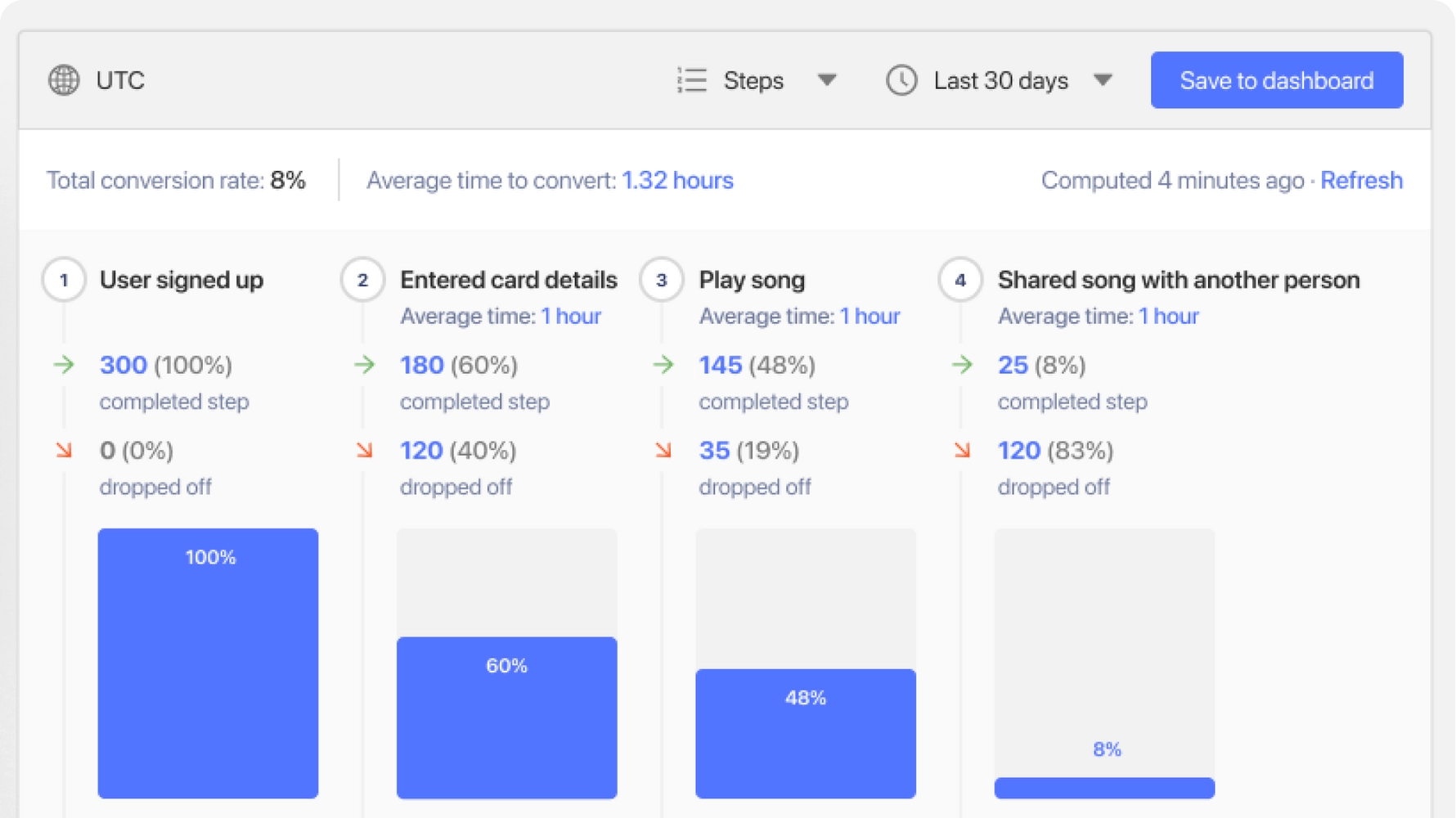
Product analytics funnel

Above: An example of a simple product analytics funnel

There are two types of data which you can gather for product analytics:

  • Quantitative data is objectively measurable, such as an increase in a number of users or sales. Using funnel analysis in PostHog to measure drop-off is an example of quantitative data analysis.
  • Qualitative data is that which is subjective, such as user feedback or observations. Using session recording in PostHog to intuit where users may be experiencing friction is an example of qualitative data analysis.

There are also frameworks which can be used to translate information between the two. NPS and CSAT scores, for example, are often used to translate user sentiment into a measurable data point.

This article is part of our PostHog Academy series where we explain the fundamentals of product analytics.

Product analytics tools are important because they enable you to make thoughtful and well-informed decisions about changes to a product. Product analytics tools also enable you to measure success (or failure!) when needed, so you know if you need to rollback or double-down on a change.

It's possible to get by without product analytics, but then it's impossible to know if changes are having a beneficial impact, or even if you are solving the right problems to start with. Product development without product analytics is like stumbling around in a dark room, trying to find the way out. You might find the way out, but you might also fall down a hole!

Nearly all modern businesses will employ product analytics tools at some level, from new start-ups such as Pry to established products with thousands of users such as Hasura.

Product analytics tools are not used solely by Product teams, but can be used by a wide range of teams or individuals within a business. These can include:

  • Product Managers or Product Engineers
  • Software Engineers or Developers
  • Leadership or senior management
  • UI or UX Designers

Individuals will often employ product analytics on a particular area, depending on their role. Product Engineers, for example, may investigate the adoption rate for new features so that they can make decisions about the product roadmap. Meanwhile, UX Designers may use product analytics tools to understand where users are rage-clicking, so they can optimize the interface.

“We use feature flags to issue changes to 50% of users and then compare the effect. Experiment, find results, decide where to focus and then iterate.”

It’s important when using product analytics tools to look at metrics relevant to specific decisions. Metrics such as the number of customers, can give you a good sense of your overall product health but won't help you plan a roadmap.

One simple set of metrics which can help all teams to focus their efforts is the so-called pirate funnel, which was created by Dave McClure and tracks AARRR. That stands for:

  • Acquisition: Users who discover your product (e.g. free trials, web traffic)
  • Activation: Users who use your product (e.g. sign-ups, first orders)
  • Retention: Users who stay with your product (e.g. repeat purchases)
  • Revenue: The money bought in by users (e.g. Subscriptions, LTV)
  • Referral: The users who share your product (e.g. reviews, shares)

Find out how to build a AARRR funnel in PostHog

No.

Most product analytics tools such as Mixpanel and Amplitude work by capturing user actions with a short code snippet or third-party cookie which sends data to their data centers. But not all platforms work this way.

PostHog enables you to self-host your product analytics, so you keep data on your infrastructure and don't need to share data with anyone. Not even PostHog.

There are many situations where it may be preferable not to share data with a third-party analytics platform, such as a need to protect user information or mitigate the risk of data breaches. Self-hosting product analytics also provides other benefits, such as circumventing ad blockers due to the lack of third-party cookies.

Find out how to self-host product analytics with PostHog and easily deploy to your infrastructure using DigitalOcean.

No.

Google Analytics is one of the most popular analytics platforms in the world and is useful for understanding a number of important metrics, but it isn’t the ideal platform for running product analytics. This is because Google Analytics was built to help users understand web metrics, rather than answer questions about why users behave in certain ways.

In short, Google Analytics provides a handy overview of web traffic or vanity metrics such as bounce rate, but it doesn’t offer tools such as feature flags or session recording.

As a result, Google Analytics is often the preferred tool for specific roles in a Marketing team that uses other Google tools, but is unsuitable for the needs of Product or Engineering teams.

Naturally, we think PostHog has the best product analytics tool available.

Why? PostHog enables you to self-host your analytics, integrates with tools such as data warehouses and offers everything you need to interrogate your data in a simple, visual UI. No SQL required. PostHog also offers many unique features which closed-source competitors do not, such as feature flags and session recording.

There are a variety of product analytics tools available to choose from however, each with its own quirks and strengths. Popular options include platforms such as Amplitude, Heap, or Mixpanel, though none of these offer self-hosted deployments.

PostHog is an open-source developer platform that helps people build successful products. We help you debug and ship your product faster.

Want to just try it already?

(Sorry for the shameless CTA.)