惯性聚合 高效追踪和阅读你感兴趣的博客、新闻、科技资讯
阅读原文 在惯性聚合中打开

推荐订阅源

Threat Intelligence Blog | Flashpoint
W
WeLiveSecurity
O
OpenAI News
N
News and Events Feed by Topic
K
KPMG report finds enterprise disconnect between AI and its ROI | CIO
cs.CV updates on arXiv.org
Webroot Blog
Webroot Blog
Google Online Security Blog
云风的 BLOG
云风的 BLOG
N
News | PayPal Newsroom
H
Hacker News: Front Page
博客园_首页
Exploit-DB.com RSS Feed
The Last Watchdog
The Last Watchdog
钛媒体:引领未来商业与生活新知
钛媒体:引领未来商业与生活新知
H
Heimdal Security Blog
cs.AI updates on arXiv.org
S
Schneier on Security
宝玉的分享
宝玉的分享
H
Hackread – Cybersecurity News, Data Breaches, AI and More
Recent Commits to openclaw:main
Y
Y Combinator Blog
Cyberwarzone
Cyberwarzone
Microsoft Security Blog
C
CXSECURITY Database RSS Feed - CXSecurity.com
GbyAI
GbyAI
Cloudbric
Cloudbric
TaoSecurity Blog
TaoSecurity Blog
人人都是产品经理
人人都是产品经理
P
Palo Alto Networks Blog
M
MIT News - Artificial intelligence
G
GRAHAM CLULEY
C
Check Point Blog
Apple Machine Learning Research
Last Week in AI
Last Week in AI
T
Troy Hunt's Blog
L
Lohrmann on Cybersecurity
www.infosecurity-magazine.com
P
Proofpoint News Feed
Blog — PlanetScale
Blog — PlanetScale
量子位
博客园 - 聂微东
S
Securelist
博客园 - 三生石上(FineUI控件)
F
Full Disclosure
G
Google Developers Blog
L
LINUX DO - 热门话题
P
Proofpoint News Feed
AI
AI
PCI Perspectives
PCI Perspectives

PostHog's RSS Feed

Training our own AI models - PostHog From 270GB RAM to 5GB: Moving local flag evaluation from Django to Rust The best analytics stack for vibe-coded apps The do's and don'ts of minimum viable product marketing - PostHog The best MCP servers for startups, by workflow 4,063 errors closed without a human opening PostHog – here's what we learned - PostHog PostHog Code and the self-driving product - PostHog Why attacking your competitors online is dumb - PostHog The best real-time analytics platforms for developers, compared DuckDB vs ClickHouse: Why we use both at PostHog - PostHog PostHog's next chapter - PostHog Making Claude Cowork actually useful - PostHog PostHog vs Matomo in-depth tool comparison You're doing lifecycle emails wrong Untangling Tokio and Rayon in production: From 2s latency spikes to 94ms flat The best HIPAA-compliant A/B testing tools - PostHog A beginner's guide to testing AI agents - PostHog I hate the standup bot (so I built an agent to do it for me) - PostHog The best CDPs for developers, compared The best error tracking tools for developers, compared The best feature flag software for developers, compared 7 best session replay tools for mobile apps 7 best free open source business intelligence tools right now 7 best free and open source LLM observability tools PostHog vs LogRocket in-depth tool comparison The most popular PostHog alternatives, compared Open source (and self-hosted) session replay tools - PostHog The 9 best GA4 alternatives for apps and websites - PostHog PostHog vs Google Analytics 4 in-depth tool comparison How we built automatic clustering for LLM traces - PostHog The 7 best HIPAA-compliant analytics tools 8 best open source analytics tools you can self-host - PostHog The best product analytics tools for startups, compared PostHog vs FullStory in-depth tool comparison The best in-app survey tools for product teams, compared The 7 best mobile app analytics tools PostHog vs Hotjar in-depth tool comparison The 8 best free and open-source feature flag services - PostHog The 5 best free and open-source A/B testing tools - PostHog The best mobile app A/B testing tools, compared What is a feature flag? Feature Flags vs Remote Config vs A/B Testing PostHog is now available in Vercel’s v0 The best Heap alternatives & competitors, compared PostHog vs Heap in-depth tool comparison PostHog vs Pendo in-depth tool comparison PostHog × Vercel: feature flags, minus the plumbing Your logs' final destination is in GA. You always end up here anyway Behind the scenes of a PostHog hackathon - PostHog The most popular Mixpanel alternatives & competitors, compared PostHog vs Mixpanel in-depth tool comparison The 9 best GDPR-compliant analytics tools How we use Logs at PostHog The best web analytics tools for developers, compared Stop AI slop: Run evals with LLM-as-a-Judge - PostHog You product data just got a job: Workflows is now out App onboarding: How to fix drop-off points Meet Logs (beta) – logs with all the tools you’re already using Why small teams crush tiger teams How we built user behavior analysis with multi-modal LLMs (in 5 not-so-easy steps) - PostHog The best Contentsquare alternatives & competitors, compared 8 learnings from 1 year of agents – PostHog AI - PostHog Why we killed our AI product assistant Workflows graduate to beta! Product data, meet automation The best Rollbar alternatives & competitors, compared Workflows are now in Alpha and I already broke mine - PostHog I've consistently underestimated how important communication is as a CEO - PostHog How we made feature flags even faster and more reliable The best session replay tools for developers, compared What I learned attending my first ever hackathon - PostHog Did you know AI is answering our community questions? - PostHog How not to be boring - PostHog We built an internal tool to generate changelog images for social media - PostHog What we built at our windswept Mykonos hackathon - PostHog How we built our onboarding email flow (with actual performance data) - PostHog We're building a better PostHog community by closing our public Slack - PostHog Introducing Notebooks for PostHog - PostHog Why we've launched PostHog user surveys - PostHog How we made feature flags faster and more reliable - PostHog In-depth: ClickHouse vs Redshift - PostHog Introducing HouseWatch: An open-source toolkit for ClickHouse - PostHog Introducing HogQL: Direct SQL access for PostHog - PostHog What we built at our sun-kissed Aruba hackathon - PostHog In-depth: ClickHouse vs BigQuery - PostHog In-depth: ClickHouse vs Elasticsearch - PostHog HogMail #22: Why do companies over-hire?" - PostHog Our simpler goal: Help engineers to be better at product - PostHog In-depth: ClickHouse vs Snowflake - PostHog HogMail #21: Avoiding the "Product Death Cycle" - PostHog Sunsetting Kubernetes support for PostHog - PostHog Why 'Product Engineer' is the most fun role I've had in tech - PostHog HogMail #20: Why do startups fail? - PostHog The best Google Optimize alternatives for apps and websites - PostHog Array 1.43.0: Massive performance improvements! - PostHog In-depth: ClickHouse vs Druid - PostHog HogMail #19: Which meetings should you kill? - PostHog CEO diary: The things I learned in 2022 - PostHog The essential tools used by product engineers - PostHog HogMail #18: What can SaaS learn from the New York Times? - PostHog What is a product engineer? - Product Engineer Handbook - PostHog Array 1.42.0: Get beta features via our roadmap! - PostHog
Solving the mystery of PostHog’s missing session recordings - PostHog
Rick Marron · 2022-02-11 · via PostHog's RSS Feed

Session Recording is one of PostHog's core features, and one of the few completely open source ression replay tools available. It allows you to see how real users use your website, mouse clicks and all. It's really cool and addictive (give it a try and you'll see what I mean).

Recently, we made a ton of improvements to the feature. To name a few, we:

  • Decreased average recording load time from ~2.5s to 700ms
  • Resolved a big bug that caused recordings to "wonk out" if a recording spanned multiple tabs or browser windows
  • Revamped the player experience to make it faster for users to get to the moment in the recording they care about
  • Improved the speed to query recordings, allowing users to search across all recordings at once (it used to be limited to a single day's worth of recordings)

But there was one fix that stood out in this quality push. Customers would often tell us recordings were missing, and we didn't know why.

This is the story of how we decreased the number of missing recordings from 15% to <1%, and in doing so, moved the feature out of beta.

Rick Marron is a software engineer at PostHog. In previous lives Rick was a Program Manager at Microsoft, and he spent over a year in Nairobi, Kenya where he developed the first publicly available real-time source for traffic data in the city using computer vision and street cameras. He's a native of Rochester, New York but lives in Los Angeles now because... sunshine. Follow him on Twitter and Github.

To start, we had to find a way to measure missing recordings. If we can't measure it, we can't know if we fixed it. But how can you measure something that's missing?

We had a couple ideas, but they all had drawbacks. The two main ones we considered were:

1. Measure how often we receive web analytics events outside of a recording: The idea is that a user should have a recording if they're sending up other events. The problem is that this doesn't account for cases when recordings are disabled, so the metric would always be < 100%.

2. Measure how often we've received data for a recording, but it wasn't complete: For a recording to be shown to users, it needs to have enough data that we can draw the entire page - we call this a 'full snapshot'. This metric would measure how often we started a recording but didn't send up a full snapshot, so we couldn't render the page for the user. Theoretically, this should rarely happen.

We decided to use the second metric because it would let us strive for 0% missing recordings. If you're curious, you can read the conversation that led to this decision in this GitHub issue.

In the first run of the metric, it showed that we were missing ~15% of recordings across PostHog Cloud users.

Checking Sentry for clues

Now that we had a metric, we started hunting for clues. What was causing the missing recordings?

The first place we looked was Sentry. There were a couple of errors in the ingestion pipeline that seemed suspicious. The most notable was a "Max data upload size exceeded" error that was firing a few thousand times a day. This seemed like it could be an obvious cause of missing recordings. If some data was not being uploaded because it was too big, it would make sense that we could not get a 'full snapshot'.

To figure out what was causing this error, we looked at data that had been uploaded which was just below our size threshold of 20mb. It looked like large data URLs of images were the cause.

To test this out, we made a filter that would remove data URLs from any payload that exceeded a 5mb threshold, and it would replace the image with an obvious placeholder.
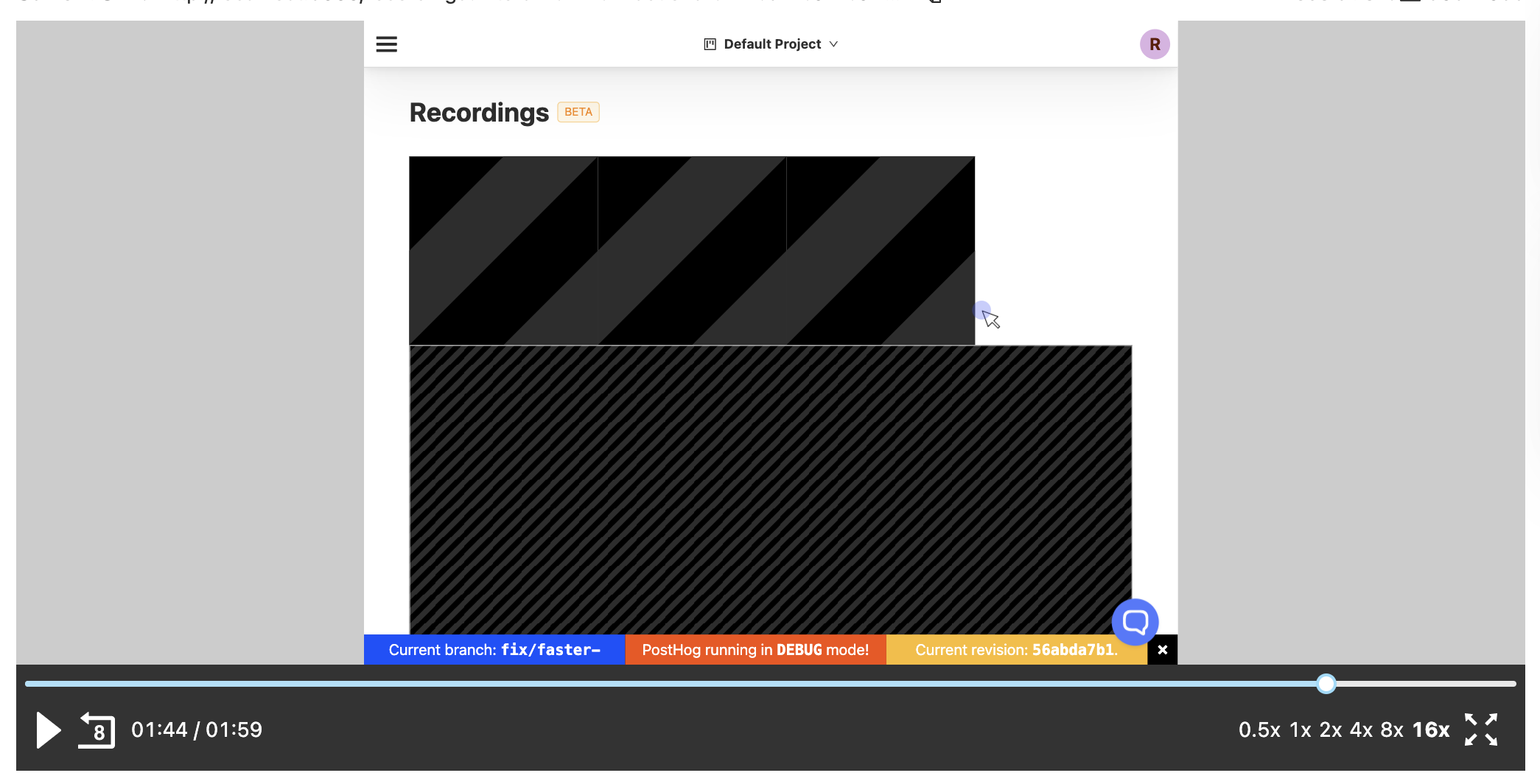
Recording Page with SVGs

One issue we faced was that we didn't want this feature to significantly increase the size of posthog-js, but we would have to include the placeholder image in the bundle. After some discussion, we landed on the idea of using a very small SVG that could easily scale to the size of the image being replaced. You can read more about the discussion that landed us here in the PR itself.

After deploying the fix, two things happened:

  1. The Sentry error went away 🥳
  2. The missing recordings only went down a few percent 😩

Back to the drawing board.

What was causing the rest of the missing recordings? With no more clues, it came time to dig through the mechanics of the code.

So, how does Session Recording work?

Under the hood, we're using the open source project RRWeb to power our recordings feature. RRWeb handles capturing what happened in the DOM, serializing it (so you can send it to your server), and then replaying the serialized data.

To decrease the amount of data that's transmitted, RRWeb works by taking a full snapshot of the DOM at the beginning of the recording, and from this point forward, it watches the MutationObserver and records only the changes to the page.

From the full snapshot, you can re-create a still image of the website, and from the mutations, you can replay how the page changes over time. This is very similar to how video compression works with "key frames" and deltas.

Solving the real mystery

With this knowledge in mind, we started looking into why we were receiving mutation data for recordings, but without a full snapshot.

Presumably, if the mutations were being sent up, the snapshot code must've already run. The mutations depend entirely on the snapshot existing in memory, so it didn't make sense that there was no full snapshot.

After a day or so of pounding our heads on the keyboard, we realized that most of the missing recording cases were on single-page applications. With this clue in mind, and knowing that RRWeb takes a full-snapshot on page load, it didn't take long to realize the cause.

We were splitting recordings when a user was inactive for 30 minutes (so users don't see a 10-hour long recording). But when the split happened, we were not taking a new full snapshot.

We made a fix for this, and the missing recordings started to quickly drop.

Because this fix went into posthog-js, and different customers upgrade at different speeds, it took a while to see the full effect of the fix in our metrics.

However, after about a month of waiting (and continuously checking the metrics 😬), the 15% missing recordings metric dropped to <1% 🎉.

With this focus on quality, we've seen the usage of the Session Recordings feature go up significantly. Weekly active users is up 2.5x, and each of those users are watching about twice as many recordings per week.

And we're not done yet, we're still working to make it even easier to find and watch the recordings that show you valuable insights about your users.

As for the remaining <1% of recordings that are missing, we're still working on that too. The going theory is that it has to do with data compression errors or slow networks, but we're not quite to the bottom of that one yet.

Read our Sessions Recordings documentation for more detailed information about the feature, or you can make an account for free to try it out yourself!

Subscribe to our newsletter

Product for Engineers

Read by 100,000+ founders and builders

We'll share your email with Substack