惯性聚合 高效追踪和阅读你感兴趣的博客、新闻、科技资讯
阅读原文 在惯性聚合中打开

推荐订阅源

D
Docker
AI
AI
博客园 - 三生石上(FineUI控件)
腾讯CDC
freeCodeCamp Programming Tutorials: Python, JavaScript, Git & More
Y
Y Combinator Blog
大猫的无限游戏
大猫的无限游戏
H
Hackread – Cybersecurity News, Data Breaches, AI and More
雷峰网
雷峰网
NISL@THU
NISL@THU
S
Schneier on Security
T
Threatpost
T
Tenable Blog
Application and Cybersecurity Blog
IT之家
IT之家
宝玉的分享
宝玉的分享
T
Tailwind CSS Blog
C
Cybersecurity and Infrastructure Security Agency CISA
P
Privacy & Cybersecurity Law Blog
I
Intezer
Microsoft Azure Blog
月光博客
月光博客
T
Threat Research - Cisco Blogs
SecWiki News
SecWiki News
AWS News Blog
AWS News Blog
博客园 - Franky
钛媒体:引领未来商业与生活新知
钛媒体:引领未来商业与生活新知
P
Proofpoint News Feed
V
V2EX
Recorded Future
Recorded Future
Microsoft Security Blog
S
Secure Thoughts
Google DeepMind News
MongoDB | Blog
MongoDB | Blog
Apple Machine Learning Research
Project Zero
Project Zero
PCI Perspectives
PCI Perspectives
G
GRAHAM CLULEY
Help Net Security
Help Net Security
Cloudbric
Cloudbric
Recent Announcements
V
Visual Studio Blog
Hacker News: Ask HN
Hacker News: Ask HN
N
News and Events Feed by Topic
C
CERT Recently Published Vulnerability Notes
The Cloudflare Blog
Forbes - Security
Forbes - Security
C
Cisco Blogs
O
OpenAI News
www.infosecurity-magazine.com

PostHog's RSS Feed

Training our own AI models - PostHog From 270GB RAM to 5GB: Moving local flag evaluation from Django to Rust The best analytics stack for vibe-coded apps The do's and don'ts of minimum viable product marketing - PostHog The best MCP servers for startups, by workflow 4,063 errors closed without a human opening PostHog – here's what we learned - PostHog PostHog Code and the self-driving product - PostHog Why attacking your competitors online is dumb - PostHog The best real-time analytics platforms for developers, compared DuckDB vs ClickHouse: Why we use both at PostHog - PostHog PostHog's next chapter - PostHog Making Claude Cowork actually useful - PostHog PostHog vs Matomo in-depth tool comparison You're doing lifecycle emails wrong Untangling Tokio and Rayon in production: From 2s latency spikes to 94ms flat The best HIPAA-compliant A/B testing tools - PostHog A beginner's guide to testing AI agents - PostHog I hate the standup bot (so I built an agent to do it for me) - PostHog The best CDPs for developers, compared The best error tracking tools for developers, compared The best feature flag software for developers, compared 7 best session replay tools for mobile apps 7 best free open source business intelligence tools right now 7 best free and open source LLM observability tools PostHog vs LogRocket in-depth tool comparison The most popular PostHog alternatives, compared Open source (and self-hosted) session replay tools - PostHog The 9 best GA4 alternatives for apps and websites - PostHog PostHog vs Google Analytics 4 in-depth tool comparison How we built automatic clustering for LLM traces - PostHog The 7 best HIPAA-compliant analytics tools 8 best open source analytics tools you can self-host - PostHog The best product analytics tools for startups, compared PostHog vs FullStory in-depth tool comparison The best in-app survey tools for product teams, compared The 7 best mobile app analytics tools PostHog vs Hotjar in-depth tool comparison The 8 best free and open-source feature flag services - PostHog The 5 best free and open-source A/B testing tools - PostHog The best mobile app A/B testing tools, compared What is a feature flag? Feature Flags vs Remote Config vs A/B Testing PostHog is now available in Vercel’s v0 The best Heap alternatives & competitors, compared PostHog vs Heap in-depth tool comparison PostHog vs Pendo in-depth tool comparison PostHog × Vercel: feature flags, minus the plumbing Your logs' final destination is in GA. You always end up here anyway Behind the scenes of a PostHog hackathon - PostHog The most popular Mixpanel alternatives & competitors, compared PostHog vs Mixpanel in-depth tool comparison The 9 best GDPR-compliant analytics tools How we use Logs at PostHog The best web analytics tools for developers, compared Stop AI slop: Run evals with LLM-as-a-Judge - PostHog You product data just got a job: Workflows is now out App onboarding: How to fix drop-off points Meet Logs (beta) – logs with all the tools you’re already using Why small teams crush tiger teams How we built user behavior analysis with multi-modal LLMs (in 5 not-so-easy steps) - PostHog The best Contentsquare alternatives & competitors, compared 8 learnings from 1 year of agents – PostHog AI - PostHog Why we killed our AI product assistant Workflows graduate to beta! Product data, meet automation The best Rollbar alternatives & competitors, compared Workflows are now in Alpha and I already broke mine - PostHog I've consistently underestimated how important communication is as a CEO - PostHog How we made feature flags even faster and more reliable The best session replay tools for developers, compared What I learned attending my first ever hackathon - PostHog Did you know AI is answering our community questions? - PostHog How not to be boring - PostHog We built an internal tool to generate changelog images for social media - PostHog What we built at our windswept Mykonos hackathon - PostHog How we built our onboarding email flow (with actual performance data) - PostHog We're building a better PostHog community by closing our public Slack - PostHog Introducing Notebooks for PostHog - PostHog Why we've launched PostHog user surveys - PostHog How we made feature flags faster and more reliable - PostHog In-depth: ClickHouse vs Redshift - PostHog Introducing HouseWatch: An open-source toolkit for ClickHouse - PostHog Introducing HogQL: Direct SQL access for PostHog - PostHog What we built at our sun-kissed Aruba hackathon - PostHog In-depth: ClickHouse vs BigQuery - PostHog In-depth: ClickHouse vs Elasticsearch - PostHog HogMail #22: Why do companies over-hire?" - PostHog Our simpler goal: Help engineers to be better at product - PostHog In-depth: ClickHouse vs Snowflake - PostHog HogMail #21: Avoiding the "Product Death Cycle" - PostHog Sunsetting Kubernetes support for PostHog - PostHog Why 'Product Engineer' is the most fun role I've had in tech - PostHog HogMail #20: Why do startups fail? - PostHog The best Google Optimize alternatives for apps and websites - PostHog Array 1.43.0: Massive performance improvements! - PostHog In-depth: ClickHouse vs Druid - PostHog HogMail #19: Which meetings should you kill? - PostHog CEO diary: The things I learned in 2022 - PostHog The essential tools used by product engineers - PostHog HogMail #18: What can SaaS learn from the New York Times? - PostHog What is a product engineer? - Product Engineer Handbook - PostHog Array 1.42.0: Get beta features via our roadmap! - PostHog
Group Analytics is now available in PostHog - PostHog
Joe Martin · 2021-12-16 · via PostHog's RSS Feed

Today, we’re excited to announce that PostHog has launched Group Analytics for both PostHog Scale / Enterprise users and those on PostHog Cloud.

Group Analytics are used for tracking and analyzing multiples of any event type within PostHog. Unlike cohorts, which essentially create lists of users, groups can track a far wider range of information because they apply at the event level.

“The Groups functionality in PostHog gives us the flexibility and power to target users at a higher level. Group Analytics also give us more detailed insight into user behavior between instances. We love it!”

As a result, Group Analytics is especially useful for certain types of product, such as:

  • B2B products: If you sell primarily to businesses, groups can be used to track data at a company level and report on metrics such as Daily Active Companies.

  • Crypto and financial products: If your product deals with payments, groups can be used to track events such as transactions and report on metrics such as Daily Payments.

  • Social media products: If your product deals with user-generated content (UGC), groups can be used to track subscriptions, as well as report on metrics such as Likes, Follows or Shares.

Groups work perfectly with all other PostHog tools, enabling you to analyze group data with funnels, trends, paths and retention charts. This opens up the potential for entirely new insights, such as using groups within a funnel analysis to see how a company moves through a sign-up funnel in the same way that you would do for an individual user.
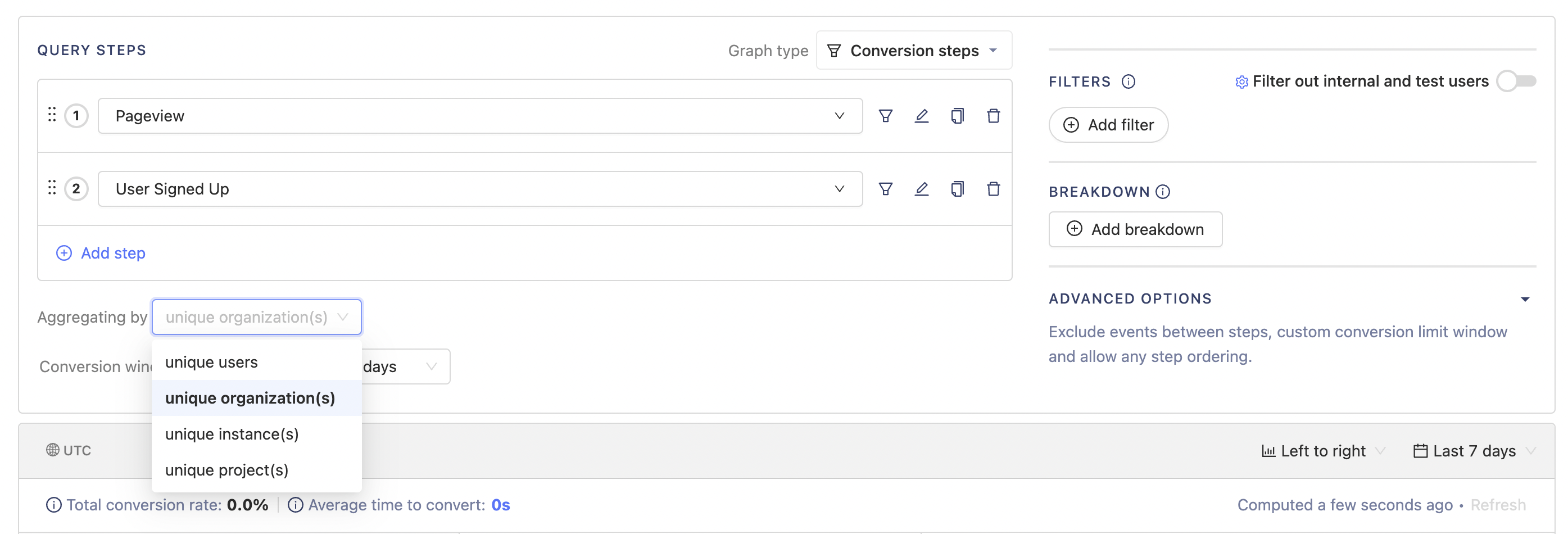
View Groups

You can even use groups with feature flags to roll out or test new features with all users within an organization. This makes feature flags a lot more practical for B2B focused products, as organizations such as Tapico, the open finance engine, have found out.

"Using groups we can enable feature flags per instance, dark launch features for a specific instance, or implement kill switches and ops flags," said Weyert de Boer, Senior Software Engineer at Tapico.

Group Analytics has been released as a premium feature and is available now for both PostHog Scale, PostHog Enterprise, and PostHog Cloud users. If you’re on PostHog Cloud you can get started with groups immediately, while self-hosted instances will first need to be updated to the latest version. We’ve prepared some documentation to help you get started with the new group types and illustrate some popular use-cases.

As always, we welcome any feedback you have as an issue in the GitHub repo, or in our community page.

Subscribe to our newsletter

Product for Engineers

Read by 100,000+ founders and builders

We'll share your email with Substack