


惯性聚合 高效追踪和阅读你感兴趣的博客、新闻、科技资讯
阅读原文 在惯性聚合中打开

推荐订阅源

C
Check Point Blog
宝玉的分享
宝玉的分享
V
Visual Studio Blog
B
Blog RSS Feed
G
Google Developers Blog
U
Unit 42
让小产品的独立变现更简单 - ezindie.com
P
Palo Alto Networks Blog
月光博客
月光博客
cs.AI updates on arXiv.org
L
LINUX DO - 最新话题
cs.CV updates on arXiv.org
小众软件
小众软件
GbyAI
GbyAI
L
LangChain Blog
A
About on SuperTechFans
Attack and Defense Labs
T
Tor Project blog
AWS News Blog
AWS News Blog
S
Security @ Cisco Blogs
H
Hacker News: Front Page
S
SegmentFault 最新的问题
Engineering at Meta
Engineering at Meta
The Register - Security
Recorded Future
Recorded Future
D
Darknet – Hacking Tools, Hacker News & Cyber Security
Hacker News - Newest:
Hacker News - Newest: "LLM"
V2EX - 技术
V2EX - 技术
H
Heimdal Security Blog
Simon Willison's Weblog
Y
Y Combinator Blog
Spread Privacy
Spread Privacy
奇客Solidot–传递最新科技情报
奇客Solidot–传递最新科技情报
WordPress大学
WordPress大学
P
Privacy International News Feed
I
Intezer
W
WeLiveSecurity
钛媒体:引领未来商业与生活新知
钛媒体:引领未来商业与生活新知
Help Net Security
Help Net Security
NISL@THU
NISL@THU
D
DataBreaches.Net
Stack Overflow Blog
Stack Overflow Blog
Exploit-DB.com RSS Feed
V
Vulnerabilities – Threatpost
N
News | PayPal Newsroom
Security Archives - TechRepublic
Google DeepMind News
The Hacker News
The Hacker News
L
Lohrmann on Cybersecurity
Schneier on Security

PostHog's RSS Feed

Training our own AI models - PostHog From 270GB RAM to 5GB: Moving local flag evaluation from Django to Rust The best analytics stack for vibe-coded apps The do's and don'ts of minimum viable product marketing - PostHog The best MCP servers for startups, by workflow 4,063 errors closed without a human opening PostHog – here's what we learned - PostHog PostHog Code and the self-driving product - PostHog Why attacking your competitors online is dumb - PostHog The best real-time analytics platforms for developers, compared DuckDB vs ClickHouse: Why we use both at PostHog - PostHog PostHog's next chapter - PostHog Making Claude Cowork actually useful - PostHog PostHog vs Matomo in-depth tool comparison You're doing lifecycle emails wrong Untangling Tokio and Rayon in production: From 2s latency spikes to 94ms flat The best HIPAA-compliant A/B testing tools - PostHog A beginner's guide to testing AI agents - PostHog I hate the standup bot (so I built an agent to do it for me) - PostHog The best CDPs for developers, compared The best error tracking tools for developers, compared The best feature flag software for developers, compared 7 best session replay tools for mobile apps 7 best free open source business intelligence tools right now 7 best free and open source LLM observability tools PostHog vs LogRocket in-depth tool comparison The most popular PostHog alternatives, compared Open source (and self-hosted) session replay tools - PostHog The 9 best GA4 alternatives for apps and websites - PostHog PostHog vs Google Analytics 4 in-depth tool comparison How we built automatic clustering for LLM traces - PostHog The 7 best HIPAA-compliant analytics tools 8 best open source analytics tools you can self-host - PostHog The best product analytics tools for startups, compared PostHog vs FullStory in-depth tool comparison The best in-app survey tools for product teams, compared The 7 best mobile app analytics tools PostHog vs Hotjar in-depth tool comparison The 8 best free and open-source feature flag services - PostHog The 5 best free and open-source A/B testing tools - PostHog The best mobile app A/B testing tools, compared What is a feature flag? Feature Flags vs Remote Config vs A/B Testing PostHog is now available in Vercel’s v0 The best Heap alternatives & competitors, compared PostHog vs Heap in-depth tool comparison PostHog vs Pendo in-depth tool comparison PostHog × Vercel: feature flags, minus the plumbing Your logs' final destination is in GA. You always end up here anyway Behind the scenes of a PostHog hackathon - PostHog The most popular Mixpanel alternatives & competitors, compared PostHog vs Mixpanel in-depth tool comparison The 9 best GDPR-compliant analytics tools How we use Logs at PostHog The best web analytics tools for developers, compared Stop AI slop: Run evals with LLM-as-a-Judge - PostHog You product data just got a job: Workflows is now out App onboarding: How to fix drop-off points Meet Logs (beta) – logs with all the tools you’re already using Why small teams crush tiger teams How we built user behavior analysis with multi-modal LLMs (in 5 not-so-easy steps) - PostHog The best Contentsquare alternatives & competitors, compared 8 learnings from 1 year of agents – PostHog AI - PostHog Why we killed our AI product assistant Workflows graduate to beta! Product data, meet automation The best Rollbar alternatives & competitors, compared Workflows are now in Alpha and I already broke mine - PostHog I've consistently underestimated how important communication is as a CEO - PostHog How we made feature flags even faster and more reliable The best session replay tools for developers, compared What I learned attending my first ever hackathon - PostHog Did you know AI is answering our community questions? - PostHog How not to be boring - PostHog We built an internal tool to generate changelog images for social media - PostHog What we built at our windswept Mykonos hackathon - PostHog How we built our onboarding email flow (with actual performance data) - PostHog We're building a better PostHog community by closing our public Slack - PostHog Introducing Notebooks for PostHog - PostHog Why we've launched PostHog user surveys - PostHog How we made feature flags faster and more reliable - PostHog In-depth: ClickHouse vs Redshift - PostHog Introducing HouseWatch: An open-source toolkit for ClickHouse - PostHog Introducing HogQL: Direct SQL access for PostHog - PostHog What we built at our sun-kissed Aruba hackathon - PostHog In-depth: ClickHouse vs BigQuery - PostHog In-depth: ClickHouse vs Elasticsearch - PostHog HogMail #22: Why do companies over-hire?" - PostHog Our simpler goal: Help engineers to be better at product - PostHog In-depth: ClickHouse vs Snowflake - PostHog HogMail #21: Avoiding the "Product Death Cycle" - PostHog Sunsetting Kubernetes support for PostHog - PostHog Why 'Product Engineer' is the most fun role I've had in tech - PostHog HogMail #20: Why do startups fail? - PostHog The best Google Optimize alternatives for apps and websites - PostHog Array 1.43.0: Massive performance improvements! - PostHog In-depth: ClickHouse vs Druid - PostHog HogMail #19: Which meetings should you kill? - PostHog CEO diary: The things I learned in 2022 - PostHog The essential tools used by product engineers - PostHog HogMail #18: What can SaaS learn from the New York Times? - PostHog What is a product engineer? - Product Engineer Handbook - PostHog Array 1.42.0: Get beta features via our roadmap! - PostHog
Introducing Data Management for PostHog - PostHog
Alex Kim · 2022-03-21 · via PostHog's RSS Feed

PostHog is growing fast. In just the last year we've measured ~36.5B total events ingested in PostHog Cloud, and hundreds of self-hosted users reached the 1M total ingested events milestone.

This is a sign of the superb growth we're seeing as a business, but data explosion is real and can be a nightmare to scale in the context of a product analytics tool. Furthermore, poor data management can seriously harm your business as it can lead to inaccurate analyses and poor business decisions.

As the biggest dogfooder of our own product, we (and many other teams) were beginning to see the consequences of the lack of in-house tools to manage our data. All the use cases we saw boiled down to a few common pain points:

  1. It is hard to understand events, actions, and properties that you yourself didn't set up.
  2. Data decays quickly, and most of the time fails to stay up-to-date with instrumentation.
  3. Event-level context in insights and dashboards is difficult to share with external people and new team members.

We set out to solve these pain points and the result is the new Data Management experience we're introducing today on PostHog Cloud and on Thursday for self-hosted.

Data Management is Chapter 1 of our Universe of New Features launch week

The Data Management page (pictured below) is the new hub for viewing, editing and managing all the data coming into your instance.
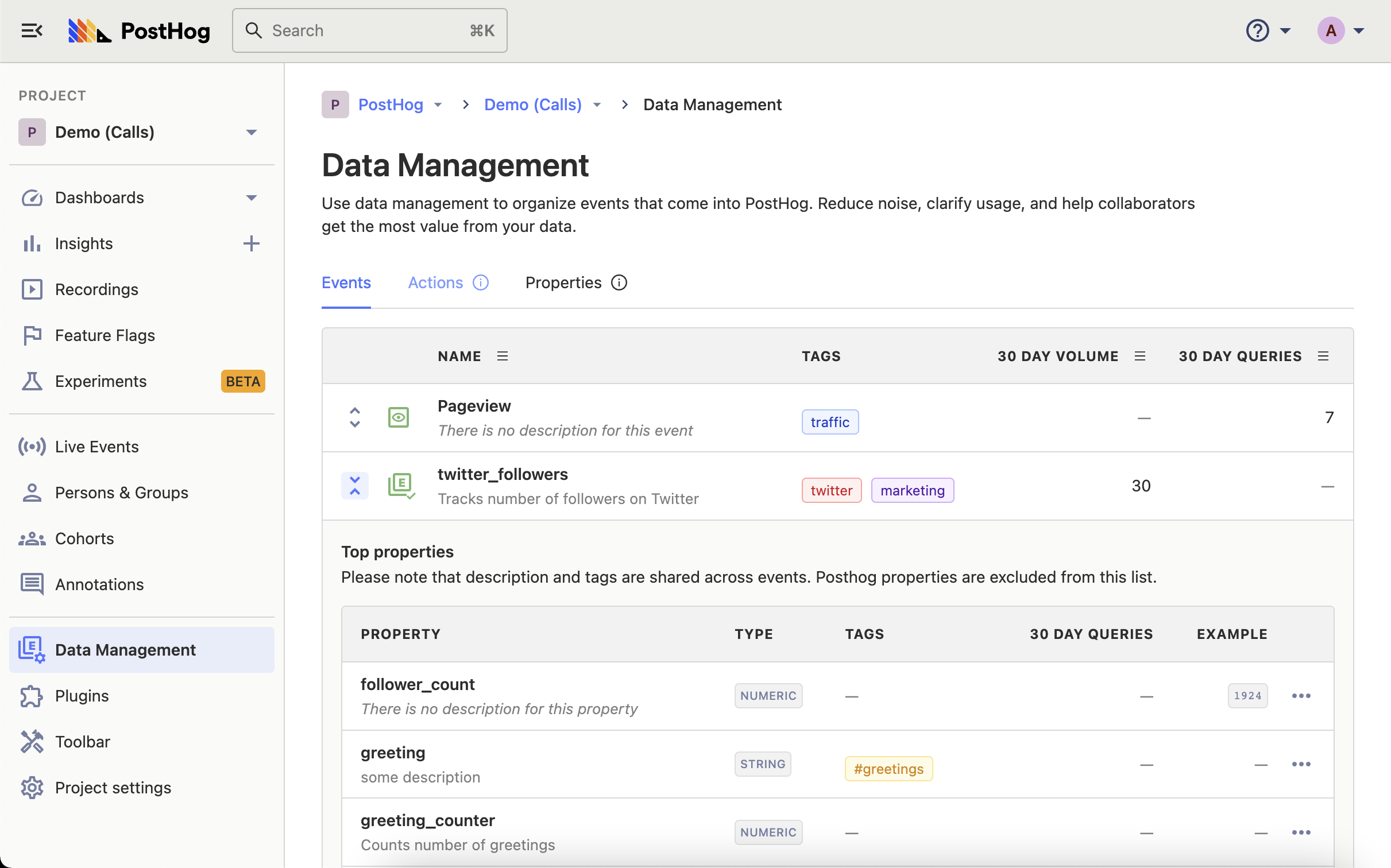
PostHog - data management tab

Data Management introduces more ways to organize and categorize your events. Event definitions can now be organized using tags and we've created the 'Verified' marker, which tells collaborators that an event should be favored over other similar events.

Verified events are prioritized within filters and other selection components, and we've introduced to two sortable "freshness" indicators (30-day volume and query volume) to make it easier to choose the correct events when creating Insights.

As part of this overhaul, we've made a few important changes to how data is organized, too. 'Event Stats' and 'Property Stats' have been renamed 'Events' and 'Event properties', and we've moved them into the Data Management tab alongside 'Actions'. The 'Events & Actions' tab has been renamed 'Activity', where you can debug incoming event data by streaming it in near real time.
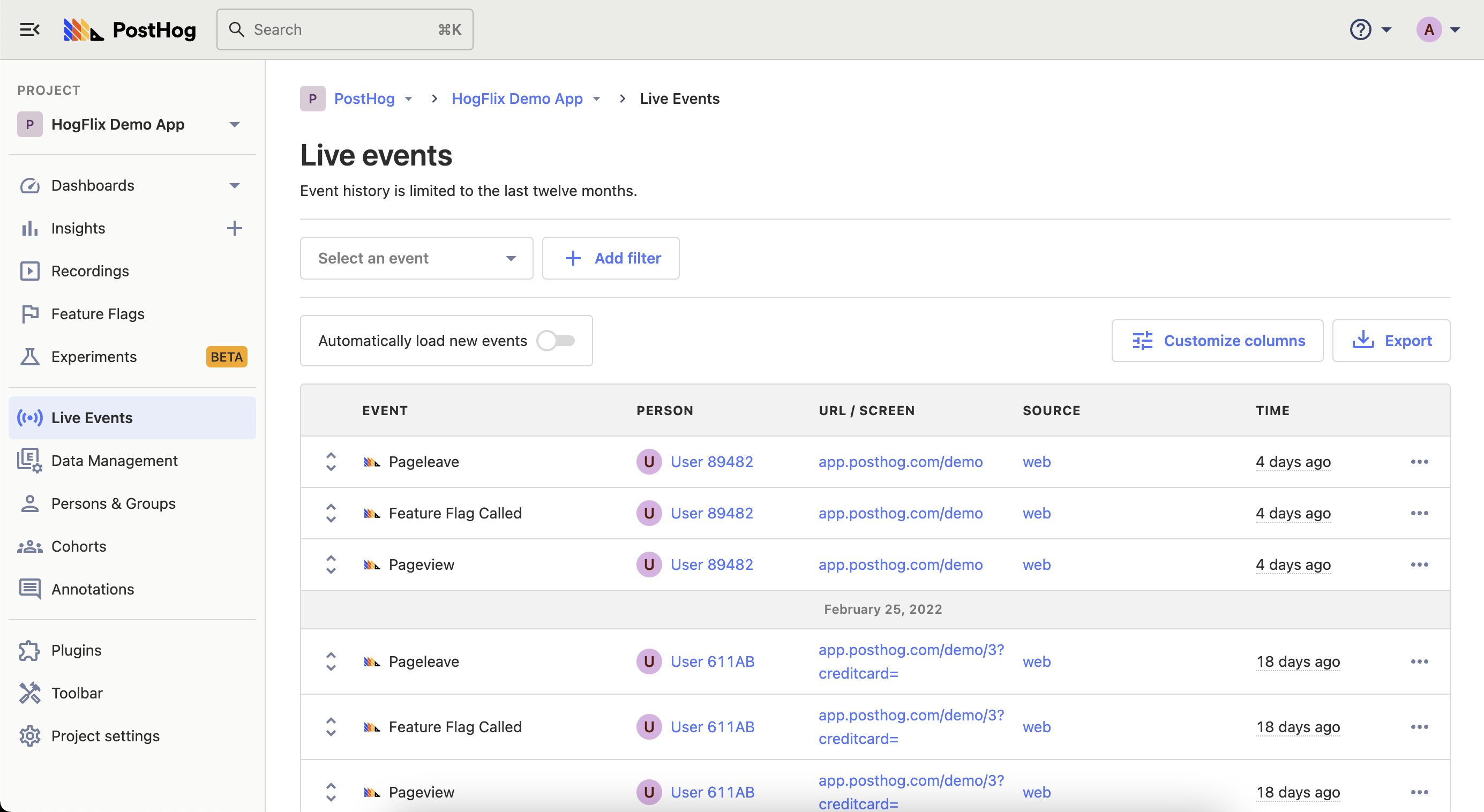
PostHog - live events tab

Not only are we giving you more ways to organize and define events, we're also making it easy to edit them wherever you are in the product.

Building an insight and see an Event or Event property that could be more descriptive? You can now create a definition for that without leaving the insight query builder.

Just hover over the Event property in the dropdown...
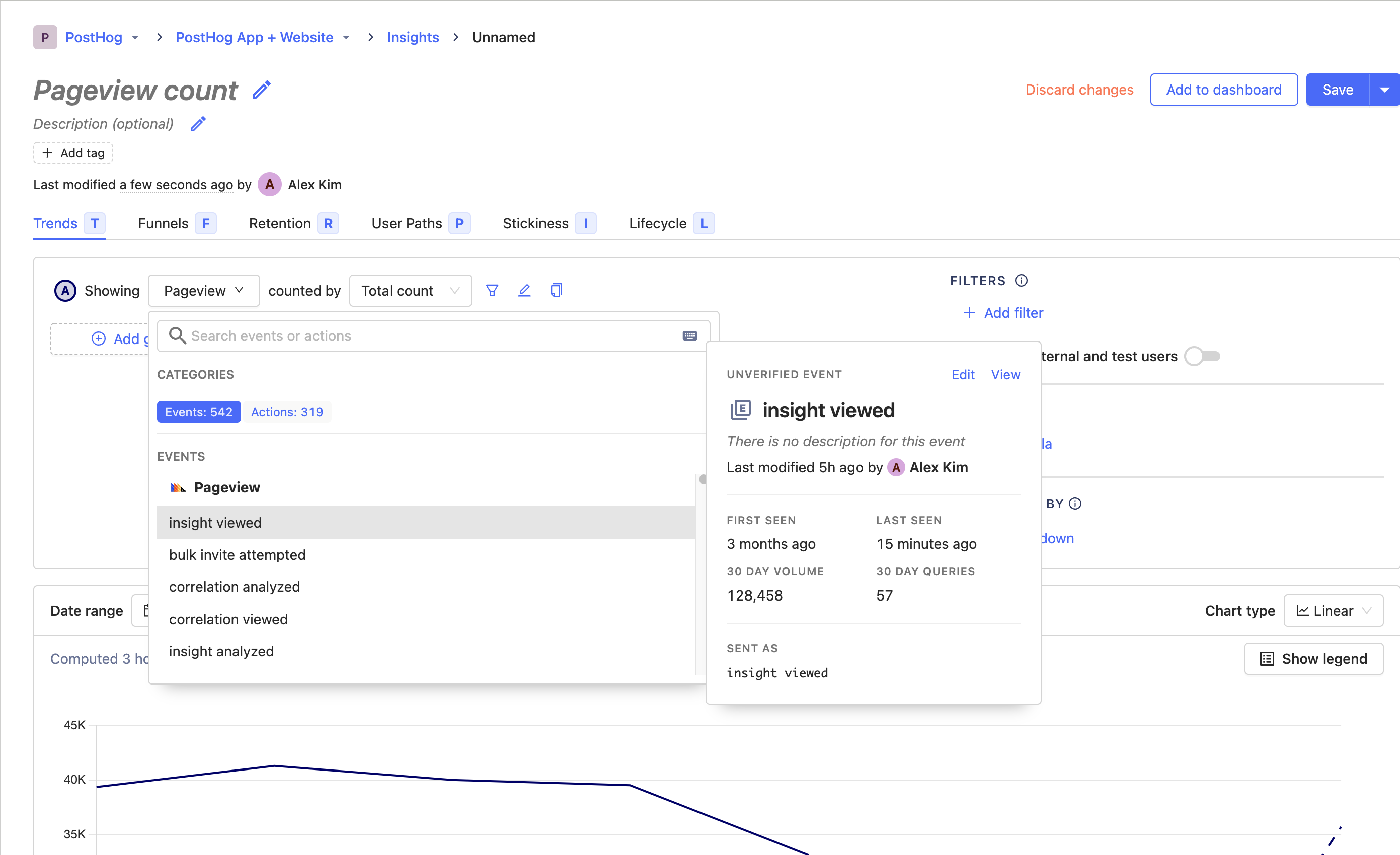
PostHog - read definition hover card

And when you click 'Edit' you can add a description, add tags or mark it as a Verified Event.
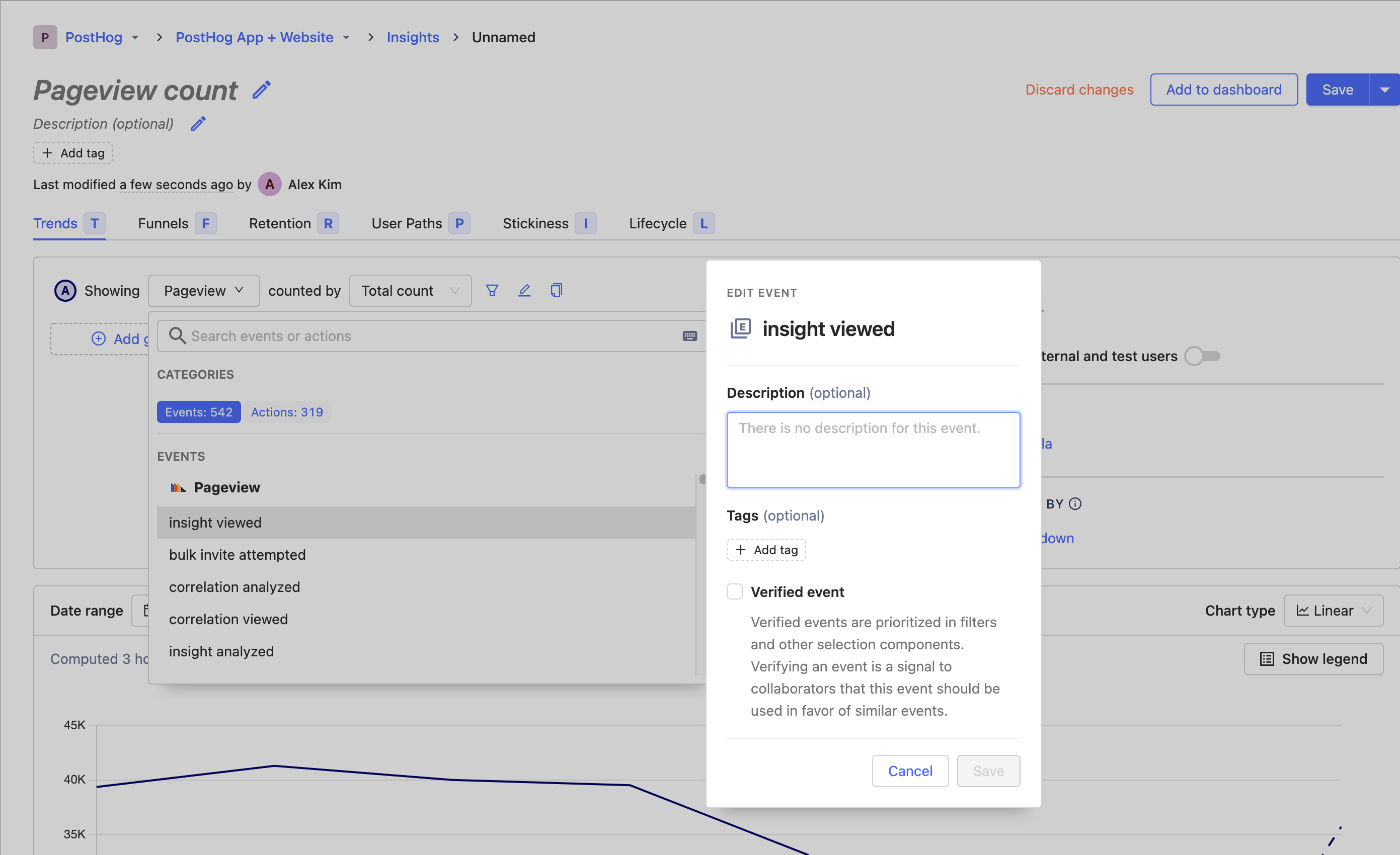
PostHog - write definition hover card

Alternatively, click on 'View' in the definition hover card and you'll be redirected to the new Data Management page, where you can explore all the Events and Event properties you've created.
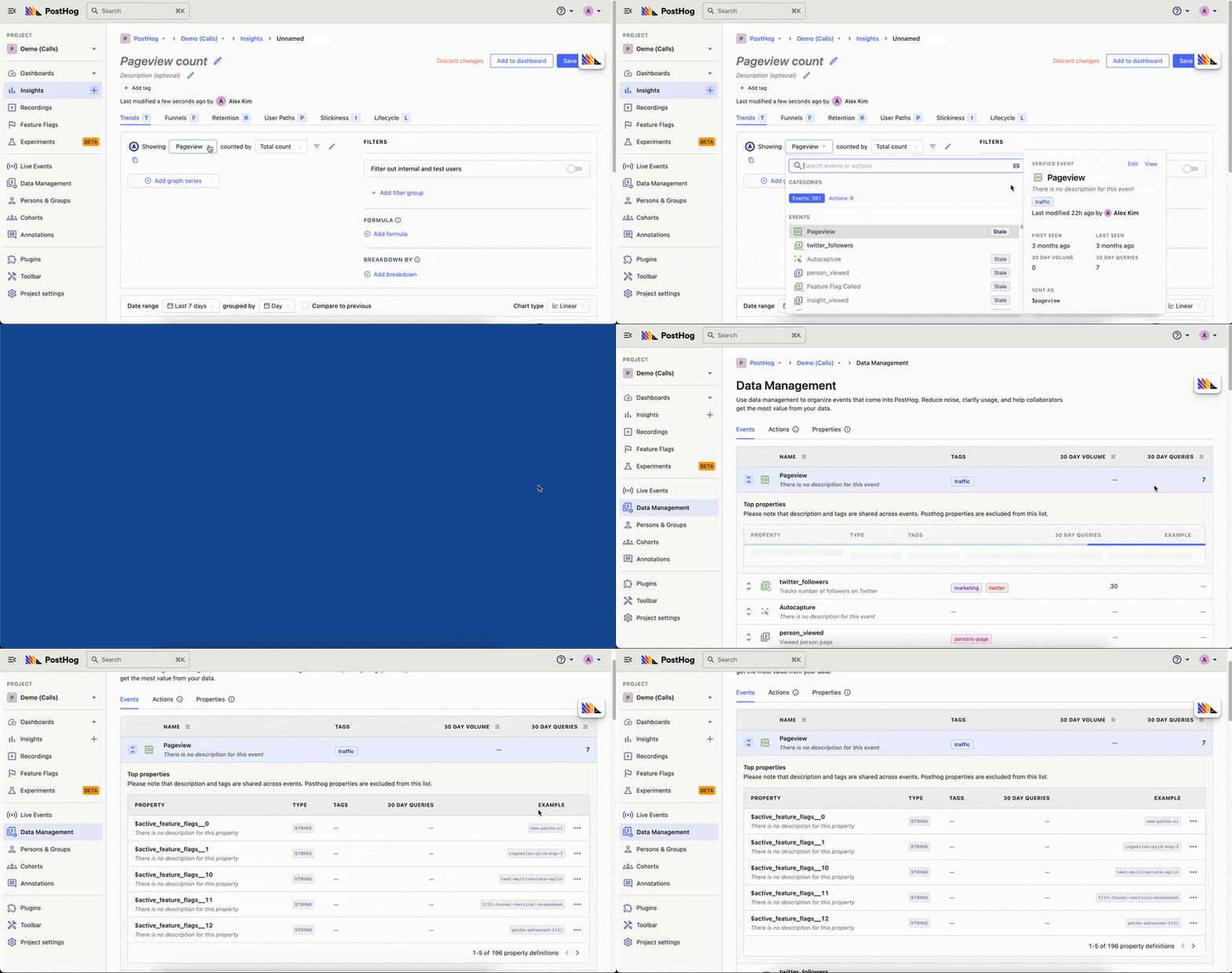
PostHog - view definition context

And if you want a gold star in best practice, you can also opt to create definitions with our API. Check out our documentation on how to use the event_definitions and property_definitions API endpoints.

Oh, and in case you were wondering, the awesome thing about definitions in PostHog is that they can be created, updated, or deleted at any time without affecting the event data that is already there, so you don't need to create event definitions before ingesting events.

To help you in your journey to data management nirvana, here are a few rules of thumb to consider when using these new features.

1. The more definitions you add, the easier it will be for your teammates to understand what each event and property represents.

Take a custom event sent as sign_up for example that is triggered on user sign up. Pretty self-explanatory, right? Not necessarily. Imagine you have a second app pushing data to the same PostHog instance sending sign up events as sign up; or maybe you send a sign up event from your frontend and one from your backend. A new teammate using PostHog will find it impossible to differentiate between the two, potentially leading to incorrect conclusions and frustration. Describing these events properly can ensure your teammates find exactly what they're looking for.

2. Official organization-wide events should be verified so that teammates can discover and use them easily.

Verified events will be prioritized in filters and other selection components to signal to the rest of the team that this event should be used in favor of other similar events. An example where this comes in handy is if there are two events that sound familiar, signed up and signed_up. Verifying the first tells others very explicitly that one is still being used and the other has gone stale.

3. Tagging is an easy way to categorize events into custom groups, be it for a product, feature or new page.

We highly recommend using tags to organize events coming in from different parts of your product. At PostHog for example, we use tags called session-recordings, funnels, and feature-flags to keep track of insights and dashboards related to those features.

Tags can also be useful for organizing PostHog for internal use. We create tags for each of our internal small teams to signal which dashboards are interesting to our respective teams.

To recap, the new Data Management experience means you can:

  • Organize your definitions with tags
  • Manage event definitions on the fly while building insights
  • Verify trusted definitions which are prioritized in the UI
  • Easily manage all your Events, Event properties and Actions in the Data Management tab
  • Debug your incoming events using in the Activity tab

These are powerful tools for organizing your data, but we're just scratching the surface. Below are just a few ideas on our roadmap that we think you'll like:

  • Role-based ownership of definitions
  • Personally identifiable information (PII) rules
  • Anomaly detection for malformed events and properties
  • Person and Group Property definitions

As always, we welcome any feedback you may have about this feature. Feel free to open an issue in our Github repo, join us directly for a call with our Product & Engineering team, or submit a ticket in our app.

PostHog is an open source developer platform that helps people build successful products. We help you debug and ship your product faster.

Want to just try it already?

(Sorry for the shameless CTA.)