


惯性聚合 高效追踪和阅读你感兴趣的博客、新闻、科技资讯
阅读原文 在惯性聚合中打开

推荐订阅源

F
Full Disclosure
OSCHINA 社区最新新闻
OSCHINA 社区最新新闻
AI
AI
博客园 - Franky
博客园 - 叶小钗
MyScale Blog
MyScale Blog
Microsoft Azure Blog
V
Visual Studio Blog
U
Unit 42
C
Check Point Blog
美团技术团队
博客园 - 【当耐特】
MongoDB | Blog
MongoDB | Blog
WordPress大学
WordPress大学
aimingoo的专栏
aimingoo的专栏
A
About on SuperTechFans
G
Google Developers Blog
腾讯CDC
Jina AI
Jina AI
博客园 - 三生石上(FineUI控件)
人人都是产品经理
人人都是产品经理
酷 壳 – CoolShell
酷 壳 – CoolShell
N
Netflix TechBlog - Medium
S
SegmentFault 最新的问题
H
Help Net Security
T
Threat Research - Cisco Blogs
T
Tenable Blog
J
Java Code Geeks
奇客Solidot–传递最新科技情报
奇客Solidot–传递最新科技情报
T
Threatpost
T
The Blog of Author Tim Ferriss
The Cloudflare Blog
Cyberwarzone
Cyberwarzone
Spread Privacy
Spread Privacy
K
Kaspersky official blog
G
GRAHAM CLULEY
Cisco Talos Blog
Cisco Talos Blog
Project Zero
Project Zero
C
CERT Recently Published Vulnerability Notes
AWS News Blog
AWS News Blog
Know Your Adversary
Know Your Adversary
T
Tor Project blog
S
Secure Thoughts
cs.AI updates on arXiv.org
PCI Perspectives
PCI Perspectives
P
Palo Alto Networks Blog
Webroot Blog
Webroot Blog
N
News | PayPal Newsroom
cs.CV updates on arXiv.org
C
Cyber Attacks, Cyber Crime and Cyber Security

Let's Encrypt

The difficulty of making sure your website is broken Simplifying Certificate Renewals for Millions of Domains with ACME Renewal Information (ARI) Six-Day and IP Address Certificates Available in Certbot Shorter Certificate Lifetimes and Rate Limits DNS-PERSIST-01: A New Model for DNS-based Challenge Validation On the Importance of "Hello" and "Thanks" 6-day and IP Address Certificates are Generally Available 10 Years of Let's Encrypt Certificates Decreasing Certificate Lifetimes to 45 Days New "Generation Y" Hierarchy of Root and Intermediate Certificates Ten Years of Community Support ACME Renewal Information (ARI) Published as RFC 9773 Native ACME Support Comes to NGINX End of Life Plan for RFC 6962 Certificate Transparency Logs OCSP Service Has Reached End of Life We've Issued Our First IP Address Certificate Expiration Notification Service Has Ended Reflections on a Year of Sunlight How We Reduced the Impact of Zombie Clients Sustaining a More Secure Internet: The Power of Recurring Donations Ending TLS Client Authentication Certificate Support in 2026 How Pebble Supports ACME Client Developers Ten Years of Let's Encrypt: Announcing support from Jeff Atwood We Issued Our First Six Day Cert Encryption for Everybody Scaling Our Rate Limits to Prepare for a Billion Active Certificates Ending Support for Expiration Notification Emails Announcing Six Day and IP Address Certificate Options in 2025 Announcing Certificate Profile Selection Ending OCSP Support in 2025 Intent to End OCSP Service More Memory Safety for Let’s Encrypt: Deploying ntpd-rs Let’s Encrypt Continues Partnership with Princeton to Bolster Internet Security Takeaways from Tailscale’s Adoption of ARI An Engineer’s Guide to Integrating ARI into Existing ACME Clients Deploying Let's Encrypt's New Issuance Chains New Intermediate Certificates Introducing Sunlight, a CT implementation built for scalability, ease of operation, and reduced cost A Year-End Letter from our Vice President Our role in supporting the nonprofit ecosystem Increase your security governance with CAA Shortening the Let's Encrypt Chain of Trust ISRG’s 10th Anniversary Improving Resiliency and Reliability for Let’s Encrypt with ARI Thank you to our 2023 renewing sponsors A Look into the Engineering Culture at ISRG Let’s Encrypt improves how we manage OCSP responses A New Life for Certificate Revocation Lists Nurturing Continued Growth of Our Oak CT Log TLS Beyond the Web: How MongoDB Uses Let’s Encrypt for Database-to-Application Security Let’s Encrypt Receives the Levchin Prize for Real-World Cryptography New Major Funding from the Ford Foundation TLS Simply and Automatically for Europe’s Largest Cloud Customers Making the Web safer and more secure for everyone Resources for Certificate Chaining Help Speed at scale: Let’s Encrypt serving Shopify’s 4.5 million domains Preparing to Issue 200 Million Certificates in 24 Hours The Next Gen Database Servers Powering Let's Encrypt A Year-End Letter from the Executive Director of Let's Encrypt and ISRG Extending Android Device Compatibility for Let's Encrypt Certificates Standing on Our Own Two Feet [Updated] Let's Encrypt's New Root and Intermediate Certificates Let's Encrypt Has Issued a Billion Certificates Multi-Perspective Validation Improves Domain Validation Security How Let's Encrypt Runs CT Logs Onboarding Your Customers with Let's Encrypt and ACME Introducing Oak, a Free and Open Certificate Transparency Log Transitioning to ISRG's Root The ACME Protocol is an IETF Standard Facebook Expands Support for Let’s Encrypt Looking Forward to 2019 Let's Encrypt Root Trusted By All Major Root Programs Engineering deep dive: Encoding of SCTs in certificates Looking Forward to 2018 ACME Support in Apache HTTP Server Project Wildcard Certificates Coming January 2018 Milestone: 100 Million Certificates Issued ACME v2 API Endpoint Coming January 2018 OVH Renews Platinum Sponsorship of Let's Encrypt Launching Our Crowdfunding Campaign Our First Grant: The Ford Foundation Squarespace OCSP Stapling Implementation Introducing Internationalized Domain Name (IDN) Support ISRG Legal Transparency Report, January 2016 - June 2016 What It Costs to Run Let's Encrypt Let's Encrypt Root to be Trusted by Mozilla Full Support for IPv6 Defending Our Brand [Updated] Progress Towards 100% HTTPS, June 2016 Leaving Beta, New Sponsors ISRG Legal Transparency Report, July 2015 - December 2015 New Name, New Home for the Let's Encrypt Client Software Our Millionth Certificate OVH Sponsors Let's Encrypt Entering Public Beta Facebook Sponsors Let's Encrypt Public Beta: December 3, 2015 Why ninety-day lifetimes for certificates? The CA's Role in Fighting Phishing and Malware Let's Encrypt is Trusted
Let’s Encrypt 2016 In Review
2017-01-06 · via Let's Encrypt

By Josh Aas, ISRG Executive Director ·

Our first full year as a live CA was an exciting one. I’m incredibly proud of what our team and community accomplished during 2016. I’d like to share some thoughts about how we’ve changed, what we’ve accomplished, and what we’ve learned.

At the start of 2016, Let’s Encrypt certificates had been available to the public for less than a month and we were supporting approximately 240,000 active (unexpired) certificates. That seemed like a lot at the time! Now we’re frequently issuing that many new certificates in a single day while supporting more than 20,000,000 active certificates in total. We’ve issued more than a million certificates in a single day a few times recently. We’re currently serving an average of 6,700 OCSP responses per second. We’ve done a lot of optimization work, we’ve had to add some hardware, and there have been some long nights for our staff, but we’ve been able to keep up and we’re ready for another year of strong growth.
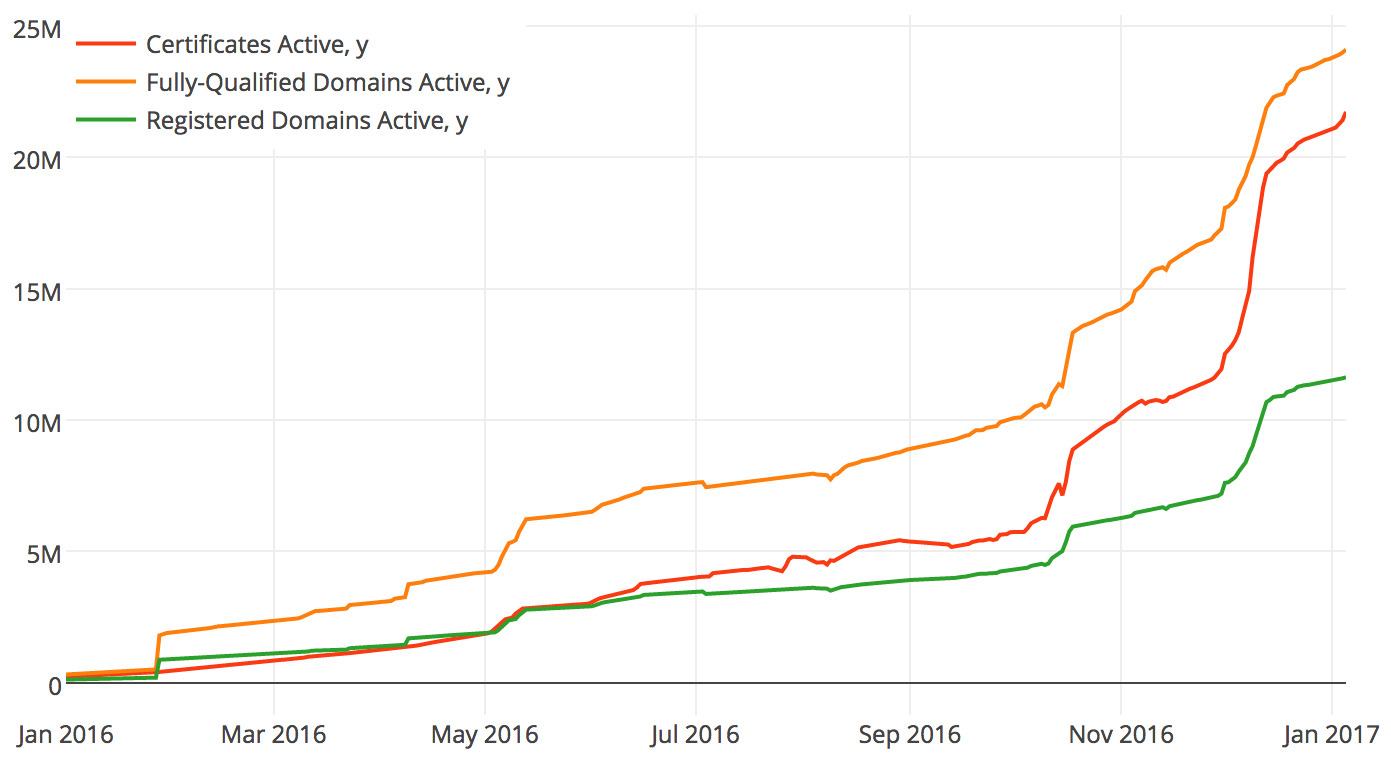
Let's Encrypt certificate issuance statistics.

We added a number of new features during the past year, including support for the ACME DNS challenge, ECDSA signing, IPv6, and Internationalized Domain Names.

When 2016 started, our root certificate had not been accepted into any major root programs. Today we’ve been accepted into the Mozilla, Apple, and Google root programs. We’re close to announcing acceptance into another major root program. These are major steps towards being able to operate as an independent CA. You can read more about why here.

The ACME protocol for issuing and managing certificates is at the heart of how Let’s Encrypt works. Having a well-defined and heavily audited specification developed in public on a standards track has been a major contributor to our growth and the growth of our client ecosystem. Great progress was made in 2016 towards standardizing ACME in the IETF ACME working group. We’re hoping for a final document around the end of Q2 2017, and we’ll announce plans for implementation of the updated protocol around that time as well.

Supporting the kind of growth we saw in 2016 meant adding staff, and during the past year Internet Security Research Group (ISRG), the non-profit entity behind Let’s Encrypt, went from four full-time employees to nine. We’re still a pretty small crew given that we’re now one of the largest CAs in the world (if not the largest), but it works because of our intense focus on automation, the fact that we’ve been able to hire great people, and because of the incredible support we receive from the Let’s Encrypt community.

Let’s Encrypt exists in order to help create a 100% encrypted Web. Our own metrics can be interesting, but they’re only really meaningful in terms of the impact they have on progress towards a more secure and privacy-respecting Web. The metric we use to track progress towards that goal is the percentage of page loads using HTTPS, as seen by browsers. According to Firefox Telemetry, the Web has gone from approximately 39% of page loads using HTTPS each day to just about 49% during the past year. We’re incredibly close to a Web that is more encrypted than not. We’re proud to have been a big part of that, but we can’t take credit for all of it. Many people and organizations around the globe have come to realize that we need to invest in a more secure and privacy-respecting Web, and have taken steps to secure their own sites as well as their customers’. Thank you to everyone that has advocated for HTTPS this year, or helped to make it easier for people to make the switch.

We learned some lessons this year. When we had service interruptions they were usually related to managing the rapidly growing database backing our CA. Also, while most of our code had proper tests, some small pieces didn’t and that led to incidents that shouldn’t have happened. That said, I’m proud of the way we handle incidents promptly, including quick and transparent public disclosure.

We also learned a lot about our client ecosystem. At the beginning of 2016, ISRG / Let’s Encrypt provided client software called letsencrypt. We’ve always known that we would never be able to produce software that would work for every Web server/stack, but we felt that we needed to offer a client that would work well for a large number of people and that could act as a reference client. By March of 2016, earlier than we had foreseen, it had become clear that our community was up to the task of creating a wide range of quality clients, and that our energy would be better spent fostering that community than producing our own client. That’s when we made the decision to hand off development of our client to the Electronic Frontier Foundation (EFF). EFF renamed the client to Certbot and has been doing an excellent job maintaining and improving it as one of many client options.

As exciting as 2016 was for Let’s Encrypt and encryption on the Web, 2017 seems set to be an even more incredible year. Much of the infrastructure and many of the plans necessary for a 100% encrypted Web came into being or solidified in 2016. More and more hosting providers and CDNs are supporting HTTPS with one click or by default, often without additional fees. It has never been easier for people and organizations running their own sites to find the tools, services, and information they need to move to HTTPS. Browsers are planning to update their user interfaces to better reflect the risks associated with non-secure connections.

We’d like to thank our community, including our sponsors, for making everything we did this past year possible. Please consider getting involved or making a donation, and if your company or organization would like to sponsor Let’s Encrypt please email us at sponsor@letsencrypt.org.