


惯性聚合 高效追踪和阅读你感兴趣的博客、新闻、科技资讯
阅读原文 在惯性聚合中打开

推荐订阅源

C
Check Point Blog
U
Unit 42
Threat Intelligence Blog | Flashpoint
奇客Solidot–传递最新科技情报
奇客Solidot–传递最新科技情报
Martin Fowler
Martin Fowler
L
LangChain Blog
博客园_首页
博客园 - 【当耐特】
Vercel News
Vercel News
I
InfoQ
GbyAI
GbyAI
爱范儿
爱范儿
D
DataBreaches.Net
Blog — PlanetScale
Blog — PlanetScale
B
Blog RSS Feed
A
About on SuperTechFans
Cyber Security Advisories - MS-ISAC
freeCodeCamp Programming Tutorials: Python, JavaScript, Git & More
G
Google Developers Blog
大猫的无限游戏
大猫的无限游戏
Apple Machine Learning Research
F
Fortinet All Blogs
N
Netflix TechBlog - Medium
酷 壳 – CoolShell
酷 壳 – CoolShell
P
Proofpoint News Feed
美团技术团队
V
V2EX
Stack Overflow Blog
Stack Overflow Blog
有赞技术团队
有赞技术团队
Y
Y Combinator Blog
OSCHINA 社区最新新闻
OSCHINA 社区最新新闻
H
Help Net Security
Recent Announcements
Microsoft Azure Blog
D
Docker
宝玉的分享
宝玉的分享
让小产品的独立变现更简单 - ezindie.com
量子位
小众软件
小众软件
J
Java Code Geeks
S
SegmentFault 最新的问题
Engineering at Meta
Engineering at Meta
Google DeepMind News
MongoDB | Blog
MongoDB | Blog
The Cloudflare Blog
Recorded Future
Recorded Future
阮一峰的网络日志
阮一峰的网络日志
T
The Blog of Author Tim Ferriss
MyScale Blog
MyScale Blog
Microsoft Security Blog

Let's Encrypt

The difficulty of making sure your website is broken Six-Day and IP Address Certificates Available in Certbot Shorter Certificate Lifetimes and Rate Limits DNS-PERSIST-01: A New Model for DNS-based Challenge Validation On the Importance of "Hello" and "Thanks" 6-day and IP Address Certificates are Generally Available 10 Years of Let's Encrypt Certificates Decreasing Certificate Lifetimes to 45 Days New "Generation Y" Hierarchy of Root and Intermediate Certificates Ten Years of Community Support ACME Renewal Information (ARI) Published as RFC 9773 Native ACME Support Comes to NGINX End of Life Plan for RFC 6962 Certificate Transparency Logs OCSP Service Has Reached End of Life We've Issued Our First IP Address Certificate Expiration Notification Service Has Ended Reflections on a Year of Sunlight How We Reduced the Impact of Zombie Clients Sustaining a More Secure Internet: The Power of Recurring Donations Ending TLS Client Authentication Certificate Support in 2026 How Pebble Supports ACME Client Developers Ten Years of Let's Encrypt: Announcing support from Jeff Atwood We Issued Our First Six Day Cert Encryption for Everybody Scaling Our Rate Limits to Prepare for a Billion Active Certificates Ending Support for Expiration Notification Emails Announcing Six Day and IP Address Certificate Options in 2025 Announcing Certificate Profile Selection Ending OCSP Support in 2025 Intent to End OCSP Service More Memory Safety for Let’s Encrypt: Deploying ntpd-rs Let’s Encrypt Continues Partnership with Princeton to Bolster Internet Security Takeaways from Tailscale’s Adoption of ARI An Engineer’s Guide to Integrating ARI into Existing ACME Clients Deploying Let's Encrypt's New Issuance Chains New Intermediate Certificates Introducing Sunlight, a CT implementation built for scalability, ease of operation, and reduced cost A Year-End Letter from our Vice President Our role in supporting the nonprofit ecosystem Increase your security governance with CAA Shortening the Let's Encrypt Chain of Trust ISRG’s 10th Anniversary Improving Resiliency and Reliability for Let’s Encrypt with ARI Thank you to our 2023 renewing sponsors A Look into the Engineering Culture at ISRG Let’s Encrypt improves how we manage OCSP responses A New Life for Certificate Revocation Lists Nurturing Continued Growth of Our Oak CT Log TLS Beyond the Web: How MongoDB Uses Let’s Encrypt for Database-to-Application Security Let’s Encrypt Receives the Levchin Prize for Real-World Cryptography New Major Funding from the Ford Foundation TLS Simply and Automatically for Europe’s Largest Cloud Customers Making the Web safer and more secure for everyone Resources for Certificate Chaining Help Speed at scale: Let’s Encrypt serving Shopify’s 4.5 million domains Preparing to Issue 200 Million Certificates in 24 Hours The Next Gen Database Servers Powering Let's Encrypt A Year-End Letter from the Executive Director of Let's Encrypt and ISRG Extending Android Device Compatibility for Let's Encrypt Certificates Standing on Our Own Two Feet [Updated] Let's Encrypt's New Root and Intermediate Certificates Let's Encrypt Has Issued a Billion Certificates Multi-Perspective Validation Improves Domain Validation Security How Let's Encrypt Runs CT Logs Onboarding Your Customers with Let's Encrypt and ACME Introducing Oak, a Free and Open Certificate Transparency Log Transitioning to ISRG's Root The ACME Protocol is an IETF Standard Facebook Expands Support for Let’s Encrypt Looking Forward to 2019 Let's Encrypt Root Trusted By All Major Root Programs Engineering deep dive: Encoding of SCTs in certificates Looking Forward to 2018 ACME Support in Apache HTTP Server Project Wildcard Certificates Coming January 2018 Milestone: 100 Million Certificates Issued ACME v2 API Endpoint Coming January 2018 OVH Renews Platinum Sponsorship of Let's Encrypt Let’s Encrypt 2016 In Review Launching Our Crowdfunding Campaign Our First Grant: The Ford Foundation Squarespace OCSP Stapling Implementation Introducing Internationalized Domain Name (IDN) Support ISRG Legal Transparency Report, January 2016 - June 2016 What It Costs to Run Let's Encrypt Let's Encrypt Root to be Trusted by Mozilla Full Support for IPv6 Defending Our Brand [Updated] Progress Towards 100% HTTPS, June 2016 Leaving Beta, New Sponsors ISRG Legal Transparency Report, July 2015 - December 2015 New Name, New Home for the Let's Encrypt Client Software Our Millionth Certificate OVH Sponsors Let's Encrypt Entering Public Beta Facebook Sponsors Let's Encrypt Public Beta: December 3, 2015 Why ninety-day lifetimes for certificates? The CA's Role in Fighting Phishing and Malware Let's Encrypt is Trusted
Simplifying Certificate Renewals for Millions of Domains with ACME Renewal Information (ARI)
2026-03-17 · via Let's Encrypt

By Nick Silverman ·

Nick Silverman is a Senior Infrastructure Engineer on the Edge Infrastructure team at Shopify, where he maintains the systems that provision, renew, and publish SSL certificates for millions of merchants’ custom domains. He is also a contributor to the Ruby acme-client gem.

The challenge

Shopify’s automated certificate management system relied on a static renewal threshold: 30 days before the end of the 90-day lifetime. To spread the load of provisioning and renewing certificates, we implemented a random 0–72 hour delay for each. While this helps evenly distribute certificate management over time, it did not take into account the Certificate Authority’s (CA) load. It was also incapable of reacting to a dynamic renewal window based on information provided by the CA.

However, this approach needed greater resilience to solve what is, in the end, a distributed coordination problem. The weaknesses are:

  • No rapid revocation response: The static logic is not aware of revocations at all.

  • Brittleness to lifetime changes: The static 30-day threshold is not resilient to changes in certificate lifetime, such as Let’s Encrypt’s announced plan to move to 45-day certificates.

  • Imperfect load distribution: Despite the random jitter, massive renewal bursts could still occur.

Shopify needed to develop a global coordination system to balance the load and handle regular and urgent renewals. Thankfully, Let’s Encrypt has led the charge on a solution for this and other very important aspects of the certificate lifecycle.

The journey

Let’s Encrypt and the Internet Engineering Task Force (IETF) published the ACME Renewal Information (ARI) standard which makes an endpoint available that provides a recommended window of time for the renewal to occur. The endpoint returns a payload that looks something like this:

GET /renewal-info/ACME_KEY_IDENTIFIER
{
  "suggestedWindow": {
    "start": "2026-02-03T04:00:00Z",
    "end": "2026-02-04T04:00:00Z"
  }
}

Shopify’s certificate management system uses the acme-client Ruby gem originally authored by another Shopify employee. A growing number of ACME clients, including certbot, have enabled support for ARI, but the Ruby gem did not yet support this feature. Rather than building a custom solution, we decided to enable support for the ARI extension directly in the client.

Let’s Encrypt’s guide to integrating ARI provided the necessary roadmap, and the implementation was completed with one PR. This contribution means that not only Shopify, but also the wider Ruby community, can benefit from the ARI extension.

Deployment and ARI at scale

Once we shipped the gem support, integrating ARI into our certificate management system was straightforward. Instead of checking a static 30-day threshold, we now query the ARI endpoint and use the suggested renewal window as the gate for initiating renewals. Those dates are stored alongside the certificate upon its initial provisioning.

The updated Ruby gem provides a method for fetching renewal information:

renewal_info = client.renewal_info(certificate: existing_certificate_pem)

This method generates an ARI certificate identifier that can be used when making the API call. The client also includes a helper method, suggested_renewal_time, which chooses a random time between the returned start and end dates. The certificate identifier can be passed to the new_order method via the replaces key, which can grant a higher priority or bypass rate limits for renewals occurring during the window, depending on the CA’s policies.

Critically, Shopify also regularly polls the ARI endpoint for updated renewal timestamps. This allows our systems to rely on those timestamps as the primary renewal timing logic and removes the need for inflexible hard-coded expiry thresholds. This becomes the mechanism that Let’s Encrypt uses to dynamically change the renewal time due to a revocation event.
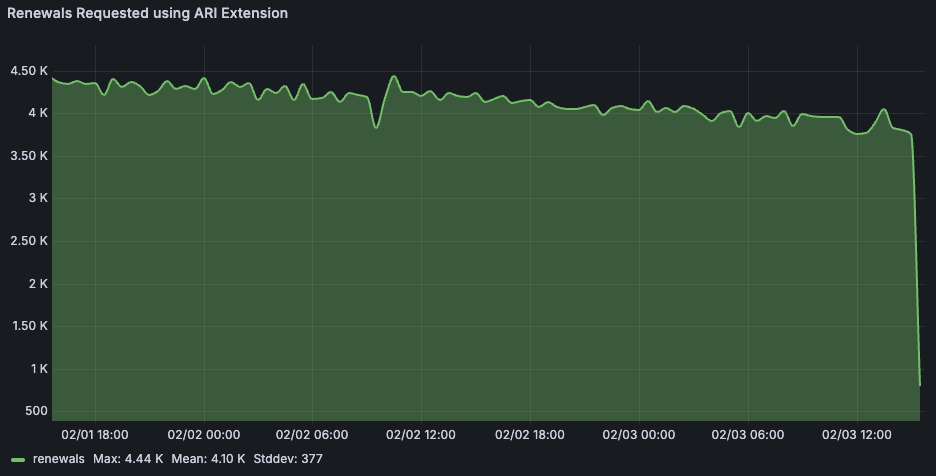
Results and rewards

Since enabling the use of the ARI extension, our certificate management system has become significantly more robust. Shopify now delegates the responsibility of determining renewal timing to Let’s Encrypt. The ARI extension has proven to be an impactful infrastructure improvement and the benefits gained are immediate. These benefits, alongside fewer manual interventions, are the operational success story:

  • Future-proofing: We gained resilience against any future certificate lifetime changes and mass revocation events without needing code updates—ensuring our renewal logic is flexible.

  • Optimized load: We directly benefit from the CA’s coordinated load balancing provided by the suggested renewal window, eliminating local randomness issues and the need for complex global coordination.

  • Revocation readiness: ARI allows systems to quickly detect and respond to revocation events when an urgent renewal is necessary, well before certificates get close to their due dates.

  • Simple implementation: The extension is mature (RFC 9773) and the implementation is straightforward, providing simplified renewal logic and CA-optimized timing.

  • Good citizenship: Anyone using ARI helps the CA optimize its infrastructure, and contributes to better aggregate behavior across the entire ecosystem.

If you’re still relying on static renewal thresholds, give ARI a look—Shopify wholeheartedly encourages all ACME users and client developers to adopt the ARI extension.