惯性聚合 高效追踪和阅读你感兴趣的博客、新闻、科技资讯
阅读原文 在惯性聚合中打开

推荐订阅源

Recent Announcements
让小产品的独立变现更简单 - ezindie.com
量子位
博客园 - 司徒正美
Security Archives - TechRepublic
P
Palo Alto Networks Blog
cs.CL updates on arXiv.org
Cyberwarzone
Cyberwarzone
小众软件
小众软件
T
Threatpost
Latest news
Latest news
J
Java Code Geeks
博客园 - Franky
博客园 - 三生石上(FineUI控件)
Project Zero
Project Zero
P
Privacy & Cybersecurity Law Blog
T
Tenable Blog
L
Lohrmann on Cybersecurity
大猫的无限游戏
大猫的无限游戏
WordPress大学
WordPress大学
Apple Machine Learning Research
Scott Helme
Scott Helme
Simon Willison's Weblog
C
CXSECURITY Database RSS Feed - CXSecurity.com
P
Privacy International News Feed
人人都是产品经理
人人都是产品经理
S
Schneier on Security
T
The Blog of Author Tim Ferriss
V
V2EX
有赞技术团队
有赞技术团队
Y
Y Combinator Blog
罗磊的独立博客
IT之家
IT之家
雷峰网
雷峰网
H
Help Net Security
C
Cyber Attacks, Cyber Crime and Cyber Security
T
Tor Project blog
C
Cybersecurity and Infrastructure Security Agency CISA
I
InfoQ
GbyAI
GbyAI
博客园 - 叶小钗
PCI Perspectives
PCI Perspectives
The GitHub Blog
The GitHub Blog
Martin Fowler
Martin Fowler
H
Heimdal Security Blog
Spread Privacy
Spread Privacy
博客园_首页
A
About on SuperTechFans
T
Tailwind CSS Blog
The Register - Security

Let's Encrypt

The difficulty of making sure your website is broken Simplifying Certificate Renewals for Millions of Domains with ACME Renewal Information (ARI) Six-Day and IP Address Certificates Available in Certbot Shorter Certificate Lifetimes and Rate Limits DNS-PERSIST-01: A New Model for DNS-based Challenge Validation On the Importance of "Hello" and "Thanks" 6-day and IP Address Certificates are Generally Available 10 Years of Let's Encrypt Certificates Decreasing Certificate Lifetimes to 45 Days New "Generation Y" Hierarchy of Root and Intermediate Certificates Ten Years of Community Support ACME Renewal Information (ARI) Published as RFC 9773 Native ACME Support Comes to NGINX End of Life Plan for RFC 6962 Certificate Transparency Logs OCSP Service Has Reached End of Life We've Issued Our First IP Address Certificate Expiration Notification Service Has Ended Reflections on a Year of Sunlight How We Reduced the Impact of Zombie Clients Sustaining a More Secure Internet: The Power of Recurring Donations Ending TLS Client Authentication Certificate Support in 2026 How Pebble Supports ACME Client Developers Ten Years of Let's Encrypt: Announcing support from Jeff Atwood We Issued Our First Six Day Cert Encryption for Everybody Scaling Our Rate Limits to Prepare for a Billion Active Certificates Ending Support for Expiration Notification Emails Announcing Six Day and IP Address Certificate Options in 2025 Announcing Certificate Profile Selection Ending OCSP Support in 2025 Intent to End OCSP Service More Memory Safety for Let’s Encrypt: Deploying ntpd-rs Let’s Encrypt Continues Partnership with Princeton to Bolster Internet Security Takeaways from Tailscale’s Adoption of ARI An Engineer’s Guide to Integrating ARI into Existing ACME Clients Deploying Let's Encrypt's New Issuance Chains New Intermediate Certificates Introducing Sunlight, a CT implementation built for scalability, ease of operation, and reduced cost A Year-End Letter from our Vice President Our role in supporting the nonprofit ecosystem Increase your security governance with CAA Shortening the Let's Encrypt Chain of Trust ISRG’s 10th Anniversary Improving Resiliency and Reliability for Let’s Encrypt with ARI Thank you to our 2023 renewing sponsors A Look into the Engineering Culture at ISRG Let’s Encrypt improves how we manage OCSP responses A New Life for Certificate Revocation Lists Nurturing Continued Growth of Our Oak CT Log TLS Beyond the Web: How MongoDB Uses Let’s Encrypt for Database-to-Application Security Let’s Encrypt Receives the Levchin Prize for Real-World Cryptography New Major Funding from the Ford Foundation TLS Simply and Automatically for Europe’s Largest Cloud Customers Making the Web safer and more secure for everyone Resources for Certificate Chaining Help Speed at scale: Let’s Encrypt serving Shopify’s 4.5 million domains Preparing to Issue 200 Million Certificates in 24 Hours A Year-End Letter from the Executive Director of Let's Encrypt and ISRG Extending Android Device Compatibility for Let's Encrypt Certificates Standing on Our Own Two Feet [Updated] Let's Encrypt's New Root and Intermediate Certificates Let's Encrypt Has Issued a Billion Certificates Multi-Perspective Validation Improves Domain Validation Security How Let's Encrypt Runs CT Logs Onboarding Your Customers with Let's Encrypt and ACME Introducing Oak, a Free and Open Certificate Transparency Log Transitioning to ISRG's Root The ACME Protocol is an IETF Standard Facebook Expands Support for Let’s Encrypt Looking Forward to 2019 Let's Encrypt Root Trusted By All Major Root Programs Engineering deep dive: Encoding of SCTs in certificates Looking Forward to 2018 ACME Support in Apache HTTP Server Project Wildcard Certificates Coming January 2018 Milestone: 100 Million Certificates Issued ACME v2 API Endpoint Coming January 2018 OVH Renews Platinum Sponsorship of Let's Encrypt Let’s Encrypt 2016 In Review Launching Our Crowdfunding Campaign Our First Grant: The Ford Foundation Squarespace OCSP Stapling Implementation Introducing Internationalized Domain Name (IDN) Support ISRG Legal Transparency Report, January 2016 - June 2016 What It Costs to Run Let's Encrypt Let's Encrypt Root to be Trusted by Mozilla Full Support for IPv6 Defending Our Brand [Updated] Progress Towards 100% HTTPS, June 2016 Leaving Beta, New Sponsors ISRG Legal Transparency Report, July 2015 - December 2015 New Name, New Home for the Let's Encrypt Client Software Our Millionth Certificate OVH Sponsors Let's Encrypt Entering Public Beta Facebook Sponsors Let's Encrypt Public Beta: December 3, 2015 Why ninety-day lifetimes for certificates? The CA's Role in Fighting Phishing and Malware Let's Encrypt is Trusted
The Next Gen Database Servers Powering Let's Encrypt
2021-01-21 · via Let's Encrypt

By Josh Aas and James Renken ·

Let’s Encrypt helps to protect a huge portion of the Web by providing TLS certificates to more than 235 million websites. A database is at the heart of how Let’s Encrypt manages certificate issuance. If this database isn’t performing well enough, it can cause API errors and timeouts for our subscribers. Database performance is the single most critical factor in our ability to scale while meeting service level objectives. In late 2020, we upgraded our database servers and we’ve been very happy with the results.

What exactly are we doing with these servers?

Our CA software, Boulder, uses MySQL-style schemas and queries to manage subscriber accounts and the entire certificate issuance process. It’s designed to work with a single MySQL, MariaDB, or Percona database. We currently use MariaDB, with the InnoDB database engine.

We run the CA against a single database in order to minimize complexity. Minimizing complexity is good for security, reliability, and reducing maintenance burden. We have a number of replicas of the database active at any given time, and we direct some read operations to replica database servers to reduce load on the primary.

One consequence of this design is that our database machines need to be pretty powerful. Eventually we may need to shard or break the single database into multiple databases, but hardware advancements have allowed us to avoid that so far.

Hardware Specifications

The previous generation of database hardware was powerful but it was regularly being pushed to its limits. For the next generation, we wanted to more than double almost every performance metric in the same 2U form factor. In order to pull that off, we needed AMD EPYC chips and Dell’s PowerEdge R7525 was ideal. Here are the specifications:

Previous Generation Next Generation
CPU 2x Intel Xeon E5-2650
Total 24 cores / 48 threads
2x AMD EPYC 7542
Total 64 cores / 128 threads
Memory 1TB 2400MT/s 2TB 3200MT/s
Storage 24x 3.8TB Samsung PM883
SATA SSD
560/540 MB/s read/write
24x 6.4TB Intel P4610
NVMe SSD
3200/3200 MB/s read/write
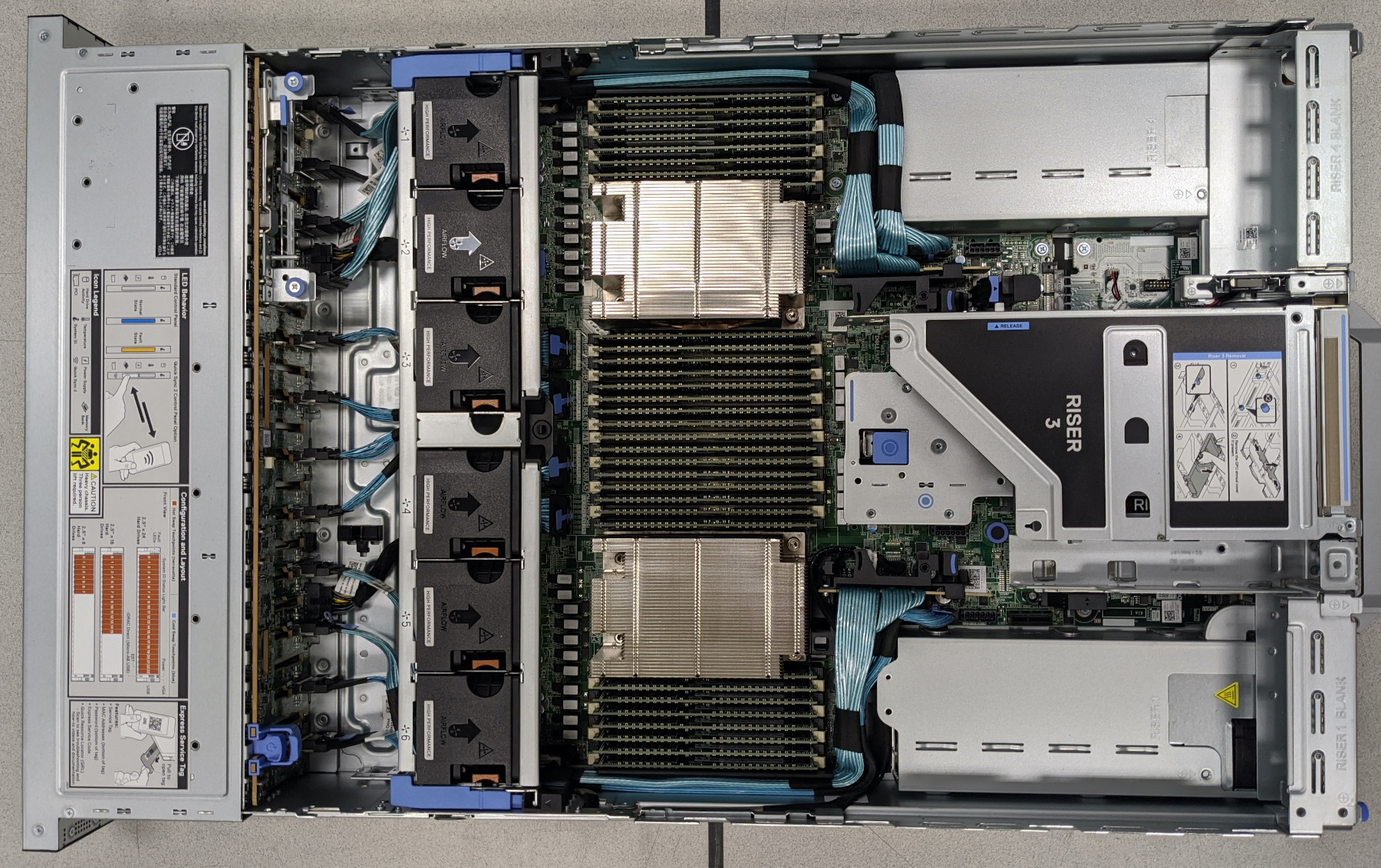
Dell PowerEdge R7525 Chassis
Dell PowerEdge R7525 internals. The two silver rectangles in the middle are the CPUs. The RAM sticks, each 64GB, are above and below the CPUs. The 24x NVMe drives are in the front of the server, on the far left.

By going with AMD EPYC, we were able to get 64 physical CPU cores while keeping clock speeds high: 2.9GHz base with 3.4GHz boost. More importantly, EPYC provides 128 PCIe v4.0 lanes, which allows us to put 24 NVMe drives in a single machine. NVMe is incredibly fast (~5.7x faster than the SATA SSDs in our previous-gen database servers) because it uses PCIe instead of SATA. However, PCIe lanes are typically very limited: modern consumer chips typically have only 16 lanes, and Intel’s Xeon chips have 48. By providing 128 PCI lanes per chip (v4.0, no less), AMD EPYC has made it possible to pack large numbers of NVMe drives into a single machine. We’ll talk more about NVMe later.

Performance Impact

We’ll start by looking at our median time to process a request because it best reflects subscribers’ experience. Before the upgrade, we turned around the median API request in ~90 ms. The upgrade decimated that metric to ~9 ms!

API Latency

We can clearly see how our old CPUs were reaching their limit. In the week before we upgraded our primary database server, its CPU usage (from /proc/stat) averaged over 90%:
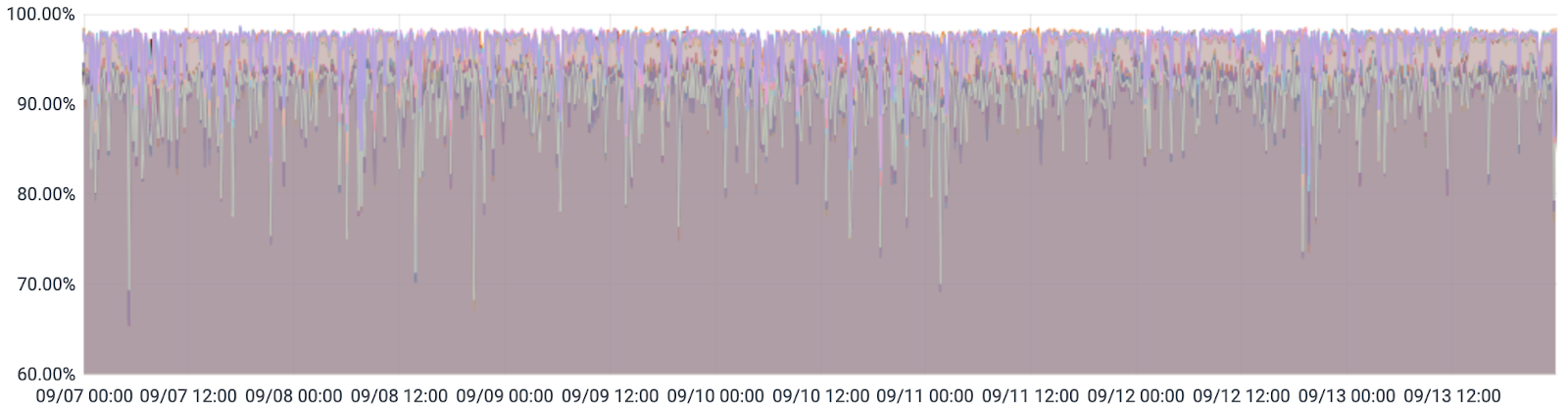
CPU Usage Before Upgrade

The new AMD EPYC CPUs sit at about 25%. You can see in this graph where we promoted the new database server from replica (read-only) to primary (read/write) on September 15.
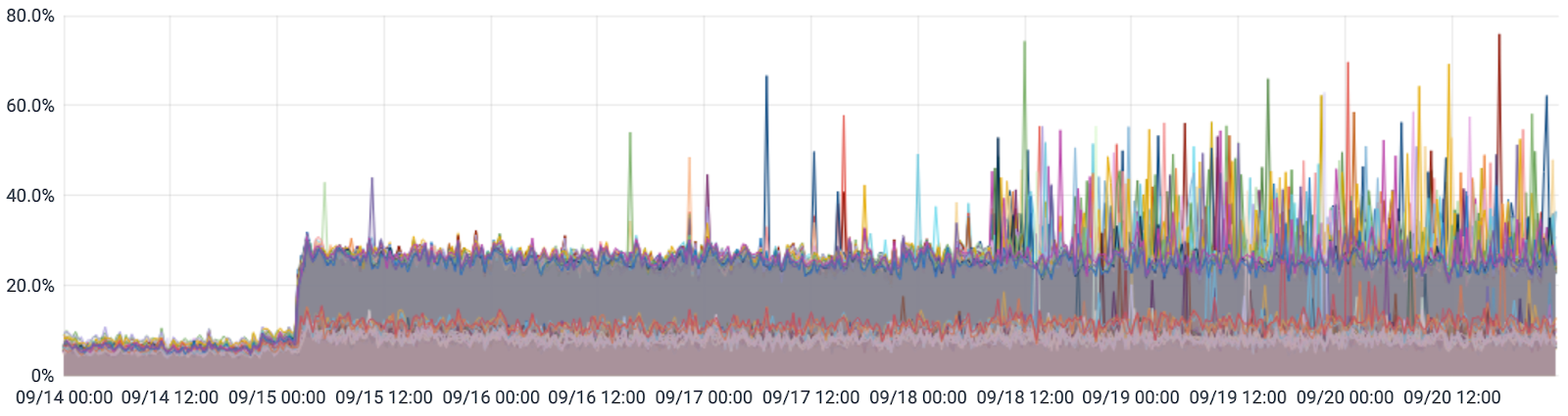
CPU Usage After Upgrade

The upgrade greatly reduced our overall database latency. The average query response time (from INFORMATION_SCHEMA) used to be ~0.45ms.
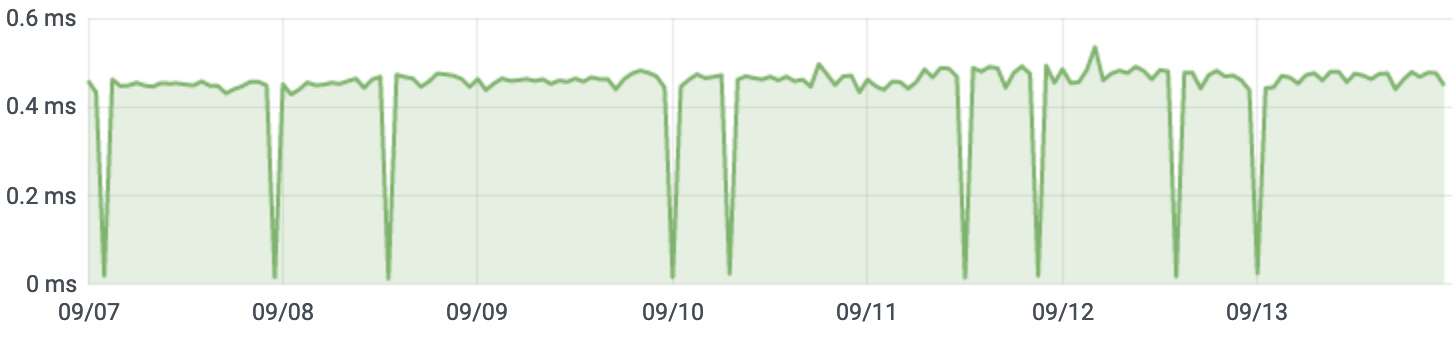
Database Latency Before Upgrade

Queries now average three times faster, about 0.15ms.
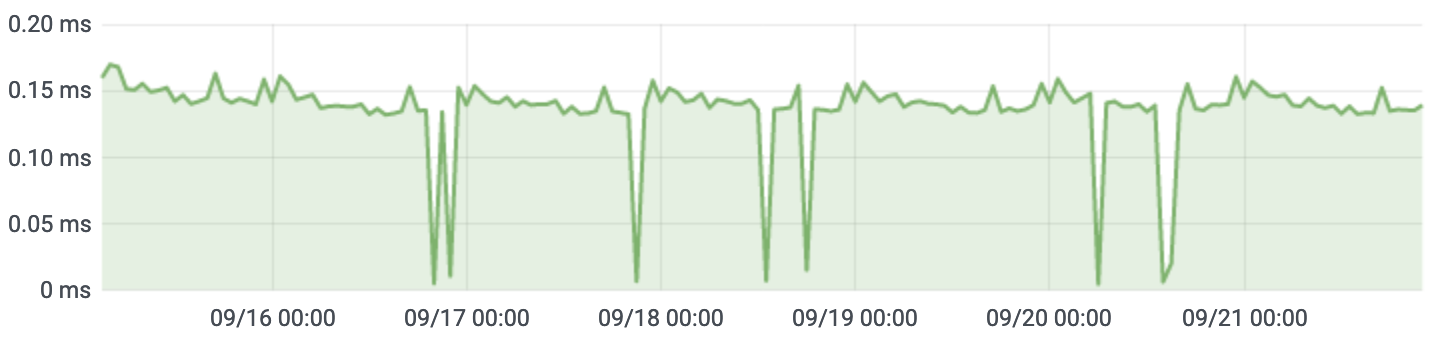
Database Latency After Upgrade

OpenZFS and NVMe

NVMe drives are becoming increasingly popular because of their incredible performance. Up until recently, though, it was nearly impossible to get many of them in a single machine because NVMe uses PCIe lanes. Those were very limited: Intel’s Xeon processors come with just 48 PCIe v3 lanes, and a number of those are used up by the chipset and add-on cards such as network adapters and GPUs. You can’t fit many NVMe drives in the remaining lanes.

AMD’s latest generation of EPYC processors come with 128 PCIe lanes - more than double what Intel offers - and they’re PCIe v4! This is enough to pack a 2U server full of NVMe drives (24 in our case).

Once you have a server full of NVMe drives, you have to decide how to manage them. Our previous generation of database servers used hardware RAID in a RAID-10 configuration, but there is no effective hardware RAID for NVMe, so we needed another solution. One option was software RAID (Linux mdraid), but we got several recommendations for OpenZFS and decided to give it a shot. We’ve been very happy with it!

There wasn’t a lot of information out there about how best to set up and optimize OpenZFS for a pool of NVMe drives and a database workload, so we want to share what we learned. You can find detailed information about our setup in this GitHub repository.

Conclusion

This database upgrade was necessary as more people rely on Let’s Encrypt for the security and privacy that TLS/SSL provides. The equipment is quite expensive and it was a sizable undertaking for our SRE team to plan and execute the transition, but we gained a lot through the process.

Support Let’s Encrypt

We depend on contributions from our supporters in order to provide our services. If your company or organization would like to sponsor Let’s Encrypt please email us at sponsor@letsencrypt.org. We ask that you make an individual contribution if it is within your means.