




September 28, 2020
I originally had planned to rehouse two of the tarantulas I keep yesterday. But when drilling holes in a plastic container to provide required ventilation it turned out that the battery of the drill was nearly empty. As charging takes a long time I decided to move the rehousing to Monday afternoon; today. Note to self: always check the drill the day before.
In the late afternoon I first drilled holes in the sides of two plastic storage boxes to provide proper cross ventilation. Additionally I also drilled holes in the lids. Each box is 6.5 liters; 29 x 19.9 x 18cm. After the drilling I moved to our bathroom to do the first rehousing; a juvenile Chromatopelma cyaneopubescens (New World). As this is the easiest spider of the two, the other being a Pterinochilus murinus red color form (Old World), I decided to practice on the docile one first. A bathroom is commonly used to do a rehousing with a risk of the tarantula escaping. I used a towel to make sure no spider could run away underneath the door. As our shower has a door that completely closes and there are no other drains or holes that was the only precaution I had to take to keep any spider inside.
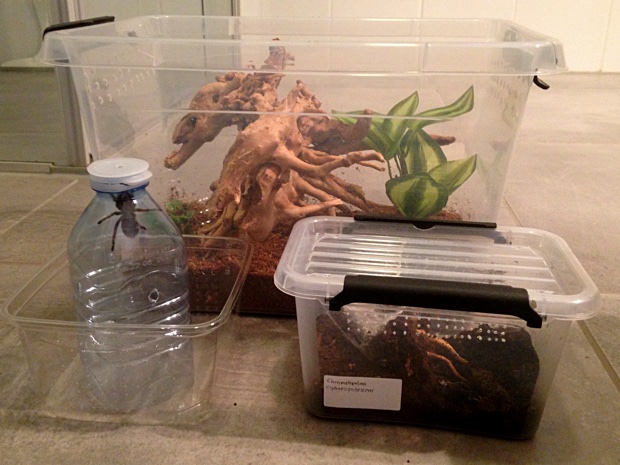
I had no problems making the Chromatopelma cyaneopubescens get into the catch cup. As this specimen is very docile I most likely could've done the transfer by using my hand, but I prefer to handle my tarantulas as little as possible and I wanted to practice with the cup.
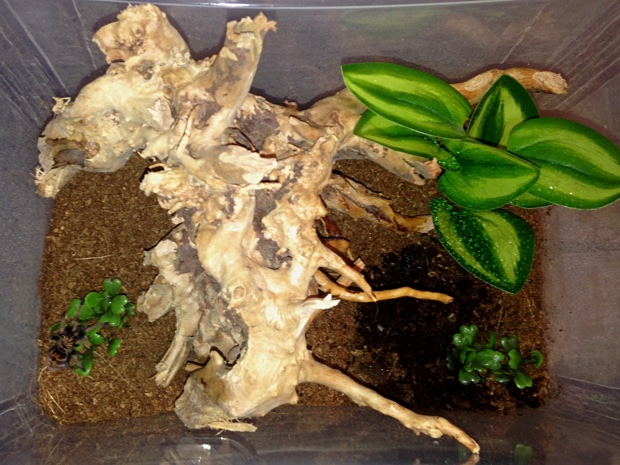
In the above photo you can see the catch cup with the spider on the left, the old terrarium (partially undone) on the left, and the new one behind. I used plastic plants to provide additional anchor points as this species likes to web a lot.
After a succesful transfer of the juvenile spider it was time for the Pterinochilus murinus, also know in the hobby as the Orange Bitey Thing. I had already planned in my head how to make it move in the catch cup; a plastic bottle with the bottom removed and some holes drilled into it in order to manipulate the spider.
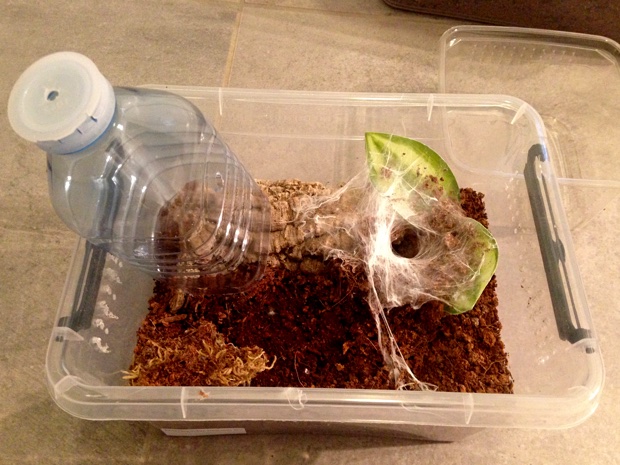
I had placed the catch cup on the small end of the burrow it had made underneath a piece of cork bark. And tried to scare it into this cup via the main entrance. But no luck. So I carefully moved the cork upside down.
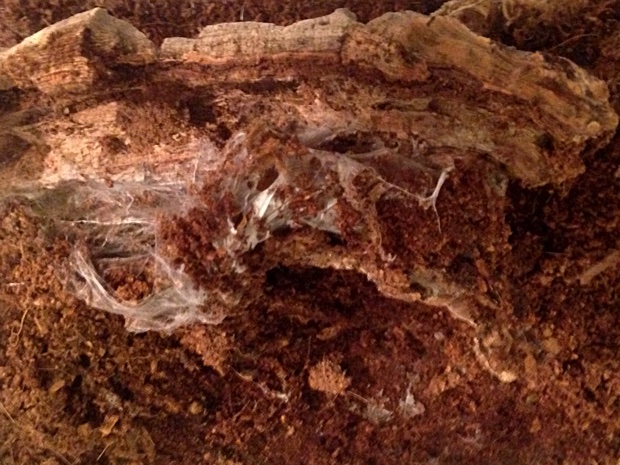
The spider was inside the silk tube it had carefully created under the cork tube. So I moved the catch cup in position and carefully pushed the spider with a thin watercolor paint brush into the direction of the opening of the silk tube over which I had placed the catch cup. The spider bolted into the cup, hit the cap, and was out and on the bathroom floor running away from me...
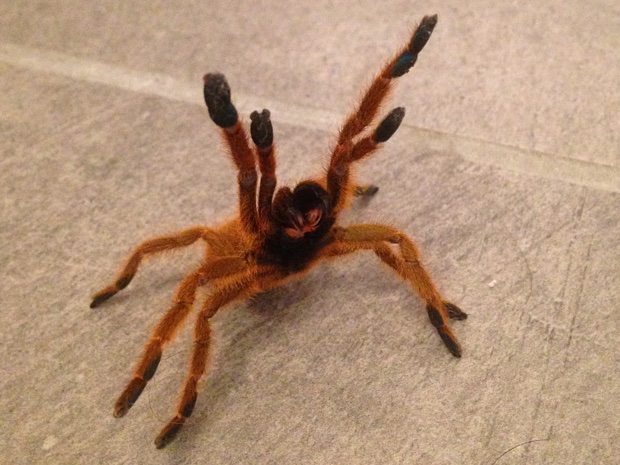
When I moved slowly towards the tarantula, it turned around and showed a threat pose. The small spider certainly lived up to its reputation; bolts easy, fast, and feisty. However, after an attempt or two I got the spider safely in the catch cup.
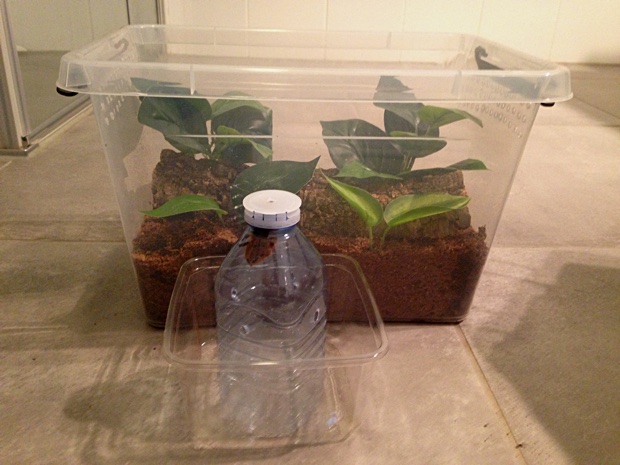
After that it was a piece of cake. I placed the catch cup in the new terrarium and carefully used the holes in the catch cup to move the spider down to the substrate. It let itself drop the last two centimeters and was soon resting on top of a piece of cork. Again I had used plastic plants to provide plenty of anchor points as this species likes to web a lot as well.
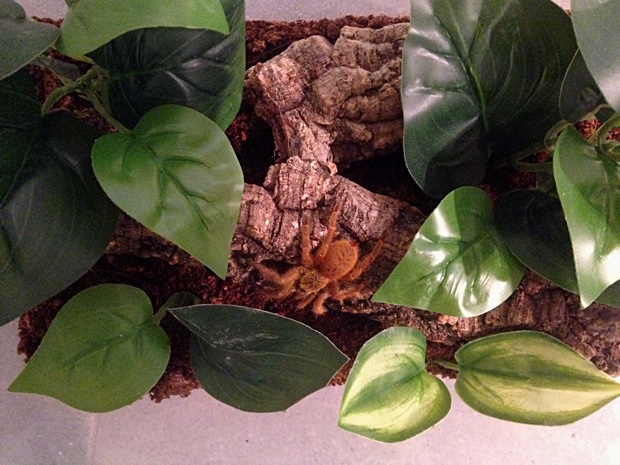
In the above set up Pterinochilus murinus has twice as much substrate compared to Chromatopelma cyaneopubescens, about 6 centimeters or well over 2 inch, as it also likes to burrow.
Related
- Invertebrate Show - where I bought the Chromatopelma cyaneopubescens as a tiny sling; 23rd of February, 2020.
- My Chromatopelma cyaneopubescens molted - first time in my care; 27th of April, 2020.
- Chromatopelma cyaneopubescens molted - second time in my care; 19th of June, 2020.
- My Chromatopelma cyaneopubescens molted again - third time in my care; 12th of August 2020.
- More Arachnids - the order I had placed online arrived, including a Pterinochilus murinus. The 7th of April, 2020.
- Pterinochilus murinus having dinner - has two nice photos of this species; 29th of July, 2020.