





There is a gesture on the iPhone that long-time mobile users are familiar with that has non-native origins. If you open the official Mail app on the inbox view, you can “pull” the interface down and the app will refresh with more emails. This is known as “pull-to-refresh.”
What not everyone may know is this interaction was made popular and invented by Loren Brichter, an independent developer who created Tweetie, a Twitter client that would later be acquired by Twitter in 2010. The pull-to-refresh gesture wasn’t just a novel interaction—it was a paradigm shift that would become ubiquitous across mobile applications.
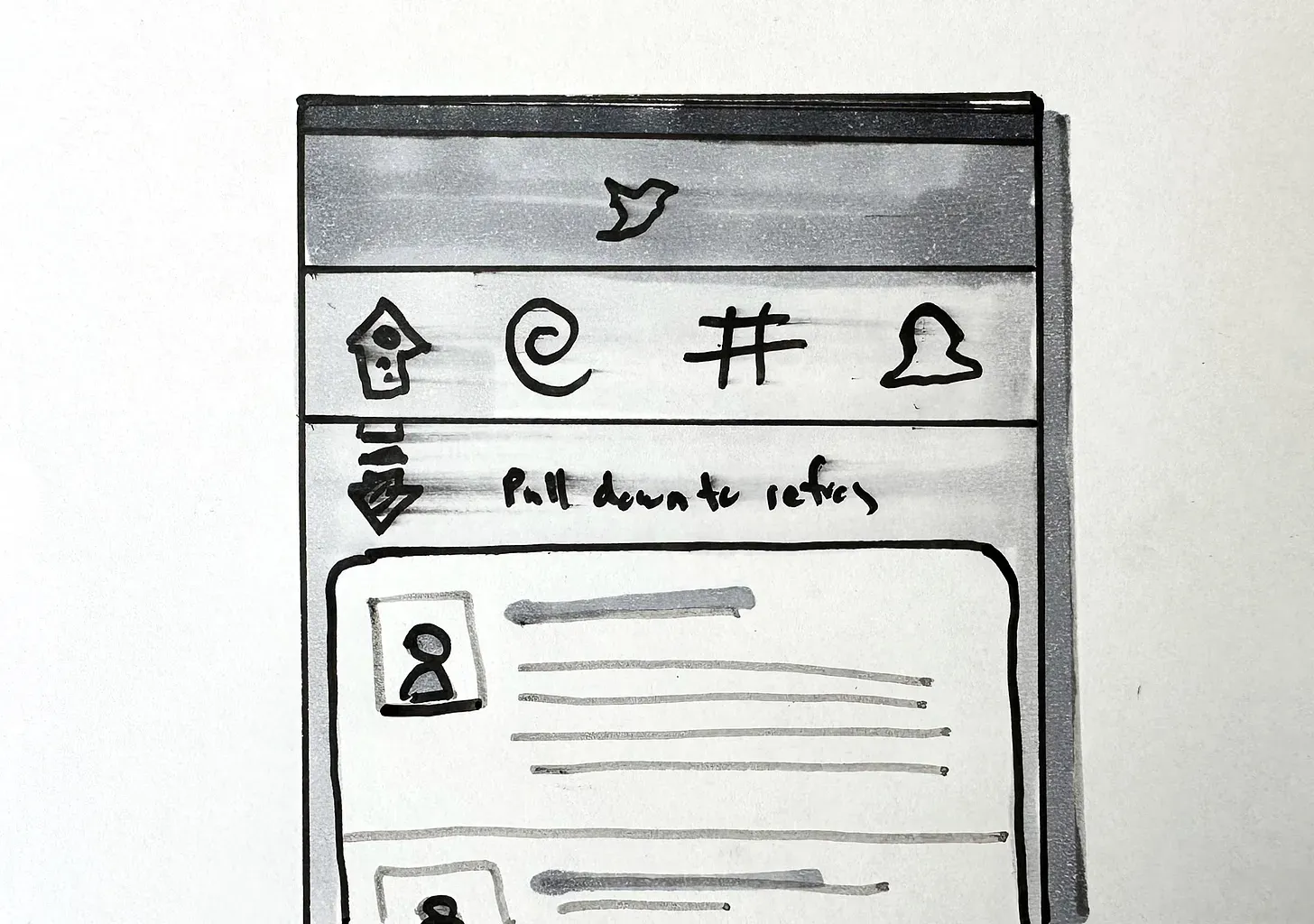
In 2008, Loren Brichter was working on Tweetie, what many described as “the Twitter app Apple itself would have made.” The challenge was simple: how do you refresh a timeline of tweets in an elegant, intuitive way?
Traditional approaches involved tapping a refresh button, usually located at the top of the screen. But Brichter had a different vision. He noticed that when users scrolled to the top of a list, there was a natural elasticity—the interface would “bounce” back into place. What if that bounce could trigger an action?
The solution was ingenious in its simplicity. Instead of requiring users to scroll to the top, lift their finger, and tap a refresh button, why not make refreshing part of the scroll gesture itself? Users could simply pull down on the timeline, and upon release, new tweets would load automatically.
Pull-to-refresh succeeded because it solved multiple problems simultaneously:
Discoverability: The gesture felt natural and was easily discoverable through normal scrolling behavior.
Efficiency: It eliminated the need for precise button tapping, especially valuable on small touch screens.
Delight: The elastic animation and satisfying “snap” made the interaction enjoyable.
Intuitiveness: It leveraged existing mental models of physical interactions—pulling to retrieve something new.
But perhaps most importantly, it turned a mechanical action into something that felt magical. This wasn’t just a functional improvement; it was a fundamental reimagining of how users could interact with dynamic content.
Today, pull-to-refresh is everywhere. From social media apps to email clients, from news readers to messaging platforms, the gesture has become as fundamental to mobile interaction as the tap or swipe. It’s been adopted across iOS, Android, and web applications. What started as one developer’s elegant solution to a specific problem became a universal design pattern.
The gesture even earned its own patent (filed by Twitter after they acquired Tweetie), though Brichter himself has suggested that developers shouldn’t worry about its enforcement. The fact that such a simple interaction warranted patent protection speaks to its innovation and impact.
So why does this matter for AI? Because we’re currently in the midst of another interface revolution, and AI still hasn’t found its “pull-to-refresh moment.”
Think about how we interact with AI today. Despite the sophisticated capabilities of large language models, we’re still largely confined to the text box—typing prompts, waiting for responses, and engaging in turn-based conversation. It’s functional, but it’s not revolutionary.
The current AI interface paradigm mirrors the early days of mobile apps: lots of buttons, explicit actions, and rigid interaction patterns. Just as mobile apps initially mimicked desktop interfaces before finding their own voice, AI applications are still searching for their native interaction model.
We’re seeing glimpses of what AI’s interface evolution might look like:
But we haven’t yet seen the breakthrough that will make AI interactions feel as intuitive and delightful as pull-to-refresh made content refreshing.
The breakthrough won’t necessarily be a gesture—it will be a fundamental reimagining of how we interact with intelligent systems. It might be:
Just as pull-to-refresh made refreshing content feel effortless, AI’s interface breakthrough will make accessing intelligence feel seamless.
The stakes for getting AI interfaces right are enormous. The company or developer who figures out AI’s equivalent of pull-to-refresh won’t just create a better user experience—they’ll potentially define how humanity interacts with artificial intelligence for years to come.
This isn’t just about convenience; it’s about accessibility, adoption, and the fundamental relationship between humans and AI. The right interface paradigm could make AI assistance as natural and widespread as pull-to-refresh became for mobile apps.
Loren Brichter’s pull-to-refresh gesture succeeded because it solved a real problem in an elegant, intuitive way. It wasn’t just a technical innovation—it was a design philosophy that prioritized user experience over technical complexity.
AI’s pull-to-refresh moment will likely follow a similar pattern. It won’t be the most technically sophisticated approach, but it will be the most human one. It will solve the interface problem we didn’t even know we had, making AI interactions feel as natural as pulling down to refresh a timeline.
The question isn’t whether this moment will come—it’s who will create it, and when. And like pull-to-refresh, when it arrives, it will seem so obvious that we’ll wonder how we ever lived without it.
Until then, we wait, experiment, and iterate. Because somewhere, perhaps in a small development studio or a large tech company, someone is working on the gesture, interaction, or paradigm that will define the next era of human-computer interaction.
The race to the interface is on. AI’s pull-to-refresh moment is coming.
Originally posted on Proof of Concept
此内容由惯性聚合(RSS阅读器)自动聚合整理,仅供阅读参考。 原文来自 — 版权归原作者所有。