


When you think of high-end or boutique design, the fashion industry likely comes to mind before software. Take something like a T-shirt. You can find a $10 version of it on a shelf at Target or spend hundreds (if not thousands) of dollars on one at a Louis Vuitton runway show. It might feel weird to think of software at first ponder, but this is where the world is heading. Could you imagine exclusive software? It’s very possible in the future. What about software that gets thrown away like a daily-use contact lens? Also possible.
There are forces of nature changing the landscape of software development that are going to change how we make software. With that, the type of software created will have a different shelf life, purpose, and level of quality. Let’s reflect on the forces of nature that are impacting this before covering what I think are four types of software in the future.
I put “easier” in quotes because of the subjectivity (perhaps “approachable” is a more appropriate word). Whether it’s no-code or writing lines of code, these two worlds are colliding. This is one of the reasons I joined Replit. If you have an internet browser, you can build software.
More people have access to creating and publishing software than ever, and that’s a great thing. I believe the best ideas that will change the world might not come from “the best” developers, but from ambitious individuals who hack something together to take an idea and turn it into something tangible.
It’s not to say that nobody is ever going to have a database in their software anymore, but there are more reasons to not need one. As the world of software creation shifts with more access to endpoints, APIs, and language models, this might result in more emphasis on client-side apps. Let’s take Threads, an Instagram company (a Meta company), which launched this month. There seem to be plans to integrate the Twitter clone with ActivityPub, a decentralized protocol also used by Mastodon.
This essentially means you can weave federated experiences into one. There is a world where you experience the same content but through multiple apps. We are entering the Twitter clone saga with Bluesky, T2 (no relation to Terminator 2: Judgment Day, unfortunately), Posts, Substack Notes, and Threads. If all of these apps used ActivityPub, having unique client-side application experiences doesn’t matter. “Apps” as we are accustomed to feel more like views.
In its early days, software distribution looked more like how we delivered physical goods than it does today. When a developer released software, it came in a box along with the floppy disk(s) and instruction manual for you to get started. Deploying software no longer needs to be written on a physical disk and can be nearly immediate. There’s going to still be a world relying on platforms to distribute software (such as the Apple App Store or Google Play for iOS and Android apps) but there are now opportunities to go direct with other software built.
The forces of nature above will result in four types of software: Commercial, Boutique, Personal, and Disposable.
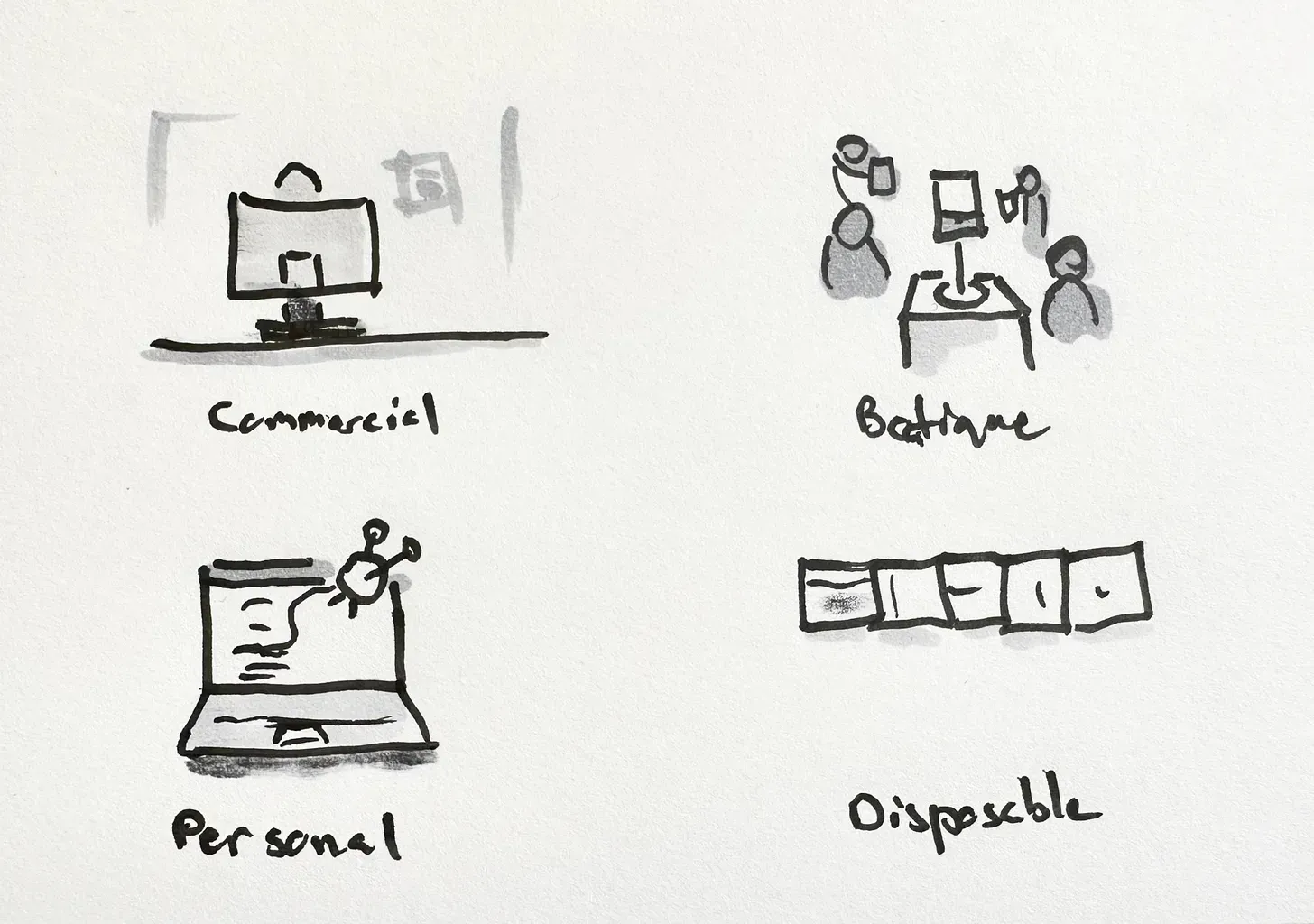
This category is the majority of what we know today. It’s enterprise software, CRMs, and administrative applications we interact with. It’s purchased through a subscription or the elusive one-time purchase with a license. Typically, commercial software is provided to you by your employer. Another sub-category is software created by entities for administrative reasons, such as government websites. The category of this software might feel basic—enough to get a job done.
I don’t need amazing parallax scrolling and animations when trying to renew my driver’s license. I just need to get it done. It just needs to work. This is the same with data entry in a CRM or other tasks most people need to get done at work—a humbling reminder that the majority of humanity doesn’t use Figma in their day-to-day (we’re a unique bunch).
The Louis Vuitton of software is becoming more of a real thing. As software continues to get easier to build at scale, and with everyone being able to do it, the age-old question arises…what happens to the craft? In a world of 3D-printed sculptures, Gianlorenzo Bernini’s work at The Vatican lives on. As time passes, there will be Bernini’s of software—having a devotion to the craft with incredible attention to detail on experiences. Be not afraid of commercial software getting rid of the craft of indie apps and high-end software. I believe in this future world, people will continue to pay for high-quality software and support the people who create it.
In the instance where Commercial or Boutique software might not meet your needs, you might make your own. Andrew Davison is an automation expert and certified Zapier partner. In June, Davison posted a tweet about how he built a RSS app with Replit. This is a prime example of personal software. It’s DIY like the hand-knitted sweater; a product achieved through your needs, passion, and own materials.
The concept of a disposable object is interesting and can be a great design (if done right). There are disposable cameras, contact lenses, and many others. In fact, the sourdough clam chowder bowl and tostada shell are two of the best examples of great disposable design. What about software that destroys itself when a certain job is done? I see in the future there are certain types of software created by people (or an AI) for a certain purpose and will dispose of it.
The world is now eating up software evolving to be known as an everyday thing we interact with. I’m personally excited about this future. It offers more choice and optionality in what people want. If you want to use a web browser, you can use a major player like Google Chrome, or a more boutique experience such as Arc from The Browser Company, perhaps making your own to fully customize. The Winampification of software seems to be making a comeback, and that’s a good thing. I for one am excited about more personal software to make your own; a world where you can create what you consume and interact with.
Originally posted on Proof of Concept
此内容由惯性聚合(RSS阅读器)自动聚合整理,仅供阅读参考。 原文来自 — 版权归原作者所有。