




惯性聚合 高效追踪和阅读你感兴趣的博客、新闻、科技资讯
阅读原文 在惯性聚合中打开

推荐订阅源

P
Proofpoint News Feed
GbyAI
GbyAI
MongoDB | Blog
MongoDB | Blog
人人都是产品经理
人人都是产品经理
A
About on SuperTechFans
Microsoft Security Blog
freeCodeCamp Programming Tutorials: Python, JavaScript, Git & More
量子位
腾讯CDC
Google DeepMind News
Vercel News
Vercel News
Blog — PlanetScale
Blog — PlanetScale
The Register - Security
博客园 - Franky
M
MIT News - Artificial intelligence
C
CERT Recently Published Vulnerability Notes
B
Blog RSS Feed
www.infosecurity-magazine.com
Simon Willison's Weblog
Attack and Defense Labs
L
Lohrmann on Cybersecurity
S
Schneier on Security
MyScale Blog
MyScale Blog
The Last Watchdog
The Last Watchdog
cs.CV updates on arXiv.org
PCI Perspectives
PCI Perspectives
博客园 - 聂微东
Exploit-DB.com RSS Feed
T
Troy Hunt's Blog
Threat Intelligence Blog | Flashpoint
T
Threat Research - Cisco Blogs
K
Kaspersky official blog
F
Fortinet All Blogs
Application and Cybersecurity Blog
D
Docker
Security Latest
Security Latest
P
Privacy & Cybersecurity Law Blog
T
Tenable Blog
B
Blog
有赞技术团队
有赞技术团队
TaoSecurity Blog
TaoSecurity Blog
C
Check Point Blog
Latest news
Latest news
H
Hackread – Cybersecurity News, Data Breaches, AI and More
让小产品的独立变现更简单 - ezindie.com
Help Net Security
Help Net Security
D
DataBreaches.Net
Google DeepMind News
N
News and Events Feed by Topic
J
Java Code Geeks

Rc-2020 on Julia Evans

Day 57: Trying to set up GitHub Actions Day 56: A little WebAssembly Day 53: a little nginx, IPv6, and wireguard Day 52: testing how many Firecracker VMs I can run Day 51: Fixed my logging and made a couple of puzzles Day 50: Building some tarballs for puzzles, and trying to make a kernel boot faster Day 49: making the VMs boot faster Day 48: Another Go program, and a little vim configuration Day 47: Using device mapper to manage Firecracker images Day 46: debugging an iptables problem Day 44: Building my VMs with Docker Day 43: Building VM images Day 42: Writing a Go program to manage Firecracker VMs Day 41: Trying to understand what a bridge is Day 40: screen flickering & a talk about containers Day 39: Customizing gotty's terminal Day 38: Modifying gotty to serve many different terminal applications at once Day 37: A new laptop and a little Vue Day 35: Launching my VMs more reliably Day 34: Learning about qemu Day 33: pairing is magic and beautiful git diffs Day 32: A Rails model that doesn't use the database with ActiveHash Day 24: a short talk about blogging myths, and a debugging tip Day 23: a little Rails testing Day 22: getting OAuth to work in Rails Day 21: wrangling systemd & setting up git deploys to a VM Day 19: Clustering faces (poorly) using an autoencoder Day 20: trying to figure out how Google Cloud IAM works Day 18: an answer to an autoencoder question Day 17: trying to wrap my head around autoencoders Day 11: learning about learning rates Day 10: Training an RNN to count to three Day 9: Generating a lot of nonsense with an RNN Day 8: Start with something that works Day 5: drawing lots of faces with sketch-rnn Day 3: an infinitely tall fridge Day 2: Rails associations & dragging divs around Day 1: a confusing Rails error message I'm doing another Recurse Center batch!
Day 13: BPTT, and debugging why a model isn't training is hard
Julia Evans · 2020-11-26 · via Rc-2020 on Julia Evans

Hello! I spent the last couple of days experimenting with using back propagation through time with RNNs.

debugging “this isn’t training” is hard

Yesterday I was training a model,and the loss over time looked like this:
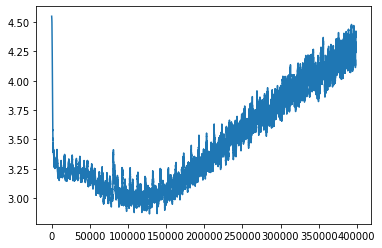
Basically, it went down for a while, and then it went back up a LOT. I still have no idea why this happened: if the optimizer was struggling to optimize, I’d expect the loss to get stuck and plateau and maybe wobble around, but not just keep going up forever. This makes no sense to me yet.

I drew a corresponding graph of the norm of the gradient of one of the weight matrices to go with this, because I kept reading about “vanishing gradients” and “exploding gradients” and I wanted to see if I was suffering from them. Here’s the graph:
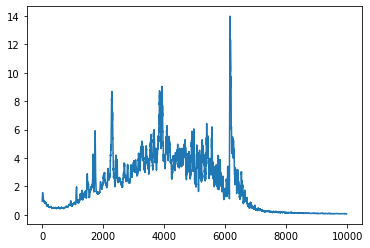
I think this graph might be showing me a vanishing gradient – the norm of the gradient does get pretty small towards the end of the graph.

BPTT: back-propagation through time

I’ve been experimenting with a different way of training my RNN: instead of writing code like this, which trains one character at a time.

for input, target in training_data:
    output, hidden = model(input, hidden)
    loss = F.cross_entropy(output, target)
    optimizer.zero_grad()
    loss.backward() # calculate the derivative
    optimizer.step() # adjust weights 
    hidden.detach()

instead I’m giving it a bunch of data (ok, the sentence is ‘a’, ‘b’, ‘c’, ’d’, ’e’, ‘f’… ) and then only doing the gradient descent/backpropagation step periodically. The code looks a little like this:

for i, (input, target) in enumerate(training_data):
    output, hidden = model(input, hidden)
    # only do the optimizer step 10% of of the time
    if random.randint(0, 10) == 2:
        loss = F.cross_entropy(output, target)
        optimizer.zero_grad()
        loss.backward() # calculate the derivative
        optimizer.step() # adjust weights 
        hidden.detach()

Some questions I have about this:

  • When I do BPTT after every 40 steps, the model fails to train (it has the “improve and then get worse” behaviour I graphed above), but when I do it after 10 steps it works fine. Why?
  • When I trained on (I think??) the same training data with the one-character-at-a-time method, the model learned a lot of character names (like CYMBELINE). When training it with BPTT it seems not to have learned any character names. I’m not yet sure if this is a difference in the training data or if I need to do something different with the model.

waiting for training to finish is frustrating

I’ve spent way too much time over the last couple of days waiting 30 minutes for a model to train so I can tell if it’s working or not. I’m not sure how to handle this yet, but I need either a faster feedback loop or something to do while I’m waiting.

I think the main reason this is frustrating is that I have a lot of hypotheses I want to experiment with, but it takes so long for every one and it’s a bit hard with a Jupyter notebook to keep track of all the hypotheses I’m trying to track.

should I be doing gradient clipping?

Recently I added “gradient clipping” to my training function. Basically I think this means that if the norm of the gradient is bigger than some value (like 1), then the optimizer scales the gradient so that it has a smaller norm.

It’s only one line of code, but I can’t tell if it’s helping yet

torch.nn.utils.clip_grad_norm_(self.rnn.parameters(), 1)

open questions

I’m just going to recap some of my open questions for myself in case I can answer them in the next post.

  • is doing gradient clipping helping?
  • why does the loss for my model climb so much? why is that even possible?
  • why does BPTT with a sequence length of 40 not work, but a sequence length of 10 work?
  • does randomizing the sequence length with BPTT help?
  • is it an “exploding gradient” if the norm of the gradient goes up to 12? (i think the answer might be “no”?)
  • is it a “vanishing gradient” if the norm of the gradient goes down to 0.05? (i think the answer might be “yes”?)
  • does the seq_len dimension in PyTorch’s LSTM class refer to BPTT? (in other words, do I have to implement BPTT myself or will that LSTM class do it for me if I format my data the right way?)
  • how can I tell if I’m having numerical stability issues?

Maybe I can answer some of those questions next!

some text the BPTT model generated

that than their conirot-ula thine not wate) For then in that my shill, And
Time, Wiss envage so love at thes: Time worture women of their cay bu thee
wisted all Tom werthen hear momed. An is perselfed? Bu mundeve teassed for my
sead wherey tood the ob'e, With eres, The ecref of heaven. 25 Levery I t

This seems really similar to the non-BPTT text:

at soerin, I kanth as jow gill fimes, To metes think our wink we in fatching
and, Drose, How the wit? our arpear War, our in wioken alous, To thigh dies wit
stain! navinge a sput pie, thick done a my wiscian. Hark's king, and Evit night
and find. Woman steed and oppet, I diplifire, and evole witk ud