





Got a website? You’re probably using cookies.
They’re those little data files that a user downloads when visiting your site. They enable shopping carts to remember items, users to save login details, and allow you to track user behavior, with consent, to improve your marketing.
And if you’re using cookies, you’ll need a cookie policy to help comply with international privacy regulations like the General Data Protection Regulation (GDPR) and ePrivacy Directive.
The good news is that you don’t need to write one from scratch yourself. A cookie policy generator can create one for you in minutes.
In this guide, we’ll help you find the best cookie policy generator for your website. Because there are a lot of them out there, and not all of them are the right solution for your site.
In a moment, you’ll discover what a cookie policy should include, what to look for in a generator, and how 6 of the most popular solutions compare.
That way you’ll easily find the best cookie policy generator for your site. One that fits your needs now and continues to support you as your setup grows.
In short
- Cookie policy generator comparison: At a glance
- What is a cookie policy?
- What’s the difference between a cookie policy and a privacy policy?
- What’s the difference between a cookie policy and a cookie banner?
- Why is a cookie policy important?
- What should a cookie policy include?
- What should you look for in a cookie policy generator?
- The best cookie policy generators
- Frequently asked questions
- Choose the best cookie policy generator for your website and your business
Cookie policy generator comparison: At a glance
| iubenda | Complianz | Termly | CookieYes | TermsFeed | Docue | |
|---|---|---|---|---|---|---|
| Automatic cookie scanning | Yes | Yes | Yes | Yes | Not included | Not included |
| Legal expert backing | Written and maintained by legal experts | Written and maintained by legal experts | Yes | Not specified on website | Not specified on website | Yes |
| Notifies you as laws evolve | Yes | Yes | Yes | Not specified | Yes, manual update required | Updates template clauses as laws change |
| Multi-language support | Included | Included | Included | Included | Included | Not included |
| Compliance coverage | Cookie policies, privacy policies, consent management, accessibility, and more in one platform | Cookie policies, consent management, and privacy policies for WordPress/Shopify | Cookie policies and consent management | Cookie consent and policy generation | Legal document generation | Legal document generation for UK businesses |
| Scales across multiple sites & regions | Yes | Yes | Limited | Limited | Limited | Not available |
| Price | Free plan available. Paid plans from €4.99/month | Free plan available. Paid plans from €59/year (less than €5/month) | Free plan available. Paid plans from $10/month | Free plan available. Paid plans from €9/month per domain | Limited free plan available. Varied one-time clause pricing | Paid plans from £39/month |
| Recommended for | Businesses of all sizes | WordPress & Shopify users | Small businesses with simple websites | Small, static websites | Small, static websites | UK-based businesses |
What is a cookie policy?
A cookie policy explains:
- What types of cookies and trackers your site uses
- Why you use them
- How a user can manage or refuse them
What’s the difference between a cookie policy and a privacy policy?
A privacy policy is a broader document covering all the ways your business handles personal data (like names, emails, and payments), while a cookie policy is a specialized document that focuses specifically on the cookies your website uses.
While a cookie policy provides a full explanation of the cookies on your site and their purpose, a cookie banner gives users a way to accept, reject, or manage cookies before non-essential tracking starts.
Why is a cookie policy important?
Privacy regulations like GDPR, the ePrivacy Directive, the California Consumer Privacy Act (CCPA), and others require websites to provide cookie policies in a clear and accessible way.
Beyond compliance, a cookie policy is good for business. It shows users that you take transparency and data privacy seriously, building trust in your brand which contributes to more sales in the long run. And with that trust, users are more likely to consent to your collection of data for better marketing insights.
What should a cookie policy include?
While it may vary slightly depending on what regions your website is active in, generally a cookie policy should include the below in clear, accessible language:
- The types of cookies you use – For example, essential cookies, analytics cookies, and advertising cookies.
- The purpose of each cookie category – Users should understand why each type of cookie exists and what it helps you do.
- Information about third parties – If external services place cookies on your site, the policy should clearly identify them and explain their role.
- Cookie duration – How long cookies remain active on a user’s device.
- How users can manage their choices – This includes instructions on changing preferences, withdrawing consent, or updating settings later on.
What should you look for in a cookie policy generator?
Here are the key features to consider when evaluating a cookie policy generator:
Accuracy based on real cookie usage
A reliable generator creates a policy that reflects the cookies and third-party services your site actually uses. A great feature to keep an eye out for is a powerful automatic cookie scanner; it’ll help you ensure your policy doesn’t miss a thing.
Legal reliability
The best cookie policy generators come with the backing of legal experts, so your policy is more likely to align with privacy regulations.
Updates as your site and laws evolve
Look for a generator that keeps your cookie policy in sync with your site. When you add new tools or services, your policy should reflect those changes. And as privacy requirements shift, you’ll get notified so you can review without starting from scratch.
Ability to scale with your site
What works for a single website might not work for multiple domains, regions, or languages. Generators built to scale make it easier to manage policies as your business grows internationally.
The best cookie policy generators
1. iubenda
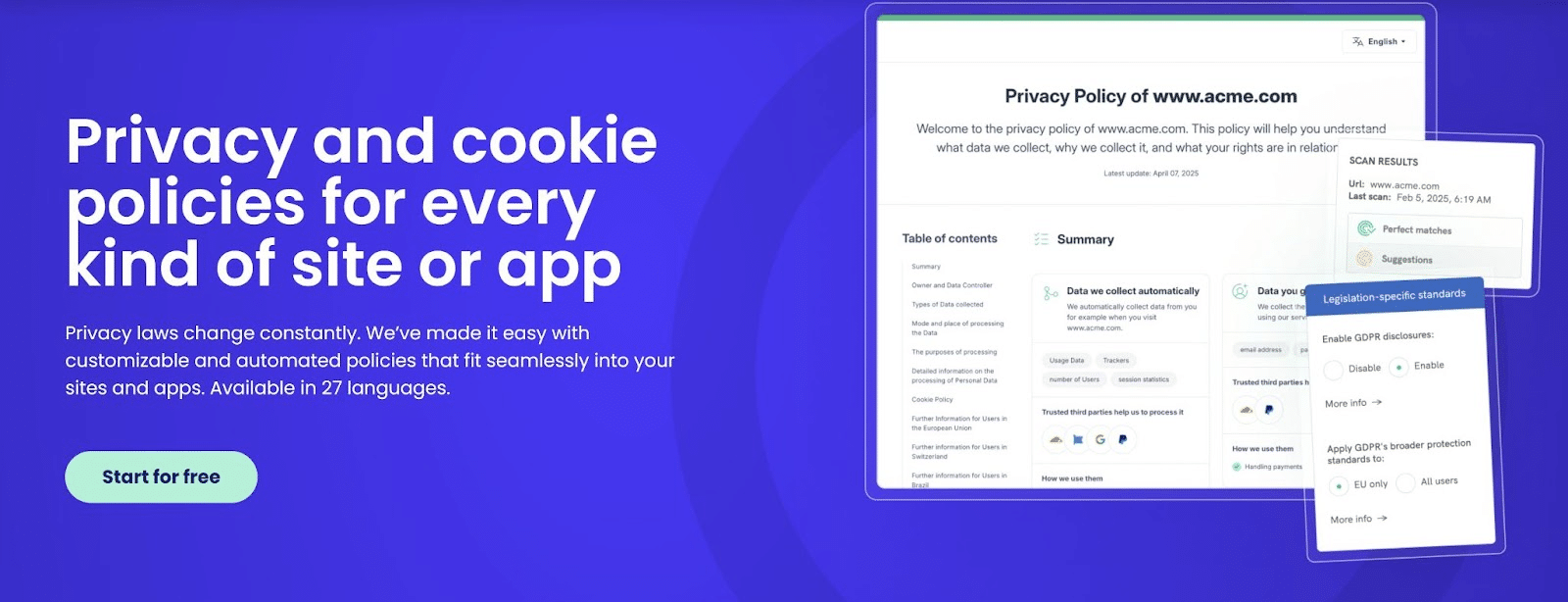
iubenda’s cookie policy generator keeps your policies current as laws change. Its legal team monitors regulatory updates and refreshes available clauses, so when something changes, you add the update in a click without rebuilding from scratch.
It also connects policy generation with site scanning, keeping your disclosures accurate as your site changes.
The generator is part of iubenda’s connected compliance solutions, giving you access to legal document generation, cookie banners, consent management, and more, all from one place.
Best for
Individuals and businesses that want easy, attorney-quality cookie policy generation and other digital compliance solutions in one place.
Pros
- Automated cookie scanner detects your website’s cookies and services, so you can quickly generate accurate cookie policies
- A team of legal experts write and update policy clauses
- Instant notifications when privacy regulations evolve
- Available in 27 languages and covers the world’s major privacy laws like GDPR, CCPA/CPRA and other US State Laws, FADP, and LGPD
- Centralized management across multiple websites and domains
- Easy to generate accurate policies that reflect actual cookie usage
- Reduces manual updates as cookies, vendors or regulations change
- Scales easily from simple sites to complex, multi-domain setups
- Easy to use
- Part of a wider digital compliance suite, with solutions for creating cookie banners, improving accessibility and more
- Excellent customer support that stays with you until they resolve your issue
- Trusted by over 150,000 organizations including Honda, Sony Music, and UNICEF
Cons
- Access to some of the advanced solutions in the suite requires a paid plan
Pricing
- Free plan available with everything you need for low-traffic sites
- Paid plans start at just €4.99/month
What people say
Users consistently mention ease of use, excellent customer support, and how the platform simplifies complex compliance requirements. Users also highlight its affordability and value, given that it offers a full range of solutions for digital compliance.
2. Complianz
Complianz is a cookie policy and consent management plugin built for WordPress and Shopify. Install it directly from your CMS and it gets to work right away.
Its hybrid cookie scanner detects the trackers running on your site, so your policy reflects what’s actually there. As your site changes, rescan and update to match.
It also handles cookie banner setup and records visitor preferences, keeping your consent logs in order.
Best for
WordPress and Shopify users who want a complete plugin to manage cookie policies and consent.
Pros
- Built-in hybrid site scanner identifies active cookies and services
- Generates a thorough and accurate cookie policy based on scanner findings
- Synchronizes with cookiedatabase.org, allowing you to automatically populate your Cookie Policy with clear, up-to-date descriptions of what each cookie does, who the service provider is, and how long until the data expires
- Compatible with multiple regions and privacy laws, including GDPR and CCPA
- Legal documents available in 49 languages
- Easy to install and configure
- Trusted by 1 million users
- Backed by legal experts
- 30-day money-back guarantee
Cons
- Advanced features require a paid plan
Pricing
- Free plan available
- Paid plans start from €59/year (less than €5 a month)
What people say
WordPress users highlight easy setup and an intuitive interface. And on Shopify, the plugin comes with top reviews for the support team.
3. Termly
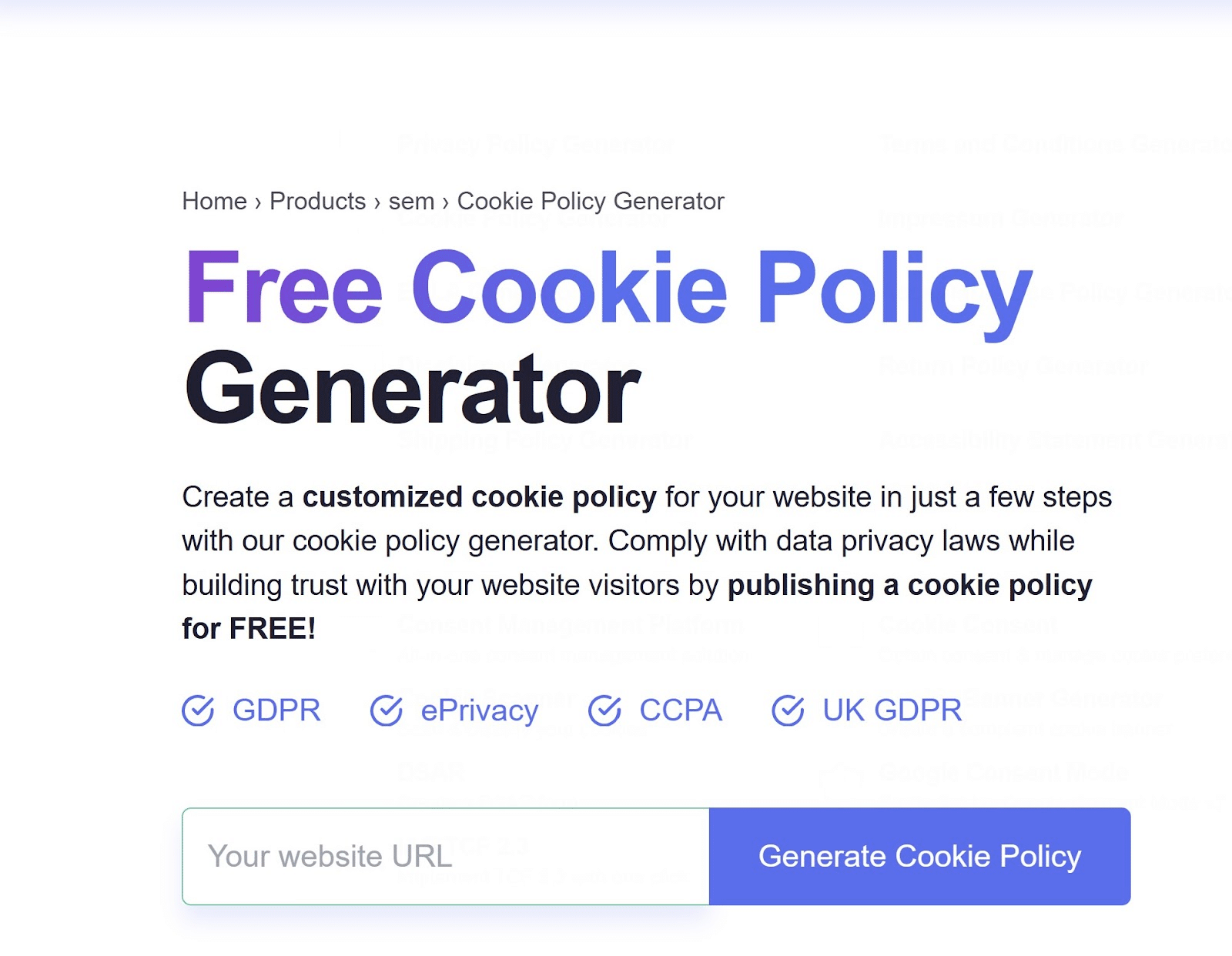
Termly offers a cookie policy generator combined with consent tools. The platform focuses on predefined templates for document generation and offers a guided setup process.
Best for
Individuals and small businesses with simple websites that need to publish a cookie policy quickly.
Pros
- Cookie policy generator built around predefined templates
- Cookie scanner
- Coverage for common privacy frameworks such as GDPR and CCPA
- WordPress integration via plugin
- Guided setup
- Simple interface
Cons
- Policies rely heavily on templates which aren’t easily customizable and don’t update as regulations change
- Limited flexibility, especially for multi-region setups
- Using it for multiple websites can get expensive
- Can negatively impact WordPress site performance
Pricing
- Free plan available with limited features
- Paid plans start from $10/month
- Costs increase based on pageviews and feature access
What people say
Users praise the easy setup process, but highlight Termly’s limitations with multi-region compliance and customization, as well as poor customer service. Many WordPress users complain about the tool slowing site performance.
4. CookieYes
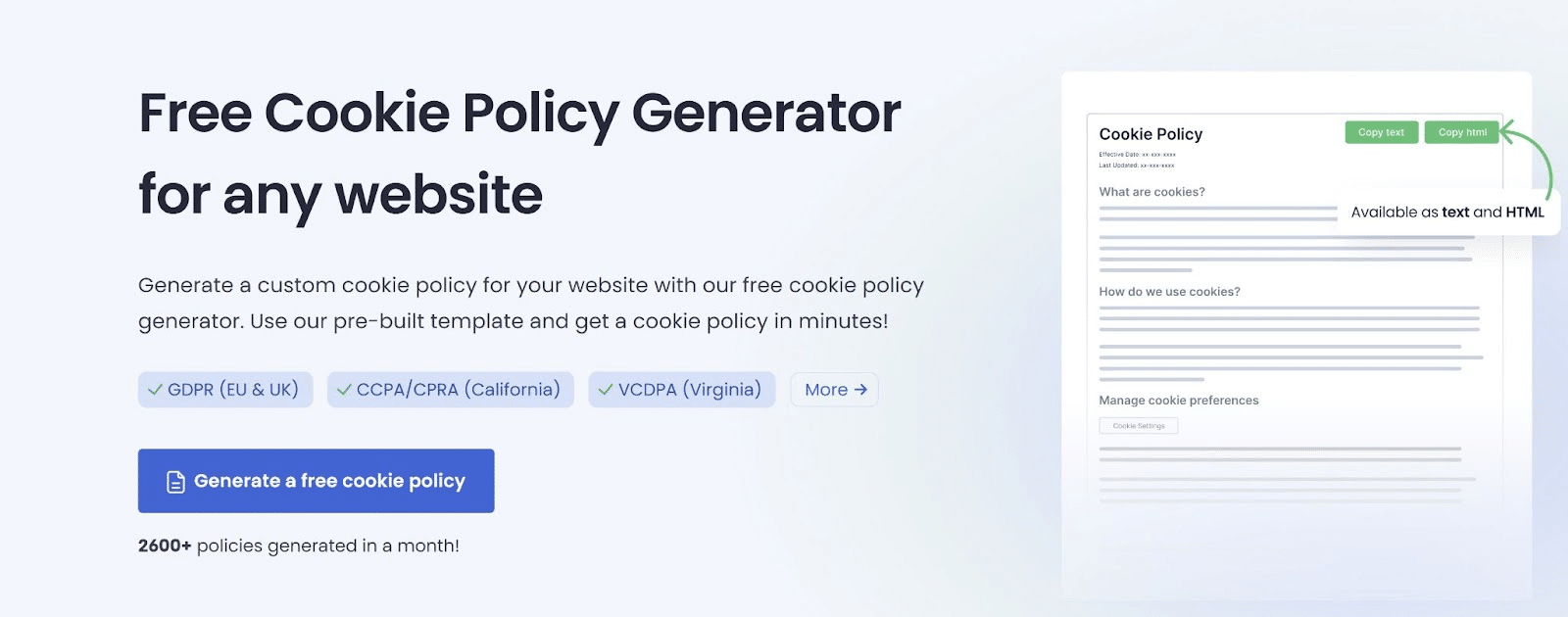
CookieYes offers a cookie policy generator that allows you to create your own policy based on a template. It does have a cookie scanner to help with generating the policy, but it often requires manual oversight.
Best for
Small websites that want to publish a cookie policy quickly and don’t expect frequent changes to their tracking setup.
Pros
- Cookie policy generator combined with a basic site scanner
- Monthly scan to update your list of cookies
- Available as a WordPress and Shopify plugin
- Quick setup
- Allows for more manual intervention
Cons
- Cookie scanning may require manual oversight in some cases to verify detection and categorization
- Can be expensive if you have multiple domains and high traffic
- Limited multi-language support
- Customization options are more limited compared to some alternatives
Pricing
- Free plan available with limited functionality
- Paid plans start at €9/month per domain
What people say
Reviews mention good customer support but limited features and issues with customization. Some users also mention poor website performance on mobile devices as a result of using CookieYes.
5. TermsFeed
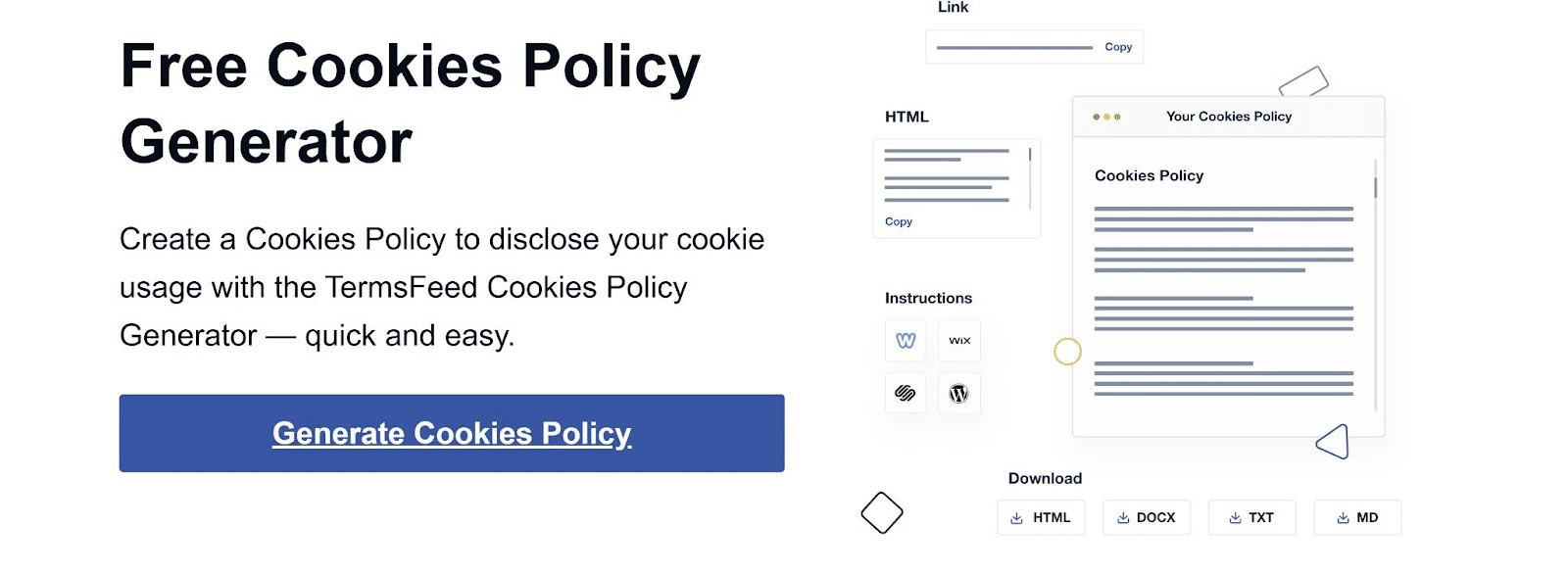
TermsFeed is a lightweight legal document generator. It lets you build a customized cookie policy, privacy policy, and terms and conditions document through a template-based flow.
Best for
TermsFeed works best for individuals and small businesses that want to generate basic legal documents for static sites where manual updates are manageable.
Pros
- Cookie policy generator based on templates
- Support for multiple types of legal documents
- Customization through guided questions
- Supports 10 languages
- Simple cookie policy generation
- Covers multiple legal document types in one place
- WordPress integration
Cons
- Doesn’t have a comprehensive cookie scanner to help you create an accurate cookie policy
- Notifies you when there are changes in regulations, but you need to update your policy manually
- Users must manually update documents as their sites change
- Limited scalability for multi-site or multi-region setups
- It’s marketed as free, but there are certain “premium clauses” that you have to purchase.
Pricing
- Offers a limited free policy option that isn’t tailored for compliance with GDPR and other privacy regulations
- One-time payments with varied pricing for specific clauses in legal documents
What people say
While users mention that it’s quick to generate a cookie policy, reviews also frequently mention difficulties with the payment process, with some highlighting that they find TermsFeed expensive for what it offers.
6. Docue
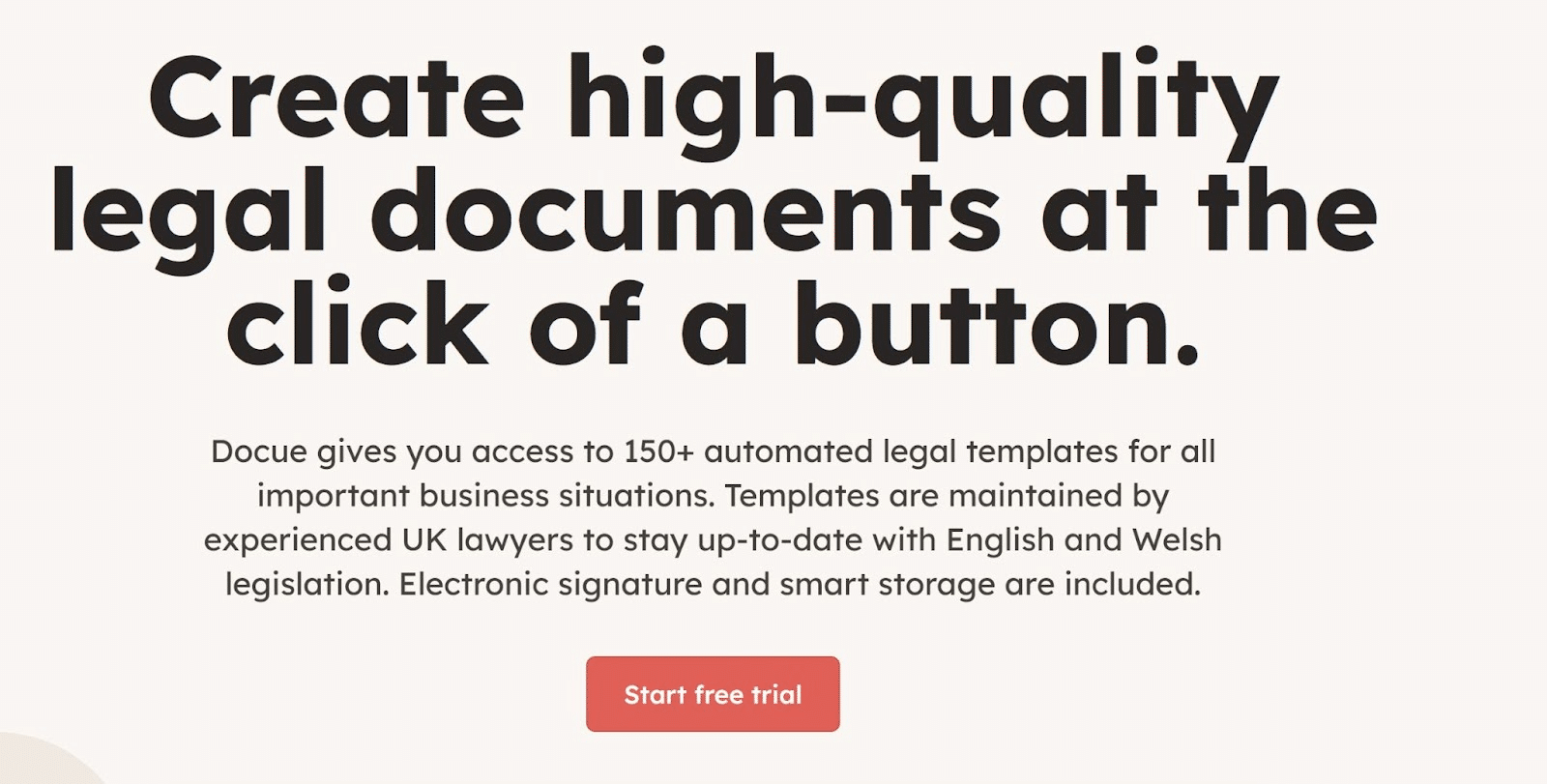
Docue is a British legal document generation tool that helps businesses create and manage contracts and legal documents, including privacy-related policies.
The platform’s focus is on legal contracts rather than on full digital compliance.
Best for
Businesses with relatively static websites that handle consent and cookie management elsewhere.
Pros
- Cookie policy and other legal document creation
- Template-based policy generation
- Clauses written and updated by a team of lawyers
- Helps generate a cookie policy aligned with UK GDPR requirements
- Allows you to tailor the document to what you need by using templated clauses
Cons
- Isn’t designed specifically for cookie policies or consent management
- No built-in cookie scanning or consent tools
- While lawyers update templates based on regulation changes, you have to manually update your policy when there are changes to your website’s cookies
- Doesn’t support international privacy regulations besides United Kingdom GDPR
- No multi-language support
Pricing
- No free plan publicly available
- Pricing starts at £39/month with an annual subscription
What people say
Some users appreciate Docue’s ability to quickly and easily generate legal documents but many mention how they feel misled by the platform’s pricing.
Frequently asked questions
What is the best cookie policy generator?
The best generator depends on your site’s complexity and compliance needs. Look for a solution that offers automatic cookie scanning, legal expert backing, and policies that update as regulations change. Integration with your existing platform and transparent pricing are also important factors.
Do I need a cookie policy?
If your website uses cookies, regulations like the GDPR and ePrivacy Directive require you to inform users about what cookies you use, why, and how they can manage their preferences. A cookie policy is the standard way to provide this information.
What’s the difference between a cookie policy and a cookie banner?
A cookie banner is the pop-up that asks for consent when someone visits your site. A cookie policy is the full document that explains which cookies you use, what data they collect, and how users can control them. You typically need both.
Choose the best cookie policy generator for your website and your business
The best cookie policy generator is one that helps you create a policy that evolves with your site as well as changing regulations.
And, if it’s a part of a wider suite of digital compliance solutions, like iubenda, you’ll not only have the best value for money but greater support for your business’ growth.
Because when you show your users that you respect their privacy by providing a cookie policy, along with solutions for consent management, you’ll be positioning your brand as transparent and trustworthy.
That kind of trust is invaluable for building customer relationships that sustain your business for the long run.