





惯性聚合 高效追踪和阅读你感兴趣的博客、新闻、科技资讯
阅读原文 在惯性聚合中打开

推荐订阅源

B
Blog RSS Feed
Jina AI
Jina AI
雷峰网
雷峰网
Blog — PlanetScale
Blog — PlanetScale
Hugging Face - Blog
Hugging Face - Blog
奇客Solidot–传递最新科技情报
奇客Solidot–传递最新科技情报
Last Week in AI
Last Week in AI
博客园 - 司徒正美
罗磊的独立博客
J
Java Code Geeks
Engineering at Meta
Engineering at Meta
WordPress大学
WordPress大学
Vercel News
Vercel News
A
About on SuperTechFans
I
InfoQ
D
DataBreaches.Net
爱范儿
爱范儿
freeCodeCamp Programming Tutorials: Python, JavaScript, Git & More
U
Unit 42
aimingoo的专栏
aimingoo的专栏
宝玉的分享
宝玉的分享
P
Proofpoint News Feed
Microsoft Azure Blog
美团技术团队

Compliance Solutions for Websites, Apps and Organizations | iubenda

AI can build your website. It can't manage your consent. | iubenda Browser signals and machine-readable consent: what they are and what the EU’s Digital Omnibus could change California Consumer Privacy Act (CCPA): Complete Guide How to increase your cookie banner opt-in rates: 5 mistakes to fix today | iubenda DPO Newsletter: Global Data Protection & Privacy News (issue #153) Why your consent management setup is a marketing performance question Everything you need to know about GDPR The redesigned cookie banner and configurator What nobody tells you about handing over the company you built European marketers are betting on retention. Privacy could be the edge they’re not using yet. The 5 best alternatives to Didomi in 2026: Pros, cons, pricing, and comparison Looking back on 15 years: what iubenda's founder would tell his 2011 self | iubenda The best cookie policy generator in 2026 DPO Newsletter: Global Data Protection & Privacy News (issue #152) | iubenda What publishers should expect from the EU’s Digital Omnibus proposal Uncertainty is the biggest blocker to AI adoption in marketing | iubenda Everything AI app builders need to know about vibecoding and privacy compliance | iubenda Introducing 1-Click Embedding for Google Tag Manager The Essential Small Business Terms and Conditions Template: What You Need to Know Terms of Use Template | iubenda IAB Europe Raises Concerns Over GDPR Procedural Regulation Draft Report | iubenda Learn from HelloFresh's Costly Mistake: Ensure Compliance with iubenda | iubenda Understanding the Spanish DPA Guide on Audience Measurement Cookies | iubenda The Austrian Data Protection Authority's FAQs on Cookies and Privacy | iubenda DPO Newsletter: Global Data Protection & Privacy News (issue #127) | iubenda Microsoft Ensuring European Data Stays Within the EU Cloud Boundary | iubenda Businesses Beware: ICO’s Record £14.3m in Fines for Data Misuse in 2023 Understanding the Risks and Responsibilities of Model-as-a-Service Companies in AI Development Facebook's New “Link History” Feature: A Blend of Convenience and Surveillance? | iubenda OpenAI’s Strategic Move in the EU: Aligning with Data Privacy Regulations
Requests to delete data processed through Google Analytic...
2022-08-09 · via Compliance Solutions for Websites, Apps and Organizations | iubenda

Why are these requests becoming more and more frequent?

Following some European data protection Authorities’ decisions, you are likely to have received requests from several users to delete personal data processed through Google Analytics.

In this article, we will examine whether these requests are legitimate and how to deal with them.

🎓

Are data deletion requests legitimate?

Article 17 of the GDPR allows users (data subjects) the right to request the deletion of personal data held by data controllers if one of the following applies:

  • when the user withdraws consent; or
  • when personal data has been processed unlawfully.

In the presence of one of the cases listed in Article 17, requests such as these are to be considered legitimate. The data controller is obliged to honor them without undue delay, and in any case, within one month of receiving them, unless one of the conditions for which the right to erasure may be denied applies.

Each request must be evaluated on a case-by-case basis, considering the elements that indicate the user’s willingness to exercise their right to erasure their personal data.

What do I need to delete data from Google Analytics 3?

To delete the user’s data who made the request, you must ensure that you have sufficient data for his correct identification.

The key data for user identification is the “Client ID.” This value is retrievable from the Google Analytics cookie called _ga (similar to GA1908667103.1592401814). Other data that can make the identification more accurate are the full IP address and the date/time of the most recent visit to the website.

If you do not have these elements, it will not be possible to identify the data subject’s data with certainty, so you will have to request them directly from the user to comply with their request.

How to delete data

Once you have collected the necessary data, you are ready to delete it.
First, log into your Google Analytics dashboard.

From the menu, select Audience and then User Explorer.
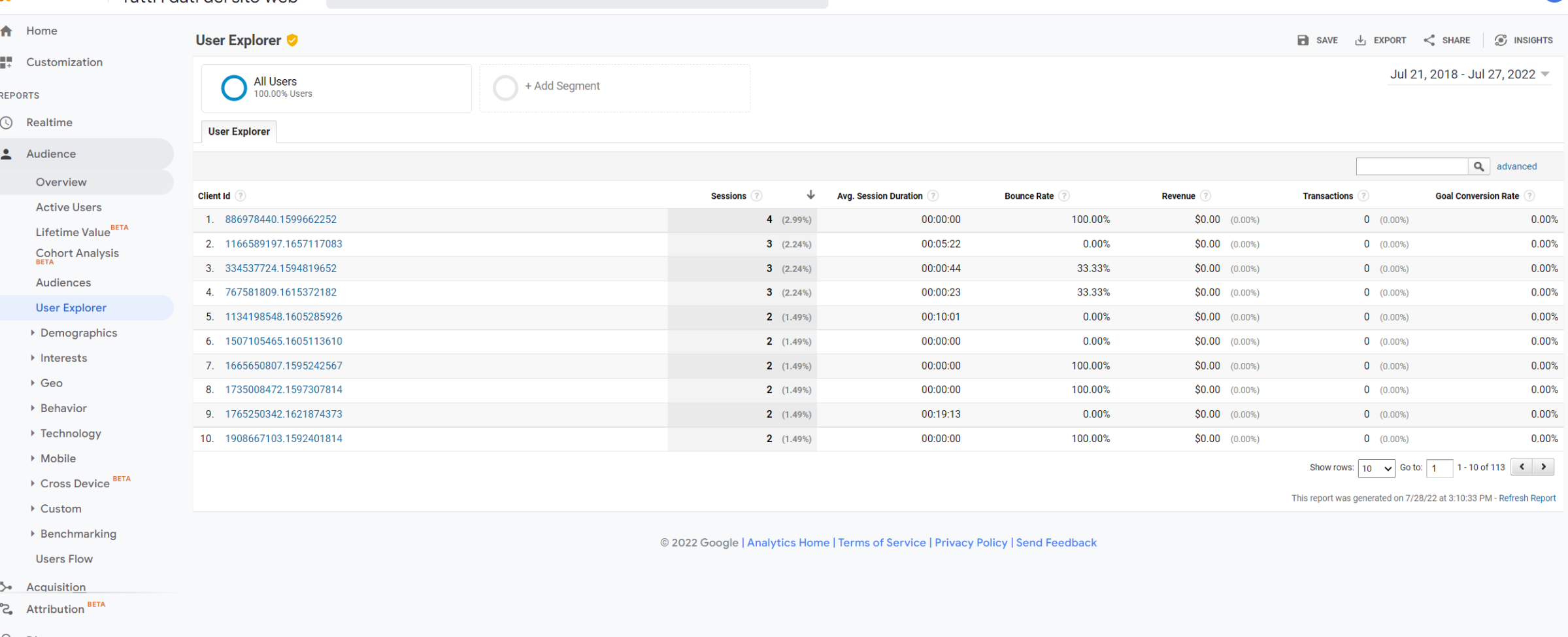
Google analytics dashboard

Filter by the Client ID code you were given (e.g., 1908667103.1592401814). You can also use other filters (IP, date/time for more accurate identification).
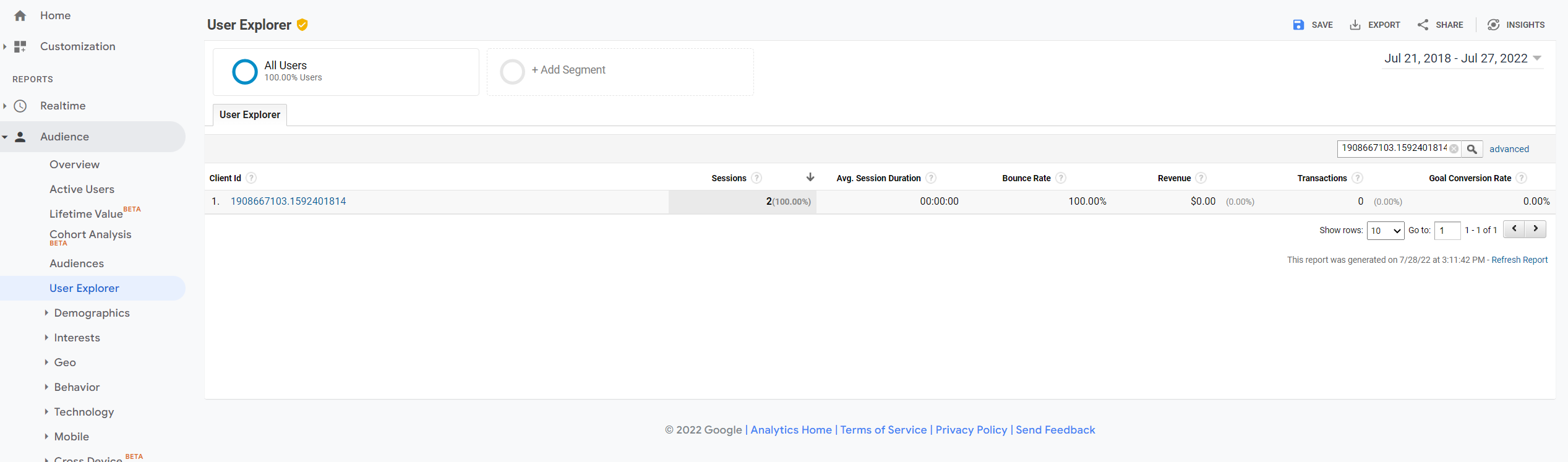
Client ID Google Analytics

Click on the filtered client-id and click the Delete user button found at the bottom of the page.
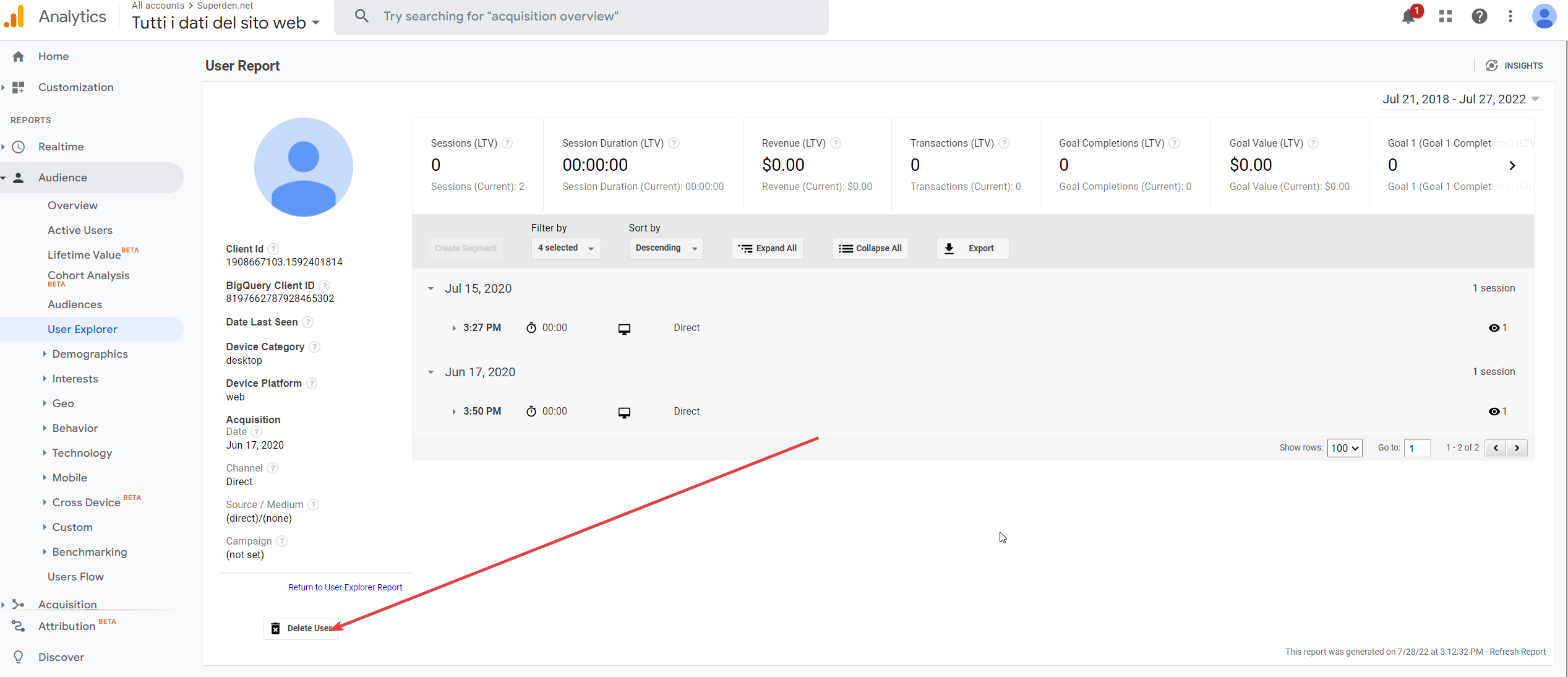
eliminare dati da google analytics 3 (federico leva)

Click OK in the message that is displayed to confirm the deletion.

In this way, you will have honored the user’s request, and you can send confirmation that you have deleted their data.

Google Analytics 3 and the GDPR: what should I do?

There is no definitive answer to this question, as the investigation into Google Analytics is still ongoing. However, some Data Protection Authorities, such as the Italian Garante, have said that to continue using Google Analytics 3, additional security measures are required.

However, it is not clear what these measures are in practice. Some alternatives to consider are:

  • Upgrade to Google Analytics 4 and apply additional measures using available settings (taking into account that, in any case, GA3 will be discontinued by Google from July 2023);
  • Switch to another analytics tool.

See also