






Most teams don’t move Redis databases often. But when they do, the complexity is rarely in Redis itself. It’s in coordinating endpoint changes across apps, services, and jobs.
Redis Cloud now supports dynamic endpoints, a stable hostname you can redirect between databases. Instead of changing the app configuration every time you move, you redirect once. It’s a controlled cutover from database A to database B, with your apps continuing to connect to the same endpoint. Dynamic endpoint redirection is currently available in public preview.
Customers can change their infrastructure without forcing coordinated app changes.
Moves aren’t daily work, but they’re common enough in production:
Some moves include data migration. Others involve redirecting traffic to a pre-provisioned database. In both cases, static endpoints are the constraint.
When apps connect directly to a database’s static endpoint:
The move itself may be simple. Updating the clients is not.
What should be a controlled infrastructure change can quickly become a cross-team operational event.
Dynamic endpoints introduce a stable Redis Cloud hostname that can be redirected from one database to another. Instead of updating endpoints across multiple services and environments, you redirect the dynamic endpoint, allowing traffic to shift from the source database to the target.
Unlike a customer-managed DNS change or load balancer, dynamic endpoints are managed within Redis Cloud, so customers can keep the same app endpoint without operating an additional routing layer.
Redirection is explicit and controlled, and once apps adopt the dynamic endpoint, future moves do not require repeated endpoint changes. Dynamic endpoints handle traffic redirection only; data migration remains a separate operation.
For example, a company may need to move its Redis database to another region because of infrastructure realignment, proximity to dependent services, or disaster recovery planning. With dynamic endpoints, the app continues to use the same hostname while the backing database changes beneath it.
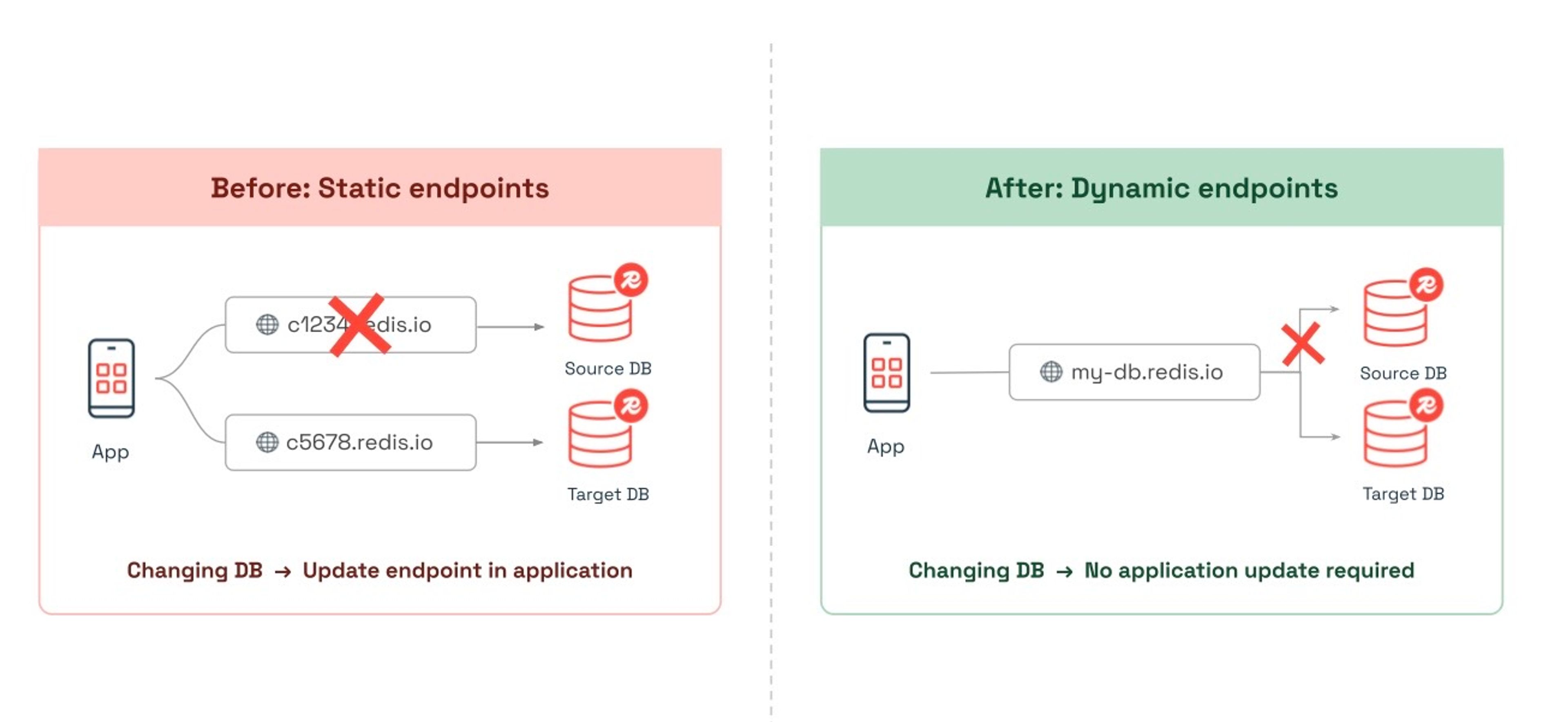
Scenario: Your app connects to an Essentials database via public access. You want to upgrade to Pro and have your app use private connectivity without having to repeat endpoint changes across all clients.
The app continues using the same hostname throughout the move; the infrastructure changes underneath it.
Dynamic endpoint redirection is currently available in public preview for supported database moves within the same account, including transitions such as Essentials to Pro and Pro to Pro. During the initial rollout, access will begin with a portion of new accounts before gradually expanding to more new and existing accounts over the coming weeks.
Support depends on factors such as port compatibility, networking, and allow list configuration, and the source and target deployment types. Some combinations, such as Active-Active databases or Pro-to-Essentials moves, are not supported.
For detailed requirements, configuration constraints, and implementation guidance, read our official docs.
此内容由惯性聚合(RSS阅读器)自动聚合整理,仅供阅读参考。 原文来自 — 版权归原作者所有。