


惯性聚合 高效追踪和阅读你感兴趣的博客、新闻、科技资讯
阅读原文 在惯性聚合中打开

推荐订阅源

Microsoft Security Blog
Google DeepMind News
P
Privacy International News Feed
www.infosecurity-magazine.com
T
Threatpost
GbyAI
GbyAI
V
Visual Studio Blog
H
Help Net Security
Vercel News
Vercel News
P
Palo Alto Networks Blog
Project Zero
Project Zero
AWS News Blog
AWS News Blog
Latest news
Latest news
Cyberwarzone
Cyberwarzone
C
Cybersecurity and Infrastructure Security Agency CISA
The Register - Security
博客园_首页
WordPress大学
WordPress大学
G
GRAHAM CLULEY
T
Tor Project blog
有赞技术团队
有赞技术团队
Know Your Adversary
Know Your Adversary
AI
AI
Threat Intelligence Blog | Flashpoint
O
OpenAI News
博客园 - 聂微东
月光博客
月光博客
S
Security Affairs
Webroot Blog
Webroot Blog
L
LangChain Blog
Apple Machine Learning Research
NISL@THU
NISL@THU
N
News and Events Feed by Topic
Blog — PlanetScale
Blog — PlanetScale
S
Securelist
V
Vulnerabilities – Threatpost
aimingoo的专栏
aimingoo的专栏
阮一峰的网络日志
阮一峰的网络日志
Stack Overflow Blog
Stack Overflow Blog
Application and Cybersecurity Blog
D
DataBreaches.Net
让小产品的独立变现更简单 - ezindie.com
Y
Y Combinator Blog
Cisco Talos Blog
Cisco Talos Blog
The Cloudflare Blog
IT之家
IT之家
博客园 - 三生石上(FineUI控件)
雷峰网
雷峰网
L
Lohrmann on Cybersecurity
T
The Blog of Author Tim Ferriss

Redis

Real-Time Fraud Detection: Latency, Features & Scale Context window in AI: why every token is a budget decision Connecting to Redis Cloud with AWS PrivateLink vs. VPC peering | Redis Why AI Misses Business Context & How Teams Fix It AI Reasoning Explained: Why Context Matters Semantic Layer vs Context Layer: Key Differences Redis array data type: How it works and when to use it Context Graphs vs. Vector Search: When RAG Falls Short What’s new in two – May 2026 edition Redis 8.8 performance improvements: Faster string, hash, streams, SCAN & more Redis 8.8: New array data structure & open source features How Conflict-free Replicated Data Types power active-active database replication Context Orchestration: What It Is & How It Works Context Compaction for AI Agents: A Complete Guide Prompt Bloat: Causes, Costs & Fixes for LLM Apps Agentic Retrieval Techniques: A Complete Guide Single-shot reliable consumers with XREADGROUP CLAIM in Redis 8.4 | Redis Long-Horizon AI Agents: Memory & State Infrastructure What is a context engine? What Is a Context Layer? AI Agent Infrastructure Context Retrieval for AI Agents: What It Is & Why It Matters Context Poisoning: How Bad Data Breaks Agent Reasoning Context is all you need: Introducing Redis Iris | Redis Context Engineering for AI: What It Is & How to Build It Dynamic endpoints: Migrate databases without changing your endpoint | Redis AI Shopping Assistants: How They Work & What to Build Endless Aisle Retail: Infrastructure & Real-Time Data LLM Speed Benchmarks: Metrics & Infrastructure Guide Context Pruning: Cut LLM Tokens Without Losing Quality What’s new in two – April 2026 edition Agentic AI Architecture: 5 Patterns Explained AI Agent vs Chatbot: Key Differences Explained Advantages of Building a Vector Search Solution API Latency in LLM Apps: Causes & How to Fix It Security advisory: [CVE‑2026‑23479] [CVE‑2026‑25243] [CVE-2026-25588] [CVE‑2026‑25589] [CVE-2026-23631] | Redis Edge Computing Latency: Causes & How to Reduce It AI Agents vs Workflows: When to Use Each Streaming LLM Responses: Make Your AI App Feel Fast Active-Active vs Active-Passive Database Architecture Prefill vs Decode: LLM Inference Phases Explained Long-Term Memory Architectures for AI Agents Time to First Byte Test: Tools, Causes & Fixes Speculative decoding: how it works & when to use it P95 Latency: What It Is & Why It Matters Why Multi-Agent LLM Systems Fail & How to Fix Them AI Human in the Loop: Production Oversight Patterns Native OpenTelemetry metrics for Redis client libraries | Redis Client-side geographic failover for Redis Active-Active | Redis Use Redis with SQL | Redis Introducing Redis Feature Form Build Google ADK Agents with persistent, real-time memory on Redis | Redis Startup Spotlight: Neuron Systems API Throttling: Algorithms, Patterns & Mistakes Agentic AI Examples Across 6 Industries Best Chunking Strategies for RAG Pipelines Agentic AI Guardrails: Controls That Work Redis joins AWS at GDC to support the next generation of gaming | Redis Designing a semantic routing system: From static rules to dynamic intelligence with Redis and Java | Redis Real-Time Dispatch System: A Complete Guide P99 Latency: What It Means & How to Fix It Tokenization in LLMs: What AI App Devs Need to Know TTFT Meaning: What is Time to First Token? Atomic slot migration with Redis 8.4 Hybrid search benefits: Why your RAG system needs both keyword & vector search What’s new in two: March 2026 edition Vector embedding generators: How they work & how to use them Throughput-optimizing Redis for L2 KV Cache Reuse What is a data pipeline? Building AI agent pipelines that don't forget, fail, or fall apart Redis achieves Google Cloud Ready, Distributed Cloud status ahead of Google Cloud Next ‘26 | Redis Real-time network monitoring: what your data platform needs to keep up AI agent API: How agents connect to the real world What is multicloud infrastructure? A guide for 2026 What is a transaction monitoring system & how does it work? Why your AI agent fails in production & how tracing helps AI agent benchmarks: Where they fall short & why your infrastructure matters What is a JSON database (and when should you use one)? Introducing the Redis Partner Network: A new foundation for real-time innovation How real-time customer segmentation works in retail Payment orchestration & vault architecture in retail Agentic systems vs. GenAI: when generation isn't enough What is fuzzy matching? Semantic caching & routing: two powerful patterns for vector classification Redis alternatives: Why there are no exact substitutes Connect to Azure Managed Redis with Redis Insight 3.2.0 How to tame the thundering herd problem Redis to Manage Storage Replication | Redis How hierarchical navigable small world (HNSW) algorithms can improve search | Redis How leading financial institutions use Redis to drive growth | Redis What’s new in two: May 2025 | Redis Introducing Model Context Protocol (MCP) for Redis | Redis Redis vs. Elasticsearch: What’s faster for GenAI & vector search? | Redis Build fast, production-worthy AI apps with Spring AI and Redis | Redis Azure Managed Redis is GA today | Redis Redis then & now: Adapting with developers through every era | Redis Supercharge Your AI with OpenShift AI and Redis: Unleash speed and scalability | Redis What’s new in two: April 2025 | Redis Redis 8 is now GA, loaded with new features and more than 30 performance improvements | Redis What is a data strategy? 6 key components explained Data replication explained: types, examples & use cases
Redis Data Integration in Redis Cloud is now GA in AWS | Redis
Redis · 2026-06-04 · via Redis

Today, we’re announcing the general availability of Redis Data Integration (RDI) in Redis Cloud on AWS.

RDI in Redis Cloud is our fully-managed service for moving operational and analytical data into Redis in near real time and keeping Redis continuously in sync with your source databases and data warehouses.

Many of those source systems can't deliver the scale or latency that real-time apps, APIs, models, and agents need. RDI is purpose-built for that path: it continuously streams updates from the source into Redis and applies native transformations that convert source records into Redis data structures optimized for sub-millisecond reads and high-scale throughput.

Over the last several months since our Redis Cloud preview, customers have validated that this is the product they want when they need a simpler, Redis-native path from systems of record to fast and linearly scalable read workloads in Redis Cloud.

That matters because RDI is more than “data ingestion.” It is how customers transform slow operational and analytical data into a fast data layer for modern apps, real-time decisioning, and AI workloads.

How RDI makes source data Redis-fast

RDI implements the two phases of the pipeline lifecycle: an initial bulk hydration that loads the source into Redis, and ongoing near-real-time CDC that keeps Redis continuously in sync as the source changes. That gives customers a consolidated Redis product for the job they actually need done: define, validate, run, and monitor source-to-Redis pipelines without managing the underlying integration infrastructure themselves.
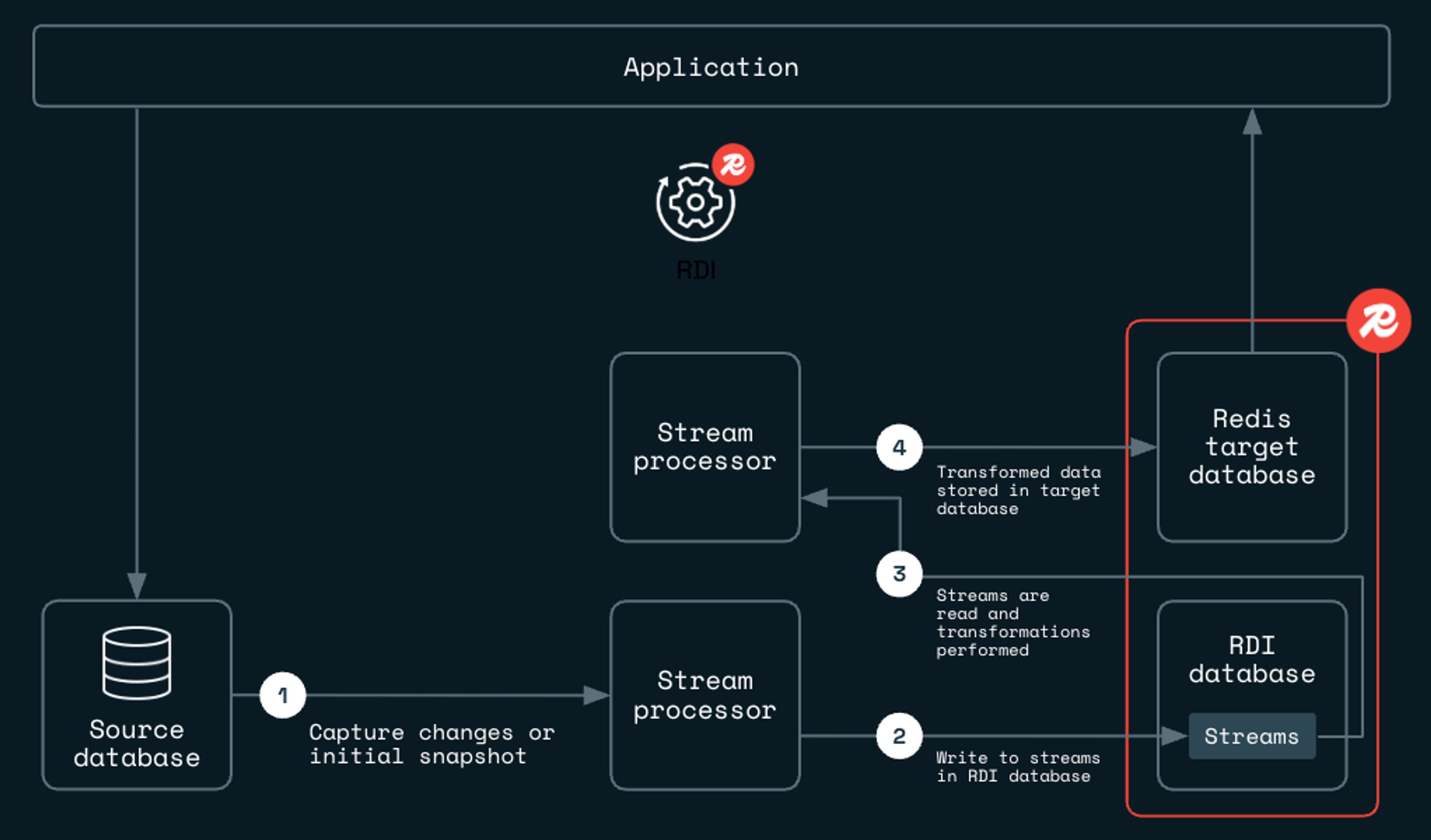
How RDI makes source data Redis-fast

Redis becomes the low-latency serving layer for data that lives in your system of record, decoupling read traffic from the source database. That means no cache misses, fresher data, less pressure on source databases, a lower total cost of ownership, and a much simpler path to building real-time apps on top of Redis Cloud.

Bringing key RDI advances to Redis Cloud

RDI in Redis Cloud GA brings many of the key improvements introduced with RDI 1.18 into the managed Redis Cloud experience, making the service fast, easy to operate, and aligned with production data pipeline needs.

Highlights include:

  • Better CDC latency and throughput, plus faster full hydration throughput through a new processor that improves full-sync performance.
  • Fast, self-service pipeline management with early validation of source connectivity, secrets, and source readiness. Includes actionable error messages during pipeline creation, private connectivity setup, and monitoring, along with clearer pipeline states and more accurate status reporting.
  • Advanced source and processor configuration for pipelines that need more control.
  • Support for snapshot SQL statements, so users can ingest only part of the source data when they need a more selective initial load.
  • New source support for Snowflake (in preview) and MongoDB in Redis Cloud.
  • CAPI support, so users can provision RDI infrastructure through API and Terraform and automate it like other Redis Cloud services.

In short, RDI in Redis Cloud GA introduces the latest performance and user experience improvements, and is aligned with how cloud teams want to build and operate production data paths.

New source support: MongoDB & Snowflake

A key highlight of this GA release is that RDI in Redis Cloud builds on established support for relational sources including MySQL, MariaDB, Oracle, SQL Server, and PostgreSQL, while also expanding beyond relational databases with especially strong support for Snowflake (in preview) and MongoDB.

Snowflake expands RDI into reverse ETL and feature-store style use cases, where precomputed data can be synced into Redis Cloud for low-latency serving. MongoDB is a natural fit for app acceleration because JSON data often maps cleanly into Redis, avoiding the joins and denormalization work that can limit the use cases from relational sources.

Together, they show that RDI in Redis Cloud is not limited to traditional relational ingestion. It now supports a broader set of operational and analytical sources for app modernization and real-time decisioning.

Why RDI matters for agents

Redis Iris is our real-time context engine for agents, and RDI is one of its foundational building blocks. In Iris, RDI continuously syncs data from your source databases and data warehouses into Redis, so agents retrieve context in real time while systems of record stay where they are. Without that sync, agents act on stale reads— yesterday's account state, last hour's order status — not the current state of the business.

RDI is especially crucial for feature store and reverse ETL scenarios. A feature store only delivers value if the serving layer has fresh features at decision time. A reverse ETL flow only helps if the data arrives in the operational path quickly enough to influence what the app, model, or agent does next.
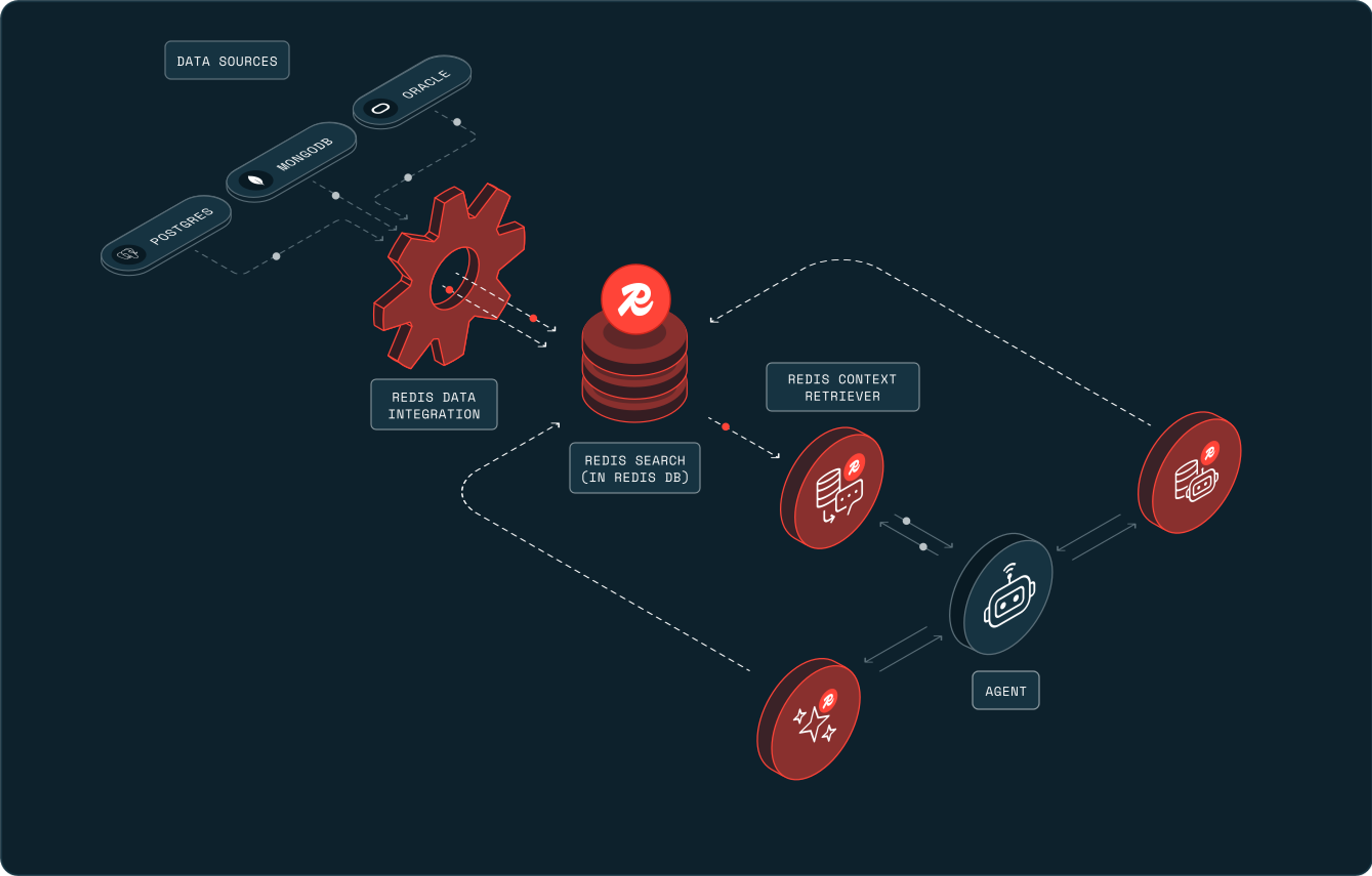
Redis Data Integration Blog

RDI is what turns data that lives elsewhere into live, actionable context inside Redis. That live context is the difference between systems that are simply connected and systems powering real-time apps and agents.

Learn more

RDI is available today in Redis Cloud on AWS, bringing Redis-native, managed data pipelines to the same platform teams already use for fast, reliable, production Redis services.

If you want to learn more about Redis Data Integration, visit the RDI overview page, read the Redis Cloud quick start, and explore how it fits into the Redis Iris vision for real-time context.