


惯性聚合 高效追踪和阅读你感兴趣的博客、新闻、科技资讯
阅读原文 在惯性聚合中打开

推荐订阅源

Microsoft Security Blog
Google DeepMind News
P
Privacy International News Feed
www.infosecurity-magazine.com
T
Threatpost
GbyAI
GbyAI
V
Visual Studio Blog
H
Help Net Security
Vercel News
Vercel News
P
Palo Alto Networks Blog
Project Zero
Project Zero
AWS News Blog
AWS News Blog
Latest news
Latest news
Cyberwarzone
Cyberwarzone
C
Cybersecurity and Infrastructure Security Agency CISA
The Register - Security
博客园_首页
WordPress大学
WordPress大学
G
GRAHAM CLULEY
T
Tor Project blog
有赞技术团队
有赞技术团队
Know Your Adversary
Know Your Adversary
AI
AI
Threat Intelligence Blog | Flashpoint
O
OpenAI News
博客园 - 聂微东
月光博客
月光博客
S
Security Affairs
Webroot Blog
Webroot Blog
L
LangChain Blog
Apple Machine Learning Research
NISL@THU
NISL@THU
N
News and Events Feed by Topic
Blog — PlanetScale
Blog — PlanetScale
S
Securelist
V
Vulnerabilities – Threatpost
aimingoo的专栏
aimingoo的专栏
阮一峰的网络日志
阮一峰的网络日志
Stack Overflow Blog
Stack Overflow Blog
Application and Cybersecurity Blog
D
DataBreaches.Net
让小产品的独立变现更简单 - ezindie.com
Y
Y Combinator Blog
Cisco Talos Blog
Cisco Talos Blog
The Cloudflare Blog
IT之家
IT之家
博客园 - 三生石上(FineUI控件)
雷峰网
雷峰网
L
Lohrmann on Cybersecurity
T
The Blog of Author Tim Ferriss

Redis

Real-Time Fraud Detection: Latency, Features & Scale Context window in AI: why every token is a budget decision Connecting to Redis Cloud with AWS PrivateLink vs. VPC peering | Redis Redis Data Integration in Redis Cloud is now GA in AWS | Redis Why AI Misses Business Context & How Teams Fix It AI Reasoning Explained: Why Context Matters Semantic Layer vs Context Layer: Key Differences Redis array data type: How it works and when to use it Context Graphs vs. Vector Search: When RAG Falls Short What’s new in two – May 2026 edition Redis 8.8: New array data structure & open source features How Conflict-free Replicated Data Types power active-active database replication Context Orchestration: What It Is & How It Works Context Compaction for AI Agents: A Complete Guide Prompt Bloat: Causes, Costs & Fixes for LLM Apps Agentic Retrieval Techniques: A Complete Guide Single-shot reliable consumers with XREADGROUP CLAIM in Redis 8.4 | Redis Long-Horizon AI Agents: Memory & State Infrastructure What is a context engine? What Is a Context Layer? AI Agent Infrastructure Context Retrieval for AI Agents: What It Is & Why It Matters Context Poisoning: How Bad Data Breaks Agent Reasoning Context is all you need: Introducing Redis Iris | Redis Context Engineering for AI: What It Is & How to Build It Dynamic endpoints: Migrate databases without changing your endpoint | Redis AI Shopping Assistants: How They Work & What to Build Endless Aisle Retail: Infrastructure & Real-Time Data LLM Speed Benchmarks: Metrics & Infrastructure Guide Context Pruning: Cut LLM Tokens Without Losing Quality What’s new in two – April 2026 edition Agentic AI Architecture: 5 Patterns Explained AI Agent vs Chatbot: Key Differences Explained Advantages of Building a Vector Search Solution API Latency in LLM Apps: Causes & How to Fix It Security advisory: [CVE‑2026‑23479] [CVE‑2026‑25243] [CVE-2026-25588] [CVE‑2026‑25589] [CVE-2026-23631] | Redis Edge Computing Latency: Causes & How to Reduce It AI Agents vs Workflows: When to Use Each Streaming LLM Responses: Make Your AI App Feel Fast Active-Active vs Active-Passive Database Architecture Prefill vs Decode: LLM Inference Phases Explained Long-Term Memory Architectures for AI Agents Time to First Byte Test: Tools, Causes & Fixes Speculative decoding: how it works & when to use it P95 Latency: What It Is & Why It Matters Why Multi-Agent LLM Systems Fail & How to Fix Them AI Human in the Loop: Production Oversight Patterns Native OpenTelemetry metrics for Redis client libraries | Redis Client-side geographic failover for Redis Active-Active | Redis Use Redis with SQL | Redis Introducing Redis Feature Form Build Google ADK Agents with persistent, real-time memory on Redis | Redis Startup Spotlight: Neuron Systems API Throttling: Algorithms, Patterns & Mistakes Agentic AI Examples Across 6 Industries Best Chunking Strategies for RAG Pipelines Agentic AI Guardrails: Controls That Work Redis joins AWS at GDC to support the next generation of gaming | Redis Designing a semantic routing system: From static rules to dynamic intelligence with Redis and Java | Redis Real-Time Dispatch System: A Complete Guide P99 Latency: What It Means & How to Fix It Tokenization in LLMs: What AI App Devs Need to Know TTFT Meaning: What is Time to First Token? Atomic slot migration with Redis 8.4 Hybrid search benefits: Why your RAG system needs both keyword & vector search What’s new in two: March 2026 edition Vector embedding generators: How they work & how to use them Throughput-optimizing Redis for L2 KV Cache Reuse What is a data pipeline? Building AI agent pipelines that don't forget, fail, or fall apart Redis achieves Google Cloud Ready, Distributed Cloud status ahead of Google Cloud Next ‘26 | Redis Real-time network monitoring: what your data platform needs to keep up AI agent API: How agents connect to the real world What is multicloud infrastructure? A guide for 2026 What is a transaction monitoring system & how does it work? Why your AI agent fails in production & how tracing helps AI agent benchmarks: Where they fall short & why your infrastructure matters What is a JSON database (and when should you use one)? Introducing the Redis Partner Network: A new foundation for real-time innovation How real-time customer segmentation works in retail Payment orchestration & vault architecture in retail Agentic systems vs. GenAI: when generation isn't enough What is fuzzy matching? Semantic caching & routing: two powerful patterns for vector classification Redis alternatives: Why there are no exact substitutes Connect to Azure Managed Redis with Redis Insight 3.2.0 How to tame the thundering herd problem Redis to Manage Storage Replication | Redis How hierarchical navigable small world (HNSW) algorithms can improve search | Redis How leading financial institutions use Redis to drive growth | Redis What’s new in two: May 2025 | Redis Introducing Model Context Protocol (MCP) for Redis | Redis Redis vs. Elasticsearch: What’s faster for GenAI & vector search? | Redis Build fast, production-worthy AI apps with Spring AI and Redis | Redis Azure Managed Redis is GA today | Redis Redis then & now: Adapting with developers through every era | Redis Supercharge Your AI with OpenShift AI and Redis: Unleash speed and scalability | Redis What’s new in two: April 2025 | Redis Redis 8 is now GA, loaded with new features and more than 30 performance improvements | Redis What is a data strategy? 6 key components explained Data replication explained: types, examples & use cases
Redis 8.8 performance improvements: Faster string, hash, streams, SCAN & more
Redis · 2026-05-30 · via Redis

Every Redis release continues a simple commitment: the same command, on the same hardware, should do more work. Redis 8.6 delivered a step change for vector workloads, sorted sets, and GET-dominated caching paths. Redis 8.8 carries that cadence forward, with the biggest wins landing on the commands that carry most real-world traffic — MGET, MSET, HGETALL, and the SCAN family — alongside meaningful improvements in streams, sorted sets, bitmaps, and the persistence and replication paths.

This post is the performance-focused companion to the Redis 8.8 release announcement. Every number below compares Redis 8.8 to Redis 8.6, the previous stable release.

Benchmarks were run across the latest generation of Intel, AMD, and ARM hardware on AWS, comparing Redis 8.6 and Redis 8.8 with identical builds on both branches. Every gain reported below has been reproduced across multiple runs using our official OSS SPEC.

The table below summarizes the impact by data type and command family; the rest of the post explains what changed in each case.

Summary of performance improvements in 8.8

Redis 8.8 introduces significant end-to-end throughput improvements:

Data typeOperationsend-to-end throughput improvements
StringMGET (pipelined, with I/O-threads)Up to 68%
MGET (pipelined, single thread)Up to 50%
MSETUp to 5%
HashHGETALLUp to 25% (1K+ fields)
StreamsXREADGROUPUp to 83% (COUNT 100)
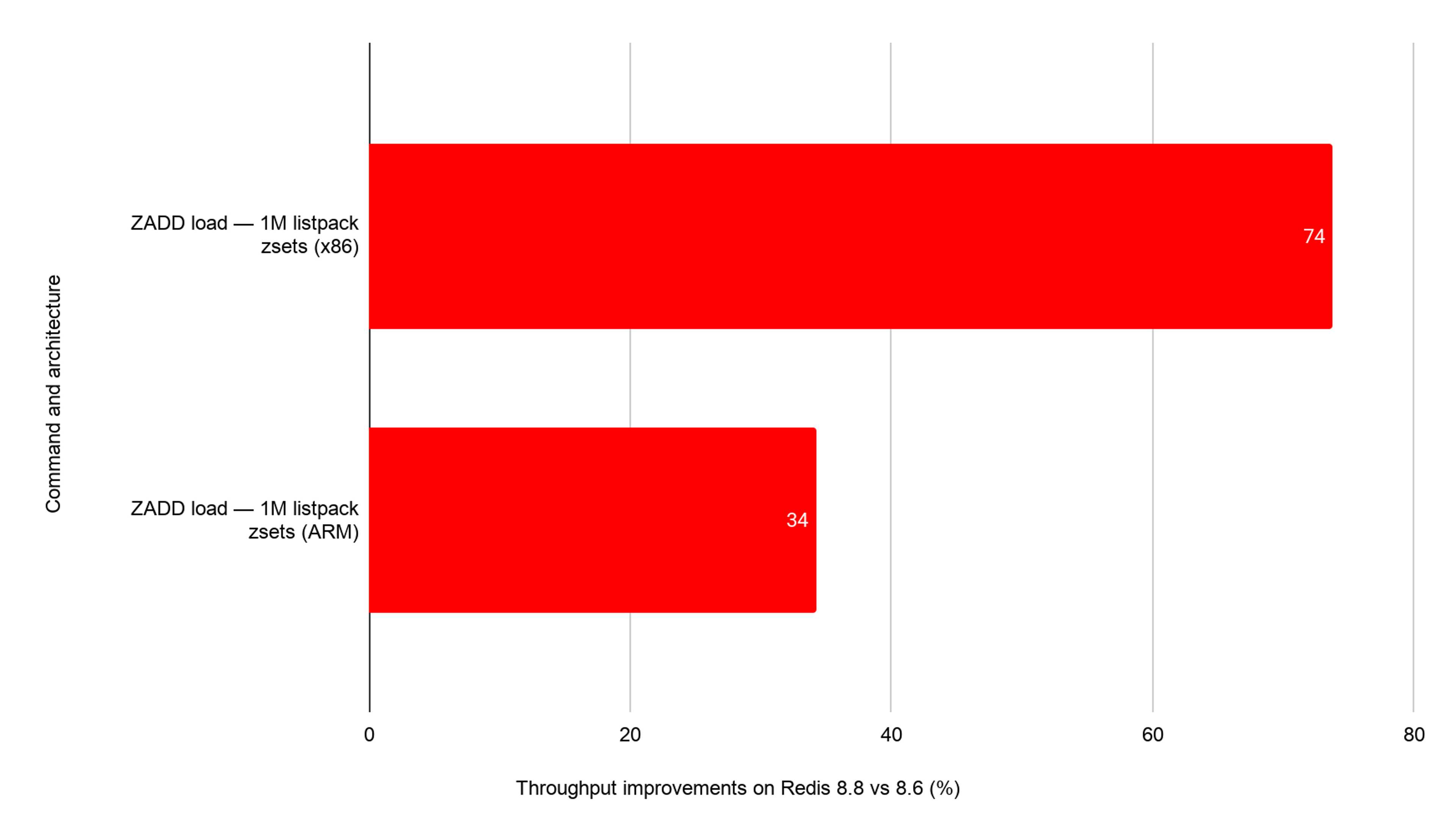
Sorted setZADD, ZINCRBY, ZRANGEBYSCOREUp to 74%
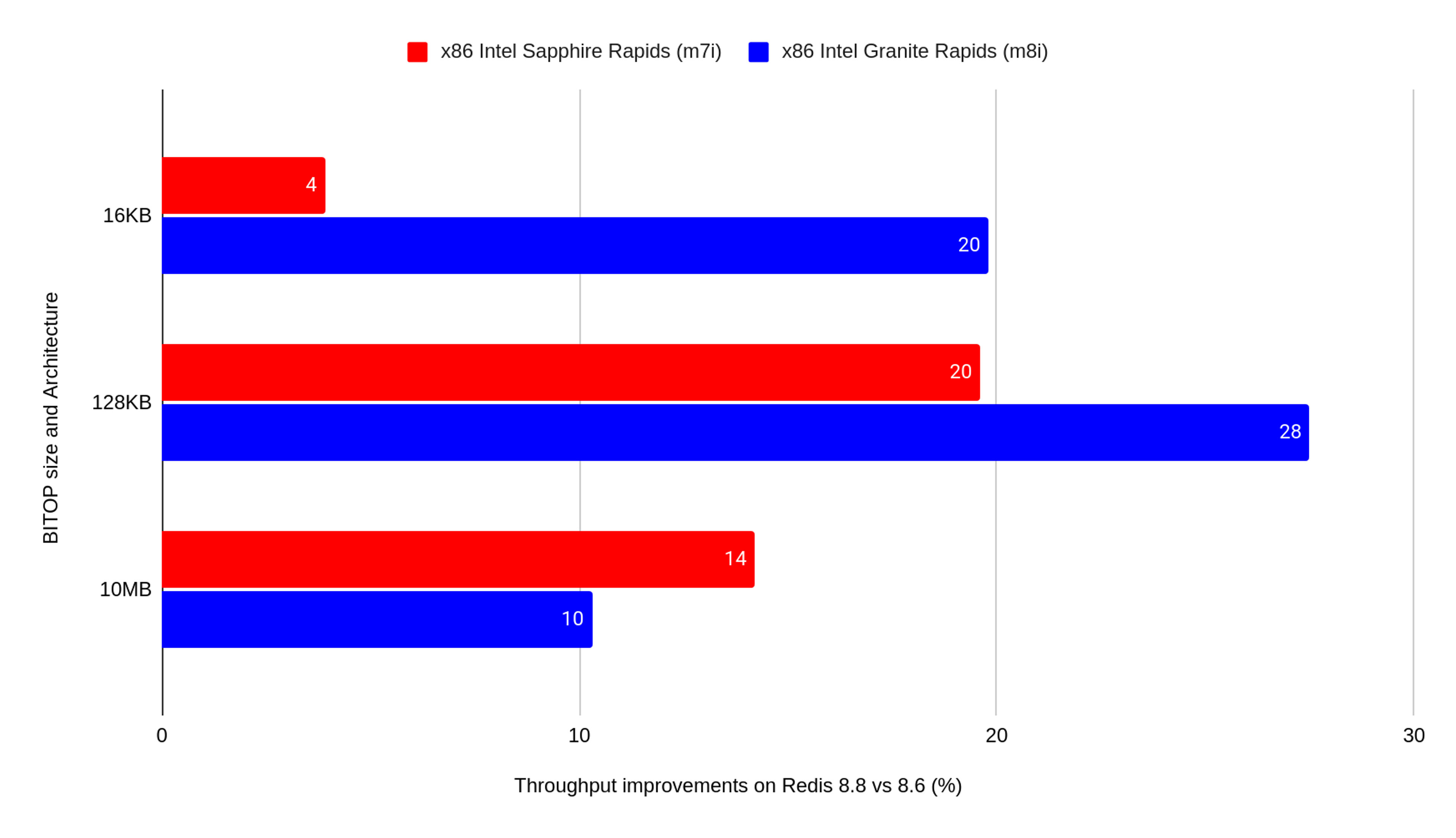
BitmapBitmap operationsUp to 28% (x86)
(several)SCAN, HSCAN, SSCAN, ZSCANUp to 40%

In addition, persistence and replication (full synchronization) is now up to 60% faster.

The performance improvements explained

MGET and MSET: up to +68% on pipelined bulk string reads

MGET and MSET are the workhorses of caching. They are also the commands most sensitive to cache-miss latency: every key in a batch means another dict traversal, and the value pointers sit in cache lines that are almost never warm when the command arrives.

In Redis 8.6 we introduced a memory prefetch framework that let single-key commands hide dict-traversal latency behind useful work. In Redis 8.8, that framework has been extended to multi-key bulk reads. When a pipelined MGET batch arrives, Redis walks the dict buckets for every key in the batch ahead of time and issues prefetch hints — so by the time each key is looked up, its cache line is already on its way to the CPU. The same idea applies to writes:

MSET and MSETNX now do a batched dict bucket prefetch for groups of keys inside setKey.

Measured on m7i.metal-24xl (x86) vs Redis 8.6:
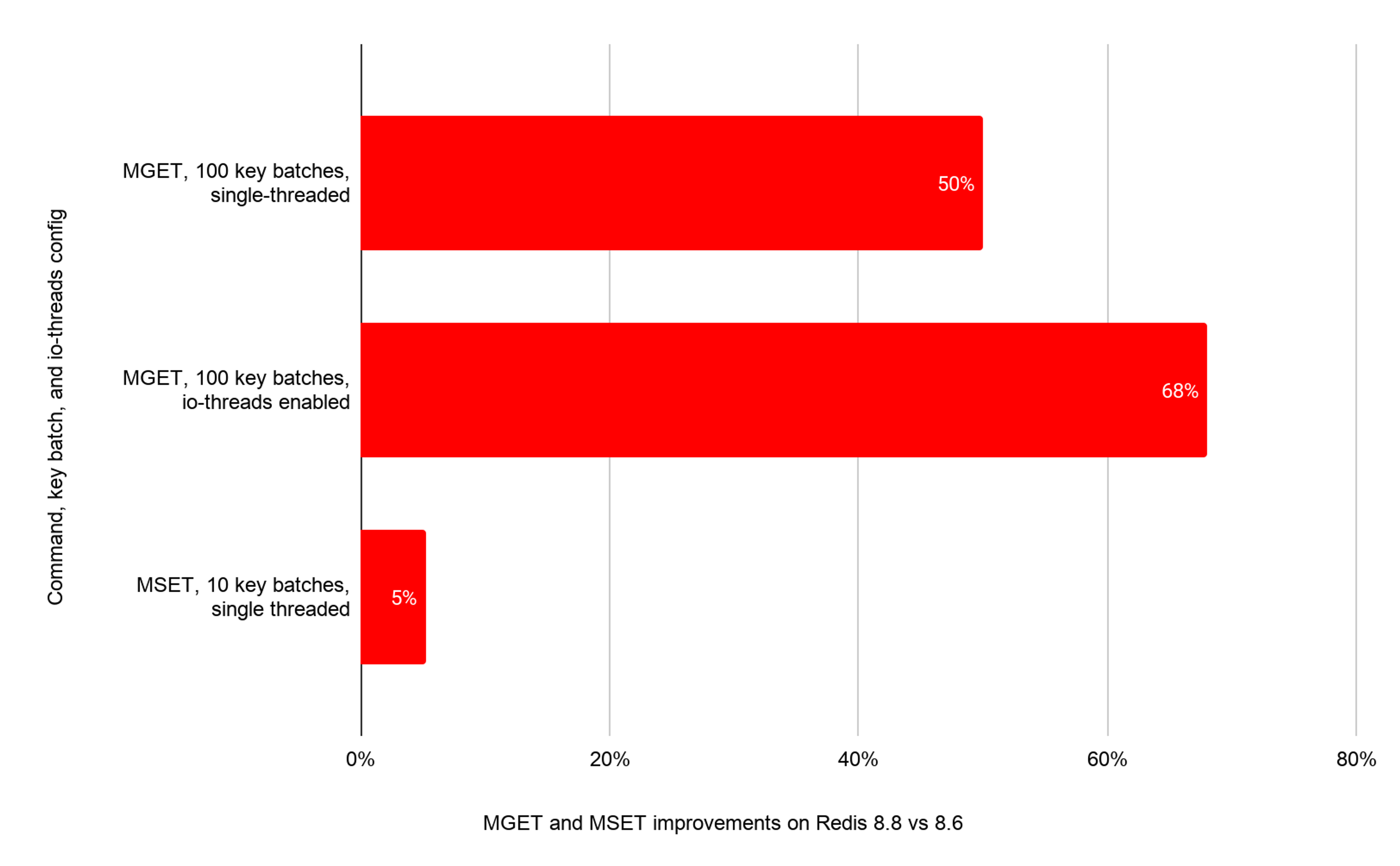
Measured on m7i.metal-24xl (x86) vs Redis 8.6

The MGET gain is the largest. In pipelined deployments with io-threads, it moves the bottleneck out of Redis' dict traversal and into the network for all but the largest values. There is no new command, no new flag, and no protocol change — upgrading is the entire deliverable.

HGETALL: up to +25% end-to-end on large hashes

HGETALL improved twice in Redis 8.8, and the improvements stack.

First, HGETALL benefits from a broader infrastructure change that extends cross-command prefetching from the pipeline header to the full pending batch — including the deferred-reply object list used by reply-heavy commands. On a 1,000-field hash, that alone lifts HGETALL by +4.6% on x86.

Second, for hashes large enough to live in the hashtable encoding, a dedicated batched dict bucket prefetch has been added to the field-iteration loop itself. The same mechanism now covers HKEYS and HVALS.

On a 1,000-field hashtable-encoded hash, the two changes compound to approximately +15% to +25% vs Redis 8.6 on x86, depending on pipeline depth and hash field count.
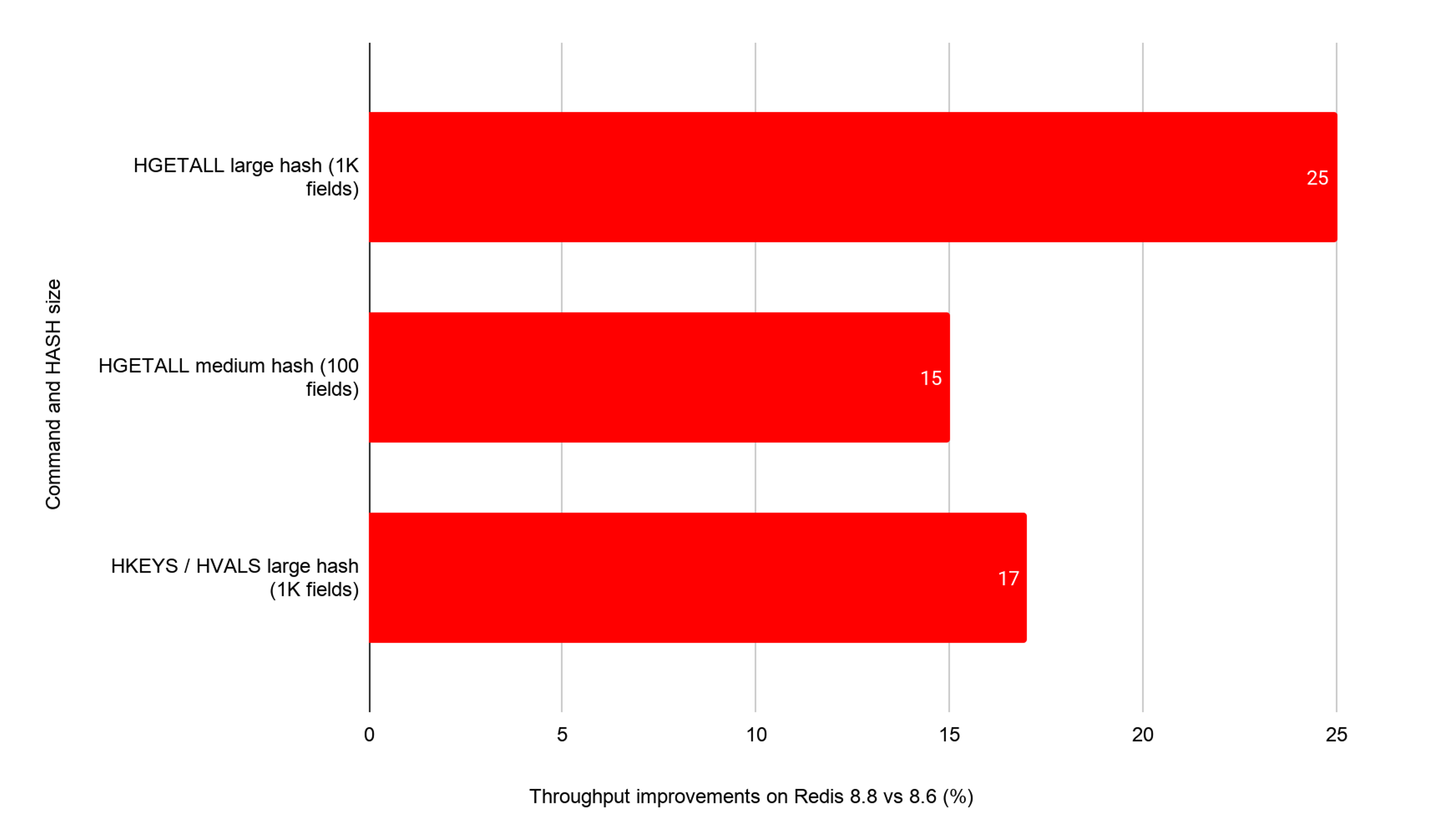
Improvements on Redis 8.8

Small, listpack-encoded hashes see the +4.6% from the broader prefetch extension alone — listpack is already cache-resident and does not need the HGETALL-specific prefetch.

SCAN family: up to +40% on pipelined cursor walks

On every SCAN, HSCAN, SSCAN, and ZSCAN call, the reply callback previously allocated a list-node per matching key — roughly 500 allocations and 500 frees per SCAN COUNT 500 command, all on the hot path. In Redis 8.8, that linked list is replaced with a stack-allocated vector container, so typical COUNT values generate zero heap allocations on the reply path.

Measured vs current unstable, on both x86 m7i and ARM m8g: SCAN COUNT 500 pipeline-10 gains +38.0% on x86 and +39.7% on ARM.
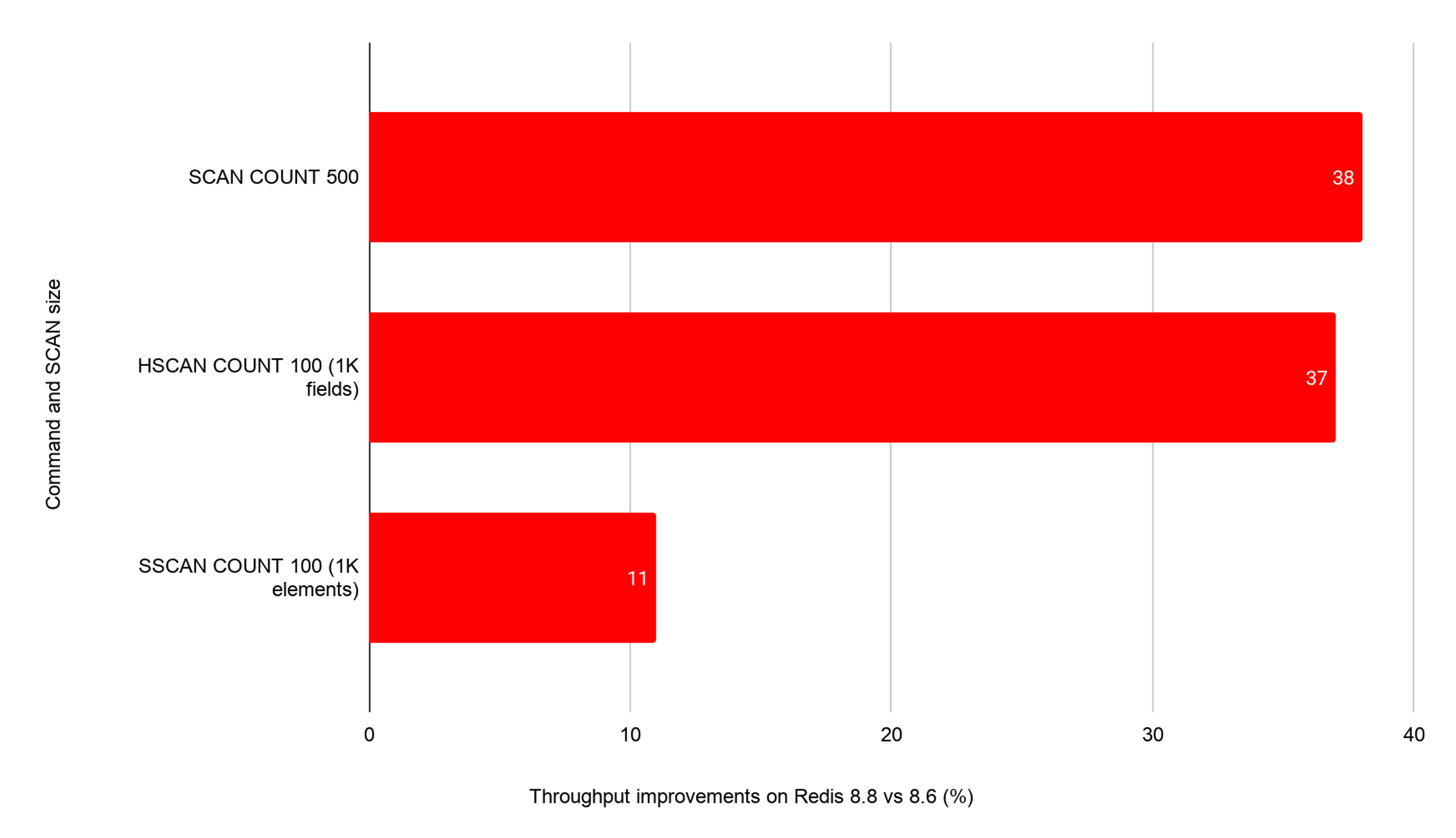
Measured vs 8.6, on both x86 m7i and ARM m8g

Streams: up to +83% on large XREADGROUP

Streams see the largest single improvement in Redis 8.8. The underlying change rewrites rax — the radix tree Redis uses to index stream entries and consumer-group pending entries — with two specializations tuned for how streams are actually accessed:

- An O(1) append fast path for sequential inserts. Stream IDs are monotonically increasing, so every XADD takes the fast path.

- A last-child-first lookup on descent. For XREADGROUP and range scans, the child you want is almost always the most recently inserted one — walking the child list from the tail eliminates the per-node linear scan.

Measured on Redis 8.6 vs Redis 8.8:
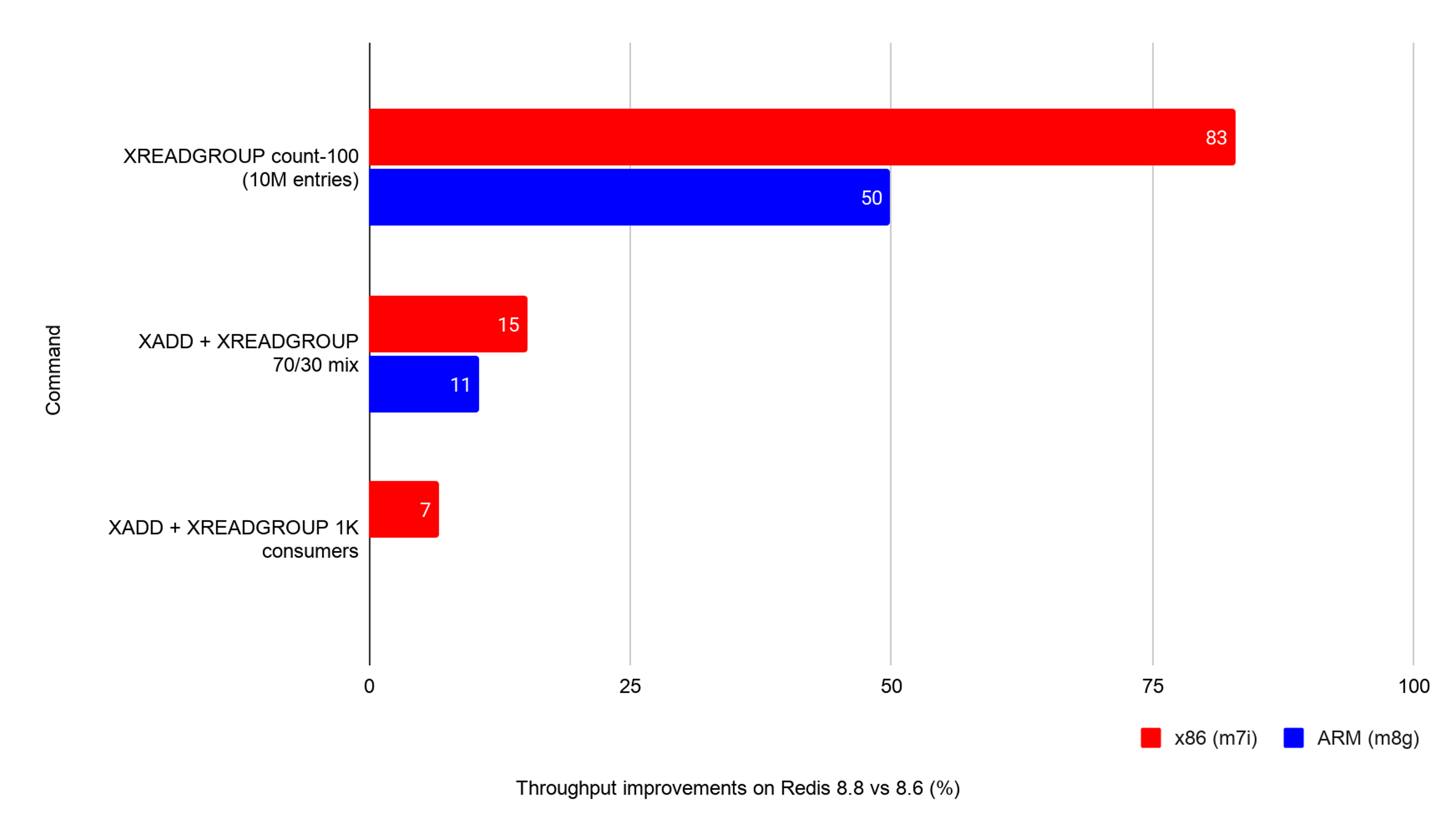
Measured on Redis 8.6 vs Redis 8.8

Sorted sets: up to +74% on score-parsing workloads

Redis 8.0 introduced the fast_float library (#11884) to accelerate ZADD, ZINCRBY, ZRANGEBYSCORE, GEOADD, and related double-parsing paths. Redis 8.8 goes further on two fronts: the fast_float C++ dependency is replaced with a pure-C implementation, simplifying the build (#14661), and the Clinger fast path has been widened to cover 17-to-19-significant-digit mantissas via a single 128-bit multiply (#15061).

On the canonical sorted-set-with-double-scores load benchmark:
Redis 8.8

This matters for any ZADD, ZINCRBY, or ZRANGEBYSCORE workload with double-precision scores — leaderboards, time-series secondary indexes, and any pattern where scores come from timestamps or client-side float-to-string conversions.

Bitmap operations: AVX-512 on modern x86

BITOP AND, OR, XOR, and NOT are now vectorized with AVX-512 on Ice Lake and newer Intel and AMD CPUs. Upstream measurements show up to +80% on value sizes of 10,000 bytes and above, with smaller gains on shorter values where the fixed dispatch overhead does not amortize.
Bitmap operations: AVX-512 on modern x86

Persistence and replication: Faster full sync, lower BGSAVE overhead

Redis 8.8 trims cost across several operational paths. Diskless full sync is the most visible win: because the replication link already provides integrity, the RDB checksum computation and validation are no longer performed on diskless transfers, cutting a 12 GB full-sync on a c8g.2xlarge replica from 35 seconds to 11 seconds — a 68% reduction.

BGSAVE and full sync also pay less in the fork child. Dict bucket arrays are now released back to the OS with MADV_DONTNEED, reducing the RSS spike and copy-on-write amplification during snapshotting, and memory tracking — which the child never used — is now disabled there.

Replication itself is lighter on the wire-feed path: the per-write bookkeeping in feedReplicationBuffer() has been reworked, so high-argument commands (HSET with many fields, MSET with many keys) pay less overhead on every replicated write. Pipelined SET, HSET, and ZADD with a replica attached measure between +3% and +26% faster. In addition, primary and replica clients are now serviced inside I/O threads, shifting more of the replication path off the main thread.

Getting started

All these enhancements are generally available on Redis 8.8 open source today. You can start using the new commands by downloading Redis 8.8 and experimenting with them in your existing workflows.

Have feedback or questions? Join the discussion on our Discord server or reach out to your account manager.