


惯性聚合 高效追踪和阅读你感兴趣的博客、新闻、科技资讯
阅读原文 在惯性聚合中打开

推荐订阅源

爱范儿
爱范儿
钛媒体:引领未来商业与生活新知
钛媒体:引领未来商业与生活新知
The Hacker News
The Hacker News
N
News and Events Feed by Topic
Simon Willison's Weblog
博客园 - 三生石上(FineUI控件)
V
Vulnerabilities – Threatpost
T
Tenable Blog
Threat Intelligence Blog | Flashpoint
P
Proofpoint News Feed
Security Latest
Security Latest
博客园 - 【当耐特】
腾讯CDC
The Cloudflare Blog
T
Tailwind CSS Blog
L
LINUX DO - 热门话题
博客园_首页
P
Palo Alto Networks Blog
人人都是产品经理
人人都是产品经理
P
Privacy & Cybersecurity Law Blog
阮一峰的网络日志
阮一峰的网络日志
有赞技术团队
有赞技术团队
AWS News Blog
AWS News Blog
S
Securelist
博客园 - Franky
C
Cyber Attacks, Cyber Crime and Cyber Security
让小产品的独立变现更简单 - ezindie.com
WordPress大学
WordPress大学
酷 壳 – CoolShell
酷 壳 – CoolShell
S
Schneier on Security
Apple Machine Learning Research
A
Arctic Wolf
P
Privacy International News Feed
Cisco Talos Blog
Cisco Talos Blog
C
Cybersecurity and Infrastructure Security Agency CISA
OSCHINA 社区最新新闻
OSCHINA 社区最新新闻
D
Darknet – Hacking Tools, Hacker News & Cyber Security
H
Heimdal Security Blog
Help Net Security
Help Net Security
博客园 - 叶小钗
月光博客
月光博客
I
Intezer
Cyberwarzone
Cyberwarzone
美团技术团队
C
CXSECURITY Database RSS Feed - CXSecurity.com
宝玉的分享
宝玉的分享
奇客Solidot–传递最新科技情报
奇客Solidot–传递最新科技情报
K
Kaspersky official blog
Hugging Face - Blog
Hugging Face - Blog
Jina AI
Jina AI

Redis

Real-Time Fraud Detection: Latency, Features & Scale Context window in AI: why every token is a budget decision Connecting to Redis Cloud with AWS PrivateLink vs. VPC peering | Redis Redis Data Integration in Redis Cloud is now GA in AWS | Redis Why AI Misses Business Context & How Teams Fix It AI Reasoning Explained: Why Context Matters Semantic Layer vs Context Layer: Key Differences Redis array data type: How it works and when to use it Context Graphs vs. Vector Search: When RAG Falls Short What’s new in two – May 2026 edition Redis 8.8 performance improvements: Faster string, hash, streams, SCAN & more Redis 8.8: New array data structure & open source features How Conflict-free Replicated Data Types power active-active database replication Context Orchestration: What It Is & How It Works Context Compaction for AI Agents: A Complete Guide Prompt Bloat: Causes, Costs & Fixes for LLM Apps Agentic Retrieval Techniques: A Complete Guide Single-shot reliable consumers with XREADGROUP CLAIM in Redis 8.4 | Redis Long-Horizon AI Agents: Memory & State Infrastructure What is a context engine? What Is a Context Layer? AI Agent Infrastructure Context Retrieval for AI Agents: What It Is & Why It Matters Context Poisoning: How Bad Data Breaks Agent Reasoning Context is all you need: Introducing Redis Iris | Redis Context Engineering for AI: What It Is & How to Build It Dynamic endpoints: Migrate databases without changing your endpoint | Redis AI Shopping Assistants: How They Work & What to Build Endless Aisle Retail: Infrastructure & Real-Time Data LLM Speed Benchmarks: Metrics & Infrastructure Guide Context Pruning: Cut LLM Tokens Without Losing Quality What’s new in two – April 2026 edition Agentic AI Architecture: 5 Patterns Explained AI Agent vs Chatbot: Key Differences Explained Advantages of Building a Vector Search Solution API Latency in LLM Apps: Causes & How to Fix It Security advisory: [CVE‑2026‑23479] [CVE‑2026‑25243] [CVE-2026-25588] [CVE‑2026‑25589] [CVE-2026-23631] | Redis Edge Computing Latency: Causes & How to Reduce It AI Agents vs Workflows: When to Use Each Streaming LLM Responses: Make Your AI App Feel Fast Active-Active vs Active-Passive Database Architecture Prefill vs Decode: LLM Inference Phases Explained Long-Term Memory Architectures for AI Agents Time to First Byte Test: Tools, Causes & Fixes Speculative decoding: how it works & when to use it P95 Latency: What It Is & Why It Matters Why Multi-Agent LLM Systems Fail & How to Fix Them AI Human in the Loop: Production Oversight Patterns Native OpenTelemetry metrics for Redis client libraries | Redis Client-side geographic failover for Redis Active-Active | Redis Use Redis with SQL | Redis Introducing Redis Feature Form Build Google ADK Agents with persistent, real-time memory on Redis | Redis Startup Spotlight: Neuron Systems API Throttling: Algorithms, Patterns & Mistakes Agentic AI Examples Across 6 Industries Best Chunking Strategies for RAG Pipelines Agentic AI Guardrails: Controls That Work Redis joins AWS at GDC to support the next generation of gaming | Redis Designing a semantic routing system: From static rules to dynamic intelligence with Redis and Java | Redis Real-Time Dispatch System: A Complete Guide P99 Latency: What It Means & How to Fix It Tokenization in LLMs: What AI App Devs Need to Know TTFT Meaning: What is Time to First Token? Atomic slot migration with Redis 8.4 Hybrid search benefits: Why your RAG system needs both keyword & vector search What’s new in two: March 2026 edition Vector embedding generators: How they work & how to use them Throughput-optimizing Redis for L2 KV Cache Reuse What is a data pipeline? Building AI agent pipelines that don't forget, fail, or fall apart Redis achieves Google Cloud Ready, Distributed Cloud status ahead of Google Cloud Next ‘26 | Redis Real-time network monitoring: what your data platform needs to keep up AI agent API: How agents connect to the real world What is multicloud infrastructure? A guide for 2026 What is a transaction monitoring system & how does it work? Why your AI agent fails in production & how tracing helps AI agent benchmarks: Where they fall short & why your infrastructure matters What is a JSON database (and when should you use one)? Introducing the Redis Partner Network: A new foundation for real-time innovation How real-time customer segmentation works in retail Payment orchestration & vault architecture in retail Agentic systems vs. GenAI: when generation isn't enough What is fuzzy matching? Semantic caching & routing: two powerful patterns for vector classification Redis alternatives: Why there are no exact substitutes Connect to Azure Managed Redis with Redis Insight 3.2.0 How to tame the thundering herd problem How hierarchical navigable small world (HNSW) algorithms can improve search | Redis How leading financial institutions use Redis to drive growth | Redis What’s new in two: May 2025 | Redis Introducing Model Context Protocol (MCP) for Redis | Redis Redis vs. Elasticsearch: What’s faster for GenAI & vector search? | Redis Build fast, production-worthy AI apps with Spring AI and Redis | Redis Azure Managed Redis is GA today | Redis Redis then & now: Adapting with developers through every era | Redis Supercharge Your AI with OpenShift AI and Redis: Unleash speed and scalability | Redis What’s new in two: April 2025 | Redis Redis 8 is now GA, loaded with new features and more than 30 performance improvements | Redis What is a data strategy? 6 key components explained Data replication explained: types, examples & use cases
Redis to Manage Storage Replication | Redis
2025-06-20 · via Redis

Redis is a simple, yet powerful in-memory database platform with use cases ranging from session management, queues and pub/sub to general-purpose cache. With its persistence and in-memory replication capabilities, Redis Enterprise is also used as a primary datastore.

As a software engineer, I frequently use Redis to overcome unique problems. In one project, our use case was simple: I wanted to replicate the contents of a file system partition with a fixed, well-defined structure: at the root of the file system we had a fixed set of directories, each with more than a million files. Our previous solution ran two processes in parallel, 24/7 to identify the modified files. The first process scanned all the file contents and identified the changed content since the previous replication. A job ran once every 24 hours to replicate the changed files. The second process indexed all the files that were successfully replicated.
Image

In our previous solution, we used an SQL database to store the file metadata (such as name, size, permissions, path, etc.) and all the information related to modified files. The scheduled replication job queried the database to pull the list of files that were modified, then replicated the content onto a remote server. After replication, it updated the SQL database, marking the files as ‘copied,’ after which the indexing process picked up the marked list to index the file content.

Redis to the Rescue

Our previous design had major disadvantages: we had to write a lot of code to save/retrieve/modify data in the SQL database, and as the database grew, we had to build a mechanism to prune the data. As the operational overhead became extensive, we started looking at ways to break free of this architecture.

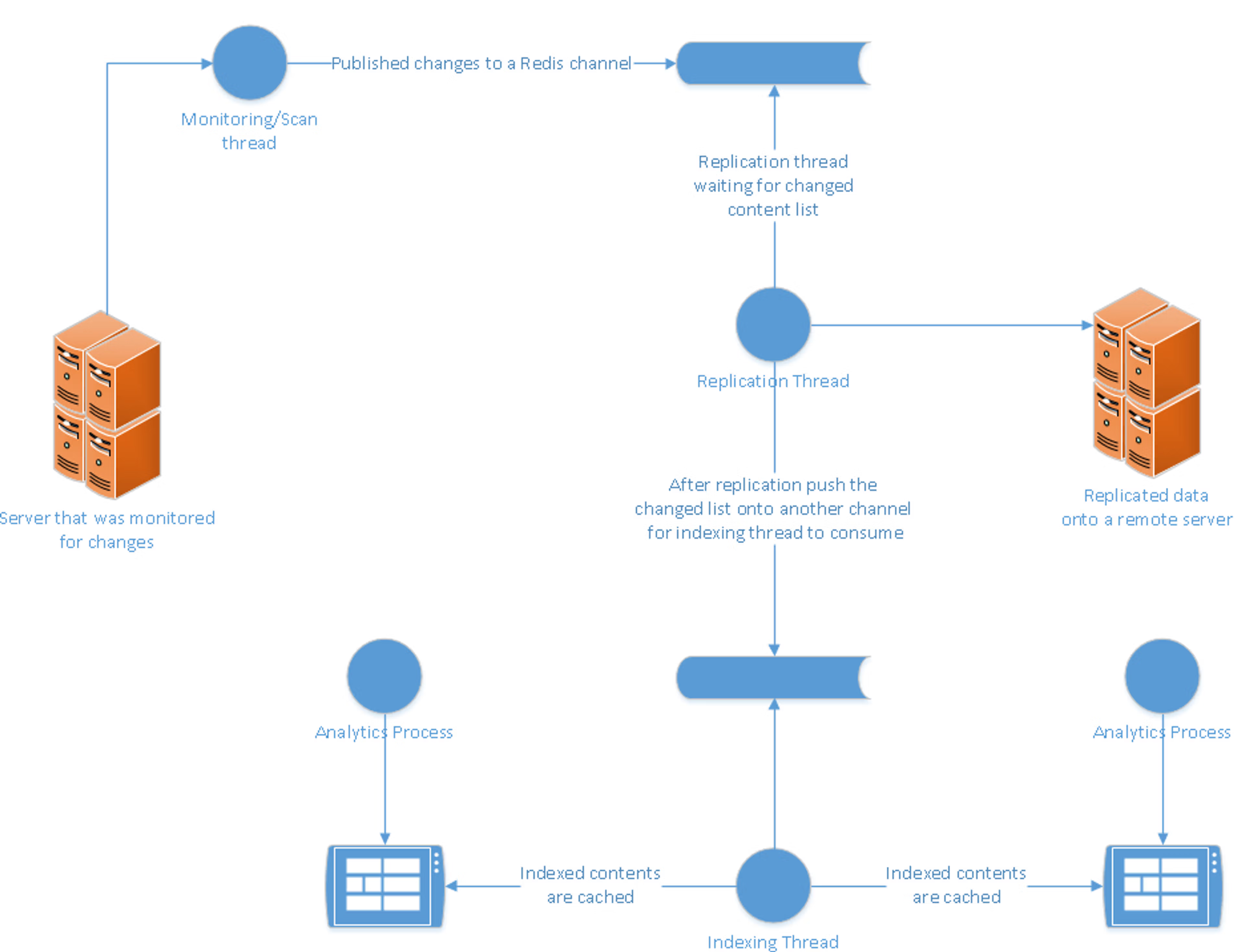
That’s when we found Redis. Redis instantly solved many of our problems. In our new solution, we used the Redis pub/sub feature to notify our various processes of new detections. The scan process published the details of the changed file(s) to a Redis channel. The replication process subscribed to that channel and replicated the file as soon as it was notified. Then the replication process notified the indexing process (via another Redis pub/sub channel). This system eliminated the need to run a job once a day and instead ran replication as an ongoing process. We also saved ourselves the hassle of cleaning up the SQL database!

Before considering the Redis pub/sub model, we also considered RabbitMQ, Kafka, etc. Each was good but required a lot of work on our end, with a bit of a learning curve. None were as versatile and easy to use as Redis.

As we adopted Redis, we discovered many of its other advantages. We started using built-in data structures such as Lists, Hashes and Sets, to perform analytics. For example, we wanted to know the frequency of changes to the files and directories, and which applications made those changes. We used Redis and its data structures to gather this information. We then passed it to the indexing process and enriched the indexed meta data with analytics data.

Getting started with Redis is extremely easy. You can sign up for Redis Cloud for free at: /redis-enterprise-cloud-free-30-mb-plan

This is a guest post by Rahul, a Software Engineer and user of Redis Enterprise as part of his work.