
惯性聚合 高效追踪和阅读你感兴趣的博客、新闻、科技资讯
阅读原文 在惯性聚合中打开

推荐订阅源

Microsoft Security Blog
Google DeepMind News
P
Privacy International News Feed
www.infosecurity-magazine.com
T
Threatpost
GbyAI
GbyAI
V
Visual Studio Blog
H
Help Net Security
Vercel News
Vercel News
P
Palo Alto Networks Blog
Project Zero
Project Zero
AWS News Blog
AWS News Blog
Latest news
Latest news
Cyberwarzone
Cyberwarzone
C
Cybersecurity and Infrastructure Security Agency CISA
The Register - Security
博客园_首页
WordPress大学
WordPress大学
G
GRAHAM CLULEY
T
Tor Project blog
有赞技术团队
有赞技术团队
Know Your Adversary
Know Your Adversary
AI
AI
Threat Intelligence Blog | Flashpoint
O
OpenAI News
博客园 - 聂微东
月光博客
月光博客
S
Security Affairs
Webroot Blog
Webroot Blog
L
LangChain Blog
Apple Machine Learning Research
NISL@THU
NISL@THU
N
News and Events Feed by Topic
Blog — PlanetScale
Blog — PlanetScale
S
Securelist
V
Vulnerabilities – Threatpost
aimingoo的专栏
aimingoo的专栏
阮一峰的网络日志
阮一峰的网络日志
Stack Overflow Blog
Stack Overflow Blog
Application and Cybersecurity Blog
D
DataBreaches.Net
让小产品的独立变现更简单 - ezindie.com
Y
Y Combinator Blog
Cisco Talos Blog
Cisco Talos Blog
The Cloudflare Blog
IT之家
IT之家
博客园 - 三生石上(FineUI控件)
雷峰网
雷峰网
L
Lohrmann on Cybersecurity
T
The Blog of Author Tim Ferriss

Redis

Real-Time Fraud Detection: Latency, Features & Scale Context window in AI: why every token is a budget decision Redis Data Integration in Redis Cloud is now GA in AWS | Redis Why AI Misses Business Context & How Teams Fix It AI Reasoning Explained: Why Context Matters Semantic Layer vs Context Layer: Key Differences Redis array data type: How it works and when to use it Context graphs: when nearest-neighbor search isn't enough What’s new in two – May 2026 edition Redis 8.8 performance improvements: Faster string, hash, streams, SCAN & more Redis 8.8: New array data structure & open source features How Conflict-free Replicated Data Types power active-active database replication Context Orchestration: What It Is & How It Works Context Compaction for AI Agents: A Complete Guide Prompt Bloat: Causes, Costs & Fixes for LLM Apps Agentic Retrieval Techniques: A Complete Guide Single-shot reliable consumers with XREADGROUP CLAIM in Redis 8.4 | Redis Long-Horizon AI Agents: Memory & State Infrastructure What is a context engine? What Is a Context Layer? AI Agent Infrastructure Context Retrieval for AI Agents: What It Is & Why It Matters Context Poisoning: How Bad Data Breaks Agent Reasoning Context is all you need: Introducing Redis Iris | Redis Context Engineering for AI: What It Is & How to Build It Dynamic endpoints: Migrate databases without changing your endpoint | Redis AI Shopping Assistants: How They Work & What to Build Endless Aisle Retail: Infrastructure & Real-Time Data LLM Speed Benchmarks: Metrics & Infrastructure Guide Context Pruning: Cut LLM Tokens Without Losing Quality What’s new in two – April 2026 edition Agentic AI Architecture: 5 Patterns Explained AI Agent vs Chatbot: Key Differences Explained Advantages of Building a Vector Search Solution API Latency in LLM Apps: Causes & How to Fix It Security advisory: [CVE‑2026‑23479] [CVE‑2026‑25243] [CVE-2026-25588] [CVE‑2026‑25589] [CVE-2026-23631] | Redis Edge Computing Latency: Causes & How to Reduce It AI Agents vs Workflows: When to Use Each Streaming LLM Responses: Make Your AI App Feel Fast Active-Active vs Active-Passive Database Architecture Prefill vs Decode: LLM Inference Phases Explained Long-Term Memory Architectures for AI Agents Time to First Byte Test: Tools, Causes & Fixes Speculative decoding: how it works & when to use it P95 Latency: What It Is & Why It Matters Why Multi-Agent LLM Systems Fail & How to Fix Them AI Human in the Loop: Production Oversight Patterns Native OpenTelemetry metrics for Redis client libraries | Redis Client-side geographic failover for Redis Active-Active | Redis Use Redis with SQL | Redis Introducing Redis Feature Form Build Google ADK Agents with persistent, real-time memory on Redis | Redis Startup Spotlight: Neuron Systems API Throttling: Algorithms, Patterns & Mistakes Agentic AI Examples Across 6 Industries Best Chunking Strategies for RAG Pipelines Agentic AI Guardrails: Controls That Work Redis joins AWS at GDC to support the next generation of gaming | Redis Designing a semantic routing system: From static rules to dynamic intelligence with Redis and Java | Redis Real-Time Dispatch System: A Complete Guide P99 Latency: What It Means & How to Fix It Tokenization in LLMs: What AI App Devs Need to Know TTFT Meaning: What is Time to First Token? Atomic slot migration with Redis 8.4 Hybrid search benefits: Why your RAG system needs both keyword & vector search What’s new in two: March 2026 edition Vector embedding generators: How they work & how to use them Throughput-optimizing Redis for L2 KV Cache Reuse What is a data pipeline? Building AI agent pipelines that don't forget, fail, or fall apart Redis achieves Google Cloud Ready, Distributed Cloud status ahead of Google Cloud Next ‘26 | Redis Real-time network monitoring: what your data platform needs to keep up AI agent API: How agents connect to the real world What is multicloud infrastructure? A guide for 2026 What is a transaction monitoring system & how does it work? Why your AI agent fails in production & how tracing helps AI agent benchmarks: Where they fall short & why your infrastructure matters What is a JSON database (and when should you use one)? Introducing the Redis Partner Network: A new foundation for real-time innovation How real-time customer segmentation works in retail Payment orchestration & vault architecture in retail Agentic systems vs. GenAI: when generation isn't enough What is fuzzy matching? Semantic caching & routing: two powerful patterns for vector classification Redis alternatives: Why there are no exact substitutes Connect to Azure Managed Redis with Redis Insight 3.2.0 How to tame the thundering herd problem Redis to Manage Storage Replication | Redis How hierarchical navigable small world (HNSW) algorithms can improve search | Redis How leading financial institutions use Redis to drive growth | Redis What’s new in two: May 2025 | Redis Introducing Model Context Protocol (MCP) for Redis | Redis Redis vs. Elasticsearch: What’s faster for GenAI & vector search? | Redis Build fast, production-worthy AI apps with Spring AI and Redis | Redis Azure Managed Redis is GA today | Redis Redis then & now: Adapting with developers through every era | Redis Supercharge Your AI with OpenShift AI and Redis: Unleash speed and scalability | Redis What’s new in two: April 2025 | Redis Redis 8 is now GA, loaded with new features and more than 30 performance improvements | Redis What is a data strategy? 6 key components explained Data replication explained: types, examples & use cases
Connecting to Redis Cloud with AWS PrivateLink vs. VPC peering | Redis
Redis · 2026-06-10 · via Redis

AWS PrivateLink resource endpoints are now generally available across all Redis Cloud Pro subscription types, including Redis Flex and Active-Active deployments. That means you can connect apps to Redis Cloud through a private, scoped endpoint without exposing entire VPC networks to each other. Our PrivateLink implementation will also support‍ smart client handoffs‍ in the near future, helping apps stay connected during maintenance and upgrades.

Redis was an early adopter of AWS PrivateLink, and large-scale enterprise customers have been using PrivateLink with Redis Cloud to meet their most demanding workloads.

Our recommendation

This post compares AWS PrivateLink and VPC peering as connectivity options for Redis Cloud, focusing on the trade-offs between security isolation, operational simplicity, latency, and throughput.

For most deployments, PrivateLink is the better default. It provides scoped connectivity, works with overlapping CIDR ranges, and avoids exposing entire VPCs to each other. VPC peering remains the better fit for extremely latency-sensitive workloads where every microsecond matters and the lowest possible network overhead is required.

The performance trade-off for PrivateLink is measurable but small: under 50 µs of additional latency in our ultra-low-latency benchmark, and no measurable throughput impact for workloads operating below saturation.

Let’s unpack where those trade-offs matter, when to choose each model, and what the benchmark data shows.

Redis Cloud has long supported VPC peering as a private connectivity option for AWS deployments, and it remains a widely used model for latency-sensitive production workloads.

Both options keep your traffic on the AWS network and off the public internet. The differences come down to four things: performance (throughput and latency), security and network complexity, and cost effectiveness.

VPC peering creates a direct bilateral route between two VPCs. It's simple to set up and adds minimal latency overhead. The trade-off is network exposure. Because VPC peering is a Layer 3 connection, it requires non-overlapping CIDR ranges between the peered VPCs. That can be a hard blocker when IP ranges collide. It also exposes more network surface area than many teams want: both VPCs gain network-level visibility into each other, not just access to the Redis database.

PrivateLink takes a different approach. Rather than routing traffic at the VPC level, it exposes a specific service endpoint that your app connects to directly. Connectivity is strictly directional—from consumer to provider—and your VPCs are never exposed to each other. You grant access to exactly one resource: your Redis database. Nothing else. PrivateLink is a Layer 4 connectivity model that works across AWS accounts and VPCs, even when CIDR ranges overlap. For teams with zero-trust requirements or operating under compliance frameworks such as SOC 2, HIPAA, or PCI DSS, this scoped, directional model is often what security policies mandate.

The performance question

To quantify the impact, we benchmarked four workloads against the same Redis Cloud Pro database (200 GB, 300K ops/s, single-AZ us-east-2, TLS disabled) using memtier_benchmark from a c5.4xlarge client. The workloads used a 1:9 write/read ratio with no rate limiting, while varying connection counts and pipeline depths to target p99 latencies ranging from sub-500 µs to sub-5 ms.

The only variable between runs was the connectivity layer (VPC peering versus PrivateLink) on the two supported topologies:

  • Single endpoint (Enterprise clustering): The standard Redis Cloud endpoint model, where your app connects through a single database endpoint.
  • OSS Cluster API: A cluster-aware topology where the client connects directly to shard-level endpoints.

Which one should I pick?

PrivateLink should be the default choice for most deployments. The additional network RTT is negligible for the majority of production workloads. The matrix shows when it isn’t:
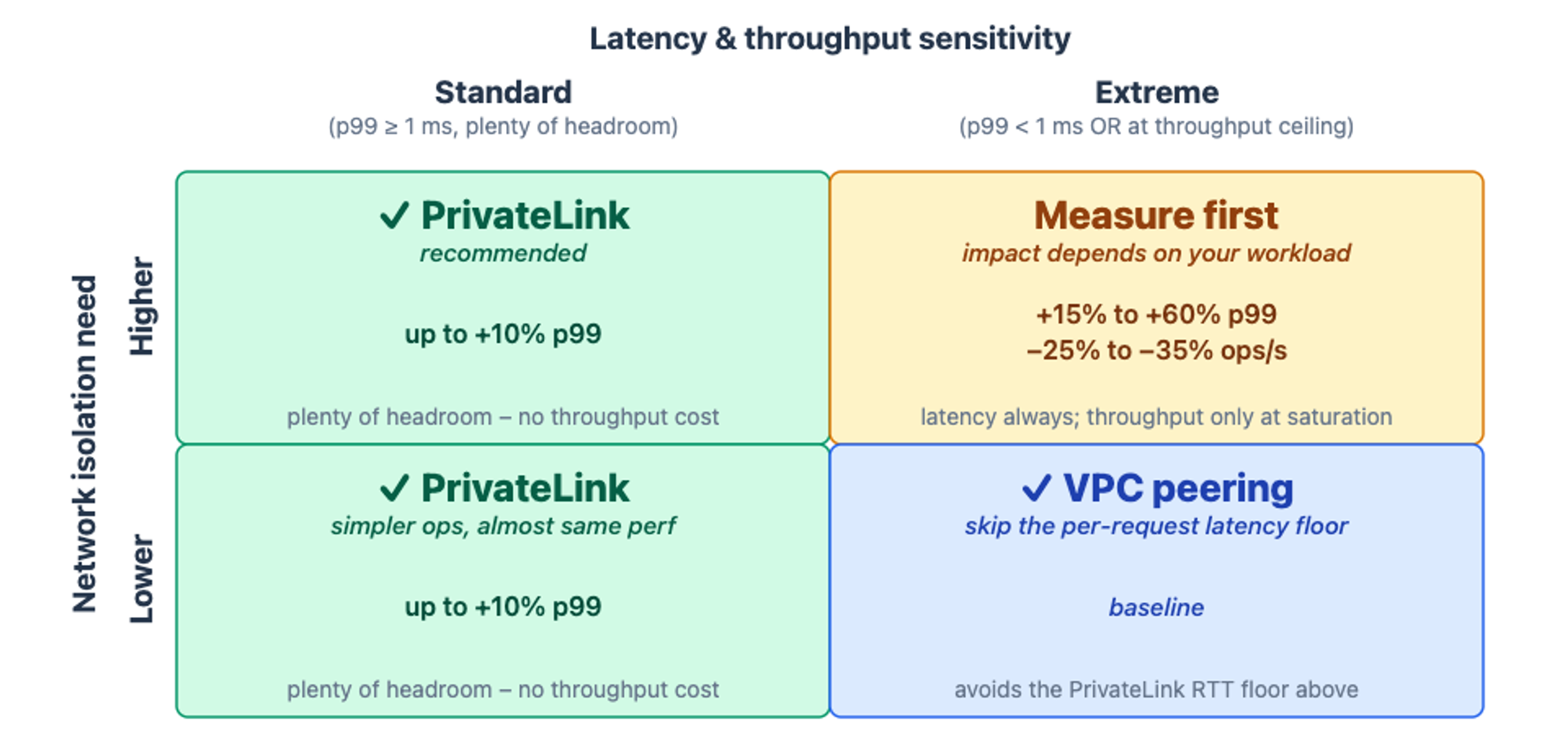
Connecting to Redis Cloud with AWS PrivateLink vs. VPC peering

Rule of thumb: PrivateLink first. Pick VPC peering only when your workload sits in the Extreme column and you don't need network isolation. Extreme workloads are those operating near hard limits: either sub-ms p99 latency targets or near-saturation throughputs.

In other words: start by asking whether you have a hard network isolation requirement. If yes, choose PrivateLink. At standard latency targets (p99 ≥ 1 ms) the cost is just an increase of ~10% on latency; at extreme targets, benchmark your workload before committing.

If no network isolation is required, the next question is whether your application has extreme workloads (p99 < 1ms or at throughput ceiling). If yes, VPC peering is the better fit. If no, prefer PrivateLink for its network isolation benefits.

Note on throughput: the penalties quoted (-25% and -35% ops/s) describe behavior at saturation. For a workload running below capacity (most production apps), the throughput “tax” doesn't show up.

How to think about the trade-off

The right mental model is an approximately 10% increase in p99 latency for typical production workloads. For ultra-low-latency workloads already operating below 500 µs, the same absolute RTT increase can translate into a much larger relative percentage increase.

Most production apps won't notice it. If your Redis operations typically complete in the 1–5 ms range (which is true for most workloads), the PrivateLink overhead becomes negligible.

For sub-500µs latency-critical apps, benchmark your specific workload. If you're running real-time bidding, high-frequency financial operations, or gaming leaderboards where every microsecond counts, the relative latency increase at p50 (up to ~50%) is worth measuring against your own SLAs. Absolute latencies should still remain sub-millisecond, but validate this against your own payload sizes, connection patterns, and SLAs.

Key takeaways

PrivateLink is our recommended connectivity model for Redis Cloud on AWS. It's the best choice for teams that care about security posture, compliance, or operational simplicity across accounts and CIDR ranges – which is most teams. VPC peering remains a reasonable choice in two specific situations: when your workload is extremely latency-sensitive and every microsecond counts, or when the security benefits of PrivateLink don't justify the additional cost for your use case.

We'll continue publishing benchmark data as testing progresses.

Get started with PrivateLink

If you’re ready to configure AWS PrivateLink on Redis Cloud, start with our docs. If you’re choosing between PrivateLink and VPC peering for a latency-sensitive workload, talk to a Redis expert about your network setup.

Benchmark environment: AWS, Redis Cloud Pro, dedicated instances. Results represent median across multiple runs. Your results may vary based on instance size, region, payload characteristics, and app access patterns.