


惯性聚合 高效追踪和阅读你感兴趣的博客、新闻、科技资讯
阅读原文 在惯性聚合中打开

推荐订阅源

Microsoft Azure Blog
The Register - Security
S
Securelist
Simon Willison's Weblog
T
The Exploit Database - CXSecurity.com
V
Vulnerabilities – Threatpost
NISL@THU
NISL@THU
P
Privacy & Cybersecurity Law Blog
V2EX - 技术
V2EX - 技术
O
OpenAI News
N
News and Events Feed by Topic
AI
AI
P
Proofpoint News Feed
Schneier on Security
Exploit-DB.com RSS Feed
Cloudbric
Cloudbric
Help Net Security
Help Net Security
C
Cyber Attacks, Cyber Crime and Cyber Security
Threat Intelligence Blog | Flashpoint
Security Latest
Security Latest
Application and Cybersecurity Blog
L
LINUX DO - 热门话题
Cyberwarzone
Cyberwarzone
Scott Helme
Scott Helme
The Hacker News
The Hacker News
Hacker News - Newest:
Hacker News - Newest: "LLM"
www.infosecurity-magazine.com
Google DeepMind News
H
Hacker News: Front Page
C
Cisco Blogs
Webroot Blog
Webroot Blog
K
KPMG report finds enterprise disconnect between AI and its ROI | CIO
Hacker News: Ask HN
Hacker News: Ask HN
cs.CL updates on arXiv.org
The Last Watchdog
The Last Watchdog
PCI Perspectives
PCI Perspectives
AWS News Blog
AWS News Blog
Recent Commits to openclaw:main
Know Your Adversary
Know Your Adversary
Latest news
Latest news
Forbes - Security
Forbes - Security
I
Intezer
Project Zero
Project Zero
C
CERT Recently Published Vulnerability Notes
T
Tenable Blog
TaoSecurity Blog
TaoSecurity Blog
S
Security @ Cisco Blogs
N
News | PayPal Newsroom
H
Heimdal Security Blog
W
WeLiveSecurity

Redis

Real-Time Fraud Detection: Latency, Features & Scale Context window in AI: why every token is a budget decision Connecting to Redis Cloud with AWS PrivateLink vs. VPC peering | Redis Redis Data Integration in Redis Cloud is now GA in AWS | Redis Why AI Misses Business Context & How Teams Fix It AI Reasoning Explained: Why Context Matters Semantic Layer vs Context Layer: Key Differences Redis array data type: How it works and when to use it Context Graphs vs. Vector Search: When RAG Falls Short What’s new in two – May 2026 edition Redis 8.8 performance improvements: Faster string, hash, streams, SCAN & more Redis 8.8: New array data structure & open source features How Conflict-free Replicated Data Types power active-active database replication Context Orchestration: What It Is & How It Works Context Compaction for AI Agents: A Complete Guide Prompt Bloat: Causes, Costs & Fixes for LLM Apps Agentic Retrieval Techniques: A Complete Guide Single-shot reliable consumers with XREADGROUP CLAIM in Redis 8.4 | Redis Long-Horizon AI Agents: Memory & State Infrastructure What is a context engine? What Is a Context Layer? AI Agent Infrastructure Context Retrieval for AI Agents: What It Is & Why It Matters Context Poisoning: How Bad Data Breaks Agent Reasoning Context is all you need: Introducing Redis Iris | Redis Context Engineering for AI: What It Is & How to Build It Dynamic endpoints: Migrate databases without changing your endpoint | Redis AI Shopping Assistants: How They Work & What to Build Endless Aisle Retail: Infrastructure & Real-Time Data LLM Speed Benchmarks: Metrics & Infrastructure Guide Context Pruning: Cut LLM Tokens Without Losing Quality What’s new in two – April 2026 edition Agentic AI Architecture: 5 Patterns Explained AI Agent vs Chatbot: Key Differences Explained Advantages of Building a Vector Search Solution API Latency in LLM Apps: Causes & How to Fix It Security advisory: [CVE‑2026‑23479] [CVE‑2026‑25243] [CVE-2026-25588] [CVE‑2026‑25589] [CVE-2026-23631] | Redis Edge Computing Latency: Causes & How to Reduce It AI Agents vs Workflows: When to Use Each Streaming LLM Responses: Make Your AI App Feel Fast Active-Active vs Active-Passive Database Architecture Prefill vs Decode: LLM Inference Phases Explained Long-Term Memory Architectures for AI Agents Time to First Byte Test: Tools, Causes & Fixes Speculative decoding: how it works & when to use it P95 Latency: What It Is & Why It Matters Why Multi-Agent LLM Systems Fail & How to Fix Them AI Human in the Loop: Production Oversight Patterns Native OpenTelemetry metrics for Redis client libraries | Redis Client-side geographic failover for Redis Active-Active | Redis Use Redis with SQL | Redis Introducing Redis Feature Form Build Google ADK Agents with persistent, real-time memory on Redis | Redis Startup Spotlight: Neuron Systems API Throttling: Algorithms, Patterns & Mistakes Agentic AI Examples Across 6 Industries Best Chunking Strategies for RAG Pipelines Agentic AI Guardrails: Controls That Work Redis joins AWS at GDC to support the next generation of gaming | Redis Designing a semantic routing system: From static rules to dynamic intelligence with Redis and Java | Redis Real-Time Dispatch System: A Complete Guide P99 Latency: What It Means & How to Fix It Tokenization in LLMs: What AI App Devs Need to Know TTFT Meaning: What is Time to First Token? Atomic slot migration with Redis 8.4 Hybrid search benefits: Why your RAG system needs both keyword & vector search What’s new in two: March 2026 edition Vector embedding generators: How they work & how to use them Throughput-optimizing Redis for L2 KV Cache Reuse What is a data pipeline? Building AI agent pipelines that don't forget, fail, or fall apart Redis achieves Google Cloud Ready, Distributed Cloud status ahead of Google Cloud Next ‘26 | Redis Real-time network monitoring: what your data platform needs to keep up AI agent API: How agents connect to the real world What is multicloud infrastructure? A guide for 2026 What is a transaction monitoring system & how does it work? Why your AI agent fails in production & how tracing helps AI agent benchmarks: Where they fall short & why your infrastructure matters What is a JSON database (and when should you use one)? Introducing the Redis Partner Network: A new foundation for real-time innovation How real-time customer segmentation works in retail Payment orchestration & vault architecture in retail Agentic systems vs. GenAI: when generation isn't enough What is fuzzy matching? Semantic caching & routing: two powerful patterns for vector classification Redis alternatives: Why there are no exact substitutes Connect to Azure Managed Redis with Redis Insight 3.2.0 How to tame the thundering herd problem Redis to Manage Storage Replication | Redis How hierarchical navigable small world (HNSW) algorithms can improve search | Redis How leading financial institutions use Redis to drive growth | Redis What’s new in two: May 2025 | Redis Redis vs. Elasticsearch: What’s faster for GenAI & vector search? | Redis Build fast, production-worthy AI apps with Spring AI and Redis | Redis Azure Managed Redis is GA today | Redis Redis then & now: Adapting with developers through every era | Redis Supercharge Your AI with OpenShift AI and Redis: Unleash speed and scalability | Redis What’s new in two: April 2025 | Redis Redis 8 is now GA, loaded with new features and more than 30 performance improvements | Redis What is a data strategy? 6 key components explained Data replication explained: types, examples & use cases
Introducing Model Context Protocol (MCP) for Redis | Redis
Redis · 2025-05-22 · via Redis

Model Context Protocol (MCP) is a standard developed by Anthropic that lets AI agentic apps use external data and tools. Think of it like a universal adapter that helps AI go beyond its training by tapping into real-time info and capabilities, like pulling weather forecasts, live stock prices or checking your calendar.

MCP is built to solve common pain points around how AI accesses and works with information.

  1. Static knowledge limitations: Most AI models are trained once and can’t access new or real-time data. MCP lets them connect to live data sources, making their responses more current and valuable.
  2. Tool interoperability: AI models often need external tools (like search engines, databases, calculators), but there’s no universal way to connect. MCP provides a standardized interface so models can interact with tools more easily.
  3. Fragmented ecosystems: Every integration between an AI and a tool must be custom-built without a standard protocol. MCP cuts the overhead by creating a plug-and-play system.
  4. Context switching: AI agents often struggle to maintain and manage context when switching between different tools or data. MCP helps maintain a coherent model of context across different sources and tools.
  5. Scalability: Scaling AI systems is difficult when each tool integration is a one-off. MCP makes it easy to scale by breaking the tight link between your models and the tools or data they rely on.

MCP integrations are available on Claude Desktop and extended to platforms like GitHub Copilot, Cursor, Augment, the OpenAI Agents SDK, and more.

That’s why we’re excited to introduce Redis’ MCP servers through two open-source projects:mcp-redis and mcp-redis-cloud.

The Redis MCP server

The mcp-redis project is a natural language interface designed to manage and search data in Redis. It integrates with MCP clients, enabling AI-driven workflows to interact with structured and unstructured data in Redis. The MCP Server makes it easy to work with everything Redis supports: strings, hashes, JSON documents, lists, sets, sorted sets, vector embeddings, etc. The server also makes available server management tools to perform a Redis database health check. Using the Redis MCP Server, the MCP client app can resort to Redis for popular use cases such as session management, conversation history, real-time caching, rate limiting, recommendations, or semantic search for retrieval augmented generation (RAG).

You can integrate this MCP Server in a few clicks using registries like the popular Smithery platform, using the pre-built Docker image made available on Docker Hub. You can also build your Docker image or clone the project and run the server locally.

MCP works with the tools you already use. IDEs like VS Code with GitHub Copilot, Cursor, and Claude Desktop support it out of the box—so you can talk to your Redis server no matter where it’s running: local, Docker, or Redis Cloud. Just connect the server you want and you’re ready to go.
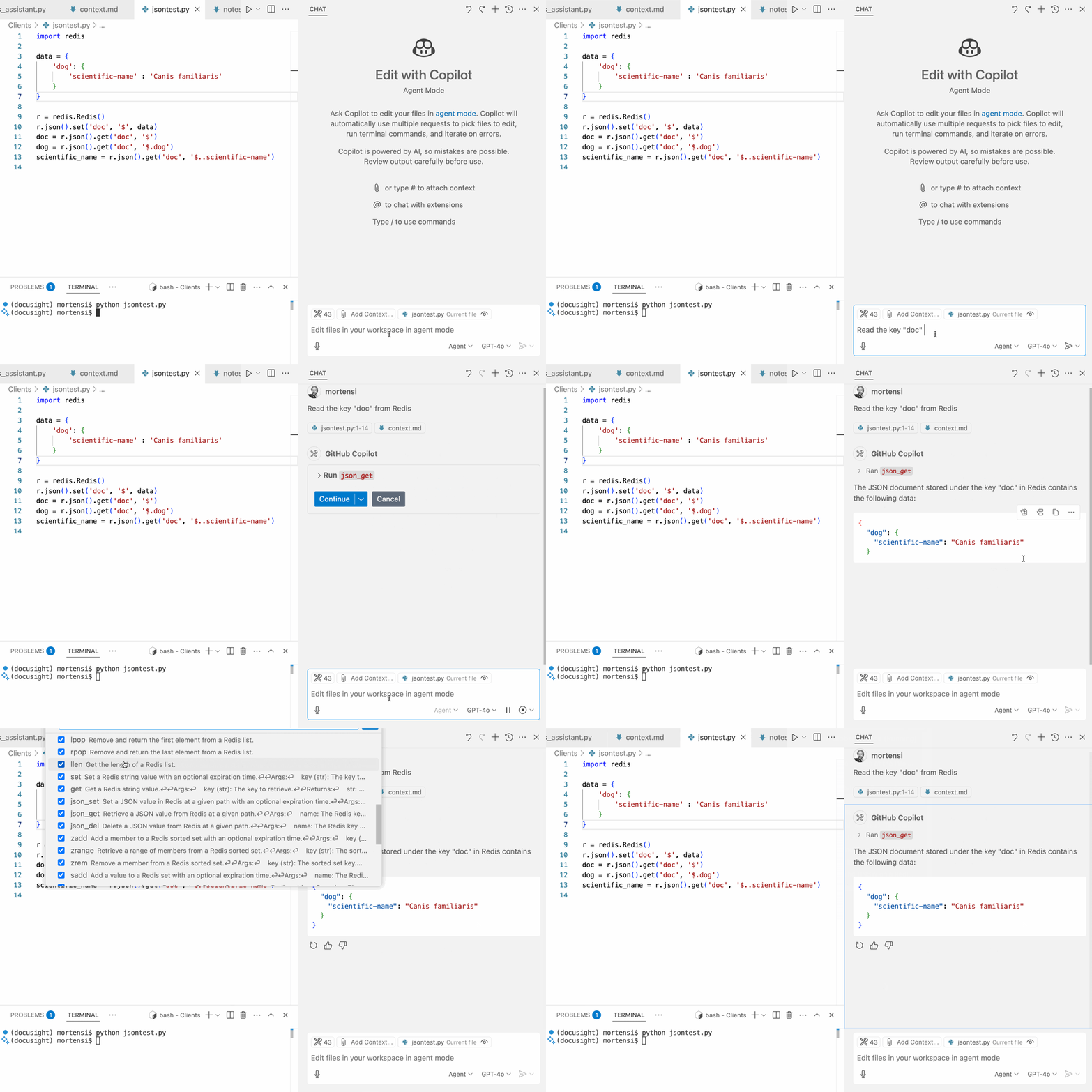
The Redis MCP server

Integrating natural language processing into your IDE opens up new possibilities to boost user experience when working with app data. But MCP is much more. You can build powerful agentic apps in SDKs such as the OpenAI Agents SDK. The SDK supports MCP so that you can provide your MCP tools to agents.

Building complex apps is much easier by plugging in the desired functionalities exposed by the many existing MCP servers. You can find an example in the mcp-redis repository. Provide as many MCP servers as you’d like, customize the agent’s instructions, and you’re ready to interact with it.

Redis Iris

Build fast, accurate AI apps that scale

Get started with Redis for real-time AI context and retrieval.
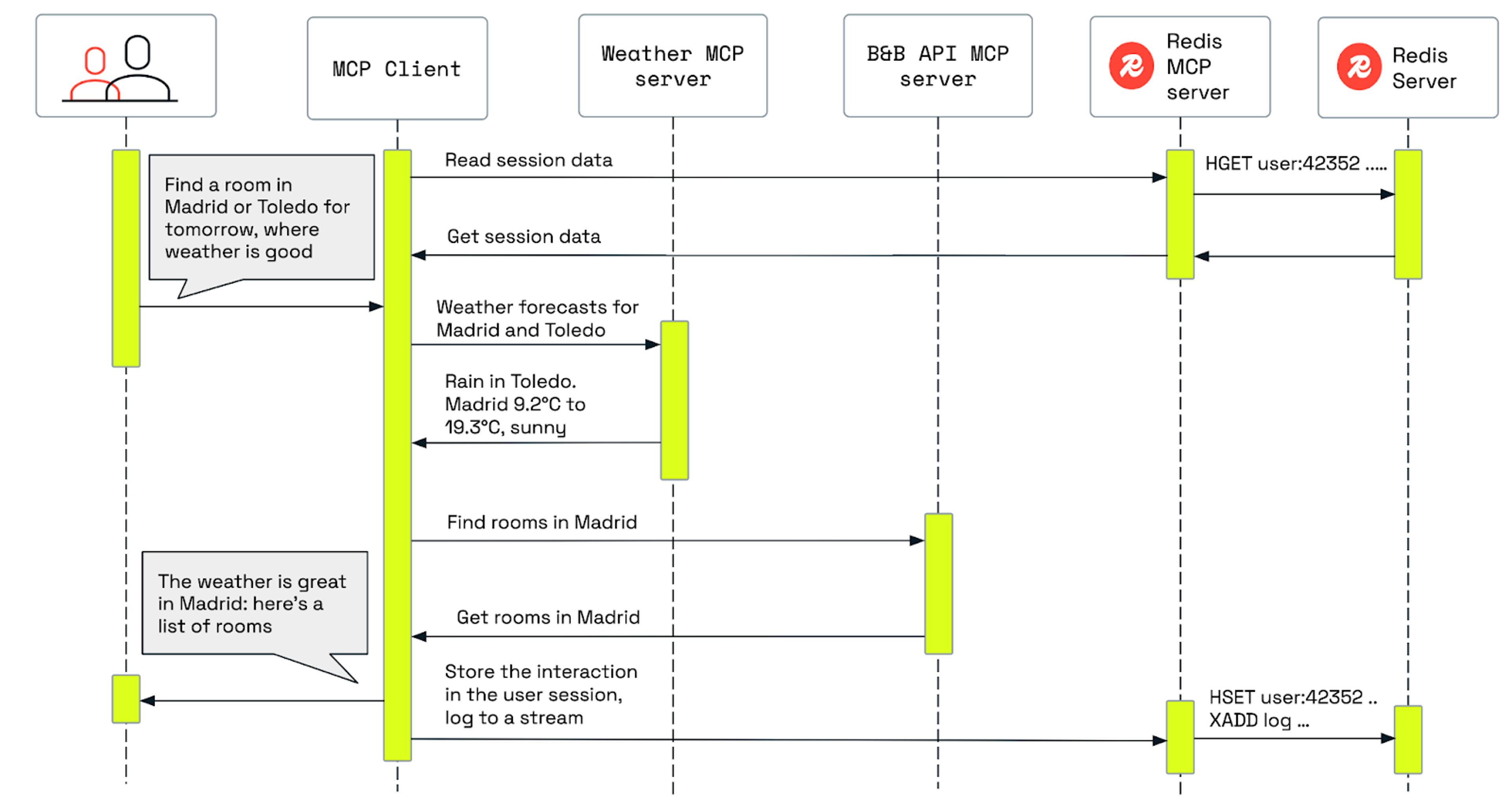
The Redis MCP server Table

Redis Cloud API MCP server

The mcp-redis-cloud gives your AI agents direct access to your Redis Cloud subscription, so they can manage it without extra tooling. With the Redis Cloud API MCP server, you can use tools like Claude Desktop, Cursor, or any MCP-compatible IDE to manage your Redis Cloud account using natural language. For example:

  • “Create a new Redis database in AWS”
  • “What are my current subscriptions?”
  • “Help me choose the right Redis database for my e-commerce app.”

This MCP server exposes the Redis Cloud REST API so you can bridge natural language instructions with programmatic Redis Cloud subscription management.
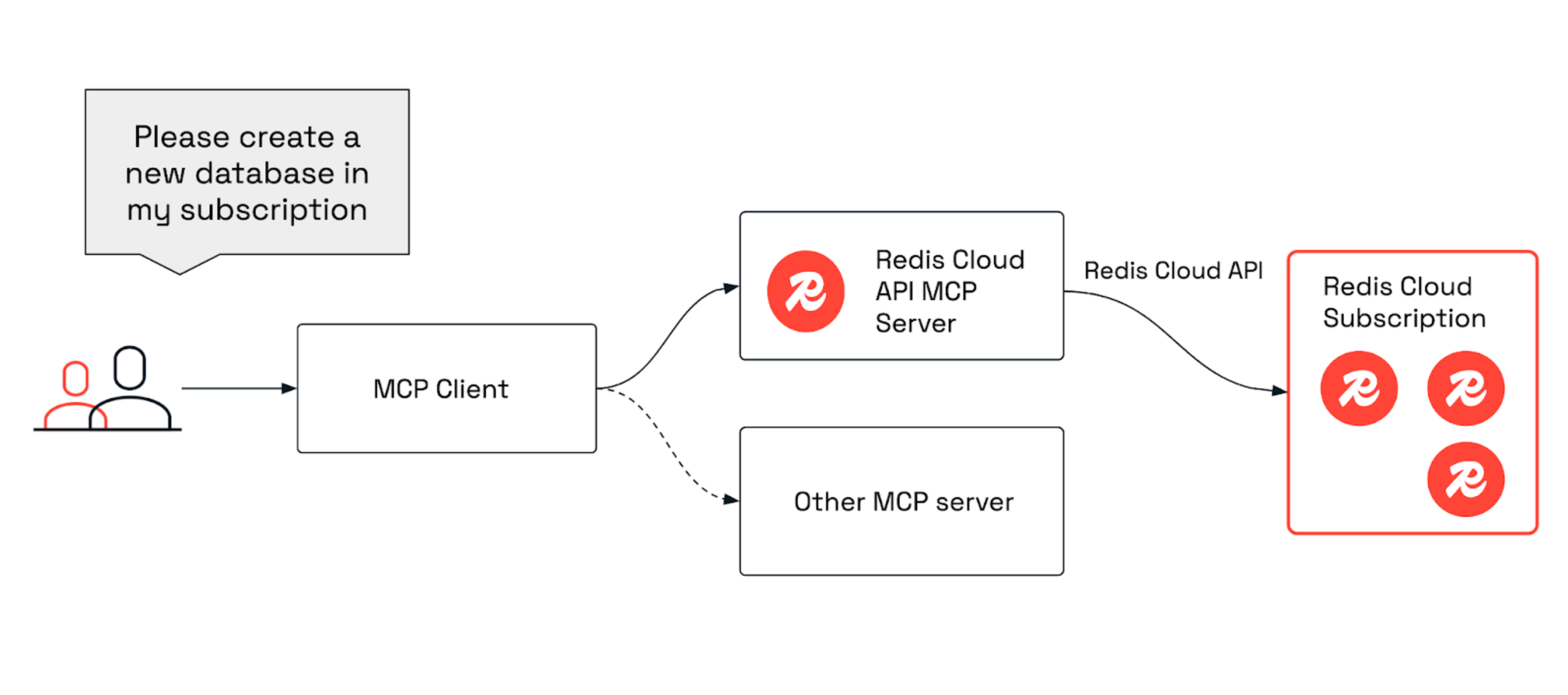
Redis Cloud API MCP server

If you want the ability to spin up databases for testing, manage your subscription, learn about the metrics of interest, or overload an existing app with the ability to create databases on demand, take a look at this server.

Redis Cloud

Build faster with Redis Cloud

Get Redis up and running in minutes, then scale as you grow.

Build smarter AI with MCP

From startups to enterprises, teams are looking at MCP to make their AI apps smarter:

  • Customer support bots: Maintaining conversation history for more coherent interactions
  • Content generation: Providing relevant reference materials to LLMs for accurate content creation
  • Personalized recommendations: Incorporating user preferences and history into AI recommendations

MCP standardizes how tools bring in relevant context for GenAI, making it simpler to add new components and manage context effectively.

Built on Redis’ speed and flexibility, MCP offers a solid base for creating AI apps that are more capable, responsive, and context-aware. Try these MCP servers in your AI agentic app or integrate them into your development tools today; you’ll find instructions in the repositories. You can explore these projects, contribute to their development, and join us in shaping the future of AI agentic apps with Redis.