


Managing GPU resources has always been a bit of a pain point, with most of the time spent clicking around interfaces with repetitive manual configuration. Our new API lets you control everything through code instead, which is great news for those who'd rather automate repetitive tasks and focus on the actual machine learning work. For those of you more familiar with our internal workings, this was known as GraphQL, and this will function much the same, but with several under-the-hood improvements to further streamline the process. Let's explore how this new API can transform your workflow and examine some practical examples of its capabilities.
The new REST API provides end-to-end management capabilities for your GPU resources. From creating and configuring pods to managing serverless endpoints, everything can now be automated through simple HTTP requests. This eliminates the need for manual intervention through web interfaces, making it perfect for integration into CI/CD pipelines and automation workflows.
Whether you need GPUs for training large models or CPU resources for preprocessing tasks, the API offers granular control over your computational resources:
The API allows you to specify data center locations across multiple regions, ensuring your workloads run close to your data or end-users, with support for both Secure Cloud and Community Cloud environments.
The API enables interruptible/spot instance deployment and management, helping you significantly reduce costs for non-time-sensitive workloads.
Let's look at some real-world examples of how you can leverage this API.
To create a new pod with an RTX 4090 GPU running PyTorch:
This will create a Pytorch pod on a 4090 GPU as requested.
For those looking to implement a cost-effective serverless architecture:
This will create an endpoint from a serverless template that was previously created.
Check the status of your pods and scale or stop them as needed.
Go to the docs page for the REST API and click on “Open API Client” in the bottom left. This will provide a UI playground, coming pre-filled with several example requests that you can tinker with at your leisure:
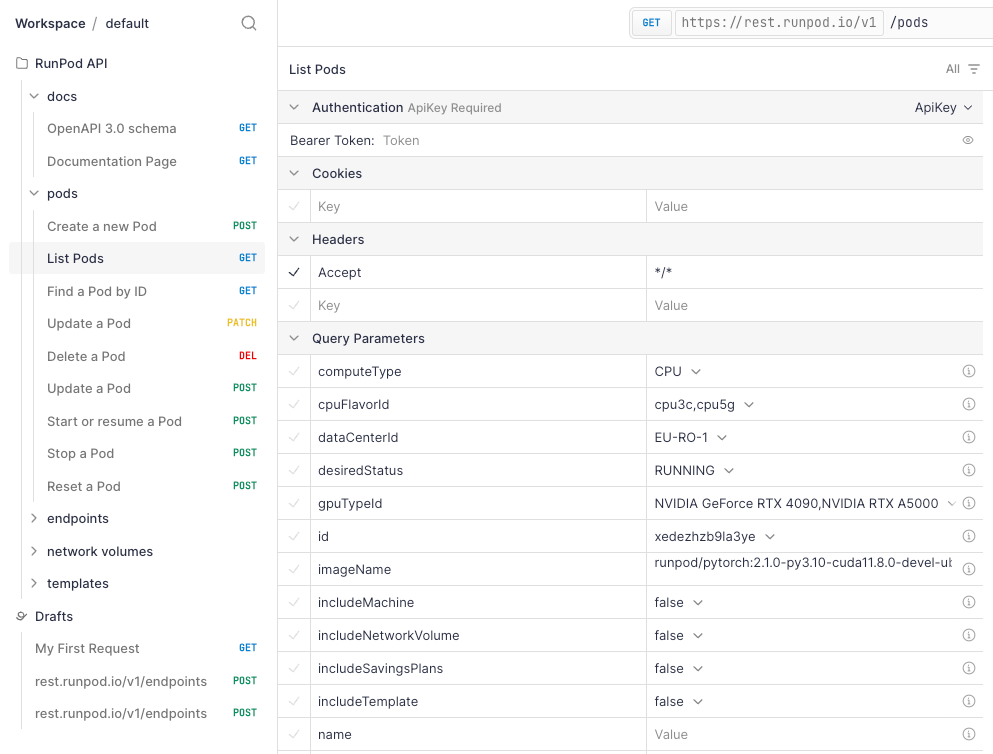
The API's flexibility opens up numerous integration scenarios:
MLOps Pipelines become much more fluid with this API. Instead of manually provisioning resources before each training run, you can code your pipeline to automatically spin up specific GPU configurations when jobs are queued. Once training completes, the resources can be released just as automatically. This removes a major bottleneck in ML workflows where data scientists often waste time waiting for infrastructure to be provisioned or remain idle.
Cost Management Systems gain new capabilities with programmatic control. You can write scripts that automatically shut down expensive GPU resources during nights and weekends when your team isn't actively working. Some organizations have reported 30-40% cost savings by implementing simple time-based pod management, especially for development environments that don't need to run 24/7.
Auto-scaling Web Services that use GPU acceleration for inference can now dynamically adjust to demand. Your application monitoring system can watch request queues or response times and trigger the creation of additional GPU pods or serverless workers during high-traffic periods. When demand subsides, extra instances can be gracefully shut down, ensuring you're only paying for what you need, when you need it.
Runpod's new REST API represents a significant step forward for organizations looking to bring infrastructure-as-code practices to their GPU cloud resources. By enabling programmatic control over every aspect of GPU resource management, it empowers developers and ML engineers to create more efficient, automated, and cost-effective workflows.
Whether you're a small team looking to automate repetitive management tasks or an enterprise implementing sophisticated MLOps pipelines, this API provides the flexibility and control needed to optimize your GPU infrastructure for modern AI development.
Author profile: Brendan McKeag
此内容由惯性聚合(RSS阅读器)自动聚合整理,仅供阅读参考。 原文来自 — 版权归原作者所有。