







This column is a part of the Off Menu newsletter, our Wednesday dispatch of restaurant news, gossip, tips, and hot takes. Sign up for weekly emails here.
When my friend Hannah Kenney can’t sleep, she makes reservations. “My favorite thing is to go on OpenTable or Tock and find nice restaurants that have availability at some future date. I’ll book a table for four, a couple of weeks will go by, I’ll forget all about it, then I’ll get a notice reminding me to confirm.” That’s when she casts out a dinner invitation, seeing which three friends bite.
Kenney is not the only one who thinks in fours when she thinks ahead. Restaurant designer Hannah Collins Tate is another one. “It’s a great excuse to add friends at the last minute, old and new. I can invite whoever I want on a whim or plan ahead,” she told me. “It’s a sweet treat I like to do for myself in the midst of the hectic mess of my life.”

Honestly, it had never occurred to me to dine speculatively, much less with a four-top. I tend to ping a friend, agree on a date, and only then pick a restaurant — a habit that, in comparison, feels pinched and perfunctory to the point of being ungenerous. Clearly, I could use more dining carpe diem.
After speaking to these friends, I realized that there may be something to booking ahead — specifically, for four — for both social and practical reasons.
Obviously, it’s a good way to snag coveted reservations. The Standard’s food editor, Lauren Saria, also a fan of this method, goes for Little Original Joe’s and House of Prime Rib. Kenney last booked State Bird Provisions and has a reservation on deck at the new North Beach restaurant Equal Parts.
Dining with a quartet might also be best for community. The turn-of-the-century German sociologist Georg Simmel argued that a dyad — a party of two — is uniquely fragile, since its existence depends on each individual continuing to show up. When applied to dining, that means when one person steps away to the bathroom, there’s a record scratch. Add another person, and you get a (opens in new tab)triad (opens in new tab) — aka, the dreaded third-wheel dynamic, the potential of two against one. It also leaves one diner sadly facing a void across the table.
Four might just be the perfect balance. There are six possible conversation pairings. Unlike with the emotional intensity of two people who feel compelled to keep up the banter, you’re allowed to take a break and focus on compulsively reaching for the butter and bread. And four feels like a real night out. “As someone in my late 30s, I’m not planning on rocking the bars till 4 a.m. So it allows dinner to become the evening’s main event,” Kenney says.
Beyond the kumbaya of communing, there are two very practical reasons to dine out as four. First, it can be thriftier A $31 bowl of seaweed chitarra with clams and guanciale feels like a gamble if you’re splitting the cost with one other person. With four, it’s only $7.75, a less risky investment.
Additionally, in our continuing era of pass-the-plate sharing, you get to try more dishes. “Miguel and I don’t always have overlapping taste,” Kenney said of her longtime partner. “He’s Spanish, so he likes olives, and I’m not a big fan.” But if they dine with others who are up for a bowl of Arbequinas, he gets to have them.
Restaurant owners like the four-top for similar reasons. “Larger groups can experience more of the menu, particularly the larger steaks,” said Marc Zimmerman, the chef-owner of SoMa’s Superprime. Then there’s the fact that a four-top is more likely to purchase a bottle of wine — or two, if it’s a party — which is good for the bottom line.
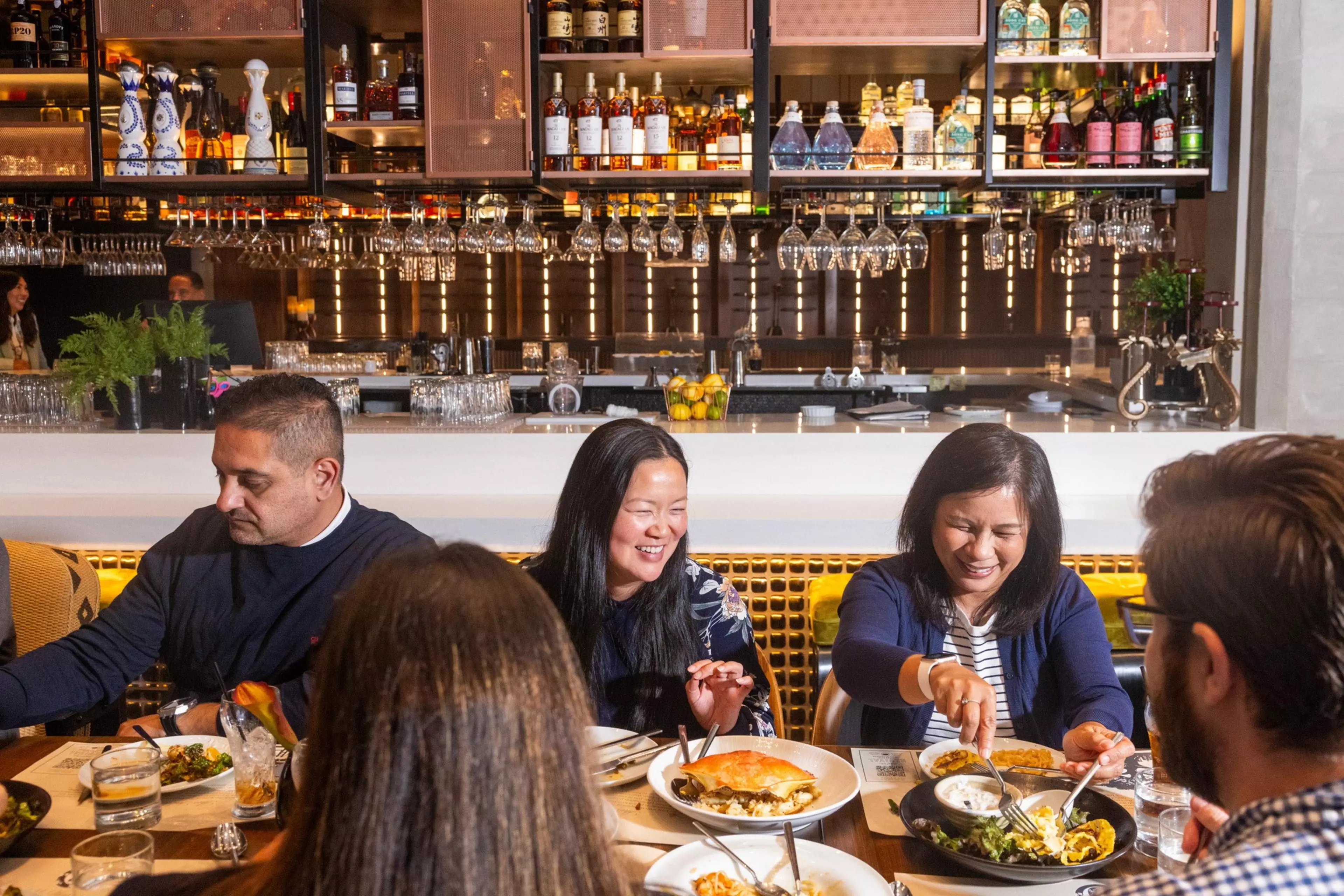
The other night, I tried out this future-four-top philosophy. I booked a table at Maria Isabel, then pieced together three friends who aren’t my usual quad squad. We ate our way through half the menu, far more than could have been mustered à deux. And because we didn’t have an overly familiar dynamic, we didn’t fall into the same-old, same-old. The conversation was rich and inquisitive, as it is when you’re developing new friends.
Somewhere between the tamale with corn and uni and
the lamb barbacoa, I experienced what I just learned is called “commensality.” The word comes from the Latin “mensa” — table — and has come to mean the act of eating together as a way to enforce social bonds. It felt good.
Not to sound like an advertorial for OpenTable (which does not sponsor this newsletter, I swear), but the tables Kenney books in the darkness of night are oddly hopeful, like little rays of light. The act of faith not only confirms she’s a person with friends to spare but also that she’s willing to bet on the good life. That — a month from now — the future version of herself will still want to get dressed, go out for dinner with a group, and clink four glasses together.
More about the author
此内容由惯性聚合(RSS阅读器)自动聚合整理,仅供阅读参考。 原文来自 — 版权归原作者所有。