










Welcome back to the Abstract! Here are the studies this week that died in the deep, let nature call, tossed a galactic salad, and became interstellar voyeurs.
First, there’s a whale necropolis under the sea that is packed with ancient carcasses and teeming with new species. Then: a bygone world preserved in poop, the fruits of the universe’s labor, and a zoom lens for distant planets.
As always, for more of my work, check out my book First Contact: The Story of Our Obsession with Aliens, or subscribe to my personal newsletter the BeX Files.
A visit to the cetacean cemetery
Scientists have discovered an unprecedented underwater “necropolis” that contains the remains of hundreds of whales that died over the past five million years, scattered across 745 miles.
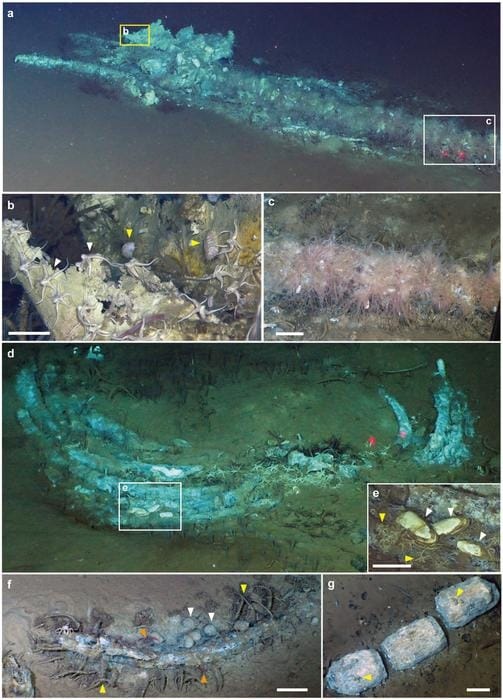
During dives in a deep sea submersible, researchers spotted whale bones submerged under more than four miles of the Diamantina Zone in the Indian Ocean, making this site the geographically largest, deepest, and oldest whale necropolis ever found. The graveyard is also teeming with species that may be “new to science” and subsist on these fortuitous “whale falls,” according to a new study.
“The discovery of whale-fall communities in the Diamantina Zone at depths exceeding 6,700 meters establishes one of the deepest known whale-fall ecosystems in the ocean, extending the known depth range of such habitats by more than 2,500 meters,” said researchers co-led by Xiaotong Peng of China’s Institute of Deep-sea Science and Engineering.
“This area has a deep and extensive accumulation comprising five modern natural whale-fall communities and 476 fossil cetaceans recorded,” the team said.
Peng and his colleagues first spotted the necropolis during dives in early 2023 using the Fendouzhe submersible, which is capable of bringing crews to depths of nearly seven miles. The team quickly realized they had tapped into a scientific motherlode, complete with an immense fossil archive of extinct animals—mostly deep-diving beaked whales—along with recent whale falls that still support thriving ecosystems of crustaceans, molluscs, worms, and microbes.
“Bone-eating worms, gastropods, vesicomyid bivalves and brittle stars dominate the megafauna (more than several centimetres in size), reaching local densities up to 2,840 individuals per square metre,” the team said. “Most recovered taxa may be new to science.”
As for why this vast necropolis formed, beaked whales may be attracted to these deep waters due to the abundance of prey sources, such as squid and fish. Some might accidentally dive so deep that they experience decompression sickness or fatal exhaustion, becoming bonus bodies for seafloor ecosystems. The sinking carcasses are then funnelled into the Diamantina Zone because of its V-shaped topography, serving up a figurative feast for scientists (and a literal one for marine biota).
“As beaked whales are known primarily from rare strandings, their abundance, distribution and ecology remain poorly understood overall,” Peng and his colleagues concluded. “Our discovery of an accumulation of skeletal remains…provides an unparalleled source of information on these largely enigmatic cetaceans.”
Mariners have long dreaded ending up in Davy Jones’ locker, the proverbial resting ground of drowned sailors. It turns out that whales have a whole locker room down in the deep, where the bodies of countless leviathans blossom into fleeting hotspots of life.
In other news…
Bathroom blast from the past
The Klondike region of Canada’s Yukon territory is famous for the 19th-century gold rush that led hopeful prospectors to riches, ruin, and early graves. But now, scientists have found a very different type of valuable nugget in Klondike soil—ancient squirrel poops made by ancient squirrel bums as early as 700,000 years ago.
Scientists sequenced ancient environmental DNA (aeDNA) from these permafrosted scats, thereby opening up a poopy portal into the past. The fossilized feces, known as coprolites, contained genetic traces of mammoth, saber-tooth cat, horse, and bison, suggesting that these Ice Age rodents may have gnawed on the corpses of much larger megafauna. The coprolites also preserved DNA from hundreds of plant species, several insects, and a bevy of microbial and fungal strains.
“The diversity and abundance of aeDNA recovered from the permafrost preserved, ground squirrel coprolites presented here underscores the immense value of Arctic rodent middens as repositories of Quaternary ecosystems,” said researchers led by Tyler J. Murchie of the Hakai Institute and McMaster University. “The ecological and evolutionary power of coprolites would appear to exceed that of both bone and sediment.”
As a bonus, the team refers to the rodent behind each coprolite as the “defecator,” in case anyone is seeking inspiration for a disgusting superhero concept.
Eat your galactic green peas
The fruits of summer gardens are beginning to ripen here on Earth, but what about the pea patches and berry bushes of outer space? In a new study, astronomers examine a sampling of so-called “Green Pea” and “Blueberry” galaxies, which are small and compact systems that have extremely high star formation (“starburst”) rates.
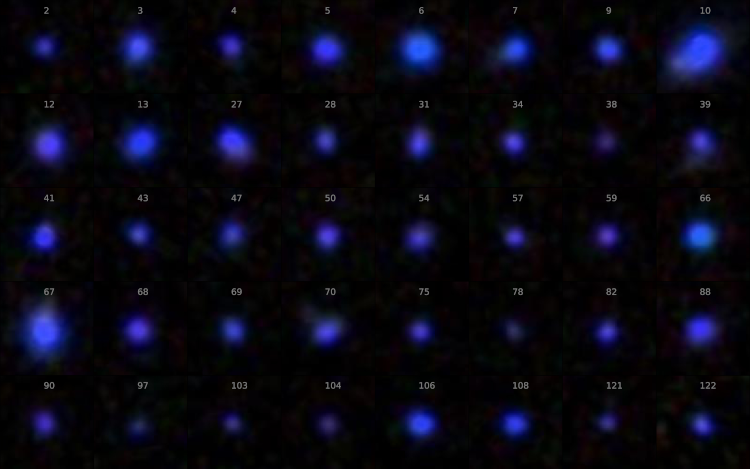
Named for their green and blue hues, these starry objects are thought by some scientists to be similar to the first galaxies that lit up the universe during the epoch of reionization more than 13 billion years ago, making them useful analogues of primordial galactic evolution.
“Within the diverse tapestry of galaxy populations, Green Pea and Blueberry galaxies represent particularly intriguing classes,” said researchers led by Maitrayee Gupta of the Astronomical Institute of the Czech Academy of Sciences. The galaxies “present an opportunity to gain a unique perspective” on the processes “driving cosmic reionisation,” the team added.
To that end, Gupta and her colleagues observed a selection of these galaxies and found that they “predominantly reside in isolated, low-density environments” which means that their intense starbursts are not driven by interactions with galactic neighbors, such as mergers. Instead, the team concluded that these recent starbursts are driven by internal processes, “reinforcing their role as nearby analogues of young, low-mass galaxies in the early Universe.”
If you’d like a more substantive galactic meal than peas and blueberries, may I recommend the Fried Egg Galaxy or the Hamburger Galaxy? Cap it off with a Milky Way for dessert.
Journey to the magic spyglass in space
There is a sweet spot in the outer wilds of the solar system, about 650 times the distance between Earth and the Sun, where it is theoretically possible to peer across interstellar space and spot surface features of exoplanets—including continents, oceans, or perhaps signs of life.
This phenomenon, known as the solar gravitational lens, is caused by the Sun’s gravity warping light from distant sources, essentially making it a stellar magnifying glass. It could be an incredible observational tool, but schlepping all the way out into the solar sticks is a huge challenge that has inspired a host of futuristic spaceflight concepts.
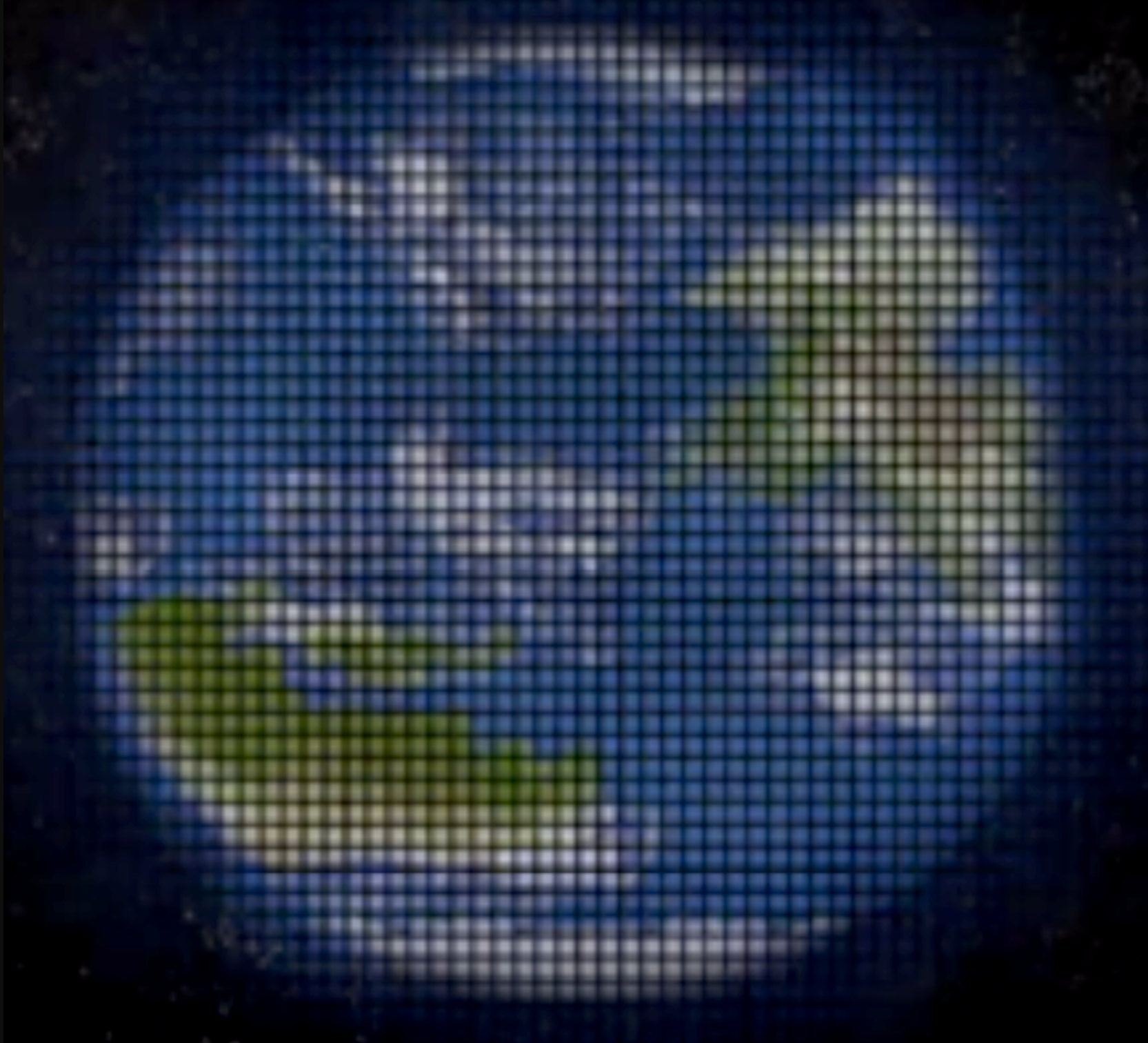
Now, scientists have proposed sending “an E-sail propelled spacecraft” called the Curved Space Telescope (CST) powered by the solar wind, a stream of charged particles emitted by the Sun. The probe would cruise through the solar system by deploying metallic tethers that tap into the solar wind and generate thrust from repulsion effects with its particles.
“One of the most interesting scientific objectives for a mission like CST would be the search for proof of extraterrestrial life,” said researchers led by Mario F. Palos of the University of Tartu. The team added that risky maneuvers, like slingshotting close to the Sun, would not be necessary for this mission, unlike previous proposals along these lines.
E-sails have never been tested in space and it’s anyone’s guess whether we’ll ever be able to send a mission to this interesting frontier. Still, it’s amazing to think about capturing close-ups of aliens on faraway exoplanets through a starry lens.
Thanks for reading! See you next week.