



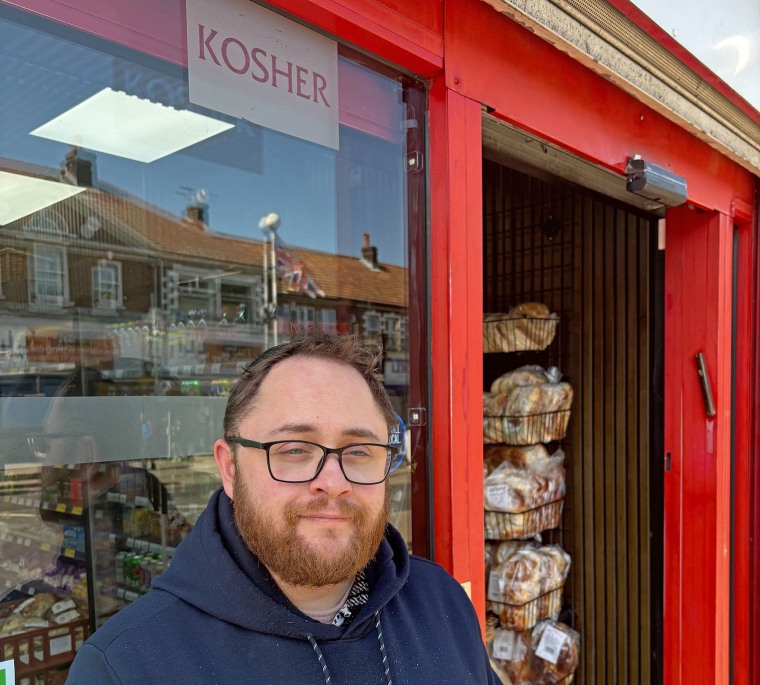
LONDON — Britain in 2026 is a place where Jack Hur doesn’t feel safe wearing his Star of David pendant. It’s where some Jewish mothers tell their teenage sons to remove their kippot before boarding the tube. It’s where dinner-table talk of leaving the country no longer seems outlandish.
Standing behind the counter of Sulam’s Kosher Food Store, Hur, 32, produces his Star of David necklace from underneath his sweatshirt. From his back pocket he reveals a kippah.
“I only wear this sometimes,” he says, unfolding the small, black skullcap. “It depends where I am.”
Ultimately for Jews, he said, “Britain just isn’t safe.”
Golders Green, a hub for Britain’s tiny Jewish community, feels like a neighborhood under siege. Antisemitism had been surging in the United Kingdom since the Hamas-led Oct. 7, 2023, terror attack on Israel and Israel’s subsequent offensive in the Gaza Strip.
There were 3,700 reported antisemitic incidents last year, more than double the number in 2022, according to the Community Security Trust, a charity that coordinates security measures at Jewish institutions and tracks this data.
But a spate of attacks against synagogues and other Jewish sites in recent weeks has brought that to another level.
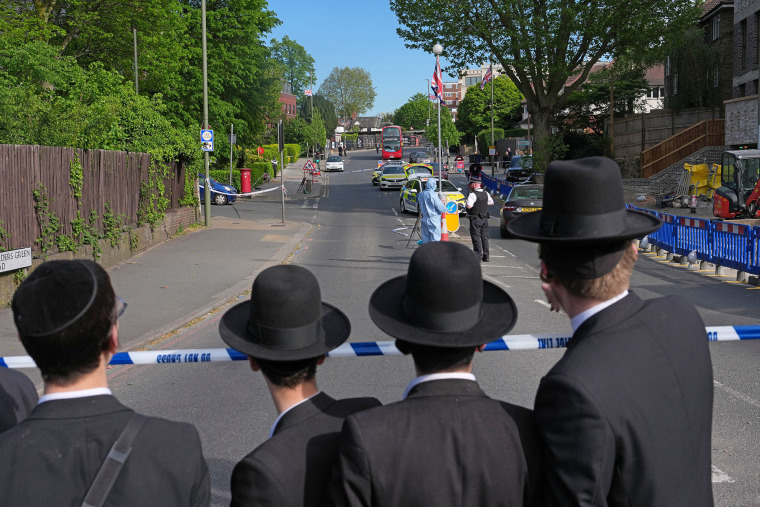
This week, two people were stabbed in Golders Green. Police have arrested and charged with attempted murder a Somali-born man who in 2020 had been referred to the government’s early prevention counterterrorism program, a case that was closed later that year. Essa Suleiman, 45, appeared in court Friday but did not enter a plea.
The Metropolitan Police classified it as a terrorist attack, and authorities raised the national threat level from “substantial” — indicating an attack is likely — to “severe,” meaning an “attack is highly likely in the next six months.”
“The U.K. has been experiencing a gradual increase in terrorist threats for some time, driven by a rise in both Islamist and extreme right-wing terrorism,” said Laurence Taylor, assistant commissioner and head of counterterrorism at the Metropolitan Police.
“Our casework is increasing across a number of ideologies and within that we are seeing an elevated threat to Jewish and Israeli individuals and institutions in the UK,” he said in a statement Thursday.
Britain’s chief rabbi, Ephraim Mirvis, agrees with Hur.
“If you are visibly Jewish, you’re not safe,” he told the BBC this week.
Some of these incidents have been claimed by a new group called Harakat Ashab al-Yamin al-Islamia, or HAYI, which analysts say has links to Iran’s Islamic Revolutionary Guard Corps, or IRGC. It’s unclear the extent to which HAYI had any involvement in the planning or preparation, or if it is merely piggybacking onto the assaults to gain publicity.
Either way, this is jolting for many of Britain’s 290,000 Jews, many of whom prided themselves in their unfussy integration into British society. Despite antisemitism, members of the community have played prominent roles, such as Jewish-born Prime Minister Benjamin Disraeli in 1868. In the 1930s, more than 10,000 Jewish children gained refuge from Nazi tyranny as part of the “Kindertransport” program.
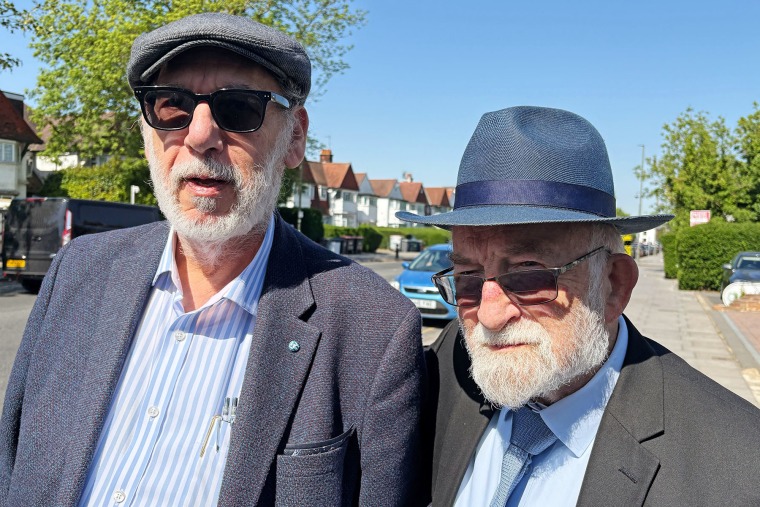
On a warm morning Friday on Golders Green Road, near where the stabbings happened, the mood was less of fear, more anger.
There was a steady cadence of police cars humming past, as well as officers stationed outside the local London Underground station. For many locals, this was too late.
“Since we’ve been standing here, we’ve had three police vehicles gone by,” said Alvin Ormonde, 75, a local planning consultant whom friends describe as an influential community figure. This was an unusual sight, he said.
He was chatting with friends beneath a tangled Union Flag, one of several hanging from a lamppost on this wide street flanked by stores interspersed with large, postwar houses.
“In a week’s time, the police presence will be back to where it was,” said another man, who like many here is distrustful of what he sees as a biased media and declined to give his name.
Much of the anger is directed at Prime Minister Keir Starmer, who, when visiting Golders Green this week, was heckled by a crowd who chanted “Keir Starmer, Jew-harmer” at him.
In response to that outpouring of anger, the government said Starmer acknowledged fear within the community. The prime minister then issued some of his strongest remarks on the subject yet, calling out the “extreme racism” that had “left a minority community in this country scared, intimidated, wondering if they belong.”
Opponents’ main source of anger is what they see as Starmer’s lax approach to the near weekly pro-Palestinian marches in London and elsewhere that they characterize as “hate marches.”
Some protesters have displayed antisemitic sentiment, and used language that conflates enmity toward Israel, Zionism and Jews themselves. The organizers of the demonstrations deny this accusation, saying their target is merely the Israeli government rather than Jews in Britain or anywhere else.
Among NBC News’ conversations in Golders Green, there was an unavoidable thread of animosity toward Muslims in general.
“They want to take over the whole place and chuck everyone out, including the British,” said one man in a dark suit and wearing payot and a kippah on Golders Green Road. Citing a mix of media mistrust and community anxiety, he too declined to give his name.
“We are all refugees,” said Ezra Kahn, 88, after ambling up and joining the conversation. “But there is a big difference between the refugees we were and the refugees that are coming in by the boatload all the time. We get on with our job, we educate our children to be good citizens and we contribute to taxes,” he said. “The refugees who are now coming by the boatload, they’re coming here and immediately start making trouble.”
It must be said that many Jewish people, including their mainstream leaders, would disavow this, insisting instead on interfaith tolerance and respect.
The Board of Deputies of British Jews, a leading community organization, says on its website that “we have a long track record of standing with Muslim communities in the fight against anti-Muslim hatred.”
And that’s a sentiment echoed by many people in Golders Green too.
Shopkeepers say the roads are quiet for a sunny Friday hours before the Jewish Sabbath.
It’s not just the stabbing, the arson attacks against synagogues, the firebombing of four Jewish ambulances two months ago; it’s that antisemitic language feels closer to the surface, less hidden in the politeness of British life, than it ever did previously.
Nigel Farage, the leader of the hard-right populist Reform UK party and a friend of President Donald Trump, has faced his own allegations. More than 30 of his former classmates have accused him of regular antisemitism when he was a schoolboy more than 40 years ago, including singing songs about gassing Jewish people. Farage has denied the allegations.
Meanwhile on the opposite end of the spectrum, two Green Party candidates have been arrested ahead of local elections next week, accused of posting antisemitic social media posts.
An idle scroll through any social media feed will reveal violent language against Jewish people that was considered widely unutterable a few years ago.
The upshot is not only that Jewish Britons feel unsafe. A poll by the Campaign Against Antisemitism last year found that 61% of the community said they had considered leaving Britain altogether.
“You cannot be Jewish in Britain today,” said one woman in a long, white summer dress and designer sunglasses, also declining to give her name. “My friends who have teenage sons tell them to take off their kippot before they get on the tube so they are not attacked.”
Outside the Beth Shmuel Synagogue, two men sit guarding the premises, both wearing non-religious dress except their kippot, smoking cigarettes and drinking coffee. This level of security is a depressing necessity in modern-day Britain.
“You know, Jewish people will be fine,” one of them said. “We may have to move to a different country, we may get to eat a little less sushi, but it’s nothing we haven’t done before.” He added, “It’s the regular Brits that will suffer in the long term with what’s happening to the country.”
此内容由惯性聚合(RSS阅读器)自动聚合整理,仅供阅读参考。 原文来自 — 版权归原作者所有。