


惯性聚合 高效追踪和阅读你感兴趣的博客、新闻、科技资讯
阅读原文 在惯性聚合中打开

推荐订阅源

S
Securelist
Cyber Security Advisories - MS-ISAC
WordPress大学
WordPress大学
OSCHINA 社区最新新闻
OSCHINA 社区最新新闻
T
Tailwind CSS Blog
V
V2EX
小众软件
小众软件
博客园 - 聂微东
H
Help Net Security
阮一峰的网络日志
阮一峰的网络日志
云风的 BLOG
云风的 BLOG
Blog — PlanetScale
Blog — PlanetScale
M
MIT News - Artificial intelligence
人人都是产品经理
人人都是产品经理
F
Fortinet All Blogs
S
Schneier on Security
Martin Fowler
Martin Fowler
MyScale Blog
MyScale Blog
Vercel News
Vercel News
freeCodeCamp Programming Tutorials: Python, JavaScript, Git & More
Google DeepMind News
Google Online Security Blog
Webroot Blog
Webroot Blog
A
Arctic Wolf
量子位
博客园 - 叶小钗
I
Intezer
C
Check Point Blog
Cloudbric
Cloudbric
IT之家
IT之家
Last Week in AI
Last Week in AI
GbyAI
GbyAI
Attack and Defense Labs
T
The Blog of Author Tim Ferriss
Y
Y Combinator Blog
Jina AI
Jina AI
K
KPMG report finds enterprise disconnect between AI and its ROI | CIO
T
Threat Research - Cisco Blogs
C
CERT Recently Published Vulnerability Notes
cs.CL updates on arXiv.org
C
Cisco Blogs
J
Java Code Geeks
cs.CV updates on arXiv.org
Engineering at Meta
Engineering at Meta
酷 壳 – CoolShell
酷 壳 – CoolShell
L
Lohrmann on Cybersecurity
有赞技术团队
有赞技术团队
Simon Willison's Weblog
The Register - Security
T
Threatpost

Ivan on Containers, Kubernetes, and Server-Side

A grounded take on agentic coding for production environments Server-Side Playgrounds Reimagined: Build, Boot, and Network Your Own Virtual Labs [not a] Kubernetes 101 - Pods, Deployments, and Services As an Attempt To Automate Age-Old Infra Patterns JavaScript or TypeScript? How To Benefit From the Dichotomy On Software Design... and Good Writing Building a Firecracker-Powered Course Platform To Learn Docker and Kubernetes How To Publish a Port of a Running Container What Actually Happens When You Publish a Container Port A Visual Guide to SSH Tunnels: Local and Remote Port Forwarding Debugging Containers Like a Pro Docker: How To Debug Distroless And Slim Containers How To Extract Container Image Filesystem Using Docker | iximiuz Labs In Pursuit of Better Container Images: Alpine, Distroless, Apko, Chisel, DockerSlim, oh my! How To Start Programming In Go: Advice For Fellow DevOps Engineers Kubernetes Ephemeral Containers and kubectl debug Command How To Develop Kubernetes CLIs Like a Pro Docker Container Commands Explained: Understand, Don't Memorize | iximiuz Labs Learning Docker with Docker - Toying With DinD For Fun And Profit How To Extend Kubernetes API - Kubernetes vs. Django The Influence of Plumbing on Programming How To Call Kubernetes API from Go - Types and Common Machinery How To Call Kubernetes API using Simple HTTP Client Kubernetes API Basics - Resources, Kinds, and Objects OpenFaaS - Run Containerized Functions On Your Own Terms Learning Containers From The Bottom Up Docker Containers vs. Kubernetes Pods - Taking a Deeper Look | iximiuz Labs Learn-by-Doing Platforms for Dev, DevOps, and SRE Folks How HTTP Keep-Alive can cause TCP race condition How to Work with Container Images Using ctr | iximiuz Labs Multiple Containers, Same Port, no Reverse Proxy... Exploring Go net/http Package - On How Not To Set Socket Options Disposable Local Development Environments with Vagrant, Docker, and Arkade DevOps, SRE, and Platform Engineering My Choice of Programming Languages Prometheus Is Not a TSDB How to learn PromQL with Prometheus Playground Prometheus Cheat Sheet - Basics (Metrics, Labels, Time Series, Scraping) Rust - Writing Parsers With nom Parser Combinator Framework pq - parse and query log files as time series Prometheus Cheat Sheet - Moving Average, Max, Min, etc (Aggregation Over Time) The Need For Slimmer Containers Understanding Rust Privacy and Visibility Model Bridge vs. Switch: Takeaways from a Real Data Center Tour | iximiuz Labs From LAN to VXLAN: Networking Basics for Non-Network Engineers | iximiuz Labs KiND - How I Wasted a Day Loading Local Docker Images Go, HTTP handlers, panic, and deadlocks Exploring Kubernetes Operator Pattern Making Sense Out Of Cloud Native Buzz Service Discovery in Kubernetes: Combining the Best of Two Worlds API Developers Never REST How Container Networking Works: Building a Bridge Network From Scratch | iximiuz Labs Traefik: canary deployments with weighted load balancing Service Proxy, Pod, Sidecar, oh my! You Need Containers To Build Images You Don't Need an Image To Run a Container Not Every Container Has an Operating System Inside Working with container images in Go Master Go While Learning Containers Implementing Container Runtime Shim: Interactive Containers How to use Flask with gevent (uWSGI and Gunicorn editions) My 10 Years of Programming Experience Implementing Container Runtime Shim: First Code Implementing Container Runtime Shim: runc Kubernetes Repository On Flame Dealing with process termination in Linux (with Rust examples) conman - [the] Container Manager: Inception Journey From Containerization To Orchestration And Beyond Linux PTY - How docker attach and docker exec Commands Work Inside Illustrated introduction to Linux iptables From Docker Container to Bootable Linux Disk Image Пишем свой веб-сервер на Python: протокол HTTP 9001 способ создать веб-сервер на Python Explaining async/await in 200 lines of code Explaining event loop in 100 lines of code Save the day with gevent Пишем свой веб-сервер на Python: процессы, потоки и асинхронный I/O Truly optional scalar types in protobuf3 (with Go examples) Node.js Writable streams distilled Node.js Readable streams distilled How to on starting processes (mostly in Linux) Дайджест интересных ссылок – Июль 2016 Пишем свой веб-сервер на Python: сокеты Наследование в JavaScript Мастерить!
Prometheus Cheat Sheet - How to Join Multiple Metrics (Vector Matching)
Ivan Velichko · 2021-06-13 · via Ivan on Containers, Kubernetes, and Server-Side

PromQL looks neat and powerful. And at first sight, simple. But when you start using it for real, you'll quickly notice that it's far from being trivial. Searching the Internet for query explanation rarely helps - most articles focus on pretty high-level overviews of the language's most basic capabilities. For example, when I needed to match multiple metrics using the common labels, I quickly found myself reading the code implementing binary operations on vectors. Without a solid understanding of the matching rules, I constantly stumbled upon various query execution errors, such as complaints about missing group_left or group_right modifier. Reading the code, feeding my local Prometheus playground with artificial metrics, running test queries, and validating assumptions, finally helped me understand how multiple metrics can be joined together. Below are my findings.

PromQL binary operators

PromQL comes with 15 binary operators that can be divided into three groups by operation type:

  • arithmetic + - / * ^ %
  • comparison < > <= >= == !=
  • logical/set and, unless, or

Binary operations are defined for different types of operands - scalar/scalar, scalar/vector, and vector/vector. And the last pair of operands, vector/vector, is the most puzzling one because the subtle vector matching rules may differ depending on the cardinality of the sides or operation type.

One-to-one vector matching

The following diagram tries to shed some light on:

  • how one-to-one vector matching works
  • how on and ignoring modifiers reduce the set of labels to be used for matching
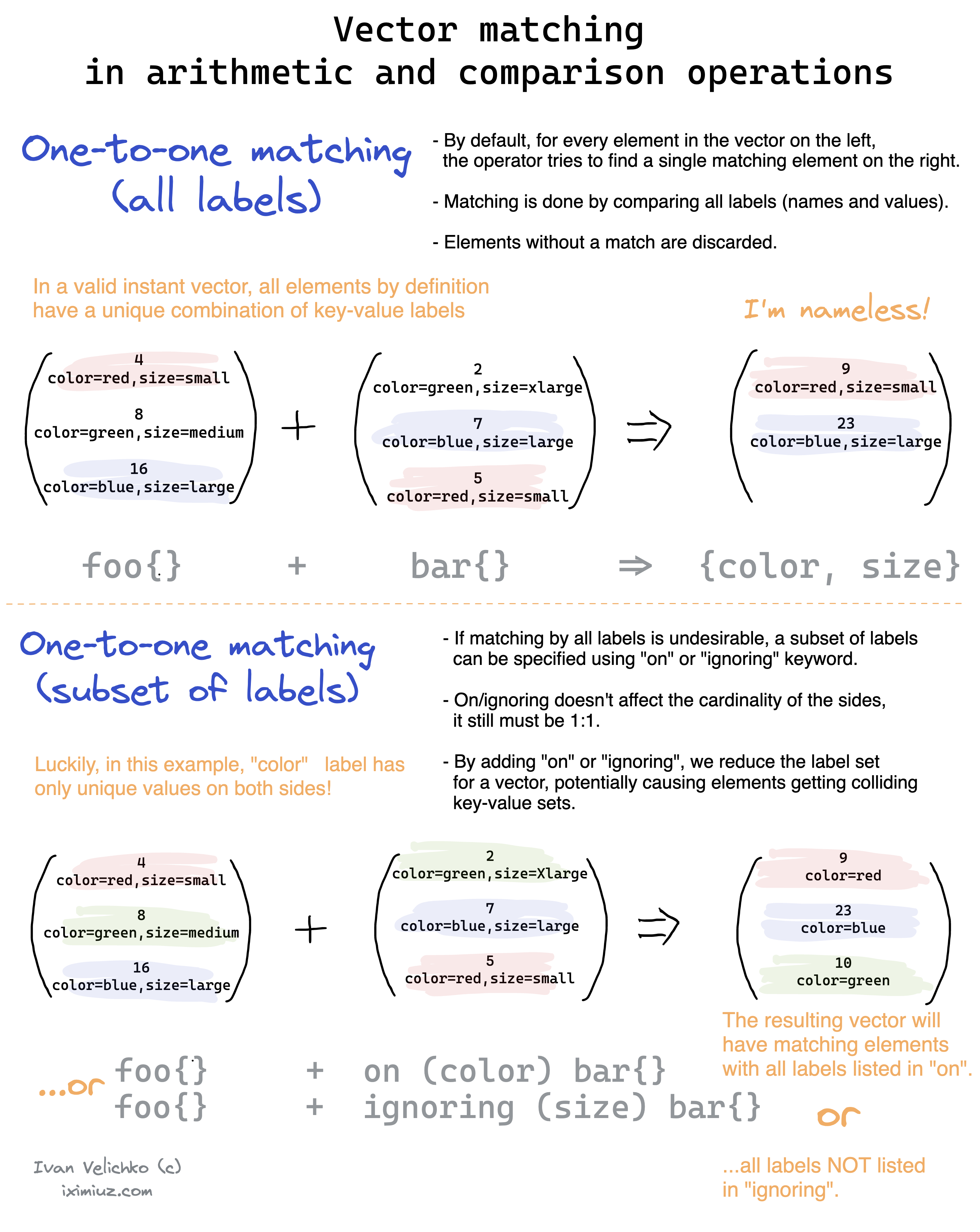
  • what problem this label set reduction can cause

PromQL one-to-one vector matching - arithmetic and comparison operations

PromQL one-to-one vector matching - arithmetic and comparison operations (clickable, 1.1 MB).

One-to-many and many-to-one vector matching

One-to-one matching is the most straightforward one. Most of the time, on or ignoring modifiers help to make a query return something reasonable. But the pitfall here is that some query results may show a one-to-one cardinality only by coincidence. For instance, when our assumptions of the potential set of values for a given label are erroneous. So, it's just so happened that the query showed a one-to-one data relationship on a selected time range, but it can be one-to-many in general. Or many-to-one.

Luckily, Prometheus does support many-to-one and one-to-many vector matching. But it has to be specified explicitly by adding either group_left or group_right modifier to a query. Otherwise, the following error might be returned during the query execution:

multiple matches for labels: many-to-one matching must be explicit (group_left/group_right)

Unless logical binary operator and|unless|or is used, Prometheus always considers at least one side of the binary operation as having the cardinality of "one". If during a query execution Prometheus finds a collision (label-wise) on the "one" side, the query will fail with the following error:

found duplicate series for the match group <keys/values> on the <left|right> hand-side of the operation: <op>;
many-to-many matching not allowed: matching labels must be unique on one side

Interesting, that even if the "one" side doesn't have collisions and group_left or group_right is specified, a query can still fail with:

multiple matches for labels: grouping labels must ensure unique matches

It can happen because, for every element on the "many" side, Prometheus should find no more than one element from the "one" side. Otherwise, the query result would become ambiguous. If the requested label matching doesn't allow to build an unambiguous result, Prometheus just fails the query.
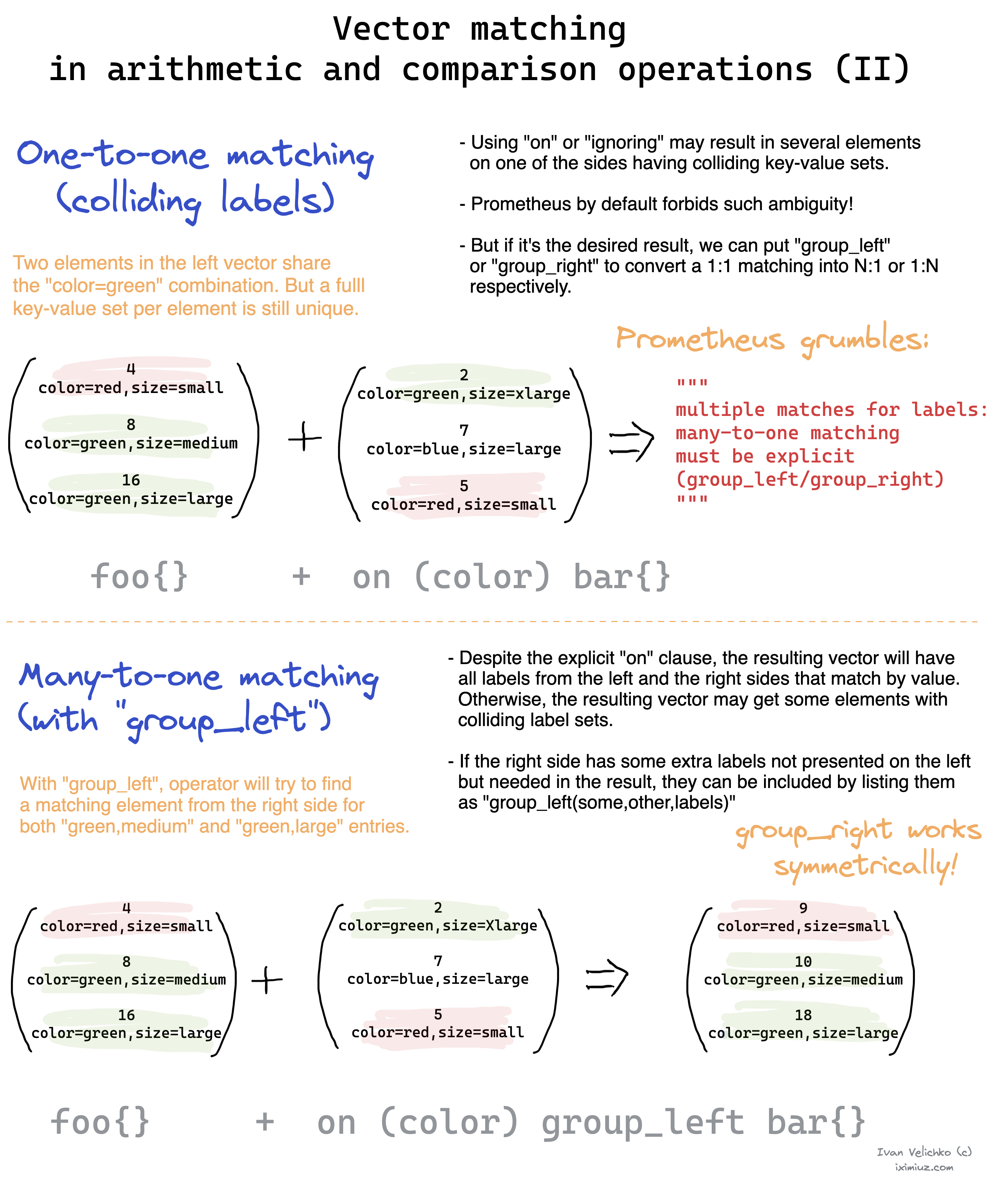
PromQL many-to-one and one-to-many vector matching - arithmetic and comparison operations

PromQL many-to-one and one-to-many vector matching - arithmetic and comparison operations (clickable, 1.2 MB).

Many-to-many vector matching (logical/set operations)

Logical (aka set) binary operators and, unless, and or surprisingly adhere to a simpler vector matching logic. These operations are always many-to-many. Hence no group_left or group_right may be needed. The following diagram focuses on how logical/set operations behave in Prometheus:

PromQL many-to-many vector matching - logical/set operations

PromQL many-to-many vector matching - logical/set operations (clickable, 1.4 MB).

Instead of conclusion

If you find this useful, check out other my Prometheus drawing. And if the idea of querying files such as Nginx or Envoy access logs with PromQL-like syntax sounds interesting to you, please give the pq project a star on GitHub. It really fuels me up:

pq - parse and query files with PromQL-like syntax

Resources