


惯性聚合 高效追踪和阅读你感兴趣的博客、新闻、科技资讯
阅读原文 在惯性聚合中打开

推荐订阅源

cs.CV updates on arXiv.org
云风的 BLOG
云风的 BLOG
aimingoo的专栏
aimingoo的专栏
Vercel News
Vercel News
T
The Blog of Author Tim Ferriss
F
Full Disclosure
A
About on SuperTechFans
C
Check Point Blog
让小产品的独立变现更简单 - ezindie.com
量子位
Know Your Adversary
Know Your Adversary
K
Kaspersky official blog
L
LINUX DO - 热门话题
Recorded Future
Recorded Future
C
Cisco Blogs
M
MIT News - Artificial intelligence
T
Tenable Blog
G
GRAHAM CLULEY
月光博客
月光博客
Recent Announcements
V
Visual Studio Blog
IT之家
IT之家
T
The Exploit Database - CXSecurity.com
The GitHub Blog
The GitHub Blog
T
Threat Research - Cisco Blogs
D
DataBreaches.Net
P
Privacy International News Feed
P
Proofpoint News Feed
I
Intezer
博客园 - 叶小钗
C
CXSECURITY Database RSS Feed - CXSecurity.com
The Hacker News
The Hacker News
Cyber Security Advisories - MS-ISAC
博客园 - Franky
SecWiki News
SecWiki News
宝玉的分享
宝玉的分享
P
Palo Alto Networks Blog
Last Week in AI
Last Week in AI
小众软件
小众软件
Hacker News - Newest:
Hacker News - Newest: "LLM"
O
OpenAI News
N
News and Events Feed by Topic
Microsoft Security Blog
Security Archives - TechRepublic
N
News and Events Feed by Topic
The Cloudflare Blog
Spread Privacy
Spread Privacy
酷 壳 – CoolShell
酷 壳 – CoolShell
Exploit-DB.com RSS Feed
B
Blog RSS Feed

Ivan on Containers, Kubernetes, and Server-Side

A grounded take on agentic coding for production environments Server-Side Playgrounds Reimagined: Build, Boot, and Network Your Own Virtual Labs [not a] Kubernetes 101 - Pods, Deployments, and Services As an Attempt To Automate Age-Old Infra Patterns JavaScript or TypeScript? How To Benefit From the Dichotomy On Software Design... and Good Writing Building a Firecracker-Powered Course Platform To Learn Docker and Kubernetes How To Publish a Port of a Running Container What Actually Happens When You Publish a Container Port A Visual Guide to SSH Tunnels: Local and Remote Port Forwarding Debugging Containers Like a Pro Docker: How To Debug Distroless And Slim Containers How To Extract Container Image Filesystem Using Docker | iximiuz Labs In Pursuit of Better Container Images: Alpine, Distroless, Apko, Chisel, DockerSlim, oh my! How To Start Programming In Go: Advice For Fellow DevOps Engineers Kubernetes Ephemeral Containers and kubectl debug Command How To Develop Kubernetes CLIs Like a Pro Docker Container Commands Explained: Understand, Don't Memorize | iximiuz Labs Learning Docker with Docker - Toying With DinD For Fun And Profit How To Extend Kubernetes API - Kubernetes vs. Django The Influence of Plumbing on Programming How To Call Kubernetes API from Go - Types and Common Machinery How To Call Kubernetes API using Simple HTTP Client Kubernetes API Basics - Resources, Kinds, and Objects OpenFaaS - Run Containerized Functions On Your Own Terms Learning Containers From The Bottom Up Docker Containers vs. Kubernetes Pods - Taking a Deeper Look | iximiuz Labs Learn-by-Doing Platforms for Dev, DevOps, and SRE Folks How to Work with Container Images Using ctr | iximiuz Labs Multiple Containers, Same Port, no Reverse Proxy... Exploring Go net/http Package - On How Not To Set Socket Options Disposable Local Development Environments with Vagrant, Docker, and Arkade DevOps, SRE, and Platform Engineering My Choice of Programming Languages Prometheus Is Not a TSDB How to learn PromQL with Prometheus Playground Prometheus Cheat Sheet - Basics (Metrics, Labels, Time Series, Scraping) Rust - Writing Parsers With nom Parser Combinator Framework pq - parse and query log files as time series Prometheus Cheat Sheet - Moving Average, Max, Min, etc (Aggregation Over Time) Prometheus Cheat Sheet - How to Join Multiple Metrics (Vector Matching) The Need For Slimmer Containers Understanding Rust Privacy and Visibility Model Bridge vs. Switch: Takeaways from a Real Data Center Tour | iximiuz Labs From LAN to VXLAN: Networking Basics for Non-Network Engineers | iximiuz Labs KiND - How I Wasted a Day Loading Local Docker Images Go, HTTP handlers, panic, and deadlocks Exploring Kubernetes Operator Pattern Making Sense Out Of Cloud Native Buzz Service Discovery in Kubernetes: Combining the Best of Two Worlds API Developers Never REST How Container Networking Works: Building a Bridge Network From Scratch | iximiuz Labs Traefik: canary deployments with weighted load balancing Service Proxy, Pod, Sidecar, oh my! You Need Containers To Build Images You Don't Need an Image To Run a Container Not Every Container Has an Operating System Inside Working with container images in Go Master Go While Learning Containers Implementing Container Runtime Shim: Interactive Containers How to use Flask with gevent (uWSGI and Gunicorn editions) My 10 Years of Programming Experience Implementing Container Runtime Shim: First Code Implementing Container Runtime Shim: runc Kubernetes Repository On Flame Dealing with process termination in Linux (with Rust examples) conman - [the] Container Manager: Inception Journey From Containerization To Orchestration And Beyond Linux PTY - How docker attach and docker exec Commands Work Inside Illustrated introduction to Linux iptables From Docker Container to Bootable Linux Disk Image Пишем свой веб-сервер на Python: протокол HTTP 9001 способ создать веб-сервер на Python Explaining async/await in 200 lines of code Explaining event loop in 100 lines of code Save the day with gevent Пишем свой веб-сервер на Python: процессы, потоки и асинхронный I/O Truly optional scalar types in protobuf3 (with Go examples) Node.js Writable streams distilled Node.js Readable streams distilled How to on starting processes (mostly in Linux) Дайджест интересных ссылок – Июль 2016 Пишем свой веб-сервер на Python: сокеты Наследование в JavaScript Мастерить!
How HTTP Keep-Alive can cause TCP race condition
Ivan Velichko · 2021-09-30 · via Ivan on Containers, Kubernetes, and Server-Side

These mysterious HTTP 502s happened to me already twice over the past few years. Since the amount of service-to-service communications every year goes only up, I expect more and more people to experience the same issue. So, sharing it here.

TL;DR: HTTP Keep-Alive between a reverse proxy and an upstream server combined with some misfortunate downstream- and upstream-side timeout settings can make clients receiving HTTP 502s from the proxy.
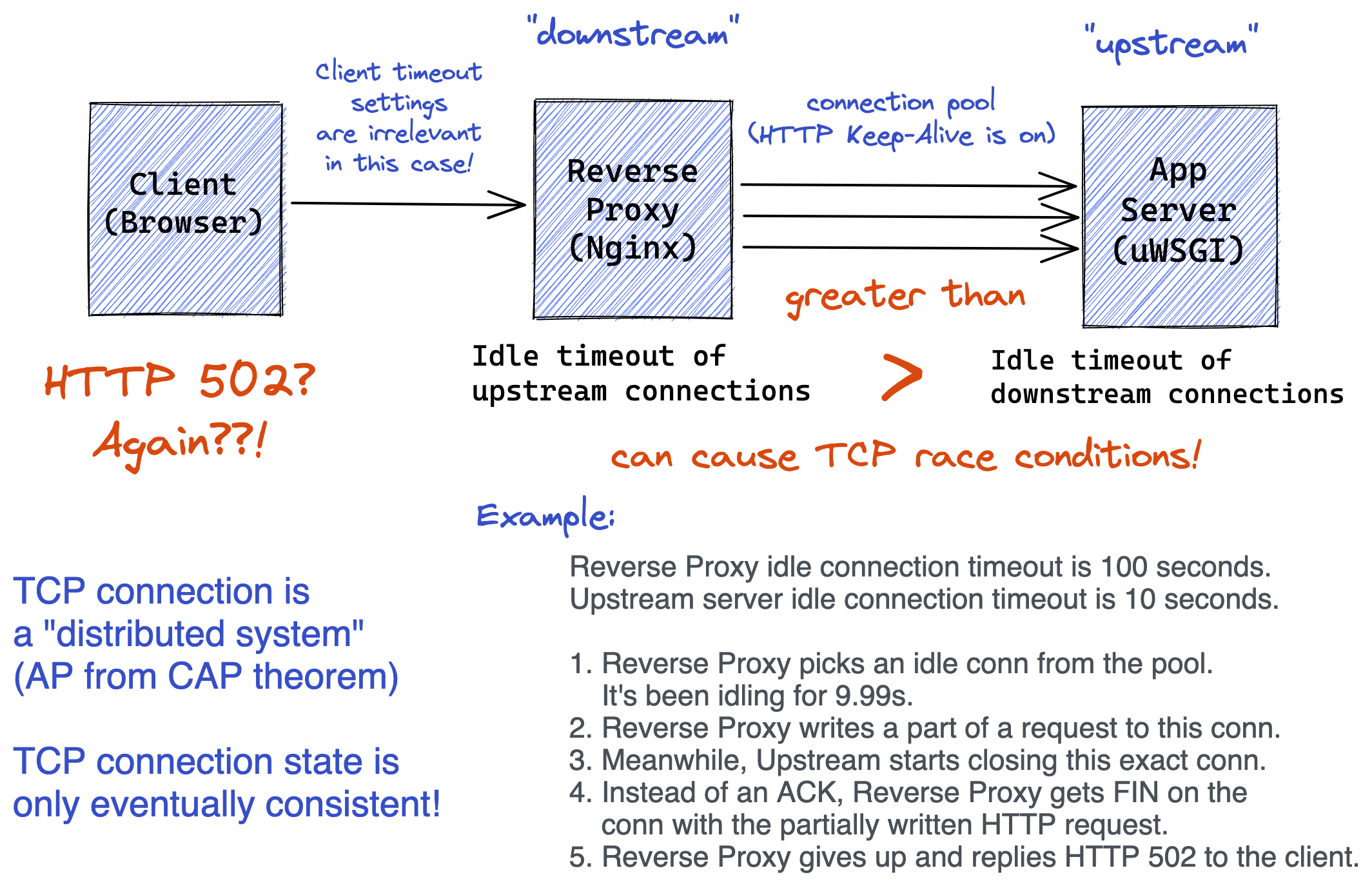
How HTTP Keep-Alive between a reverse proxy and an upstream can cause HTTP 502s due to a TCP race condition.

Level up your server-side game — join 20,000 engineers getting insightful learning materials straight to their inbox.

Below is a longer version...

HTTP 502 status code, also know as Bad Gateway indicates that a server, while acting as a gateway or proxy, received an invalid response from the upstream server. Typical problems causing it (summarized by Datadog folks):

  • Upstream server isn't running.
  • Upstream server times out.
  • Reverse proxy is misconfigured (e.g., my favourite one - trying to call uWSGI over HTTP while it listens on uwsgi protocol 🙈).

However, sometimes there seems to be no apparent reason for HTTP 502s responses while clients sporadically see them:

For me personally, it happened twice already - the first time, with a Node.js application running behind AWS ALB; and the second time, with a Python (uWSGI) application running behind Traefik reverse proxy. And it took quite some time for my team to debug it back in the day (we even involved premium AWS support to pin down the root cause).

Long story short, it was a TCP race condition.

A detailed explanation of the problem, including some low-level TCP packet analysis, can be found in this lovely article. And here, I'll just try to give a quick summary.

First off, any TCP connection is a distributed system. Well, it should make sense - the actual state of a connection is distributed between its [remote] endpoints. And as the CAP theorem dictates, any distributed system can be either available 100% of the time or consistent 100% of the time, but not both. TCP obviously chooses the availability. Hence, the state of a TCP connection is only eventually consistent!

Why does it matter for us?

While this serverfault answer says that the HTTP Keep-Alive should be used only for the client-to-proxy communications, from my experience, proxies often keep the upstream connections alive too. This is a so-called connection pool pattern when just a few connections are heavily reused to handle numerous requests.

When a connection stays in the pool for too long without being reused, it's marked as idle. Usually, idle connections are closed after some period of inactivity. However, the server-side (i.e., the upstream) can also have a notion of idle connections. And sometimes, the proxy and the upstream may choose a rather misfortunate combination of connection timeout settings. If the proxy and the upstream have exactly the same idle timeout durations or the upstream drops connection sooner than the proxy, the end clients start experiencing HTTP 502s.

While one endpoint (the proxy) can still be thinking that the connection is totally fine, the other endpoint may have already started closing the connection (the upstream).

So, the proxy starts writing a request into a connection that is being closed by the upstream. And instead of getting the TCP ACK for the sent bytes, the proxy gets TCP FIN (or even RST) from the upstream. Oftentimes, the proxy just gives up on such requests and responds with immediate HTTP 502 to the client. And this is completely invisible on the application side! So, no application logs will be helpful in such a case.

HTTP Keep-Alive can cause TCP race conditions 🤯

Ok, it happened again... Hence, the diagram!

In a (reverse_proxy + app_server) setup, the reverse proxy should be dropping connections more frequently than the app server. Otherwise, clients will see sporadic HTTP 502s.

Why? 🔽 pic.twitter.com/YBb2tP3Zfg

— Ivan Velichko (@iximiuz) September 29, 2021

The problem is actually quite generic. Theoretically, it can happen in any point-to-point TCP communication where the connections are reused if the upstream drops connections faster than the downstream. However, most of the time, the problem manifests itself with a reverse proxy talking to an upstream with HTTP Keep-Alive being on.

How to mitigate:

  • Make sure the upstream (application) idle connection timeout is longer than the downstream (proxy) connection timeout.
  • Disable connection reuse between the upstream and the proxy (turn off HTTP Keep-Alive).
  • Employ HTTP 5xx retries on the client-side (well, they are often a must-have anyway).

Level up your server-side game — join 20,000 engineers getting insightful learning materials straight to their inbox: