




惯性聚合 高效追踪和阅读你感兴趣的博客、新闻、科技资讯
阅读原文 在惯性聚合中打开

推荐订阅源

L
LangChain Blog
Recent Announcements
GbyAI
GbyAI
H
Hackread – Cybersecurity News, Data Breaches, AI and More
Microsoft Azure Blog
N
Netflix TechBlog - Medium
人人都是产品经理
人人都是产品经理
MongoDB | Blog
MongoDB | Blog
D
DataBreaches.Net
freeCodeCamp Programming Tutorials: Python, JavaScript, Git & More
WordPress大学
WordPress大学
U
Unit 42
腾讯CDC
D
Docker
The GitHub Blog
The GitHub Blog
阮一峰的网络日志
阮一峰的网络日志
Vercel News
Vercel News
I
InfoQ
Jina AI
Jina AI
爱范儿
爱范儿
宝玉的分享
宝玉的分享
博客园 - Franky
G
Google Developers Blog
P
Proofpoint News Feed

Hackaday

Why Not Yserver? It’s Xserver, But Rust-y. OpenCAL: Computed Axial Lithographic 3D Printing For Everyone Is A CS Degree DOA Thanks To LLMs? IEEE Says TBD. Double The VRAM Of An RTX 3070 The Pacemaker Patch Robot Chess But Each Piece Is A Small Robot Bambuddy Says Bye To Bambu Lab Cloud Services Converting A Scanning Electron Microscope Into A TEM Is Surprisingly Easy Custom Watch Is On The Case Patterns Everywhere Behold A 60 Hz Refresh Rate E-ink Monitor GentleOS, A Simple OS For Your Old PC Deeply Optimized MSX Emulation On ESP32-S3 With VGA Output Homebrew Macropad Looks Good The Air Position Indicator For The B-29 Building A 1:150 Scale Toyota ProBox Micro Remote Control Car Adding Weight To A 3D Print With Plaster Of Paris, Cleanly Hackaday Podcast Ep 373: GPS, Danger In Space, And Robby The Robot A Peek Inside The Secret Lagercrantz Suitcase Radio This Week In Security: Microsoft On Microsoft, Register Your Domains, Linux On ARM, And FreeBSD Joins The File Cache Club Glue-in Hinge Design Tries Something Different The Hackaday Communicator Badge, Re-Imagined With New Firmware Amiga 1232 Storm CD Packs Every Upgrade Into One Wedge So Many Analog To Digital Converters Repairing A Pair Of Voodoo 2 GPUs For Some SLI Action AI The Truly Environmentally Friendly Way Evidence For Water Vapor Plumes On Europa Vanishes In Re-Analysis Mechanical Stability For Your Coils 3D Printed Hose Sprayer Sets Phasers To Suds The Merits Of Comment-Driven Development As Counterweight To TDD
An Orbital StormWall Could Mitigate The Next Carrington E...
Suppressed C · 2026-06-17 · via Hackaday

Skip to content

The Carrington Event was the most intense geomagnetic storm ever recorded. In September 1859, auroras were visible as close to the equator as Columbia and some telegraph stations were severely damaged by current induced in the lines. If a similar event occurred today, with a lot more more wiring to pick up current than just an embryonic telegraph network, the results would almost certainly be cataclysmic.

Various modifications to the grid have been proposed to avoid another storm of that magnitude bringing on a new dark age, but a recent paper in the journal Space Weather proposes a more radical solution: using the sun’s energy to create a massive barricade in space.
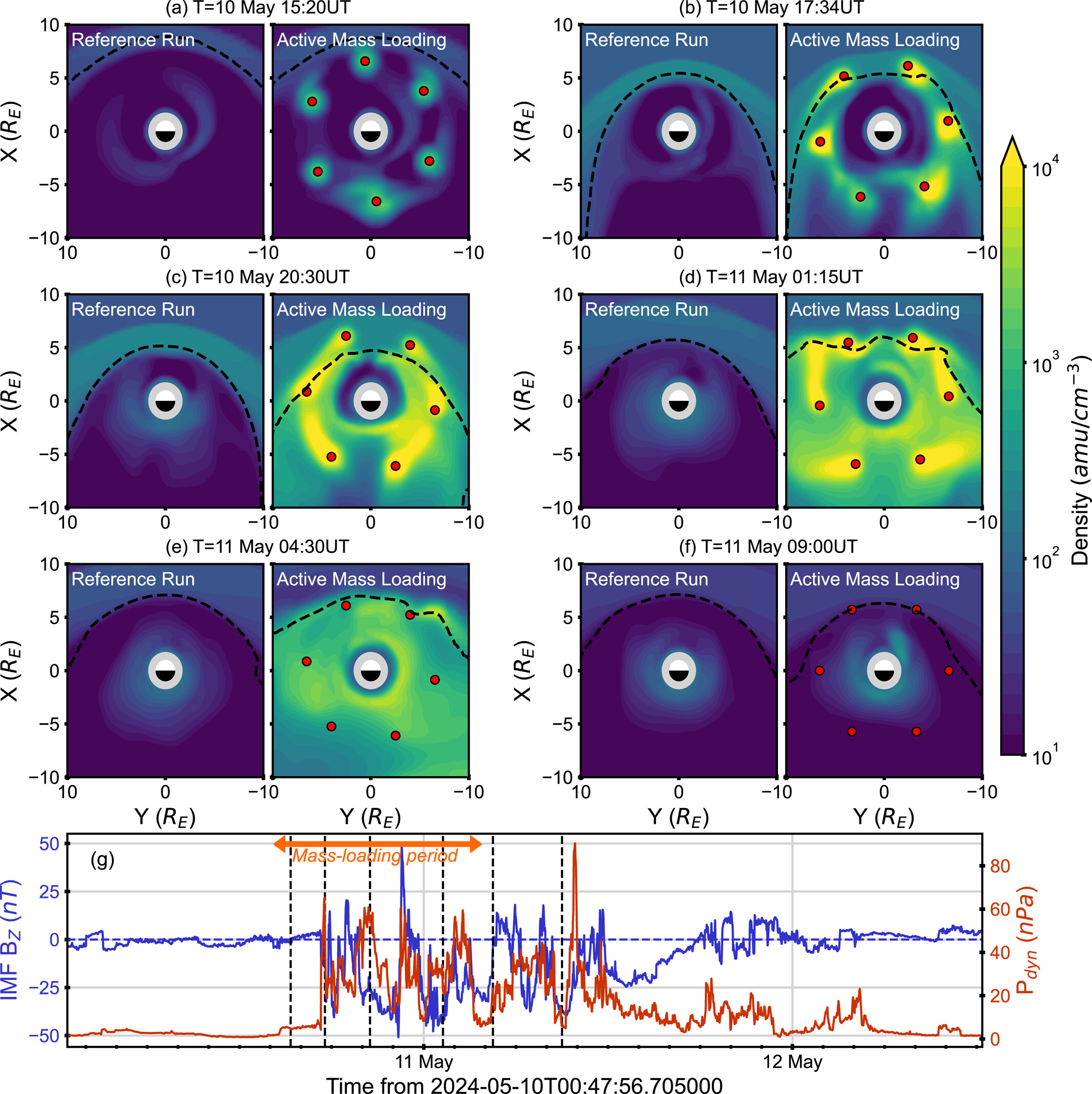
Time evolution of a simulated geomagnetic storm, with and without the StormWall.

While the authors of the paper refer to this concept by the compelling name StormWall, it’s not a physical wall. It’s actually just gas, likely of alkali metal atoms, to be deployed by solar-powered satellites.

To oversimplify, the proposal is to release lots and lots of neutral gas in Geosynchronous Earth Orbit (GEO), in what the researchers call “artificial mass loading” — the neutral gas would of course be ionized by the storm, but in so doing could absorb up to 50% of the incoming energy of the geomagnetic storm, frustrating its coupling to Earth’s magnetosphere. As a bonus, it would protect not just terrestrial assets like the power grid, but everything in a lower orbit than the mass load: everything from communication satellites in GEO to the International Space Station. Assuming its hasn’t been reduced to debris laying at the bottom of Point Nemo by then, anyway.

In simulations, the StormWall required 384,048 kg of gas, which is not exactly trivial. But even accounting for tanking, the researchers estimate that would only take about six launches of SpaceX’s Starship. Though that does assume its GEO capabilities end up being roughly equivalent to the massive vehicle’s projected 100-tons-to-Mars payload capacity.

It’s certainly an interesting hack to solve a problem that has caused a lot of worry these past decades. If you’re interested in learning more about the record-setting geomagnetic storm, we have a piece about the 1859 Carrington Event that should give you plenty of anxiety about the frailty of our modern infrastructure.