

惯性聚合 高效追踪和阅读你感兴趣的博客、新闻、科技资讯
阅读原文 在惯性聚合中打开

推荐订阅源

博客园 - 叶小钗
D
Docker
Google DeepMind News
Y
Y Combinator Blog
钛媒体:引领未来商业与生活新知
钛媒体:引领未来商业与生活新知
Blog — PlanetScale
Blog — PlanetScale
OSCHINA 社区最新新闻
OSCHINA 社区最新新闻
U
Unit 42
博客园 - 【当耐特】
N
Netflix TechBlog - Medium
V
Visual Studio Blog
Microsoft Azure Blog
博客园_首页
Recent Announcements
GbyAI
GbyAI
T
Tailwind CSS Blog
S
SegmentFault 最新的问题
WordPress大学
WordPress大学
T
The Blog of Author Tim Ferriss
Engineering at Meta
Engineering at Meta
L
LangChain Blog
A
About on SuperTechFans
M
MIT News - Artificial intelligence
B
Blog

Hackaday

Why Not Yserver? It’s Xserver, But Rust-y. OpenCAL: Computed Axial Lithographic 3D Printing For Everyone Is A CS Degree DOA Thanks To LLMs? IEEE Says TBD. Double The VRAM Of An RTX 3070 The Pacemaker Patch Robot Chess But Each Piece Is A Small Robot Bambuddy Says Bye To Bambu Lab Cloud Services Converting A Scanning Electron Microscope Into A TEM Is Surprisingly Easy Custom Watch Is On The Case Patterns Everywhere Behold A 60 Hz Refresh Rate E-ink Monitor GentleOS, A Simple OS For Your Old PC Deeply Optimized MSX Emulation On ESP32-S3 With VGA Output Homebrew Macropad Looks Good The Air Position Indicator For The B-29 Building A 1:150 Scale Toyota ProBox Micro Remote Control Car Adding Weight To A 3D Print With Plaster Of Paris, Cleanly Hackaday Podcast Ep 373: GPS, Danger In Space, And Robby The Robot A Peek Inside The Secret Lagercrantz Suitcase Radio This Week In Security: Microsoft On Microsoft, Register Your Domains, Linux On ARM, And FreeBSD Joins The File Cache Club Glue-in Hinge Design Tries Something Different The Hackaday Communicator Badge, Re-Imagined With New Firmware Amiga 1232 Storm CD Packs Every Upgrade Into One Wedge So Many Analog To Digital Converters Repairing A Pair Of Voodoo 2 GPUs For Some SLI Action AI The Truly Environmentally Friendly Way Evidence For Water Vapor Plumes On Europa Vanishes In Re-Analysis Mechanical Stability For Your Coils 3D Printed Hose Sprayer Sets Phasers To Suds The Merits Of Comment-Driven Development As Counterweight To TDD
All The Different Lasers, And How Well They Mark 3D Prints
Donald Papp · 2026-06-25 · via Hackaday

Skip to content

[Stefan] of CNC Kitchen has an informative video describing his experiences with trying to cleanly laser-mark 3D printed plastics using different methods, and it also happens to be a fantastic tour of all the different laser options available to hobbyists and workshops these days.

Laser marking is a fast and effective way to put things like product names, serial numbers, and other information on plastics. [Stefan] wondered whether laser options would be capable of creating clean and professional marks on 3D-printed items, and approached things with his usual attention to detail.
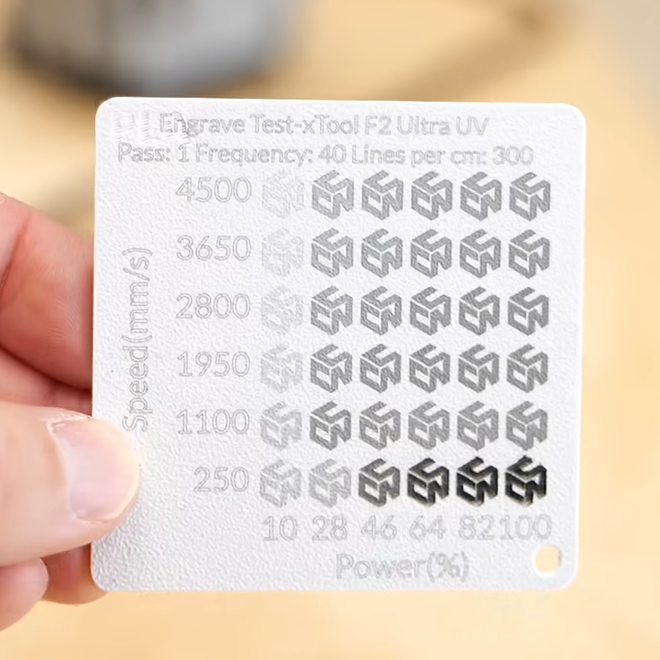
Great results can be had, but using the right tool and dialing in the right settings is critical to results.

How does a laser mark plastic? When the laser hits the material, its energy is dumped into it and can cause pigment bleaching, microfoaming, charring, melting, or ablation (vaporizing) of the surface. The goal is to have a combination of laser and material that delivers a crisp, high-contrast result.

There are several kinds of laser technologies easily available today, and of course a variety of filament types. [Stefan] printed a whole bunch of different PLA, PETG, ASA, TPU, and polycarbonate samples in different colors and tested them with different laser machines, including:

  • UV laser (355 nm wavelength)
  • Blue diode laser (450 nm wavelength)
  • MOPA fiber laser (1,064 nm wavelength)
  • CO2 laser (10,600 nm wavelength)

So is it possible? Yes, but it’s still a bit of a fussy process. There isn’t a one-size-fits-all solution for marking plastic, because results depend a lot on the the right combination of laser type, settings, and target material. That being said, [Stefan] was able to obtain some really great results.

Overall the UV laser was the most suited to marking 3D-printed plastics. [Stefan] says it produced the cleanest results on the widest range of materials with the least fiddling. The MOPA fiber laser also worked, but is clearly more of a metal-marking tool. We’ve seen them etch super-fine PCB traces and while great results are possible it isn’t quite in its element with plastics. Other lasers could get good results under just the right circumstances, but are overall best suited to cutting tasks rather than marking thermoplastics.

Check out the video below for the full details, including some really fantastic closeups.