

惯性聚合 高效追踪和阅读你感兴趣的博客、新闻、科技资讯
阅读原文 在惯性聚合中打开

推荐订阅源

B
Blog
I
InfoQ
Y
Y Combinator Blog
The Last Watchdog
The Last Watchdog
博客园_首页
The Cloudflare Blog
博客园 - 【当耐特】
Engineering at Meta
Engineering at Meta
罗磊的独立博客
月光博客
月光博客
V
V2EX
大猫的无限游戏
大猫的无限游戏
腾讯CDC
GbyAI
GbyAI
云风的 BLOG
云风的 BLOG
Stack Overflow Blog
Stack Overflow Blog
cs.AI updates on arXiv.org
Attack and Defense Labs
cs.CV updates on arXiv.org
Google Online Security Blog
B
Blog RSS Feed
Webroot Blog
Webroot Blog
OSCHINA 社区最新新闻
OSCHINA 社区最新新闻
N
Netflix TechBlog - Medium
量子位
freeCodeCamp Programming Tutorials: Python, JavaScript, Git & More
Vercel News
Vercel News
C
CERT Recently Published Vulnerability Notes
人人都是产品经理
人人都是产品经理
Threat Intelligence Blog | Flashpoint
Recent Announcements
Cyberwarzone
Cyberwarzone
G
Google Developers Blog
H
Heimdal Security Blog
MyScale Blog
MyScale Blog
The Register - Security
博客园 - 三生石上(FineUI控件)
小众软件
小众软件
aimingoo的专栏
aimingoo的专栏
T
Tenable Blog
CTFtime.org: upcoming CTF events
O
OpenAI News
C
Check Point Blog
Forbes - Security
Forbes - Security
SecWiki News
SecWiki News
K
Kaspersky official blog
The GitHub Blog
The GitHub Blog
Security Archives - TechRepublic
F
Full Disclosure
阮一峰的网络日志
阮一峰的网络日志

Hackaday

Why Not Yserver? It’s Xserver, But Rust-y. OpenCAL: Computed Axial Lithographic 3D Printing For Everyone Is A CS Degree DOA Thanks To LLMs? IEEE Says TBD. Double The VRAM Of An RTX 3070 The Pacemaker Patch Robot Chess But Each Piece Is A Small Robot Bambuddy Says Bye To Bambu Lab Cloud Services Converting A Scanning Electron Microscope Into A TEM Is Surprisingly Easy Custom Watch Is On The Case Patterns Everywhere Behold A 60 Hz Refresh Rate E-ink Monitor GentleOS, A Simple OS For Your Old PC Deeply Optimized MSX Emulation On ESP32-S3 With VGA Output Homebrew Macropad Looks Good The Air Position Indicator For The B-29 Building A 1:150 Scale Toyota ProBox Micro Remote Control Car Adding Weight To A 3D Print With Plaster Of Paris, Cleanly Hackaday Podcast Ep 373: GPS, Danger In Space, And Robby The Robot A Peek Inside The Secret Lagercrantz Suitcase Radio This Week In Security: Microsoft On Microsoft, Register Your Domains, Linux On ARM, And FreeBSD Joins The File Cache Club Glue-in Hinge Design Tries Something Different The Hackaday Communicator Badge, Re-Imagined With New Firmware Amiga 1232 Storm CD Packs Every Upgrade Into One Wedge So Many Analog To Digital Converters Repairing A Pair Of Voodoo 2 GPUs For Some SLI Action AI The Truly Environmentally Friendly Way Evidence For Water Vapor Plumes On Europa Vanishes In Re-Analysis Mechanical Stability For Your Coils 3D Printed Hose Sprayer Sets Phasers To Suds The Merits Of Comment-Driven Development As Counterweight To TDD Building A Desktop Catalytic Cracker Process 4 Billion Pixels Per Second From 16 DIY Cameras For The Best V-Tubing Rig Ever 3D Printing A Miniature CoreXY Printer An Unlikely Host For An 8080 Emulator Using Brand New NiMH Cells After Sitting 12 Years Unused Investigating The S3 Virge’s Reputation As A 3D Decelerator Card Over-Engineering An FDM Spool Holder From Prusa Mk4S Remains As It Turns Out, There’s More Than One Cassette Mechanism Being Made After All Using Windows 11 On An LGA 775 PC With AGP Videocard Hackaday Podcast Episode 372: PopTubers, Shifty Semiconductors, And Shelving Shelf Labels An Ethernet WiFi Router on a Pi Pico 2W This Week In Security: Messing With AI, 7Zip And Notepad++ Vulnerabilities, HTTP2 Bomb, And More Using Electrolysis For More Than Just Generating Hydrogen Vintage Turntable Gets Brain Transplant And Home Assistant Integration Connecting Your Car To Home Assistant Microsoft Claims 20 Second Qubits If You Want To Hack Me, Come In Through The Speaker Ways To Embed Magnets In 3D Prints And Not Ruin Printers An RGB Keyboard For Your Hackaday Communicator Badge The World’s First GPIB Speech Synthesizer, And It’s For A GRiD Compass Ask Hackaday: How Do You Feel About Electronic Shelf Labels? Make Your Ceiling Disappear With ADS-B And Short-Throw Projector Fixing A Nintendo Game Boy Clone That Runs Too Fast Web-Based Control For A CB Radio Distilling Stale Gasoline To Make It Usable Again DIY Ceramic Circuit Boards Surely Count As Solarpunk Texas Instruments Changes The NE5532 And Others Into Incompatible Versions Deltarune’s Tenna Brought To Life Linux Fu: Fake Webcams, GUI Edition Hydraulic Drive For Your Lawn Tractor But Just What Is This ‘Artificial Intelligence’? Game Dodecahedron Runs AArch64 Assembly A Diffraction Grating Makes This Clock Readable Turning An Old 3D Printer Into A Vinyl Cutter For Cheap A High-Vacuum Controller For An Eventual Electron Microscope Does Your Terminal Speak Morse? This One Does From Scrappy Pallet Wood To Fancy Tea Tray The 2026 EMF Badge Arrives, With An Add-On. As Expected, It’s Familiar Linux Fu: Taming Strace STM32 Handheld Has OpenGL And All The Classics Jenny’s Daily Drivers: Microsoft Windows 11 Using A Mirror To 3D Scan Both Sides Of An Object At Once Cookies, Baked The 3D Printer Way Restoring Apple’s Terrible But Awesome IBook Laptop After The Dust Settles: Building Pebble Apps Bilingual E-paper News Feed Helps Brush Up Language Skills On The Wisdom Of Replacing A NiMH Module In A Prius Battery Pack Know Your Food: Cheesemaking Like A Wire Bender, But For Pop Tubes Revisiting Making Your Own Internet Router In 2026 Reverse Engineering A Rock Bottom NES Clone Classically-named Argus Robot Is Terminator Meets Tumbleweed Making a Zippy FDM Printer out of Wood Off-Grid OCR Server Powered By IPhone Hackaday Links: May 31, 2026 A Camera Viewfinder Makes A Great TV 4-bit Relay Logic Counter Begs To Have Its Buttons Pushed Loading Sega Genesis Games Off A Vinyl Record Ebike Display Uses Reflective LCD Modern Graphics Via DisplayLink For Your ISA-Era PC The Final Steps To A Sub-Minute Benchy Poking Around With JTAG On A Guitar Amp Keychain GameCube Controller Made Functional Breaking Enigma With An FPGA, Just Like At Bletchley Park The Uncooperative Mirror Will Not Help You Testing Various Ways To Waterproof FDM Printed Parts Cheap Yellow Display With Boosted PSRAM Turned Snazzy Emulator Station It’s Another Pi Handheld. But It’s A Really Good One Take The Reins Of This Unique Controller Be Your Own Oil Company With Desktop Fischer-Tropsch Process
The Trains With Rubber Tires
Zoe Skyfores · 2026-06-24 · via Hackaday

The train was one of the game-changing inventions that defined the Industrial Age. No more would humanity rely on tempestuous animals to haul goods and passengers great distances across the land. Fire and steam came along to rapidly increase the speed of travel and transformed the very fabric of society itself.

To this day, the vast majority of train networks rely on the same basic principle—heavy locomotives and carriages running steel wheels on steel tracks. Yet, there is a curious alternative twist on this concept that sees trains of carriages riding on tires instead. But what would possess anyone to build a rubber tired train?

Where The Rubber Meets The Rail
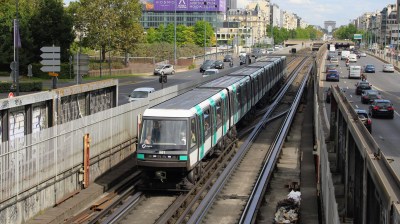
An MP-05 running on the Paris Metro. Credit: Momo Ratp, CC BY-SA 4.0

The first practical rubber-tired train system came about in the wake of World War II. The Paris metro had been poorly maintained during the German occupation, and was in dire need of repair or replacement. The state-owned public transport operator RATP and tire supplier Michelin came to the table, developing a concept wherein vehicles running on pneumatic tires would ride on a flat steel or concrete  “rollway.” The vehicles would also have backup steel wheels that run against a steel rail for safety, keeping the train upright in the case of a tire blowout. Guidance would be provided by extra rubber tires mounted to the wheel bogies on a vertical axis, running against a vertical guideway built into the track, in a manner not dissimilar from later O-Bahn systems.
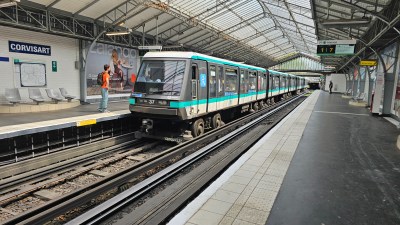
An MP 89 CC consist running on line 6 of the Paris Metro at Corvisart station. These electric multiple units entered service in 1997. Credit: author

By the 1950s, when the concept was being seriously developed, steel-wheeled railways had been around for well over a century. They were the norm for good reason, but running rubber-tired trains did offer some advantages. The pliable tires would soak up vibrations, which was both good for passenger comfort as well as also virtually eliminating high-pitched squealing noises that are common on steel railways. The rubber tires, running on concrete or steel surfaces, also offered greatly improved grip. This allowed the rubber-tired metro trains in Paris to climb much greater grades with ease, compared to traditional steel-wheeled railcars. It also aided in early automation efforts on the Paris Metro, as the higher grip level made it easier to ensure locomotives stopped at the right position when entering stations. Rail wear is also greatly reduced compared to steel-on-steel systems.

Note the guidewheels which run against the vertical guideways built into the track. Credit: author

Of course, rubber tires also came with some drawbacks. Tracks were more expensive to build due to the need to incorporate both rollways and guideways, and commonly a steel rail to supply electricity to the trains. Rubber tires don’t last as long as steel wheels, either, aren’t as robust, and are subject to blowouts when damaged. The flexing of pneumatic rubber tires also makes the trains less energy efficient, and generates more heat in operation, which can be a concern in underground operations. As tires break down, they also create particulate pollution which isn’t great for urban air quality or for the people breathing it in.
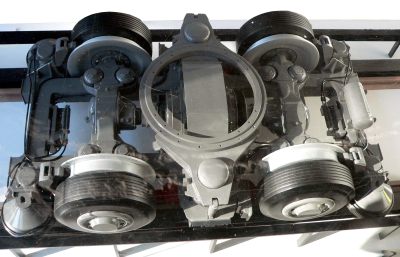
A bogie from an MP 89 of the Paris Metro, showing the main wheels as well as the guide wheels. Credit: Rama, CC BY-SA 2.0

The Paris Metro found the oddball concept to be of great use, particularly given some of the higher grades faced in certain parts of the network. In time, lines 1, 4, 6, 11, and 14 would all be retooled to the Michelin-designed system with rubber-tired railcars running on 1,435 mm rollways. Various airport routes would later adopt rubber tired services, too, as well as the Toulouse, Lille, Lyon, and Marseille metros as well.
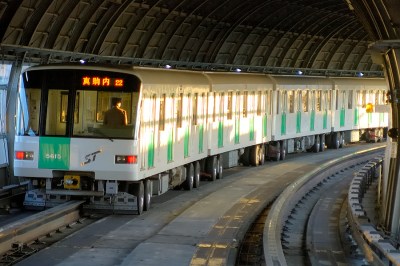
Various rubber-tired metro systems have sprung up around the world. The basic concept is usually the same, though exact implementations differ. This system deployed in Sapporo, Japan, relies on a central rail guidance system, and was built by Kawasaki Heavy Industries. Credit: 出々 吾壱, CC BY SA 3.0

The system was not just limited to France, either. Mexico City found a rubber-tired metro to be the perfect transport solution, as the reduced vibrations were a massive boon given the area’s unstable soils. Other famous examples include the Montreal Metro in Canada, and lines 1, 2, and 5 of the Santiago Metro in Chile. Many other smaller-scale examples can be found around the world, often serving airport routes or shorter-distance lines.

Rubber-tired metros are unlikely to ever fully overtake more traditional steel-wheeled trains in popularity. There are more drawbacks than positives for most typical operations, particularly when it comes to maintenance and ongoing costs. Nevertheless, they have their place, particularly where grip is at a premium, grades are steep, or there is a keen desire to avoid excessive noise and vibration to keep the peace or avoid disturbing the subsurface. These rail-like curios stand out as a weird surprise treat for any railfan visiting Paris, or any of the other similar systems that can be found around the world.