


惯性聚合 高效追踪和阅读你感兴趣的博客、新闻、科技资讯
阅读原文 在惯性聚合中打开

推荐订阅源

N
News and Events Feed by Topic
爱范儿
爱范儿
Apple Machine Learning Research
博客园 - 叶小钗
Last Week in AI
Last Week in AI
博客园 - 三生石上(FineUI控件)
OSCHINA 社区最新新闻
OSCHINA 社区最新新闻
月光博客
月光博客
大猫的无限游戏
大猫的无限游戏
让小产品的独立变现更简单 - ezindie.com
博客园 - Franky
人人都是产品经理
人人都是产品经理
The Cloudflare Blog
酷 壳 – CoolShell
酷 壳 – CoolShell
博客园 - 司徒正美
罗磊的独立博客
博客园 - 聂微东
T
Troy Hunt's Blog
美团技术团队
IT之家
IT之家
A
Arctic Wolf
腾讯CDC
雷峰网
雷峰网
SecWiki News
SecWiki News
博客园_首页
L
LINUX DO - 最新话题
Cloudbric
Cloudbric
量子位
N
News and Events Feed by Topic
小众软件
小众软件
C
CXSECURITY Database RSS Feed - CXSecurity.com
Cyberwarzone
Cyberwarzone
J
Java Code Geeks
V
V2EX
cs.CL updates on arXiv.org
Latest news
Latest news
Webroot Blog
Webroot Blog
F
Fortinet All Blogs
P
Privacy International News Feed
NISL@THU
NISL@THU
Google Online Security Blog
WordPress大学
WordPress大学
PCI Perspectives
PCI Perspectives
GbyAI
GbyAI
宝玉的分享
宝玉的分享
阮一峰的网络日志
阮一峰的网络日志
S
Secure Thoughts
Simon Willison's Weblog
P
Palo Alto Networks Blog
V
Visual Studio Blog

Arpit Bhayani

Temporal Primer - Building Long-Running Systems What Matters in Production RAG Structure of Every LLM Chat How LLMs Really Work Your Monolith Is Already A Distributed System Databases Were Not Designed For This BM25 JOIN Algorithms Venting at Work Comes at a Reputation Cost Why Half Your Skills Expire Every Few Years Multi-Paxos - Consensus in Distributed Databases MySQL Replication Internals Bloom Filters When You Increase Kafka Partitions Product Quantization The Q, K, V Matrices The Day I Accidentally Deleted Production How LLM Inference Works What are Blocking Queues and Why We Need Them Heartbeats in Distributed Systems How Writes Work in Apache Cassandra Redis Replication Internals How to Handle Arrogant Colleagues at Work How Does a CDN Handle Content Replication You Can't Fix Everything on Day One When Emotions Spill Over at Work Why gRPC Uses HTTP2 Meetings With No Agenda Are a Waste of Time Career Longevity Beats Constant Job Hopping Stay Relevant at Higher Salary Levels Why Distributed Systems Need Consensus Algorithms Like Raft Why Do Databases Deadlock and How Do They Resolve It Why and How Cache Locality Can Make Your Code Faster Why Eventual Consistency is Preferred in Distributed Systems Why does DNS use both UDP and TCP Should You Do a Master's My Honest Take Empathy Makes Great Engineers Unstoppable Good Mentors Build People, Not Just Skills Why You Should Always Have Back-Burner Projects Before You Push Back, Know What You're Standing On Be the One They Can Count On How Much Are People Willing to Bet on You How to Get Leadership to Say Yes to Your Project Don't Let Your Best Ideas Die in Silence Be the Person Everyone Wants to Work With The XY Problem and How to Avoid It The Startup Hiring Lie Nobody Talks About You Won't Be Promoted Unless You Ask It's Not Enough to be Right; Learn to be Heard No One Ships Great Software Alone You Don't Win by Proving Others Wrong Appreciate Generously; It Costs Nothing, But Builds Everything Your Soft Skills Aren't Soft at All Before you form an opinion, experience it Why You Need Both Curiosity and Action to Thrive A Daily Worklog Changed Everything How We Handle Mistakes Defines Us Own Your Mistakes Don't Wait. Step Up. Temporary Fixes Are Permanent Why Interviews Are Biased And What Sets You Apart Saying 'This isn't my problem' is actually the problem How to Write Effective OKRs Never Lose a Battle due to Miscommunication When In Doubt, Code It Out How to Follow Up Without Annoying People Lead Projects That Land, Execution Over Everything Abstract Thinking Will Define Your Next Decade We Engineers Suck at Task Estimation Shiny Obect Syndrome in Tech When to Change Jobs - The 3P Framework Comfort and Competition - Know When to Switch Gears Paper Notes - On-demand Container Loading in AWS Lambda Paper Notes - SQL Has Problems. We Can Fix Them Pipe Syntax In SQL Paper Notes - NanoLog - A Nanosecond Scale Logging System Don't Wait, Learn - The Best Resource is Mythical Paper Notes - WTF - The Who to Follow Service at Twitter The Unexpected Benefit of Reading Random Engineering Articles Roadmaps Are Limiting Your Growth Stop Leaving Money on the Table - Negotiate Your Job Offer Never Bad-Mouth Your Past Employers Show You're a Culture Fit Quantify your resume, Know Your Numbers The Importance of Being Likeable in Interviews Questions to Ask Your Interviewer How to Build Trust Through Collaboration Do This, Once You Are Out of the Interview Cycle Stop Pitching Ideas, Start Pitching Projects Read Those Design Docs, Even the Ones That Seem Irrelevant The Best Engineering Lessons Happen During Outages Great Engineers Start Broad LLM Summaries are Ruining Your Learning Turn System Design Interviews into Discussions Title Inflation At Work, Find Your Own Projects 6 Simple Strategies to Cracking Any Tech Interview How to Remain Unblocked Solving the Knapsack Problem with Evolutionary Algorithms Generating Pseudorandom Numbers with LFSR Local vs Global Indexes in Partitioned Databases
Partitioning Strategies for Distributed Databases
Arpit Bhayani · 2022-01-24 · via Arpit Bhayani

Partitioning plays a vital role in scaling a database beyond a certain scale of reads and writes. In this essay, we take a detailed look into Partitioning basics and understand how it can help us scale our Reads and Writes beyond a single machine.

What is Partitioning?

A database is partitioned when we split it, logically or physically, into mutually exclusive segments. Each partition of the database is a subset that can operate as a smaller independent database on its own. A database is always deterministically partitioned on a particular attribute like User ID, Time, Location, etc., allowing all records having the same attribute value to reside in the same partition. This will enable us to fire localized queries on a partitioned attribute.

Partitioning

Say a database has grown to be 100GB big, and we choose to partition it on User ID into 4 partitions. To decide which record goes in which partition, we can use a Hash Function applied on the User ID to map one record to exactly one partition. Hence to trace where a record of a particular user resides, we pass it through the same Hash Function and find the owning partition.

We will talk about partitioning strategies in detail in future essays, so keep an eye.

Why do we partition?

We need to partition a database for several reasons, but load distribution and availability are the primary reasons. Let’s dive deeper into each and see how partitioning benefits us.

Load Distribution

A database is partitioned when it needs to handle more reads or writes than one over-scaled database. Our go-to strategy to handle more reads or more writes is to scale the database vertically. Given that vertical scaling has a limit due to hardware constraints, we have to go horizontal and distribute the load across multiple nodes.

Scaling Reads

By partitioning a database into multiple segments, we get a significant boost in the performance of localized queries. Say we have a database with 100M rows split into 4 partitions with roughly 25M rows each. Now, instead of one database supporting querying over 100M rows, we split the read load across 4 databases allowing us to quickly execute the query and serve the results to the users.

If the read query is localized by partitioned attribute, we need only one (of the four) partitions to execute the query and get the results, thus distributing the read load. For example, in a blogging platform, if our database is partitioned by User ID and we want to find the total number of posts made by a user, this query only needs to be executed on one small partition of data.

Scaling Reads with Partitioning

Suppose the read queries require us to fetch records from multiple partitions, given that each partition is independent. In that case, we can parallelize the execution and then merge the results before sending them out to the users. In either case, we get a massive performance boost in query execution.

Scaling Reads with Partitioning - Parallel Reads

Scaling Writes

In a traditional Master-Replica setup, there is one Master node that takes in all the write requests, and to scale reads, this Master has a few configured Replicas. To handle more Write operations in such a setup, one approach is to scale the Master node vertically by adding more CPU and RAM. The second approach is to scale it horizontally by adding multiple nodes acting as independent Multiple Master nodes.

Given that vertical scaling has a limit, scaling writes that adding multiple independent Master nodes becomes a go-to strategy beyond a certain scale, where Partitioning plays a key role. In a partitioned setup, since one record can is present on one partition, the total write operations are evenly distributed across all the Master nodes, allowing us to scale beyond a single machine.
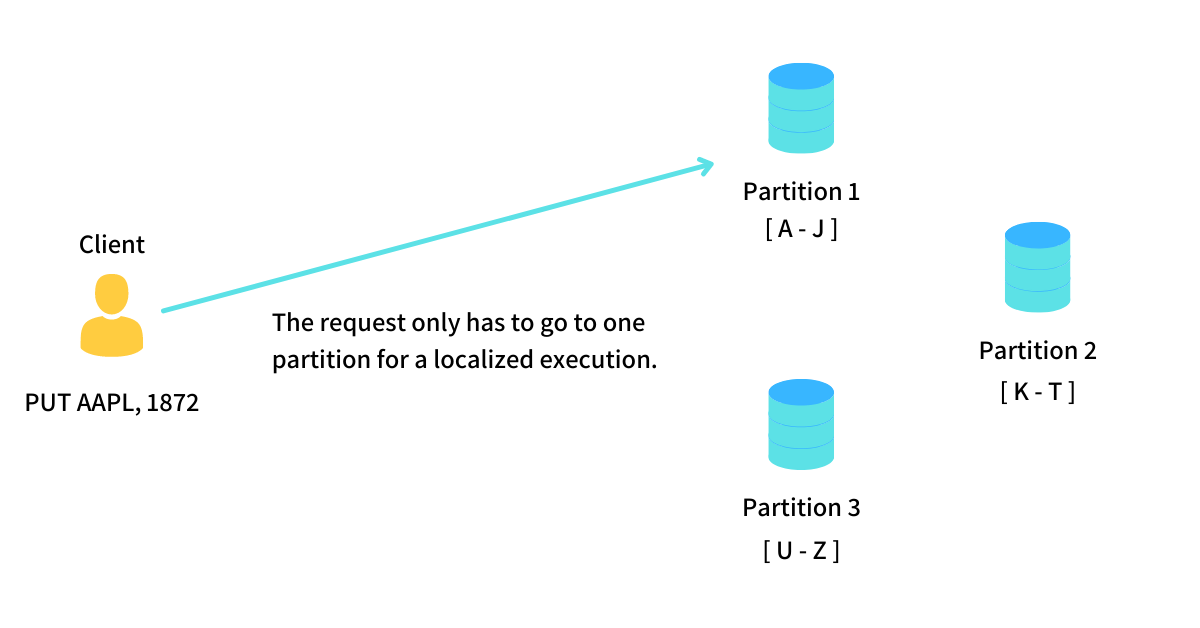
Scaling writes with Partitioning

Improving Availability

By partitioning a database, we also get a massive improvement in data availability. Since our data is divided across multiple data nodes, even if one of the nodes abruptly crashes and becomes unrecoverable, we only lose a fraction of our data and not the whole of it.

We can further improve the availability of our data by replicating it across multiple secondary data nodes. Thus each partition resides on multiple data nodes, and in case of them crashes, we can fully recover the lost data from the secondary node, giving our fault tolerance a massive boost.

Partitioning for High Availability

Each record thus belongs to exactly one partition, but the replicated copy of the record can be stored on other data nodes for fault tolerance. These replicated copies are similar to Read Replicas that either synchronously or asynchronously follow the primary copy and keep itself updated.

Types of partitioning

Data can be partitioned in two ways - Horizontal and Vertical. In terms of relational databases, Horizontal Partitioning involves putting different rows into different partitions, and Vertical Partitioning involves putting different columns into separate partitions.

Horizontal partitioning is a very common practice in scaling relational and non-relational databases. It allows us to visit just one partition and get our query answered. It also enables us to split our query load across partitions by making one partition responsible for a particular row/record.

Vertical partitioning is seen in action in Data Warehouses, where we have to crunch a lot of numbers and fire complex aggregation queries. Vertical partitioning is particularly useful when we are not querying all the columns of a particular record and refer to querying a fewer set of columns in each query.