





Stateful programs often become complex beasts as they grow. Program state incohesively spread across a bunch of variables, spuriously guarded by even more variables, is what I refer to as implicit state. When working with such code, we have to reconstruct a model mentally, identifying possible states and transitions between them, to modify the program with confidence. Even if a test suite can help, the process is tedious and error-prone, and I insist we should have our tools do the heavy lifting instead.
By teaching the type system about possible states and state transitions in our program, it can verify that we follow our own business rules, both when we write new code, and when we modify existing code. It is not merely a process of asking the compiler “did I do okay?” Our workflow can be a conversation with the compiler, a process known as type-driven development. Moreover, the program encodes the state machine as living machine-verified documentation.
After having given my talk at Code Mesh on this topic, and having spent a lot of time researching and preparing examples, I want to share the material in the form of a blog post series. Each post will cover increasingly advanced techniques that give greater static safety guarantees. That is not to say that the latter techniques are inherently better, nor that they are the ones that you should use. This series is meant as a small à la carte of event-driven state machine encodings and type safety, where you can choose from the menu based on your taste and budget. I will, however, present the techniques in a linear form. Also, note that these posts do not claim to exhaust all options for state machine encodings.
There are many trade-offs, including type safety and strictness, implementation complexity, and how language, technique, and library choices affect your team. Taking one step towards explicit state, in an area where it leverages your project in doing so, can be the best choice. You don’t have to go nuts with type systems to use explicit states in your program! Furthermore, most mainstream languages today let you encode states as data types in some way.

This is the introductory post, in which I’ll show the first step on our way from implicit state and despair to writing stateful and effectful programs with great confidence. We will use Haskell and algebraic data types (ADTs) to encode possible states as data types. You should be able to read and understand this post without knowing much Haskell. If not, tell me, and I will try to explain better.
First, we should have a clear understanding of what a finite-state machine is. There are many variations and definitions, and I’m sure you, especially if coming from an engineering background, have some relation to state machines.
In general, a finite-state machine can be described as an abstract machine with a finite set of states, being in one state at a time. Events trigger state transitions; that is, the machine changes from being in one state to being in another state. The machine defines a set of legal transitions, often expressed as associations from a state and event pair to a state.
For the domains we will be exploring, the Erlang documentation’s definition of a finite-state machine is simple and useful:
State(S) × Event(E) → Actions (A), State(S’)
If we are in state S and the event E occurs, we should perform the actions A and make a transition to the state S’.
That is the basis for the coming posts. I will not categorize as Mealy or Moore machines, or use UML state charts, at least not to any greater extent. Some diagrams will use the notation for hierarchical state machines for convenience.
The running example we will use in these posts is a shopping cart checkout, modeled as an event-driven finite-state machine. This stems from a real-world project I worked on, where the lack of explicit states in code became a real problem as requirements evolved. It’s the use-case that inspired me to look for more robust methods.
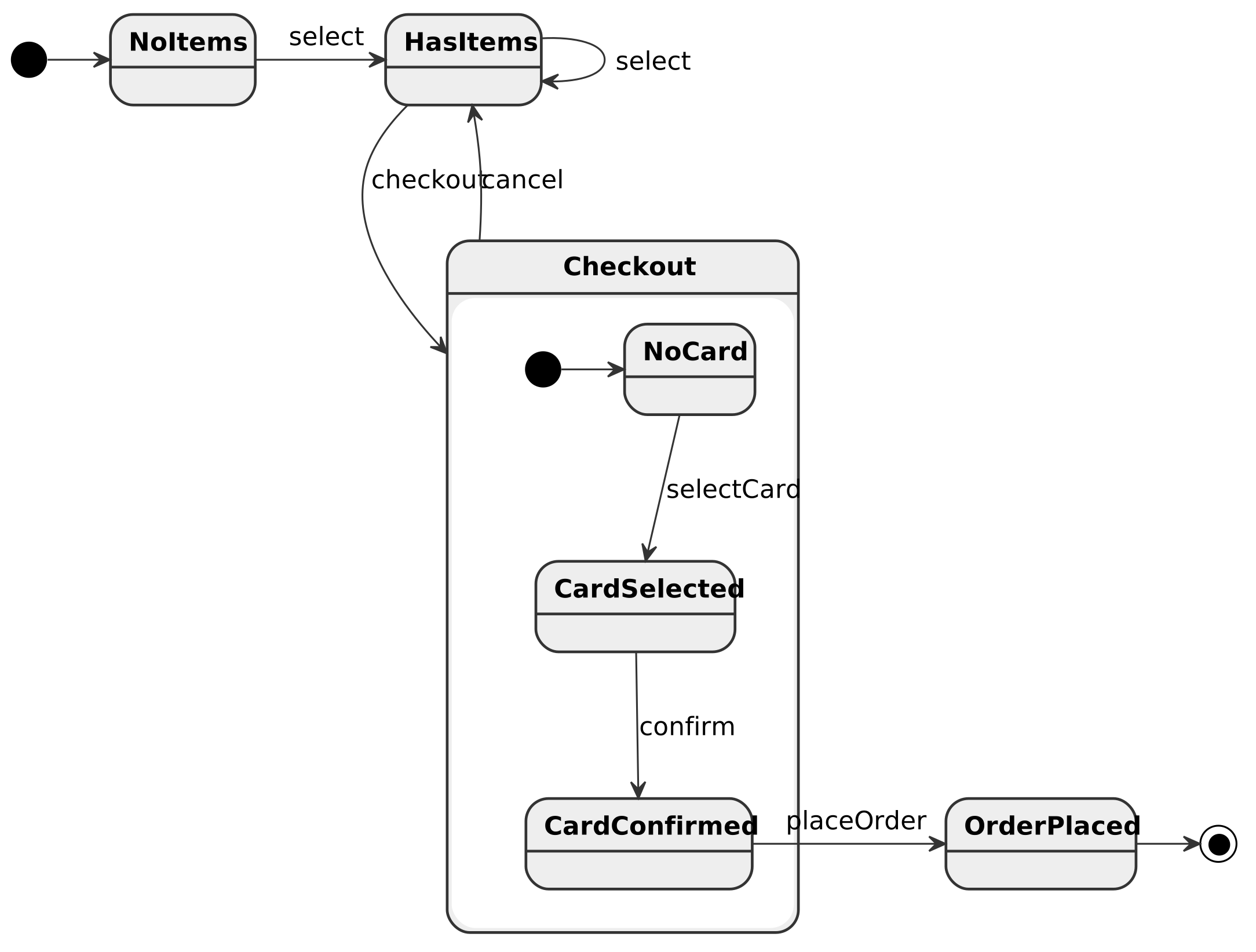
As shown graphically in the state diagram above, we start in “NoItems”, selecting one or more items, staying in “HasItems”, until we begin the checkout. We enter the nested “Checkout” machine on the “checkout” event. Modeling it as a hierarchically nested machine we can have all its states accept the “cancel” event. We select and confirm a card, and eventually place an order, if not canceled.
Let’s get started. We will use Text instead of
String, and NonEmpty lists. The two modules
PaymentProvider and Checkout hide some
implementation detail of lesser importance.
{-# LANGUAGE OverloadedStrings #-}
module StateMachinesWithAdts where

import Control.Monad      (foldM)
import Data.List.NonEmpty
import Data.Text          (Text)
import Text.Printf        (printf)

import qualified PaymentProvider
import           Checkout        ( Card(..)
                                 , CartItem(..)
                                 , calculatePrice
                                 )
CheckoutState is a sum type, with one constructor for
each valid state. Some constructors are nullary, meaning they
have no arguments. Others have arguments, for the data they carry.
data CheckoutState
  = NoItems
  | HasItems (NonEmpty CartItem)
  | NoCard (NonEmpty CartItem)
  | CardSelected (NonEmpty CartItem)
                 Card
  | CardConfirmed (NonEmpty CartItem)
                  Card
  | OrderPlaced
  deriving (Show, Eq)
Looking at the state constructors in the definition of
CheckoutState, we can see how they accumulate state as the
machine makes progress, right up until the order is placed.
Note that CartItem and Card are imported
from the shared Checkout module.
Similar to the data type for states, the data type for events, called
CheckoutEvent, defines one constructor for each valid
event. The non-nullary constructors carry some data with the event.
data CheckoutEvent
  = Select CartItem
  | Checkout
  | SelectCard Card
  | Confirm
  | PlaceOrder
  | Cancel
  deriving (Show, Eq)
We have now translated the diagram to Haskell data types, and we can implement the state transitions and actions.
Now, we might consider the simplest possible implementation of a state machine a function from state and event to the next state, very much like the definition from Erlang’s documentation quoted above. Such a function could have the following type:
CheckoutState -> CheckoutEvent -> CheckoutStateIn a state machine that itself can be regarded a pure function, such as a parser, or a calculator, the above signature would be fine. For our purposes, however, we need to interleave side effects with state transitions. We might want to validate that the selected items exist using external database queries, and send requests to a third-party payment provider when placing the order.
Some systems built around the concept of a state reducer function, such as The Elm Architecture or Pux, support a way of specifying the side effects together with the next state. A starting point to achieve this in Haskell, for our checkout state machine, is the following type signature:
checkout
  :: CheckoutState
  -> CheckoutEvent
  -> IO CheckoutState
A state transition then returns IO of the next state,
meaning that we can interleave side effects with transitions. We create
a type alias for such a function type, named FSM.
type FSM s e =
  s -> e -> IO s
Then we can write the type signature for checkout using
our data types as parameters.
checkout :: FSM CheckoutState CheckoutEventThe definition of checkout pattern matches on the
current state and the event. The first five cases simply builds up the
state values based on the events, and transitions appropriately. We
could add validation of selected items, and validation of the selected
credit card, but we would then need explicit error states, or terminate
the entire state machine on such invalid inputs. I’ll err on the side of
keeping this example simple.
checkout NoItems (Select item) =
  return (HasItems (item :| []))

checkout (HasItems items) (Select item) =
  return (HasItems (item <| items))

checkout (HasItems items) Checkout =
  return (NoCard items)

checkout (NoCard items) (SelectCard card) =
  return (CardSelected items card)

checkout (CardSelected items card) Confirm =
  return (CardConfirmed items card)
Remember the state diagram? The nested “Checkout” machine accepts the “cancel” event in all its states, and so does our implementation. We switch on the current state, and cancel in the correct ones, otherwise remaining in the current state.
checkout state Cancel =
  case state of
    NoCard items          -> return (HasItems items)
    CardSelected items _  -> return (HasItems items)
    CardConfirmed items _ -> return (HasItems items)
    _                     -> return state
To demonstrate how an interleaved side effect is performed, we use
the imported chargeCard and calculatePrice to
charge the card. The implementations of chargeCard and
calculatePrice are not important.
checkout (CardConfirmed items card) PlaceOrder = do
  PaymentProvider.chargeCard card (calculatePrice items)
  return OrderPlaced
The last case is a fall-through pattern, for unaccepted events in the current state, which effectively has the machine remain in its current state.
checkout state _ = return stateThat is it for checkout, our state reducer function
using IO.
To run our machine, we can rely on foldM. Given a
machine, an initial state, and a foldable sequence of events, we get
back the terminal state inside IO.
runFsm :: Foldable f => FSM s e -> s -> f e -> IO s
runFsm = foldM
Just getting back the terminal state might be too much of a black
box. To see what happens as we run a machine, we can decorate
it with logging. The withLogging function runs the state
machine it receives as an argument, logs its transition, and returns the
next state.
withLogging
  :: (Show s, Show e)
  => FSM s e
  -> FSM s e
withLogging fsm s e = do
  s' <- fsm s e
  printf "- %s × %s → %s\n" (show s) (show e) (show s')
  return s'
Combining these building blocks and running them in GHCi, with a list
of events as input, we see the transitions logged and our side-effecting
chargeCard operation.
*StateMachinesWithAdts> runFsm
   (withLogging checkout)
   NoItems
   [ Select (CartItem "potatoes" 23.95)
   , Select (CartItem "fish" 168.50)
   , Checkout
   , SelectCard (Card "0000-0000-0000-0000")
   , Confirm
   , PlaceOrder
   ]
- NoItems × Select (CartItem {itemId = "potatoes", itemPrice = 23.95}) → HasItems (CartItem {itemId = "potatoes", itemPrice = 23.95} :| [])
- HasItems (CartItem {itemId = "potatoes", itemPrice = 23.95} :| []) × Select (CartItem {itemId = "fish", itemPrice = 168.5}) → HasItems (CartItem {itemId = "fish", itemPrice = 168.5} :| [CartItem {itemId = "potatoes", itemPrice = 23.95}])
- HasItems (CartItem {itemId = "fish", itemPrice = 168.5} :| [CartItem {itemId = "potatoes", itemPrice = 23.95}]) × Checkout → NoCard (CartItem {itemId = "fish", itemPrice = 168.5} :| [CartItem {itemId = "potatoes", itemPrice = 23.95}])
- NoCard (CartItem {itemId = "fish", itemPrice = 168.5} :| [CartItem {itemId = "potatoes", itemPrice = 23.95}]) × SelectCard (Card "0000-0000-0000-0000") → CardSelected (CartItem {itemId = "fish", itemPrice = 168.5} :| [CartItem {itemId = "potatoes", itemPrice = 23.95}]) (Card "0000-0000-0000-0000")
- CardSelected (CartItem {itemId = "fish", itemPrice = 168.5} :| [CartItem {itemId = "potatoes", itemPrice = 23.95}]) (Card "0000-0000-0000-0000") × Confirm → CardConfirmed (CartItem {itemId = "fish", itemPrice = 168.5} :| [CartItem {itemId = "potatoes", itemPrice = 23.95}]) (Card "0000-0000-0000-0000")
Charging card 0000-0000-0000-0000 $192.45
- CardConfirmed (CartItem {itemId = "fish", itemPrice = 168.5} :| [CartItem {itemId = "potatoes", itemPrice = 23.95}]) (Card "0000-0000-0000-0000") × PlaceOrder → OrderPlaced
OrderPlaced
Yes, the logging is somewhat verbose, but there we have it; a simplified event-driven state machine using ADTs for states and events. The data types protect us from constructing illegal values, they bring the code closer to our conceptual model, and they make state transitions explicit.
This is a great starting point, and as I argued in the introduction of this post, probably the leg on our journey with the highest return on investment. It is, however, still possible to implement illegal state transitions! We would not get any compile-time error bringing our attention to such mistakes. Another concern is that the state machine implementation is tightly coupled with IO, making it hard to test.
We could factor out the side effects in checkout using
MTL-style
type classes or free monads, , or perhaps using extensible-effects.
That said, in the next post I will show you a technique to tackle both
the side effect and testability concerns, using MTL-style abstraction of
the state machine itself.
Why don’t you go on and read part 2 next!
此内容由惯性聚合(RSS阅读器)自动聚合整理,仅供阅读参考。 原文来自 — 版权归原作者所有。