惯性聚合 高效追踪和阅读你感兴趣的博客、新闻、科技资讯
阅读原文 在惯性聚合中打开

推荐订阅源

T
The Exploit Database - CXSecurity.com
F
Fortinet All Blogs
U
Unit 42
F
Full Disclosure
雷峰网
雷峰网
博客园 - 司徒正美
云风的 BLOG
云风的 BLOG
钛媒体:引领未来商业与生活新知
钛媒体:引领未来商业与生活新知
T
Tailwind CSS Blog
The Cloudflare Blog
Last Week in AI
Last Week in AI
罗磊的独立博客
D
DataBreaches.Net
C
Check Point Blog
www.infosecurity-magazine.com
CTFtime.org: upcoming CTF events
O
OpenAI News
C
CXSECURITY Database RSS Feed - CXSecurity.com
aimingoo的专栏
aimingoo的专栏
S
Security @ Cisco Blogs
大猫的无限游戏
大猫的无限游戏
让小产品的独立变现更简单 - ezindie.com
S
SegmentFault 最新的问题
NISL@THU
NISL@THU
OSCHINA 社区最新新闻
OSCHINA 社区最新新闻
The Hacker News
The Hacker News
Webroot Blog
Webroot Blog
Security Latest
Security Latest
cs.CL updates on arXiv.org
Google DeepMind News
酷 壳 – CoolShell
酷 壳 – CoolShell
N
News | PayPal Newsroom
P
Proofpoint News Feed
B
Blog RSS Feed
MongoDB | Blog
MongoDB | Blog
C
Cybersecurity and Infrastructure Security Agency CISA
N
News and Events Feed by Topic
Google Online Security Blog
H
Help Net Security
Spread Privacy
Spread Privacy
T
Threat Research - Cisco Blogs
GbyAI
GbyAI
I
Intezer
Application and Cybersecurity Blog
M
MIT News - Artificial intelligence
Vercel News
Vercel News
Cyber Security Advisories - MS-ISAC
IT之家
IT之家
MyScale Blog
MyScale Blog
腾讯CDC

Sealos Blog

Build a Full-Stack App with Claude Code + InsForge — Zero Backend Code | Sealos Blog InsForge vs Supabase: Which Backend for AI-Powered Development? | Sealos Blog Kubernetes NodePort Exhaustion: SSH Gateway Solution | Sealos Blog Claude Code Metrics Dashboard: Grafana Setup (2026) | Sealos Blog What Is RustFS? Apache 2.0 MinIO Alternative (2026) | Sealos Blog Claude Code Mobile: iPhone, Android & SSH (2026) | Sealos Blog Eaglercraft Server Hosting: Fast Setup (2026) | Sealos Blog An Honest Review: Migrating a Complex Microservice App from Heroku to Sealos | Sealos Blog The Ultimate Guide to Kubernetes Audit Logging for Security and Compliance | Sealos Blog Cost Optimization Shootout: Sealos Autonomous FinOps vs. Kubecost Manual Reports | Sealos Blog For CTOs: How to Cut Your Cloud Bill by 50% Without Sacrificing Performance | Sealos Blog Building Resilient Systems: A Deep Dive into Sealos High-Availability and Auto-Failover | Sealos Blog Building a Scalable Event-Driven Architecture with Sealos Managed Kafka | Sealos Blog Beyond kubectl apply: 5 GitOps Best Practices for Production-Ready CI/CD on Sealos | Sealos Blog Advanced RAG Pipelines: Why Your Choice of Vector Database (like Milvus) Matters | Sealos Blog Advanced MLOps: How to Monitor and Evaluate LLM Applications in Production | Sealos Blog A Developer's Guide to Kubernetes RBAC: Securing Your Cluster the Easy Way with Sealos | Sealos Blog A CISO's Guide to Cloud Development: Securing the CI/CD Pipeline with Sealos DevBox | Sealos Blog What is Kubernetes Multi-Tenancy? A Guide for Platform Engineers | Sealos Blog What is Infrastructure from Code (IfC)? The Next Step After Infrastructure as Code (IaC) | Sealos Blog What is GitOps? A Beginner's Guide to "Push-to-Deploy" Workflows | Sealos Blog What is eBPF? The Future of Kubernetes Networking and Security | Sealos Blog What is an "AI-Native" Platform? (And Why You Need One for MLOps) | Sealos Blog What is an Agentic Workflow? Building the Next Generation of AI Apps | Sealos Blog What is a Kubernetes Chargeback Model (And How Does it Save You Money?) | Sealos Blog What is a "Headless" Development Environment? (And How it Works with VS Code) | Sealos Blog What is a Graph-Based Vector Database? (And When to Use It Over Milvus) | Sealos Blog What is a "Cloud Operating System"? The Next Evolution of PaaS Explained | Sealos Blog The Real Cost of EKS: How Sealos Delivers a Simpler, Cheaper Kubernetes Experience | Sealos Blog The 3 Types of Kubernetes Autoscaling (HPA, VPA, CA) and How Sealos Manages Them for You | Sealos Blog Sealos vs Vercel: Why a Cloud OS Beats a Frontend Platform for Full-Stack Apps | Sealos Blog Sealos vs. Render vs. Fly.io: A 2025 Guide to the Best Heroku Alternatives | Sealos Blog Sealos vs. OpenShift: Kubernetes for Developers vs. Kubernetes for Ops Teams | Sealos Blog Sealos vs. Netlify: When to Choose a Full Kubernetes Platform over a Static Site Hoster | Sealos Blog Sealos vs. DigitalOcean App Platform: A Head-to-Head Comparison on Cost, Features, and Scalability | Sealos Blog Sealos vs. AWS Elastic Beanstalk: The Modern PaaS for Developers Who Hate YAML | Sealos Blog Sealos DevBox vs. AWS Cloud9: Why Your CDE Should Be Platform-Agnostic | Sealos Blog For Developers: Stop Wasting Time on DevOps. A 10-Minute Guide to Shipping Faster with DevBox. | Sealos Blog Deploying n8n with Docker: From Local Setups to a Radically Simple Cloud Alternative | Sealos Blog The Impact of Prompt Bloat: How the Sealos AI Proxy Can Cache Queries and Cut LLM Costs | Sealos Blog The FinOps Playbook: How to Implement Kubernetes Chargebacks and Showbacks with Sealos | Sealos Blog Smoke Testing for ML Pipelines: Catching Data and Model Errors Before They Hit Production | Sealos Blog Optimizing PostgreSQL Performance: A Guide to Sealos Managed Database Tuning | Sealos Blog Managing Kubernetes Multi-Tenancy: How Sealos Enforces Resource Quotas and Network Policies | Sealos Blog From Days to Minutes: How to Standardize Developer Environments for Your Entire Engineering Org | Sealos Blog For Platform Engineers: How to Build a Golden Path IDP (Internal Developer Platform) with Sealos | Sealos Blog For FinOps Managers: The 5 Leakiest Buckets in Your Kubernetes Budget (And How to Plug Them) | Sealos Blog For Educators & IT Admins: How to Provide a Secure, Scalable Cloud Lab for 1000+ Students on a Budget | Sealos Blog What is a Vector Database? A Beginner's Guide to Milvus, Pinecone, and More | Sealos Blog Why Your Microservices Architecture is Failing (And How a Cloud OS Can Fix It) | Sealos Blog The Power of Autoscaling: A Deep Dive into HPA, VPA, and Cluster Autoscaler | Sealos Blog The Total Economic Impact of Cloud Development Environments (CDEs) | Sealos Blog The Illustrated Guide to the Kubernetes Control Plane | Sealos Blog The MLOps Lifecycle Explained: From Data Prep to Model Deployment | Sealos Blog Beyond Vercel's AI Cloud: The Case for an AI-Native Operating System | Sealos Blog The Architecture of a Modern AI Application: A 2025 Blueprint | Sealos Blog GitHub Codespaces is Great, But Your Workflow is Incomplete. Here's Why. | Sealos Blog The Best Heroku Alternatives in 2025 for Scalability and Cost | Sealos Blog CAST AI vs. Kubecost vs. Sealos: Choosing the Right K8s Cost Management Tool | Sealos Blog DevBox vs. Gitpod vs. Replit: An Unbiased Comparison for 2025 | Sealos Blog Unlocking Hidden Savings: A Guide to Using Spot Instances Safely in Kubernetes | Sealos Blog Can a CDE Really Replace Your MacBook Pro? A Performance Benchmark | Sealos Blog The End of "Works on My Machine": Achieving 100% Reproducible Builds with DevBox | Sealos Blog The Ultimate Guide to GPU Provisioning and Management in Kubernetes | Sealos Blog Rightsizing Kubernetes Workloads: How to Stop Wasting Money on CPU and Memory Requests | Sealos Blog The 2025 Guide to Kubernetes Cost Optimization: 10 Strategies to Cut Your Bill in Half | Sealos Blog FinOps for Startups: How to Build a Cost-Conscious Culture from Day One | Sealos Blog How to Onboard a New Developer in Under 5 Minutes with Sealos DevBox | Sealos Blog Calculating Kubernetes Costs: A Breakdown of EKS, GKE, and AKS Pricing Models | Sealos Blog Case Study: How We Reduced Our Kubernetes Bill by 87% with Sealos | Sealos Blog Are You Overpaying for Managed Kubernetes? The True Cost of Vendor Lock-in | Sealos Blog Beyond Monitoring: How Sealos Autonomously Optimizes Your Cloud Spend | Sealos Blog A Practical Guide to Kubernetes Security: Hardening Your Cluster in 2025 | Sealos Blog A Secure-by-Design Development Workflow with Isolated Cloud Environments | Sealos Blog Setting Up a Collaborative Python Data Science Environment with DevBox | Sealos Blog Using the Sealos AI Proxy to Manage and Cache LLM API Calls | Sealos Blog Migration Guide: Moving Your Node.js & Postgres App from Heroku to Sealos in Under an Hour | Sealos Blog Serving Machine Learning Models at Scale: A Guide to Inference Optimization | Sealos Blog Headless Development with Sealos: Using Your Local VS Code with a Powerful Cloud Backend | Sealos Blog How to Build and Deploy a RAG Pipeline with Llama 3 and Milvus on Sealos | Sealos Blog From Localhost to Production in 15 Minutes: A Full-Stack CDE Workflow with Sealos DevBox | Sealos Blog GitOps on Autopilot: Implementing a CI/CD Pipeline with Sealos and GitHub Actions | Sealos Blog Fine-Tuning Open-Source LLMs on a Budget with Sealos | Sealos Blog From Docker Compose to Kubernetes: A Simple Migration Path with Sealos | Sealos Blog Building an AI Agentic Workflow with LangChain and Sealos | Sealos Blog What is Helm for Kubernetes? The Ultimate Package Manager Explained | Sealos Blog What is a Custom Resource Definition (CRD) in Kubernetes? | Sealos Blog What is a Kubernetes StatefulSet? A Practical Guide | Sealos Blog What is a Kubernetes Ingress Controller? A Guide to Smart Traffic Routing | Sealos Blog What is a Kubernetes Operator? Automating Complex Applications | Sealos Blog What is a Kubernetes Service? A Simple Guide for Developers | Sealos Blog Streamlining Your CI/CD Pipeline with a DevBox Build Environment | Sealos Blog Why Standardized Development Environments Are Key to Team Velocity | Sealos Blog What Is GitHub Codespace? | Sealos Blog DevBox Install? Skip It Entirely. Get a Ready-to-Code Environment in One Click with Sealos DevBox. | Sealos Blog How to Set Up a DevBox: The Ultimate Guide to 1-Click Cloud Development | Sealos Blog Empowering Indie Devs and Startup Teams: How Sealos DevBox Accelerates Agile Development | Sealos Blog From Chaos to Consistency: How Sealos DevBox Transforms Enterprise Development Workflows | Sealos Blog From Campus Labs to Cloud Freedom: How Sealos DevBox Supercharges Student Development | Sealos Blog How Sealos DevBox Cut Container Commit Time from 15 Minutes to 1 Second | Sealos Blog
How to Deploy AFFINE: The Open-Source Notion Alternative | Sealos Blog
Sealos · 2024-04-07 · via Sealos Blog

AFFiNE is a powerful open-source alternative to Notion and Miro that prioritizes privacy and security by saving your notes locally. If you're looking for a knowledge management tool that combines document editing with whiteboard functionality while maintaining complete control over your data, AFFINE offers the perfect solution.

Built with Rust and TypeScript, AFFINE provides developers with maximum creative freedom while requiring minimal setup - just a single command runs the entire project. This comprehensive guide will walk you through deploying your own private AFFINE instance using Sealos, ensuring you maintain data privacy while enjoying all premium features completely free.

Unlike Miro and Notion which focus specifically on whiteboards and pages, AFFINE positions itself as an integrated KnowledgeOS. It uses kanban boards, tables, and rich text paragraphs as building blocks to create pages or whiteboards where you can perform document editing, data processing, or brainstorming in one unified environment.
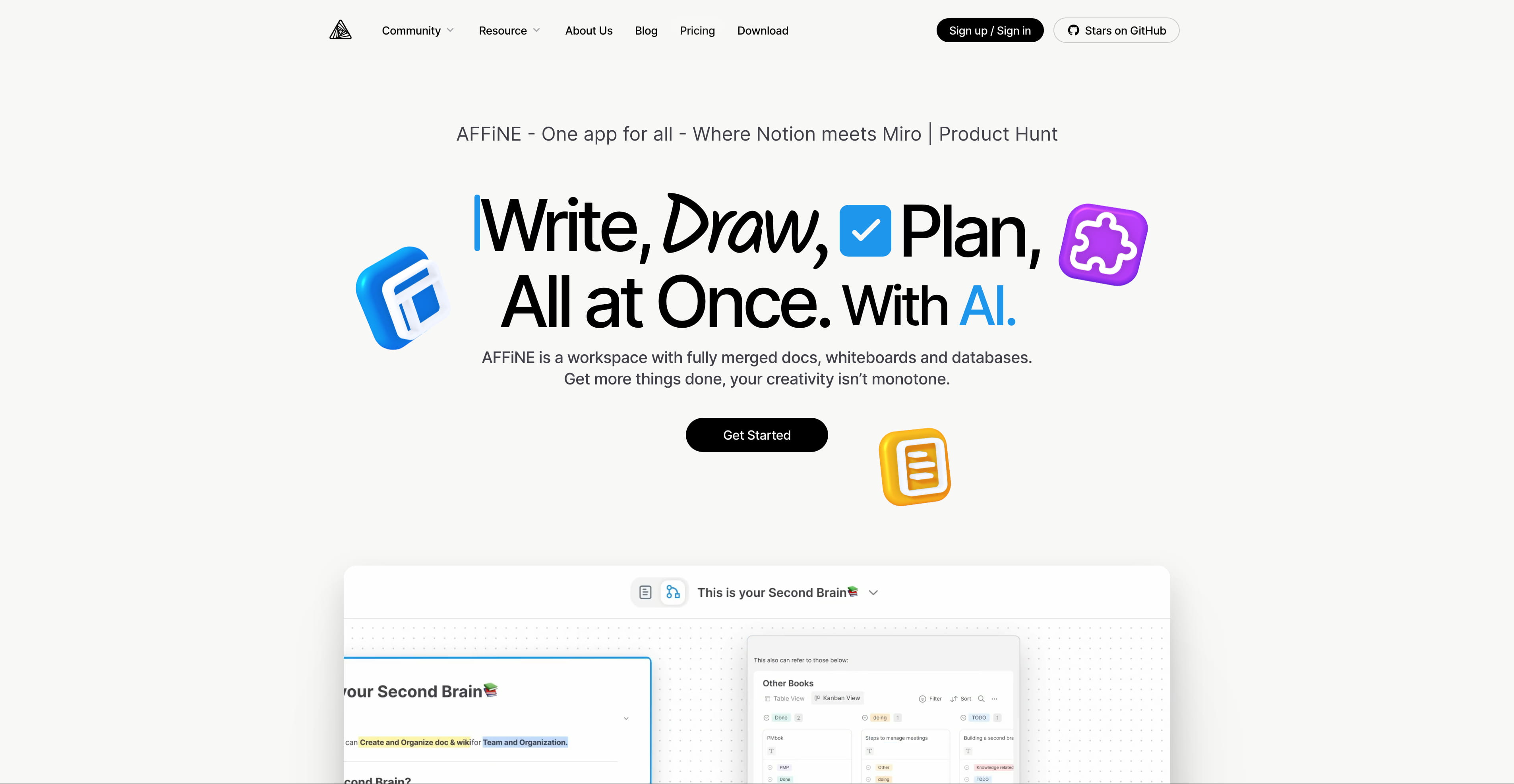
AFFINE main dashboard interface with document editor and whiteboard capabilitiesAFFINE main dashboard interface with document editor and whiteboard capabilities

Figure 1: AFFINE main interface showing document editing and knowledge management capabilities

Document and Whiteboard Integration

While many editing applications claim to be productivity canvases, AFFINE stands out as one of the few that truly allows you to place any building block on an infinite canvas - from rich text and sticky notes to embedded webpages, multi-view databases, linked pages, and even slides.

Every page offers two distinct views, enabling you to access and edit fully-featured blocks anywhere in any format. This integration provides flexibility that neither Notion nor Miro can match on their own.
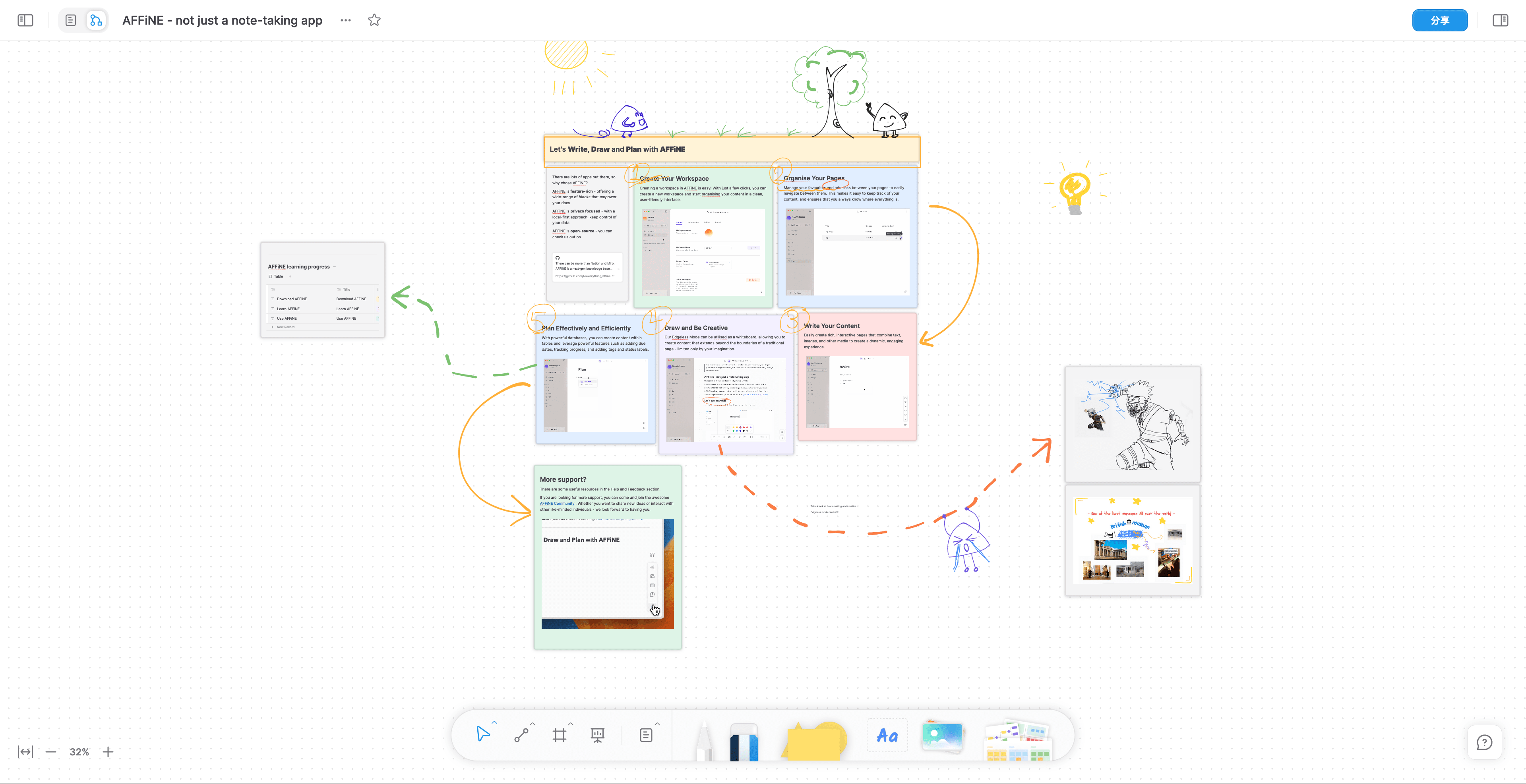
AFFINE Whiteboard feature supporting multiple view modes and collaborative editingAFFINE Whiteboard feature supporting multiple view modes and collaborative editing

Figure 2: AFFINE's infinite canvas feature, enabling free organization and arrangement of content similar to Miro but with Notion's document capabilities

Multimodal AI Assistant

From drafting professional work reports to transforming outlines into expressive presentations, summarizing articles into well-structured mind maps, or even designing and coding prototype applications and websites with just a single prompt - AFFINE AI can do it all.

The AI assistant integrates seamlessly with both document and whiteboard modes, providing contextual help without requiring expensive add-on subscriptions like those offered by competing platforms.

Local-First and Real-Time Collaboration

AFFINE adheres to the local-first software principles, emphasizing data privacy while still enabling powerful collaboration features. You can completely opt out of using its cloud services and handle synchronization yourself, giving users more choices and flexibility compared to cloud-only solutions like Notion.

Self-Hosting Capabilities

Users can freely fork and build custom versions of AFFINE or deploy it privately using the methods described in this guide. A plugin ecosystem and third-party modules are coming soon, providing extensibility that closed-source alternatives cannot match.

Among the many knowledge management tools available, AFFINE offers these distinctive advantages:

  1. Open Source and Free

    • Fully open source with transparent codebase
    • No subscription fees required (unlike Notion's $8-15/month plans)
    • Freedom to customize and extend functionality
  2. Enhanced Data Security

    • Local-first storage approach protects sensitive information
    • Support for self-hosting on your own infrastructure
    • Complete control over where your data is stored and how it's backed up
  3. Comprehensive Integrated Features

    • Incorporates Notion's document management capabilities
    • Integrates Miro's whiteboard functionality in the same interface
    • Supports multi-user real-time collaboration without compromises
  4. Consistent Cross-Platform Experience

    • Works seamlessly across desktop and mobile devices
    • Maintains feature parity across all platforms
    • Ensures your content looks and behaves the same everywhere
FeaturesAFFINENotionMiro
Document Editing
Whiteboard Functionality
Local-First
Self-Hosting
Real-Time Collaboration
AI Assistant
PriceFree and Open SourcePaid SubscriptionPaid Subscription
Data Privacy ControlHighLimitedLimited
Customization OptionsExtensiveLimitedLimited
Mobile Support

Technical Requirements for Self-Hosting AFFINE

AFFINE's self-hosted deployment requires the following components:

  • PostgreSQL database
  • Redis database
  • Docker environment (optional)

However, the one-click deployment process with Sealos handles all these requirements automatically, making self-hosting accessible even for non-technical users.

One-Click Deployment Process

The Sealos App Store offers a seamless deployment solution, allowing you to complete the entire setup with just a mouse click.

  1. Visit the deployment link:

    Deploy on Sealos

  2. Click "Go to Sealos Deployment" to begin deployment

    If you're a first-time Sealos user, you'll need to register and log in to a Sealos public cloud account. After logging in, you'll be automatically redirected to the template deployment page.

Once redirected, click "Deploy Application" in the top-right corner to start the deployment process. When deployment completes, simply click "Details" to access the application's details page.
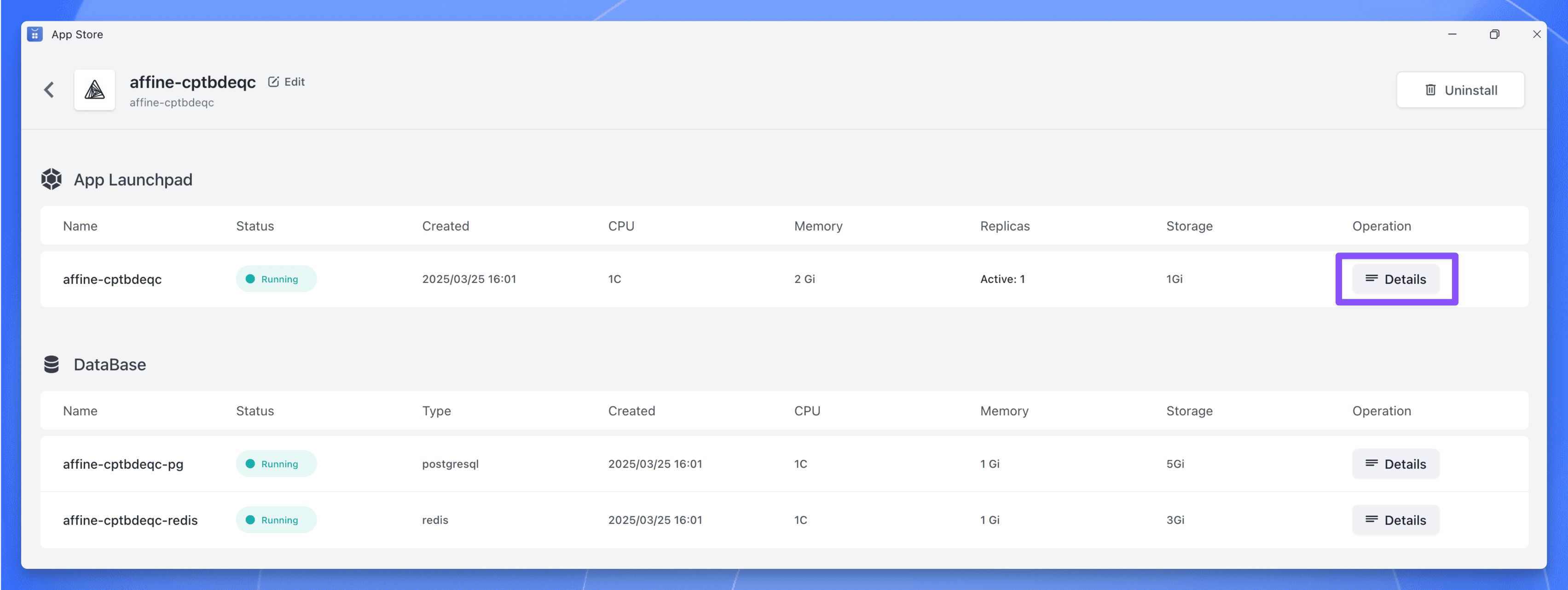
AFFINE deployment configuration interface on Sealos platformAFFINE deployment configuration interface on Sealos platform

Figure 3: AFFINE deployment configuration page on the Sealos platform showing simplified setup options

Post-Deployment Configuration

Wait until the instance status shows "running," then click the log icon to view logs:
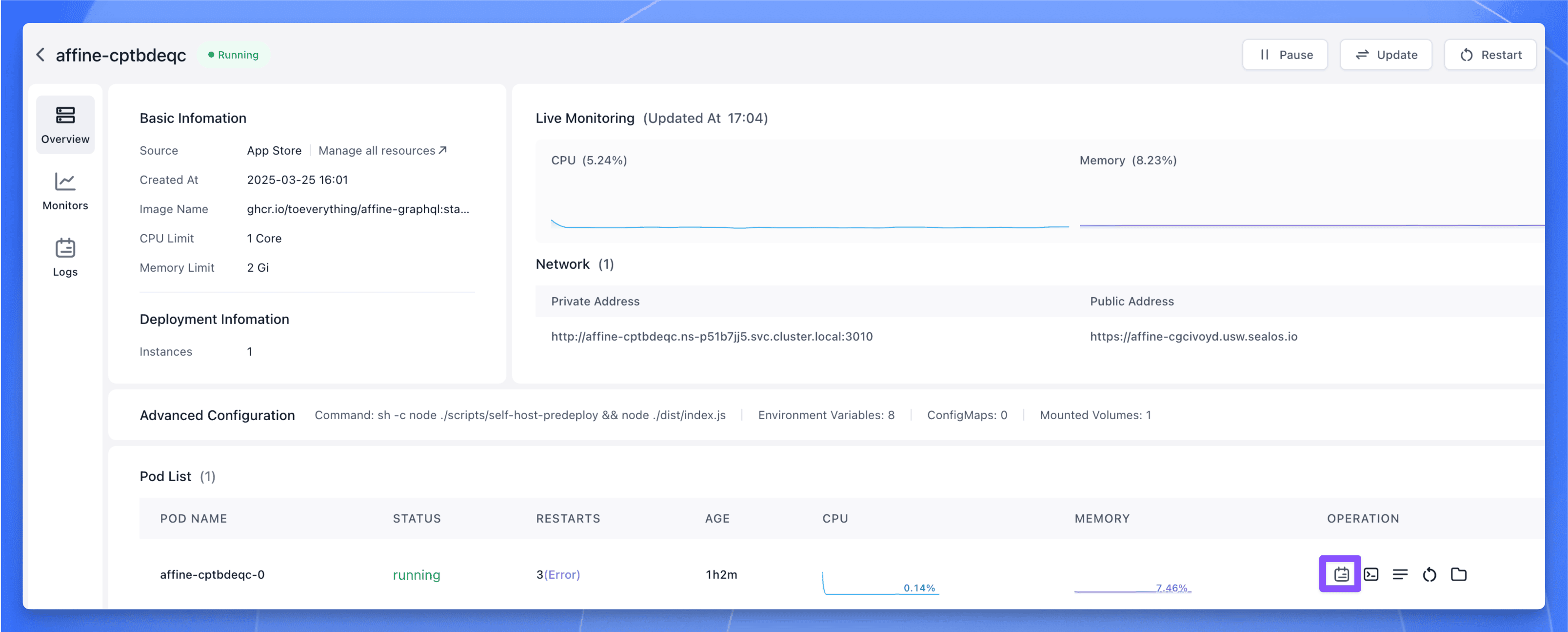
AFFINE deployment log viewing interface for monitoringAFFINE deployment log viewing interface for monitoring

Figure 4: Log viewing interface during the AFFINE deployment process, helpful for troubleshooting

If you see the following logs, it indicates a successful startup:

AFFINE successful startup log interface showing completed setupAFFINE successful startup log interface showing completed setup

Figure 5: Log information showing successful AFFINE startup with all services properly initialized

Now click the public network address to open the AFFINE Web UI:
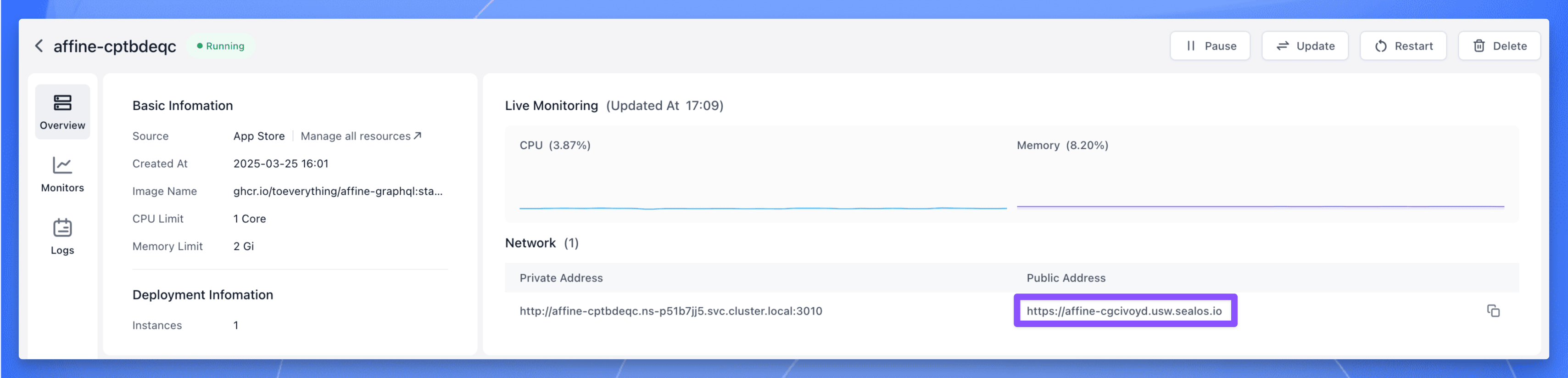
AFFINE instance details page with access informationAFFINE instance details page with access information

Figure 6: AFFINE instance details page showing connection information for your private deployment

After opening the interface, register and log in first, then return to the homepage.

By default, AFFINE uses local browser storage. If you want to log in to your self-deployed cloud service, click "Enable AFFINE Cloud" in the top-right corner:
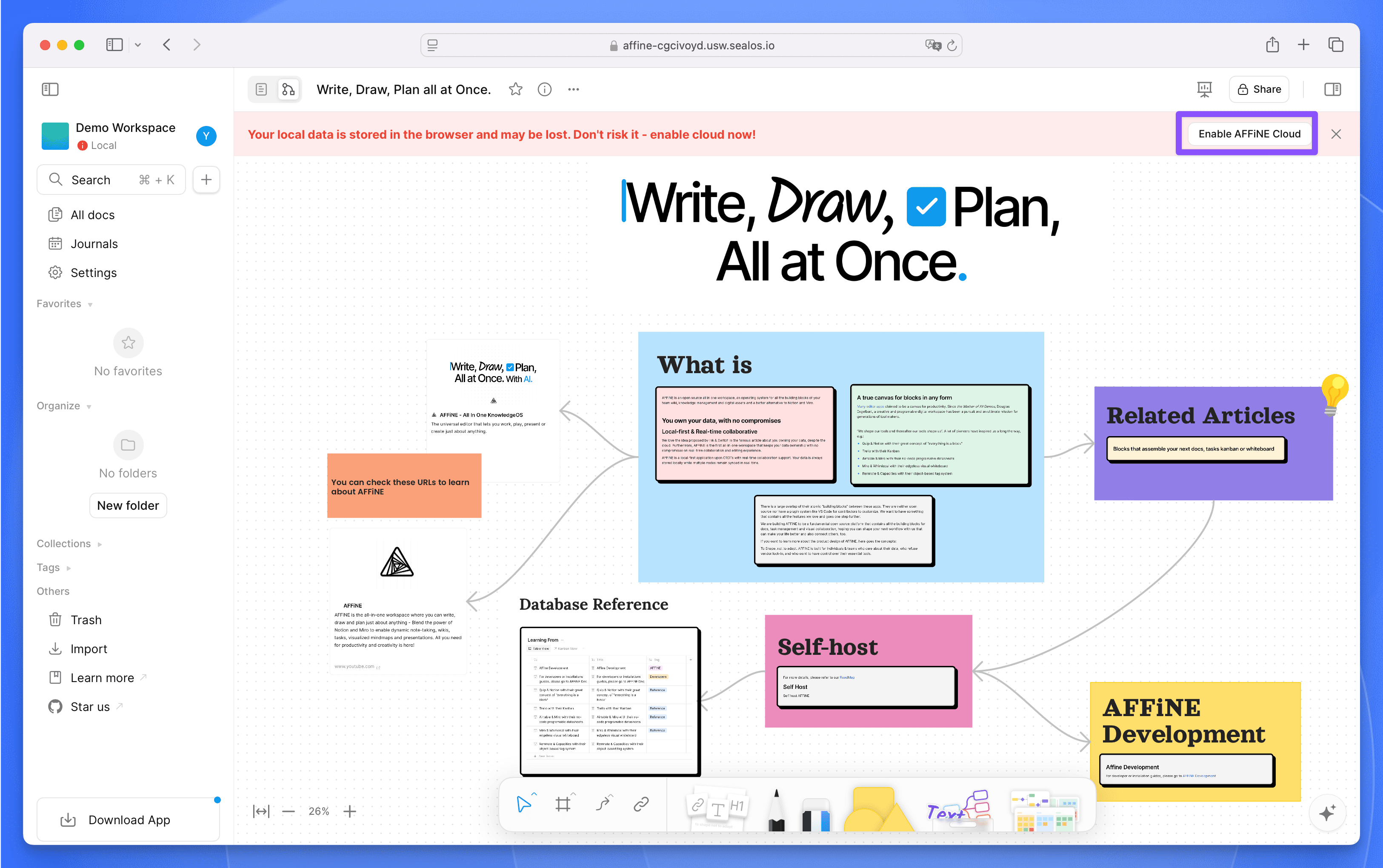
AFFINE cloud service enabling interface for data synchronizationAFFINE cloud service enabling interface for data synchronization

Figure 7: AFFINE cloud service enabling page for configuring synchronized storage

Once enabled, you can start using AFFINE right away with all features fully activated.

AFFINE is very intuitive and easy to use. After completing deployment and logging in, you can:

  1. Create a workspace: Click on the workspace in the top-left corner, then click the "+ Create Cloud Workspace" button to create a new workspace. You can customize the workspace with a name and icon.

  2. Create a new document: Within your workspace, click the "+" button in the left sidebar to create a new document page.

  3. Edit content: AFFINE offers a WYSIWYG (What You See Is What You Get) editing experience where you can:

    • Use Markdown syntax for quick formatting
    • Insert images, tables, code blocks, and other multimedia content
    • Access additional functions through the / command
    • Drag and rearrange content layout
  4. Collaboration and sharing:

    • Click the share button in the top-right corner to invite others to collaborate
    • Configure page access permissions
    • Monitor other users' editing activities in real-time
  5. Data Synchronization: Once cloud services are enabled, all your content automatically syncs to the cloud, allowing you to work seamlessly across different devices.

AFFINE also offers comprehensive keyboard shortcuts to boost your productivity. Press Ctrl+/ or Cmd+/ to view all available shortcuts.

Document Mode Features and Commands

Document mode is AFFINE's basic editing mode, focusing on single-document creation. This mode features powerful editing capabilities that satisfy most document creation requirements.
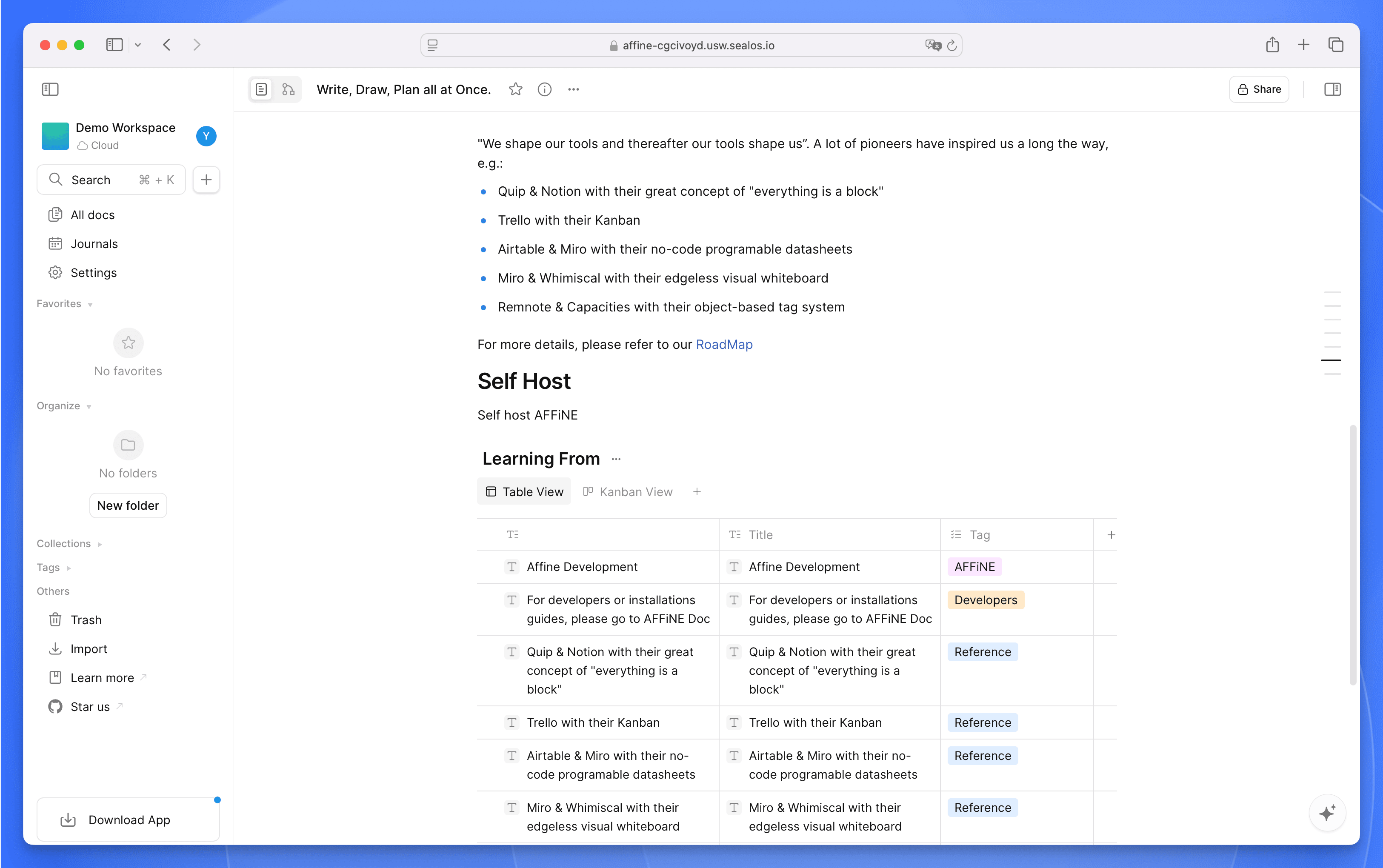
AFFINE Document Mode with rich text editing capabilitiesAFFINE Document Mode with rich text editing capabilities

Figure 8: AFFINE Document Mode showing Notion-like document editing features with clean interface

Using the / command menu, you can quickly access various functions including: text editing, formatting options, list management, document operations, content and media insertion, date and time selection, database creation, template framework application, group management, and additional shortcuts. These features enable more efficient organization and editing of your document content.
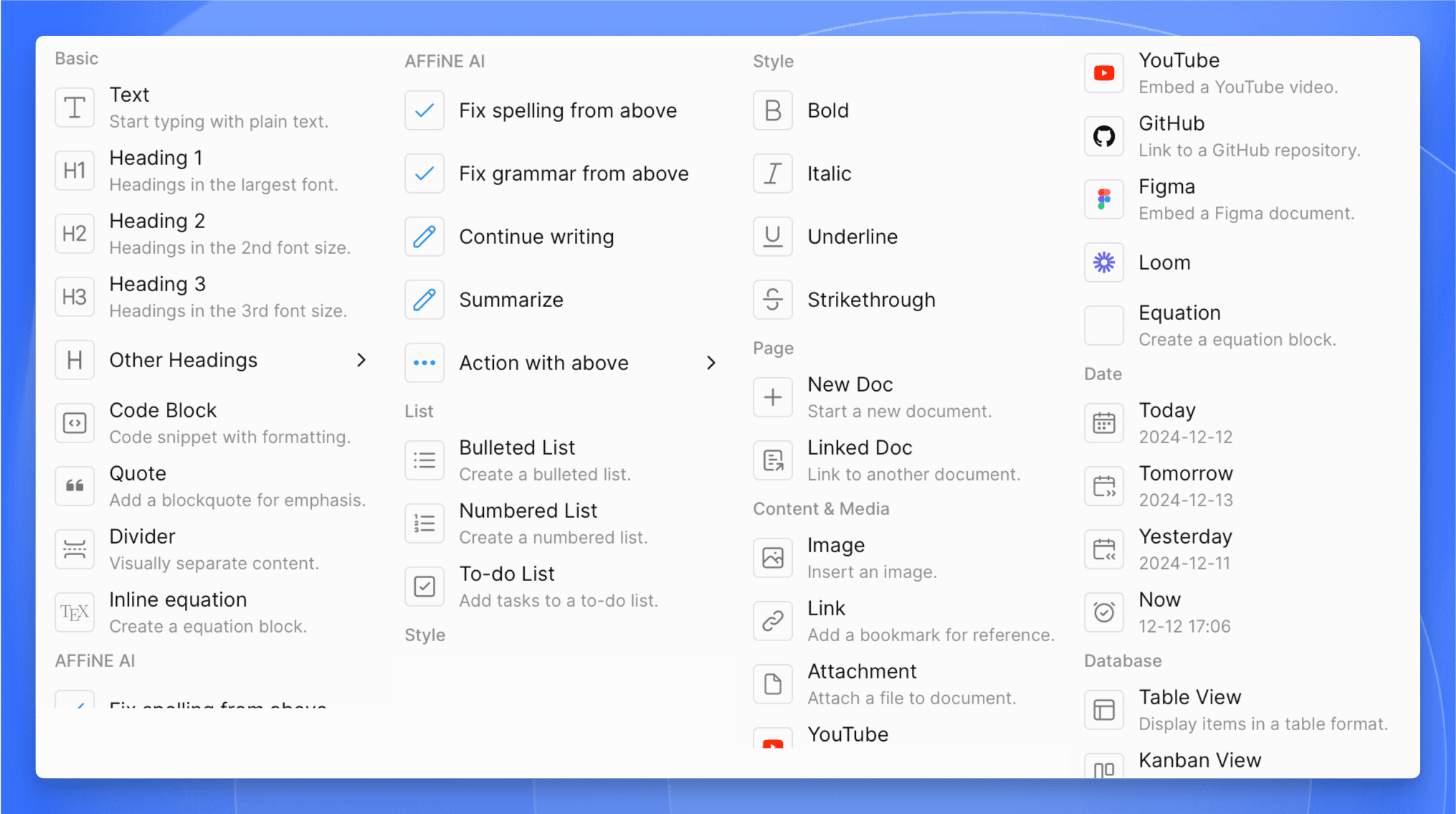
AFFINE Document Mode Command Menu for quick access to functionsAFFINE Document Mode Command Menu for quick access to functions

Figure 9: AFFINE Document Mode Command Menu showing the variety of blocks and functions available

Whiteboard Mode Capabilities

When you switch to whiteboard view, content from the text view automatically converts into standalone text modules embedded within the whiteboard, making flexible layout and organization easier.

Whiteboard mode offers an infinite canvas where you can edit text, draw by hand, upload images, apply templates, draw lines, and use the eraser, among other operations.
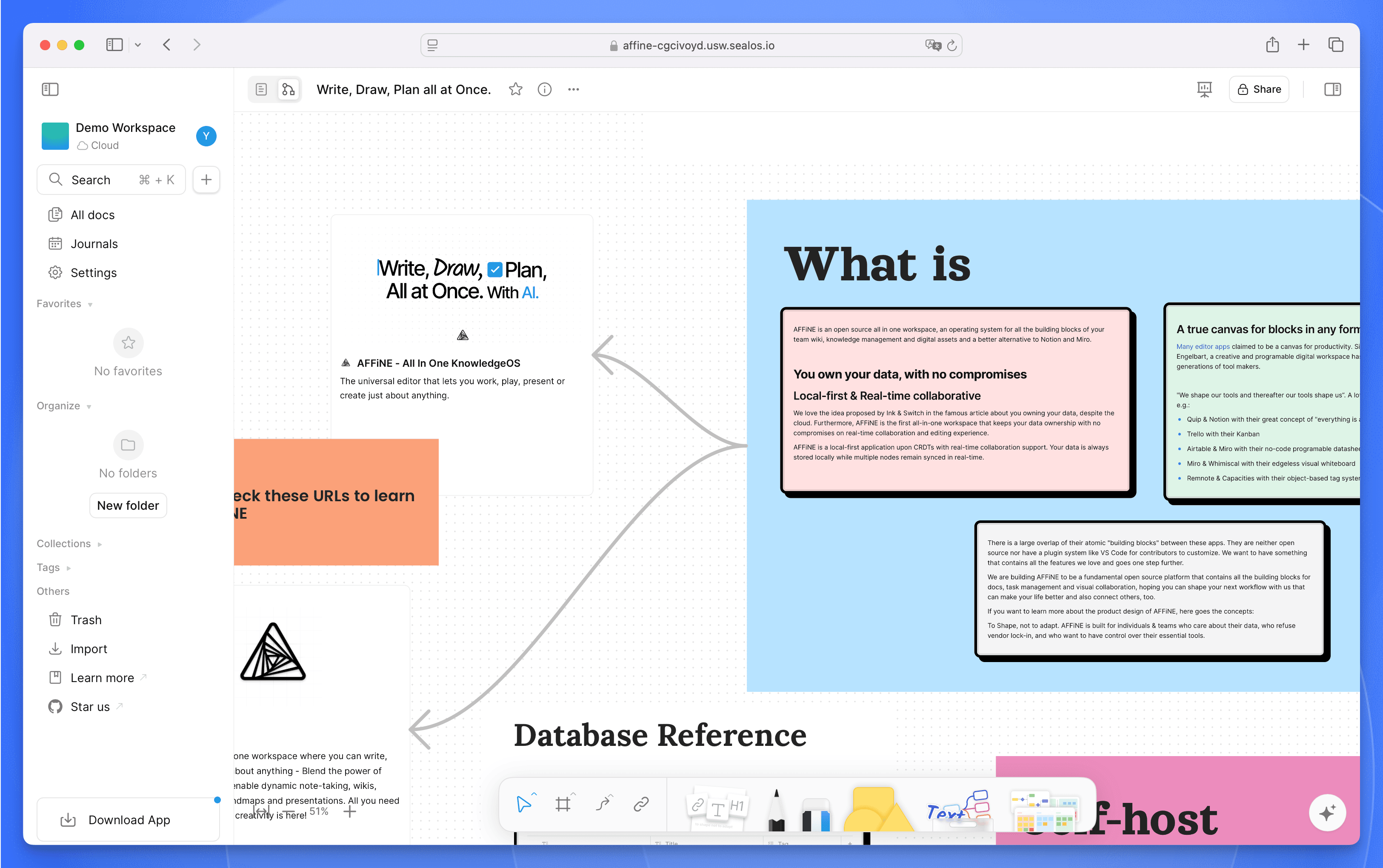
AFFINE Whiteboard Mode showing infinite canvas functionalityAFFINE Whiteboard Mode showing infinite canvas functionality

Figure 10: AFFINE Whiteboard Mode demonstrating the Miro-like infinite canvas functionality

AFFINE includes a diverse template library featuring mind maps, task planning, project management, market analysis charts, and many other types. You can quickly start working by importing these templates with just one click.
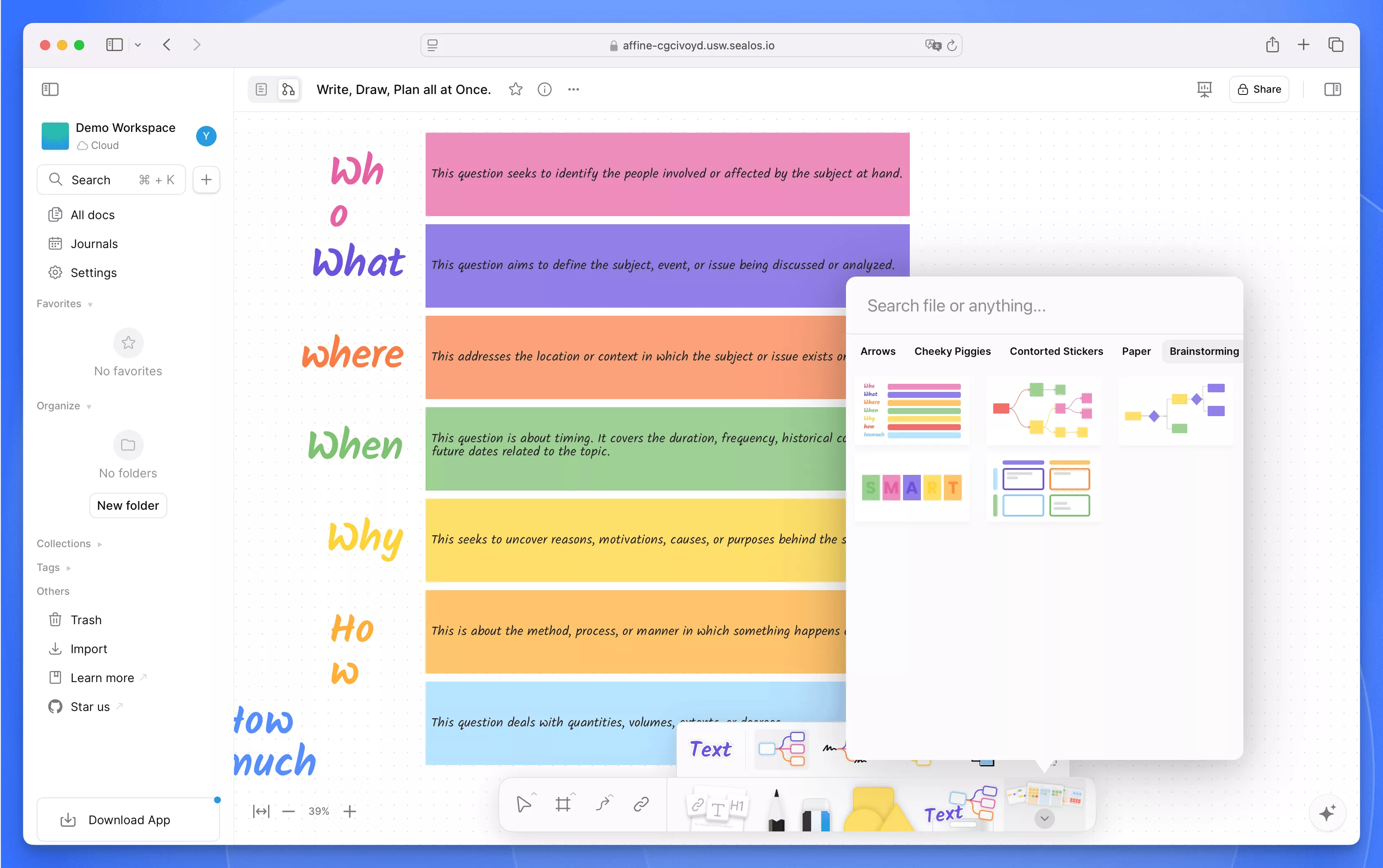
AFFINE Whiteboard Mode Template library with pre-built optionsAFFINE Whiteboard Mode Template library with pre-built options

Figure 11: AFFINE Whiteboard Mode Template library offering productivity-boosting pre-designed layouts

AFFINE is a powerful yet user-friendly knowledge management tool that integrates document editing and whiteboard capabilities, offering users a flexible space for creation. Through its intuitive interface, users can easily create and manage workspaces, edit documents, and collaborate with team members.

Whether for personal knowledge management or team collaboration, AFFINE excellently meets all needs. The cloud synchronization feature ensures data security and accessibility, allowing users to work anytime and anywhere. With the self-hosting option detailed in this guide, you can maintain complete control over your data while enjoying all premium features at no cost.

Overall, AFFINE represents the future of knowledge management tools - open-source, privacy-focused, and feature-rich without the subscription fees of commercial alternatives like Notion and Miro.