

惯性聚合 高效追踪和阅读你感兴趣的博客、新闻、科技资讯
阅读原文 在惯性聚合中打开

推荐订阅源

Hugging Face - Blog
Hugging Face - Blog
Jina AI
Jina AI
宝玉的分享
宝玉的分享
奇客Solidot–传递最新科技情报
奇客Solidot–传递最新科技情报
让小产品的独立变现更简单 - ezindie.com
人人都是产品经理
人人都是产品经理
博客园 - 聂微东
OSCHINA 社区最新新闻
OSCHINA 社区最新新闻
J
Java Code Geeks
博客园 - 【当耐特】
小众软件
小众软件
博客园 - Franky
S
SegmentFault 最新的问题
WordPress大学
WordPress大学
雷峰网
雷峰网
The Cloudflare Blog
酷 壳 – CoolShell
酷 壳 – CoolShell
量子位
Last Week in AI
Last Week in AI
博客园_首页
月光博客
月光博客
IT之家
IT之家
阮一峰的网络日志
阮一峰的网络日志
Webroot Blog
Webroot Blog
Stack Overflow Blog
Stack Overflow Blog
腾讯CDC
云风的 BLOG
云风的 BLOG
cs.AI updates on arXiv.org
W
WeLiveSecurity
Recent Commits to openclaw:main
D
Docker
The Last Watchdog
The Last Watchdog
有赞技术团队
有赞技术团队
Hacker News - Newest:
Hacker News - Newest: "LLM"
D
DataBreaches.Net
S
Security @ Cisco Blogs
Blog — PlanetScale
Blog — PlanetScale
GbyAI
GbyAI
TaoSecurity Blog
TaoSecurity Blog
S
Security Affairs
Y
Y Combinator Blog
O
OpenAI News
罗磊的独立博客
MongoDB | Blog
MongoDB | Blog
钛媒体:引领未来商业与生活新知
钛媒体:引领未来商业与生活新知
Forbes - Security
Forbes - Security
P
Palo Alto Networks Blog
freeCodeCamp Programming Tutorials: Python, JavaScript, Git & More
K
Kaspersky official blog
Cloudbric
Cloudbric

Jordan Fulghum

I built a private ChatGPT for my family OpenAI has a branding problem Post-primary-care On Mystery POST-SOFTWARE (March 2026) Your Product Is No Longer the Center of Gravity Remote Work, AI, and the Disappearing Engineer Mastery Fun vs Frontier Fun 2026 is the Year of Self-hosting Cassette — The Simple Computer in the Cloud VocalMaze - A 60-Second Screen for Cognitive Decline Album Cards: Rebuilding the Joy of Music Discovery for My 10-Year-Old I Prototyped an IDE for How We Actually Code Now Vibecoding Took Away the Fun
I Used Claude Code + Autoresearch to Trace My Family History Back to Jamestown
Jordan Fulghum · 2026-03-20 · via Jordan Fulghum

by Jordan Fulghum, March 2026

My genealogy has always been spotty. Names passed down through word of mouth, half-remembered stories, a few dates. I've always wanted to fill in the blanks, but genealogy research is slow, manual detective work. You chase records, cross-check names, and hope you don't go down the wrong path.

A few days ago I came across autoresearch-genealogy by Matt Prusak. It's heavily inspired by Andrej Karpathy's "autoresearch" idea, which is simple: you give an agent a metric, you give it tools, and you let it run until it optimizes that metric. Autoresearch-genealogy is a lighter version of that pattern. It uses Claude Code and instructs it to hit a minimum number of iterations to optimize for a metric on a scoped basis. Same philosophy, just easier to get going.

The project itself is a set of prompts, guidelines, guardrails, and helpful resources that the agent can use, plus a templated Obsidian vault that gets filled in over time with everything from immigration records to DNA tests.

I wired it up and gave it a starting point: a family tree with fewer than 10 names.

What came out

Fulghum coat of arms
The Fulghum coat of arms.

After a few sessions, the agent expanded that into:

  • 168 individuals
  • 19+ family lines
  • 300+ years of history
  • A browsable, searchable dataset with sources attached to almost everything

My oldest confirmed ancestor traces back to an early Jamestown settler, a man named Holt, mentioned in Adventurers of Purse and Person, the definitive record of Virginia's first colonists.

More interesting than the tree itself is what sits behind it: census records, death certificates, DAR applications, church records, newspaper clippings, and even conflicting accounts. Each person is a file and each claim is tied to a source. It's really more like a graph of evidence than a family tree.

A few things it found

Most of this is only interesting to me, but a few stood out:
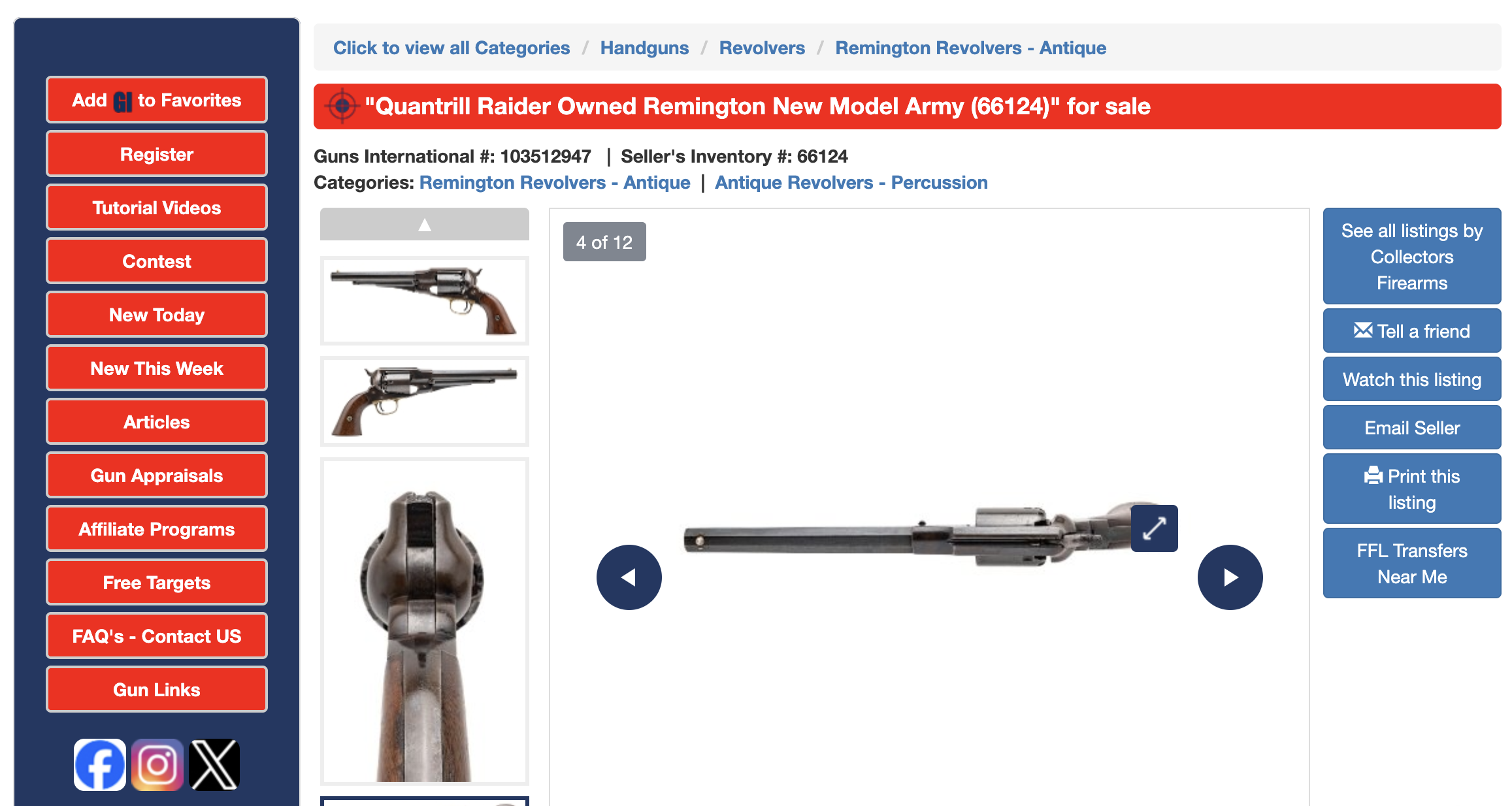
  • My great-great-great-great grandfather rode with Quantrill (and likely alongside Jesse James). The agent found an affidavit, matched timelines, and even surfaced his revolver for sale. My OpenClaw agent is negotiating the price with the seller.
Quantrill raider Remington revolver auction listing
An auction listing for a Remington revolver owned by my great-great-great-great grandfather, a Quantrill raider. Negotiations ongoing.
  • One ancestor died by suicide in 1705. Under colonial Virginia law, that meant his estate was forfeited to the Crown. The governor petitioned Queen Anne (!) to return it to the children. She approved it.
  • My great-grandfather died in a Standard Oil refinery explosion when my grandfather was three. I had never heard this. The agent found the newspaper clipping.
  • My grandmother filed for DAR membership. That line traces back to Bailey Anderson, who is documented well enough to have a plaque and published historical references.
  • We never knew my paternal grandfather's original birth name. The agent found it.
  • My oldest confirmed ancestor, Randolph Holt I (~1607), was an indentured servant listed in the 1624/5 Muster among "Doctor Pott's Men in the Maine: to James' Citty." He served in the household of Dr. John Pott, who himself served as Governor of Virginia and has a Wikipedia article. That an indentured servant in Jamestown is a direct ancestor is kind of wild.

The output

Everything lands in a markdown vault: one file per person, links between people, embedded sources, explicit unknowns.

Claude also built a small Next.js app on top of it so it's actually usable: browse by family line, search across people and places, click through relationships, basic tree visualization.

I deployed it on a tiny Cassette instance so I could share it with family.

I had Claude try a few different genealogy tree JavaScript libraries, and I didn't like any of them. So I just said "forget it, make your own." And it did. It wrote the SVG from scratch that visualizes my entire family tree from the 16th century to now.

Where it breaks

It's not perfect. Records get sparse fast the further back you go. Names shift, spelling changes, people disappear and reappear. Entire branches can look "correct" and still be wrong. The agent helps by flagging single-source claims, preserving conflicts instead of flattening them, and logging failed searches, but you still need judgment.

Next

I want to push this further: add 23andMe data and see what aligns or breaks, pressure test weaker branches, and keep extending lines with stronger sourcing.

I found this genuinely addicting because there's always more. Every branch has a parent. Every dead end might just need a different search. You can always go higher up the tree. And you'll be surprised by what the agent finds. I keep being.

If you want to try it: autoresearch-genealogy, a markdown file, and some patience. That's enough to get started.


Follow me on Twitter for more.