惯性聚合 高效追踪和阅读你感兴趣的博客、新闻、科技资讯
阅读原文 在惯性聚合中打开

推荐订阅源

L
LangChain Blog
The GitHub Blog
The GitHub Blog
Recent Announcements
MyScale Blog
MyScale Blog
P
Proofpoint News Feed
S
Security @ Cisco Blogs
N
News and Events Feed by Topic
H
Hacker News: Front Page
Attack and Defense Labs
S
Secure Thoughts
Microsoft Security Blog
N
Netflix TechBlog - Medium
U
Unit 42
Stack Overflow Blog
Stack Overflow Blog
T
Threat Research - Cisco Blogs
Google Online Security Blog
Spread Privacy
Spread Privacy
Threat Intelligence Blog | Flashpoint
Exploit-DB.com RSS Feed
L
LINUX DO - 热门话题
T
Tenable Blog
博客园 - 叶小钗
D
DataBreaches.Net
freeCodeCamp Programming Tutorials: Python, JavaScript, Git & More
博客园_首页
人人都是产品经理
人人都是产品经理
aimingoo的专栏
aimingoo的专栏
C
Check Point Blog
博客园 - 三生石上(FineUI控件)
量子位
P
Proofpoint News Feed
H
Help Net Security
Blog — PlanetScale
Blog — PlanetScale
宝玉的分享
宝玉的分享
Recorded Future
Recorded Future
The Register - Security
F
Fortinet All Blogs
Engineering at Meta
Engineering at Meta
钛媒体:引领未来商业与生活新知
钛媒体:引领未来商业与生活新知
Last Week in AI
Last Week in AI
S
Schneier on Security
V
Vulnerabilities – Threatpost
雷峰网
雷峰网
Microsoft Azure Blog
G
GRAHAM CLULEY
G
Google Developers Blog
月光博客
月光博客
V
V2EX
T
Troy Hunt's Blog
A
Arctic Wolf

Comments for TrueNAS – Open Enterprise Storage

How to Set Up and Install TrueNAS CORE Yes, You Can (Still) Virtualize TrueNAS TrueNAS enables Container Storage and Kubernetes | TrueNAS - Open Enterprise Storage TrueNAS 12.0-U2 is Released | TrueNAS - Open Enterprise Storage OpenZFS 2.0 Ships First on TrueNAS | TrueNAS - Open Enterprise Storage TrueNAS 12.0-U1 is Scheduled for early December | TrueNAS - Open Enterprise Storage iXsystems TrueNAS M60 Recognized as SDC Awards Storage Hardware Innovation of the Year Finalist | TrueNAS - TrueNAS 12.0 is Released! The TrueNAS Mini X and Mini X+ are here! TrueNAS SCALE Release Plan | TrueNAS - Open Enterprise Storage iXsystems Unveils Industry's Fastest OpenZFS Storage System with Launch of TrueNAS M60 | TrueNAS - Open TrueNAS 12.0 BETA2 Showcases Performance Improvements | TrueNAS - Open Enterprise Storage Be One of the First to Test Drive TrueNAS 12.0 BETA | TrueNAS - Open Enterprise Storage TrueNAS is Multi-OS New-New TrueNAS Logo Unveiled | TrueNAS - Open Enterprise Storage Recession Proof Storage | FreeNAS 11.3-U3.1 Now Available - Issue #80 | TrueNAS - Open Enterprise Storage Open Source Infrastructure is Recession-Proof | TrueNAS - Open Enterprise Storage Understanding How OpenZFS Keeps Your Data Safe | TrueNAS - Open Enterprise Storage You Can Influence the TrueNAS CORE Roadmap! | TrueNAS - Open Enterprise Storage TrueNAS CORE is the new FreeNAS Setting Up Users, Permissions, and ACLs on FreeNAS | TrueNAS - Open Enterprise Storage TrueNAS Updates for VMware vSphere 7 | TrueNAS - Open Enterprise Storage How to Set Up Windows SMB Shares on FreeNAS | TrueNAS - Open Enterprise Storage FreeNAS and TrueNAS are Unifying Introducing the FreeNAS Mini E+ and All-Flash Minis | TrueNAS - Open Enterprise Storage Plex Permissions in FreeNAS 11.3 | TrueNAS - Open Enterprise Storage Latest TrueNAS and FreeNAS Release Delivers Wizards, Plugins, and Accelerated Replication | TrueNAS - Open How To Back Up Google Drive to FreeNAS | TrueNAS How To Enable Wireguard on FreeNAS 11.3 | TrueNAS - Open Enterprise Storage The Official FreeNAS Hardware Guide | TrueNAS - Open Enterprise Storage December 11 Plugins Update: ClamAV Fix & CloudStack FreeNAS Mini Black Friday Sale Starts Now! - Issue #73 | TrueNAS - Open Enterprise Storage Breaking Down the FreeNAS Mini E! | TrueNAS TrueCommand Shifts to Prime Time | TrueNAS - Open Enterprise Storage AMD EPYC 7002 Powers Scalable TrueNAS Solutions FreeNAS and TrueNAS 11.3 make their Debuts October 30 Plugins Update | TrueNAS - Open Enterprise Storage Overview of Datasets and Snapshots in FreeNAS | TrueNAS - Open Enterprise Storage September 13 Plugins Update | TrueNAS - Open Enterprise Storage August 27 Plugin Updates: Security & Version Fixes July 24 Plugins Update | TrueNAS - Open Enterprise Storage Mount a TrueNAS or FreeNAS Share to a Docker Host | TrueNAS - Open Enterprise Storage TrueNAS Updates for VMware vSphere | TrueNAS - Open Enterprise Storage July 10 Plugins Update | TrueNAS - Open Enterprise Storage June 26 Plugins Update | TrueNAS - Open Enterprise Storage Open ZFS vs. Btrfs | and other file systems | TrueNAS - Open Enterprise Storage ZFS vs. OpenZFS Backup Evolved: Asigra Plugin for FreeNAS Back Up Plugins and Jails on FreeNAS | TrueNAS Take Command of Your NAS Fleet with TrueCommand™ | TrueNAS - Open Enterprise Storage Next Batch of Updated Plugins and How to Recover from Failed Plugin Updates | TrueNAS - Open Enterprise Run S3 Object Storage on FreeNAS and TrueNAS | TrueNAS - Open Enterprise Storage Sync Files to Dropbox with TrueNAS or FreeNAS February Plugin Updates & New Plugins for Testing Why SATA-DOMs Are Better than USB Drives for Booting Up Your FreeNAS System | TrueNAS - Open Enterprise Six Metrics for Measuring ZFS Pool Performance Part 2 | TrueNAS - Open Enterprise Storage Six Metrics for Measuring ZFS Pool Performance Part 1 | TrueNAS - Open Enterprise Storage TrueNAS M-Series Certified for Veeam Backup FreeNAS 11.1 is Now Available for Download! | TrueNAS FreeNAS 11.0 Released with VM & S3 Storage Support To SLOG or not to SLOG: How to best configure your ZFS Intent Log | TrueNAS - Open Enterprise Storage vCenter Web Client Plug-in for TrueNAS Now Available | TrueNAS - Open Enterprise Storage The ZFS ZIL and SLOG Demystified | TrueNAS - Open Enterprise Storage FreeNAS: A Worst Practices Guide | TrueNAS - Open Enterprise Storage FreeNAS Hardware Guide III: Pools, Performance & Cache FreeNAS vs TrueNAS FreeNAS 8.0.1‑RELEASE & Official Documentation Released
Cross-Site Disaster Recovery with TrueNAS
iX Team · 2020-09-09 · via Comments for TrueNAS – Open Enterprise Storage

This is historic content that may contain outdated information. For the newest information on FreeNAS and TrueNAS, please visit TrueNAS.com or read our latest Blogs.

TrueNAS has long supported disaster recovery (DR) scenarios. This blog attempts to address the various types of supported DR scenarios and their related workflows.
Point-in-Time Recovery – ZFS Replication
Of the native ways to replicate data, ZFS replication is the most efficient and reliable method for asynchronously replicating data from one TrueNAS system to another. Replication is based on snapshots of datasets or zvols and synchronizes the snapshots of the first system to the second system. There are numerous advantages to using ZFS replication. One of those is that a snapshot is a point-in-time, read-only copy of the data. This ensures that the contents of the snapshot cannot be altered.
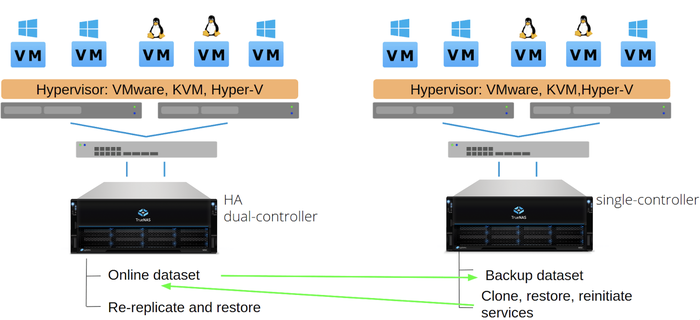
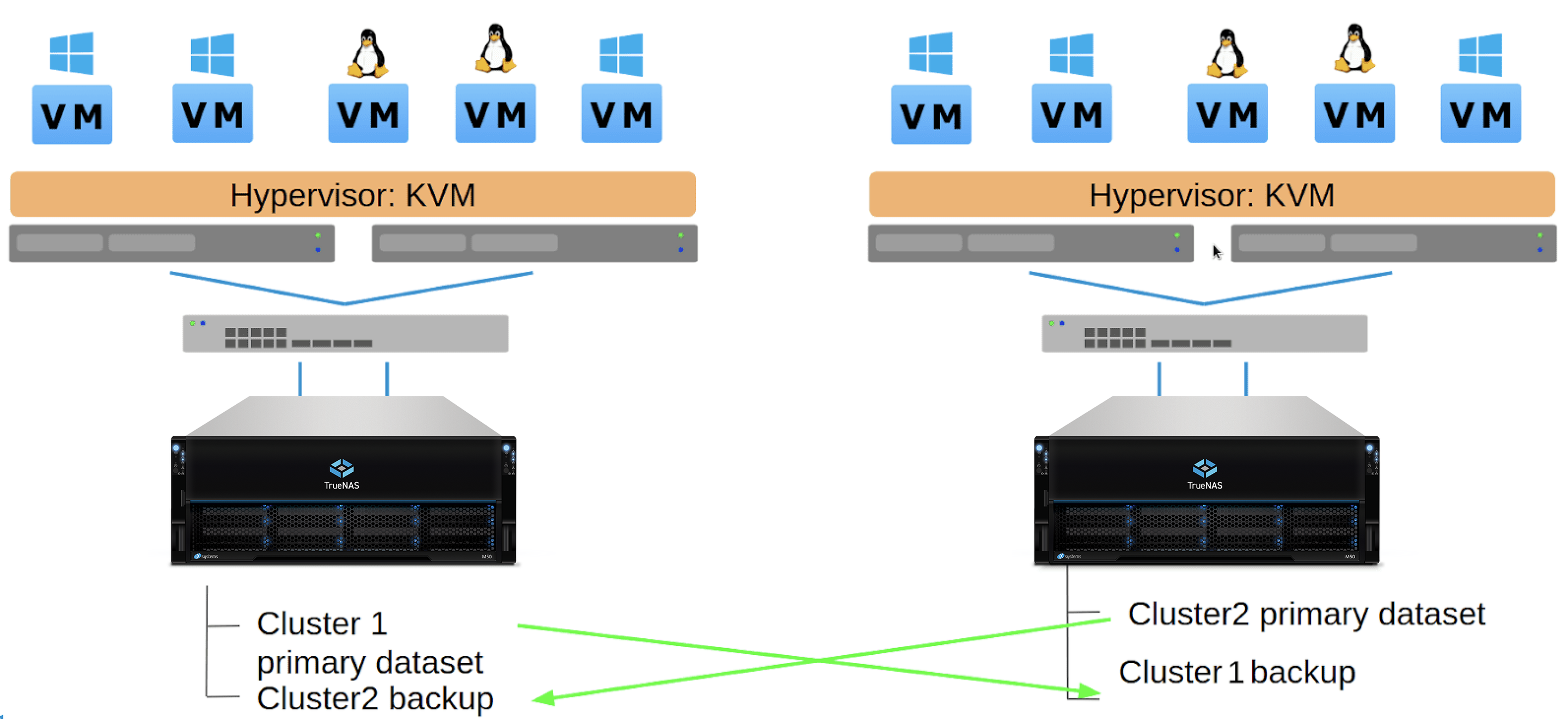
single direction disaster recoveryReplicate in a single direction for DR

dual-site disaster recovery Replicate bi-directionally for dual-site DR

ZFS replication is commonly used for disaster recovery. Should the first system or site go down, the remote system can be brought back by cloning the snapshot to a new dataset and restoring the share. This recovery does require some work on the side of the admin, but it’s incredibly quick and ensures that whatever was transferred is retained. Snapshots and replications can be scheduled to run every few minutes.
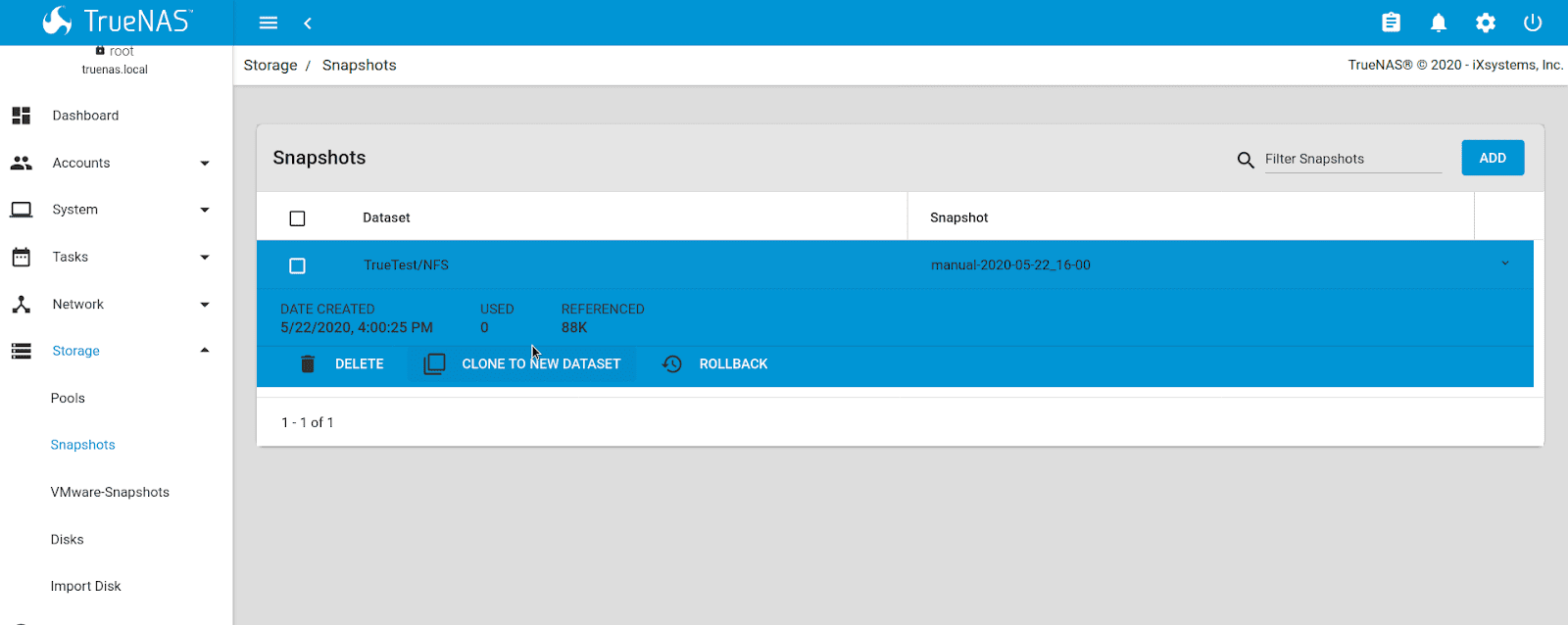
snapshot stored on systems
Another benefit of ZFS replication is the capability for the snapshots and referenced data to be stored on systems and pools of different specs or pool configuration. All-flash, high-performance pools can be backed up to lower performance pools with traditional drives and different RAID configurations. Smaller systems can also be backed up to larger central repositories. Companies such as FirstLink and others use this to help clone edge devices like the TrueNAS Mini systems to a central core TrueNAS in their data center. ZFS replication on TrueNAS ensures data protection regardless of system complexity, size, or location.
File-based Recovery – Rsync
Rsync is a file-level migration that’s the same as rsync in the Linux/FreeBSD command line. It’s handy for semi-live sync of data if you need just the same files between sites each shared over a local share.
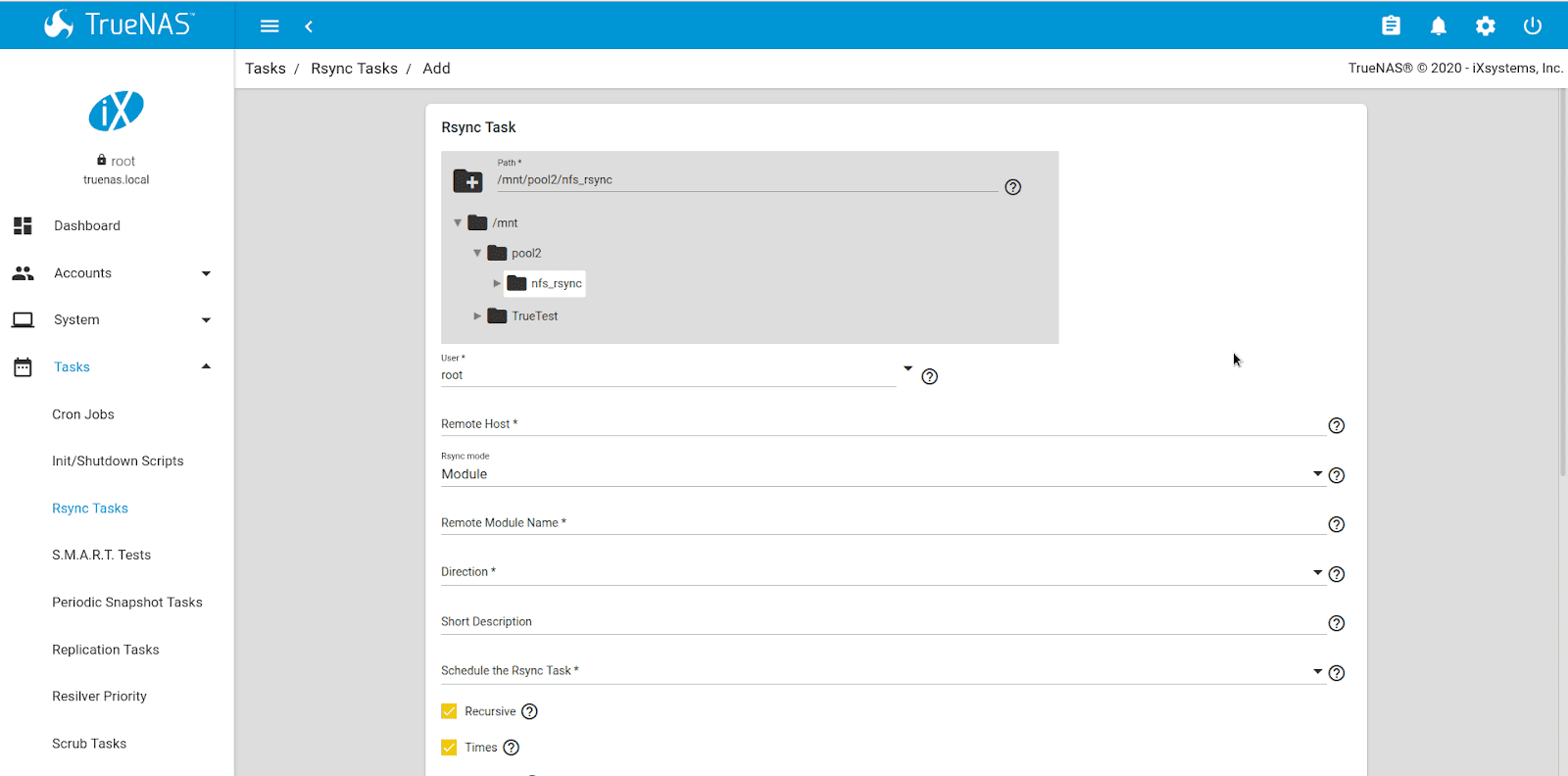
File-based Recovery - Rsync
Rsync is useful for file transfer, but it’s not recommended if files are being modified. For example, if an rsync task starts while 100 GB is being written and the data is changed before the file is written, it will cause issues with versioning and data integrity. Rsync should never be used to copy active VM data stores, block-level data (iSCSI or fibre channel shares), or other data that could constantly be in use. Rsync is slower than ZFS replication, particularly for large datasets, so it’s recommended for convenience over data integrity. It can be used between TrueNAS and many other systems.
More information about setting rsync tasks in TrueNAS is located here.
File Recovery To or From the Cloud – Cloud Sync
TrueNAS can copy, pull, and sync data to a variety of cloud-based data storage systems, including Amazon AWS, Microsoft Azure, Google GCP, Google Drive, Backblaze B2, Dropbox, Box, and more. By integrating rclone sync for file transfers, this feature can copy files on TrueNAS into a cloud repository of a user’s choosing.
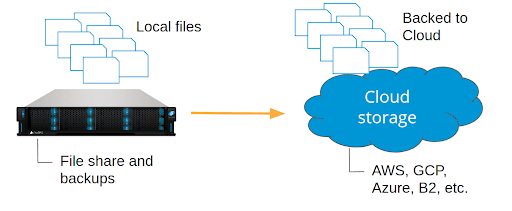
local files to cloud storage
For larger datasets, TrueNAS systems are more cost-effective long-term than cloud offerings, including Amazon AWS. For this reason, using TrueNAS as a backup target for protecting cloud-based data, e.g., from AWS, Dropbox, or Google Drive, is ideal because data stored in TrueNAS will get scrubbed, checked, and retained with an unlimited number of snapshots available.
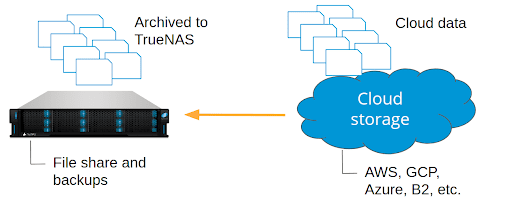
cloud to archived
Automatic Site-to-Site failover – DNS, Load-Balancing, Proprietary Tools
Automatic failover between sites is beyond the scope of TrueNAS systems alone. TrueNAS is a storage system, and while it handles data replication well in a variety of ways, automatic failover to a remote site requires knowledge of the services themselves. For environments with web or video streaming services, DNS round-robin with failover might be feasible. Several web servers, like NGINX, also feature load-balancing services which could help mitigate service overload or downtime. TrueNAS systems provide a stable backend in this topology, with the option of also running ZFS replication for additional safety. Contact iXsystems if you need assistance with designing a storage system for your business.

TrueNAS is a storage platform with powerful ways to ensure data integrity and consistency between local and remote sites. ZFS replication is the fastest and best way to ensure the data transferred is intact. Rsync is useful for file sync but cannot be used for live data or block-level data that could change during transfer. Cloud sync supports user workloads that archive to or from mainstream cloud providers. Beyond these tools, TrueNAS works with other systems, such as Asigra Backup and iconik smart media management, to provide an ultra-scalable backend with robust performance and a strong emphasis on data protection. The tools that TrueNAS provides combined with the flexibility to work with nearly any IT environment make it a robust system for cross-site and DR workloads.