

惯性聚合 高效追踪和阅读你感兴趣的博客、新闻、科技资讯
阅读原文 在惯性聚合中打开

推荐订阅源

Google DeepMind News
Martin Fowler
Martin Fowler
Google DeepMind News
大猫的无限游戏
大猫的无限游戏
雷峰网
雷峰网
MyScale Blog
MyScale Blog
G
GRAHAM CLULEY
云风的 BLOG
云风的 BLOG
MongoDB | Blog
MongoDB | Blog
WordPress大学
WordPress大学
Y
Y Combinator Blog
The Register - Security
宝玉的分享
宝玉的分享
S
Schneier on Security
N
News and Events Feed by Topic
T
Threat Research - Cisco Blogs
C
Cyber Attacks, Cyber Crime and Cyber Security
G
Google Developers Blog
cs.AI updates on arXiv.org
钛媒体:引领未来商业与生活新知
钛媒体:引领未来商业与生活新知
博客园_首页
S
Security @ Cisco Blogs
H
Hackread – Cybersecurity News, Data Breaches, AI and More
V
Visual Studio Blog
M
MIT News - Artificial intelligence
U
Unit 42
OSCHINA 社区最新新闻
OSCHINA 社区最新新闻
人人都是产品经理
人人都是产品经理
W
WeLiveSecurity
Latest news
Latest news
博客园 - 【当耐特】
P
Palo Alto Networks Blog
博客园 - 叶小钗
Simon Willison's Weblog
Jina AI
Jina AI
cs.CL updates on arXiv.org
T
Troy Hunt's Blog
L
LangChain Blog
腾讯CDC
Microsoft Azure Blog
博客园 - Franky
C
Check Point Blog
O
OpenAI News
C
Cisco Blogs
T
Tor Project blog
A
About on SuperTechFans
F
Full Disclosure
D
Darknet – Hacking Tools, Hacker News & Cyber Security
L
Lohrmann on Cybersecurity
Attack and Defense Labs

AlgoMaster Newsletter

The AlgoMaster Mobile App Is Here! Kafka vs RabbitMQ vs SQS I Created 1000+ Interactive Animations for Interviews How LLMs are Actually Trained Amazon's Bar Raiser Reveals How to Crack Tech Interviews 20 Networking Concepts Explained in 15 Minutes A deep dive into the Transformer architecture Monolith vs Microservices vs Modular Monoliths Neural Networks Explained In Plain English Top 10 API Gateway Use Cases in System Design How to build an autonomous AI agent like OpenClaw (from scratch) Launching comprehensive resources to master coding interviews Tech Stack I used to build my coding platform (algomaster.io) 300+ Engineering Articles to Level Up Your System Design Skills 20 AI Concepts Explained in 20 Minutes 12 OOP Concepts EVERY Developer Should Know I created a comprehensive resource to master Concurrency Interviews 7 Graph Algorithms You Should Know for Coding Interviews in 2026 Polling vs. Long Polling vs. SSE vs. WebSockets vs. Webhooks How to Scale a System from 0 to 10 million+ Users DSA was HARD until I Learned these 20 Patterns How Git Works Internally How Load Balancers Actually Work I Created the Most Comprehensive System Design Interview Resource How to Use AI Effectively in Large Codebases
The Hidden Cost of Database Indexes
Ashish Pratap Singh · 2026-01-06 · via AlgoMaster Newsletter

“Just add an index.”

This is the most common advice when a query runs slow. And it works. Indexes can turn a 30-second query into a 30-millisecond one.

But indexes aren’t free. Every index you create comes with costs that are easy to overlook until they become a problem.

In this article, we’ll explore the hidden costs of database indexes that every developer should understand before reaching for `CREATE INDEX`.

When you think about indexes, you probably think about SELECT queries. But every index also affects INSERT, UPDATE, and DELETE operations.

Here’s why: an index is a separate data structure (usually a B-Tree) that maintains a sorted copy of the indexed column(s) along with pointers to the actual rows. When you modify data in the table, the database must also update every index on that table.
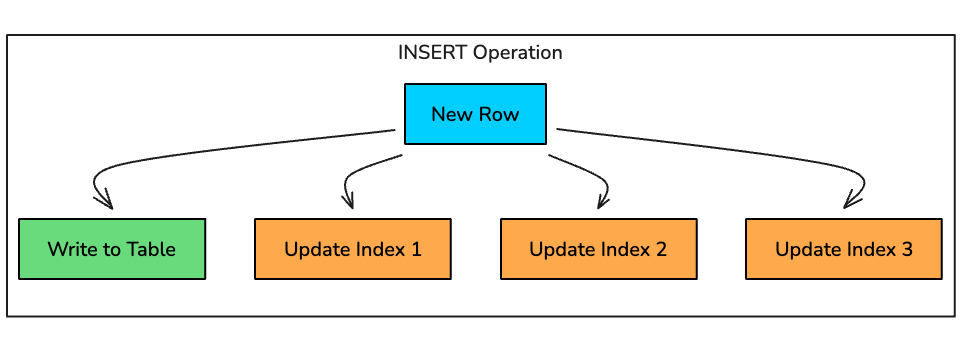
INSERT: For every new row, the database must:

  1. Write the row to the table

  2. Find the correct position in each B-Tree index

  3. Insert a new entry in each index

  4. Potentially rebalance the B-Tree if nodes split

UPDATE: When you update an indexed column, the database must:

  1. Update the row in the table

  2. Remove the old entry from the index

  3. Insert a new entry at the correct position

  4. This is essentially a DELETE + INSERT on the index

DELETE: For every deleted row, the database must:

  1. Remove the row from the table

  2. Find and remove the corresponding entry in each index

  3. Potentially rebalance the B-Tree

Consider a table with 5 indexes. Every INSERT now requires 6 write operations instead of 1. The overhead compounds quickly:
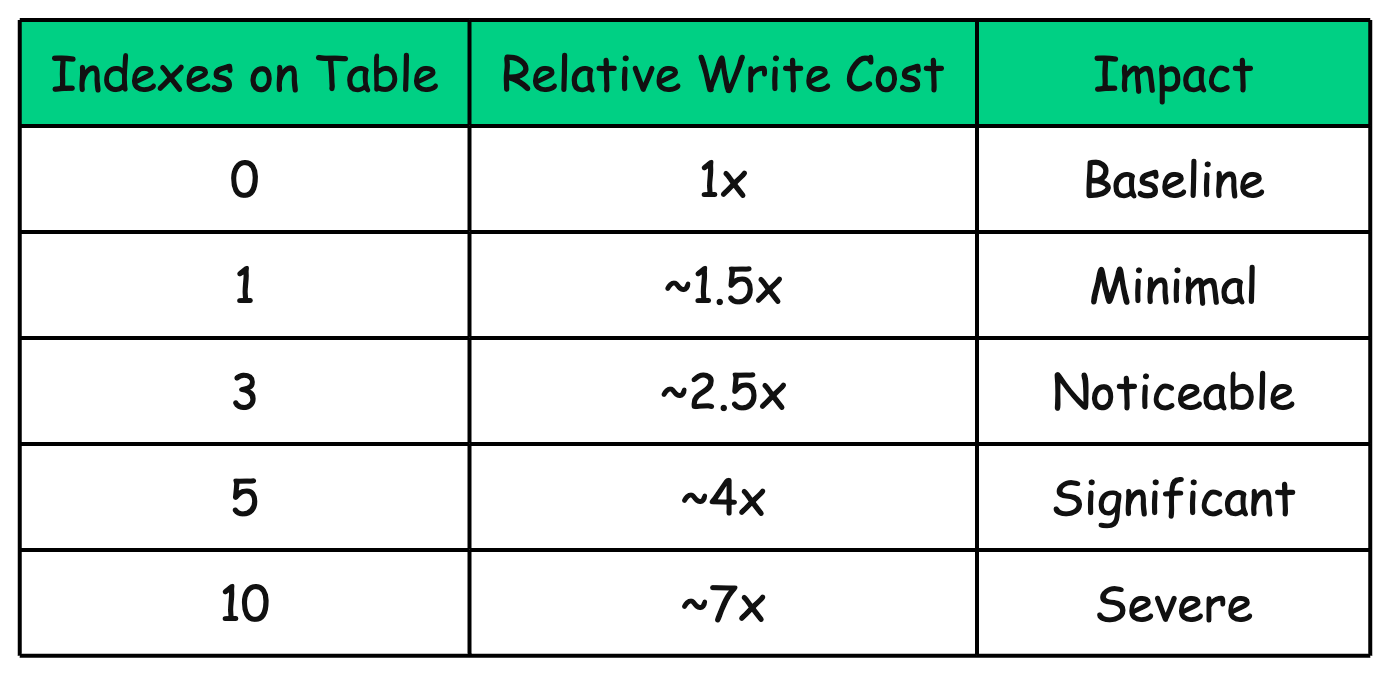
These numbers are approximate and depend on many factors (index type, column size, tree depth), but the trend is clear: more indexes = slower writes.

For write-heavy workloads like logging systems, event tracking, or IoT data ingestion, this overhead can become a serious bottleneck.