








Protocol Buffers (protobuf), Google’s brainchild for efficient data serialization, have become an indispensable tool in the modern software development landscape. They offer a compact and efficient way to structure data for storage or transmission, making them ideal for applications like gRPC services, data storage, and inter-service communication. gRPC is even branching into the frontend of the web, with gRPC-Web and ConnectRPC. This means that the traditional protobuf workflow can sometimes feel a bit dated and cumbersome with tooling that isn’t quite made to be easy to use and, worse, can be easy to use incorrectly. In this article, we’ll explore some modern tools that address these pain points, making protobuf development more enjoyable and productive. But first, let’s recap how the “traditional” protobuf workflow typically works.
Traditional Workflow
Here’s what a typical workflow can look like when working with protobufs:
- Define the Protobuf File: You create a
.protofile, defining your message structures, enums, and services (if using gRPC). - Compile with
protoc: You use theprotoccompiler to generate code in your desired languages (e.g., Go, Java, Python, Rust, etc.) from your.protofiles. - Implement and Use: You implement the server-side logic (if applicable) using the generated server stubs and utilize the generated client code to interact with your protobuf-based services.
Let’s visualize this traditional workflow to highlight these pain points:

What’s Missing?
While this workflow gets the job done, it leaves a lot of room for improvement:
- Error-Prone Build Steps: The process often involves manual compilation and code generation, increasing the risk of human errors. Most people introduce a
Makefileor a bash script to handle callingprotoc, but even this can be error-prone and difficult to maintain. Some believe this doesn’t exist or some magical build system “handles it for you”, but I assure you, it exists and it’s not hard to find plenty of examples of this. - This workflow doesn’t include a standardized way to handle protobuf dependencies. Traditionally, this involves the Makefile or bash script that I just mentioned to download protobufs from various online repositories or manually copying them between projects. This is bad, but the Protobuf/gRPC projects don’t really give much guidance on how to reuse protobufs, so people have just done it themselves in wildly different ways.
- Lack of Consistency: Without proper tooling, it’s challenging to maintain consistent formatting and styling across multiple
.protofiles. - Breaking Changes: Manually tracking changes to your protobufs and ensuring backward compatibility can be tedious and error-prone.
- No Mocking or Prototyping: It takes a good amount of effort to make a gRPC service, even if you just want to use mock data.
Fortunately, the Protobuf ecosystem has evolved dramatically in the last few years, and most of the advancement is from third-parties (not Google), which is exciting. So let’s cover parts of the modern workflow that you won’t see in a gRPC or protobuf tutorial.
The Protobuf ecosystem has seen a surge of innovation in recent years, with many third-party tools emerging to address the limitations of the traditional workflow. Let’s delve into some of these tools.
JSON to Proto
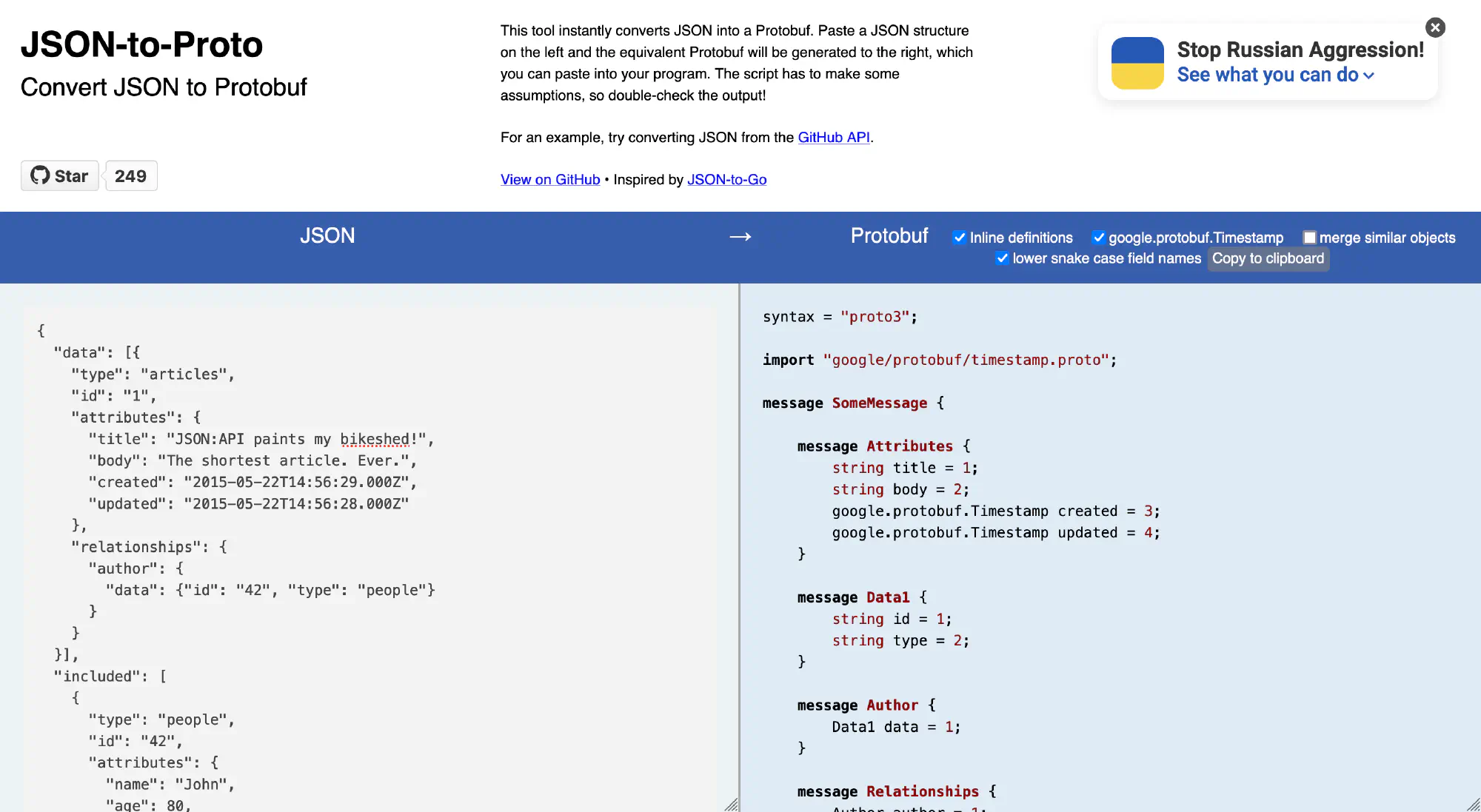
JSON to Proto is a online tool that simplifies the creation of protobuf definitions if you are brand new to protobufs. I wouldn’t recommend using this for the long haul, but it can be a good way to get started quickly by pasting in sample JSON data, and the tool will generate a corresponding .proto file for you. This is particularly useful when you’re starting with existing JSON data or want to quickly prototype a protobuf schema. Learn more from the Github repo.
Protobuf Pal
Protobuf Pal is a browser-based protobuf editor designed to streamline the creation and editing of .proto files. It offers features like syntax highlighting, error checking, and auto-completion, making it easier to write valid protobuf definitions.
Buf CLI
Buf is a comprehensive toolkit designed to make working with protobufs a breeze.

The Buf CLI offers several powerful features:
buf generate: A replacement forprotocthat provides consistent code generation across different languages and environments. Read more here.buf lint: A linter that helps you maintain clean and consistent protobuf definitions, catching potential issues early. Read more here.buf format: An opinionated formatter to ensure consistent styling across your.protofiles. Read more here.buf curl: is useful not only for development but also for testing. You can use it to send gRPC requests from your terminal, making it easy to verify the behavior of your services. It can craft requests using server reflection, local protobuf files, descriptor files or from a reference to the buf.build registry. Read more here.
$ buf curl --list-methods https://demo.connectrpc.com
connectrpc.eliza.v1.ElizaService/Converse
connectrpc.eliza.v1.ElizaService/Introduce
connectrpc.eliza.v1.ElizaService/Say
$ buf curl -d '{"sentence":"Hello! I need some help, doc"}' https://demo.connectrpc.com/connectrpc.eliza.v1.ElizaService/Say
{
  "sentence": "Hello...I'm glad you could drop by today."
}
You can use the buf CLI directly on the CLI (which is great when you’re playing around or adding it to a continuous integration process) or integrated into your code editor, which is where the real magic happens, anyway.
Buf Schema Registry (BSR)
The Buf Schema Registry (BSR) is the missing package manager for Protobufs, but it does a bit more than that. Not only does it allow you to push versioned schemas to one place, but it also has cool features like automatically generated SDKs. The idea is that you can just import the package in your favorite language and magically you have your server stubs and clients in the language of your choice (as long as it’s Go, Typescript/Javascript, Java/Kotlin, Swift, Python or Rust).
With the BSR, you no longer need bespoke Makefile or bash scripts to pull down protobuf dependencies.
Testing
This next set of tools are good for testing live gRPC endpoints. Obviously, gRPCurl is an amazing tool for this, but let’s discover some tools that are a bit newer to the scene.
Buf Studio
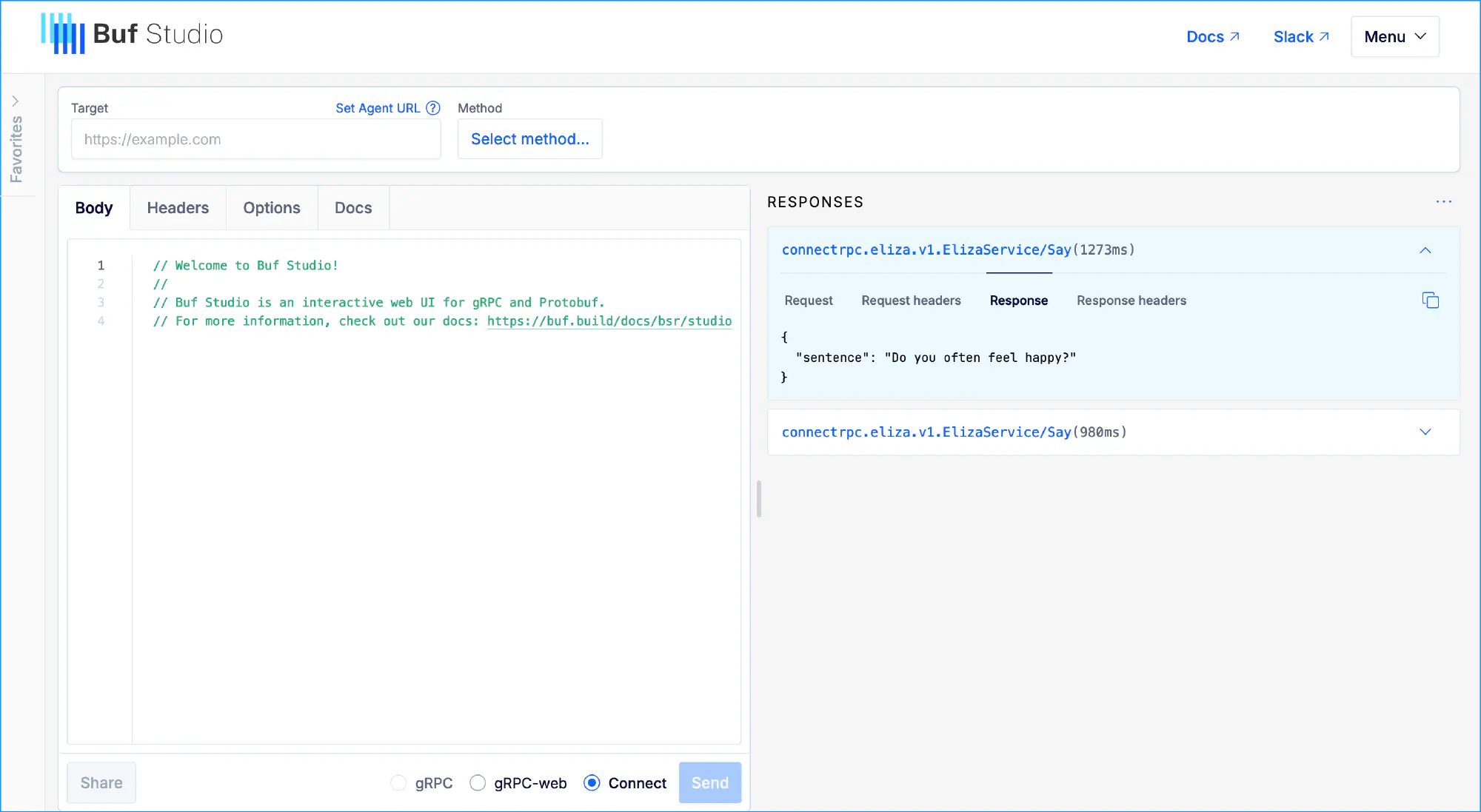
Buf Studio is an interactive web UI for all your gRPC and Protobuf services stored on the Buf Schema Registry. With Buf Studio you can craft gRPC/gRPC-Web/Connect requests using images on the buf registry. Buf Studio uses those protobuf schemas to support autocompletion of these requests, which is super cool. It can also use an agent that is built into the Buf CLI to proxy requests from internal networks, making this web-based tool a bit more flexible.
Postman
Postman, a popular API testing tool, now supports gRPC. You can leverage its familiar interface to construct and send gRPC requests, making it a convenient option for testing your protobuf services.
Insomnia
Insomnia is another API testing platform that has added gRPC support. Similar to Postman, it allows you to design and execute gRPC requests within its user-friendly environment.
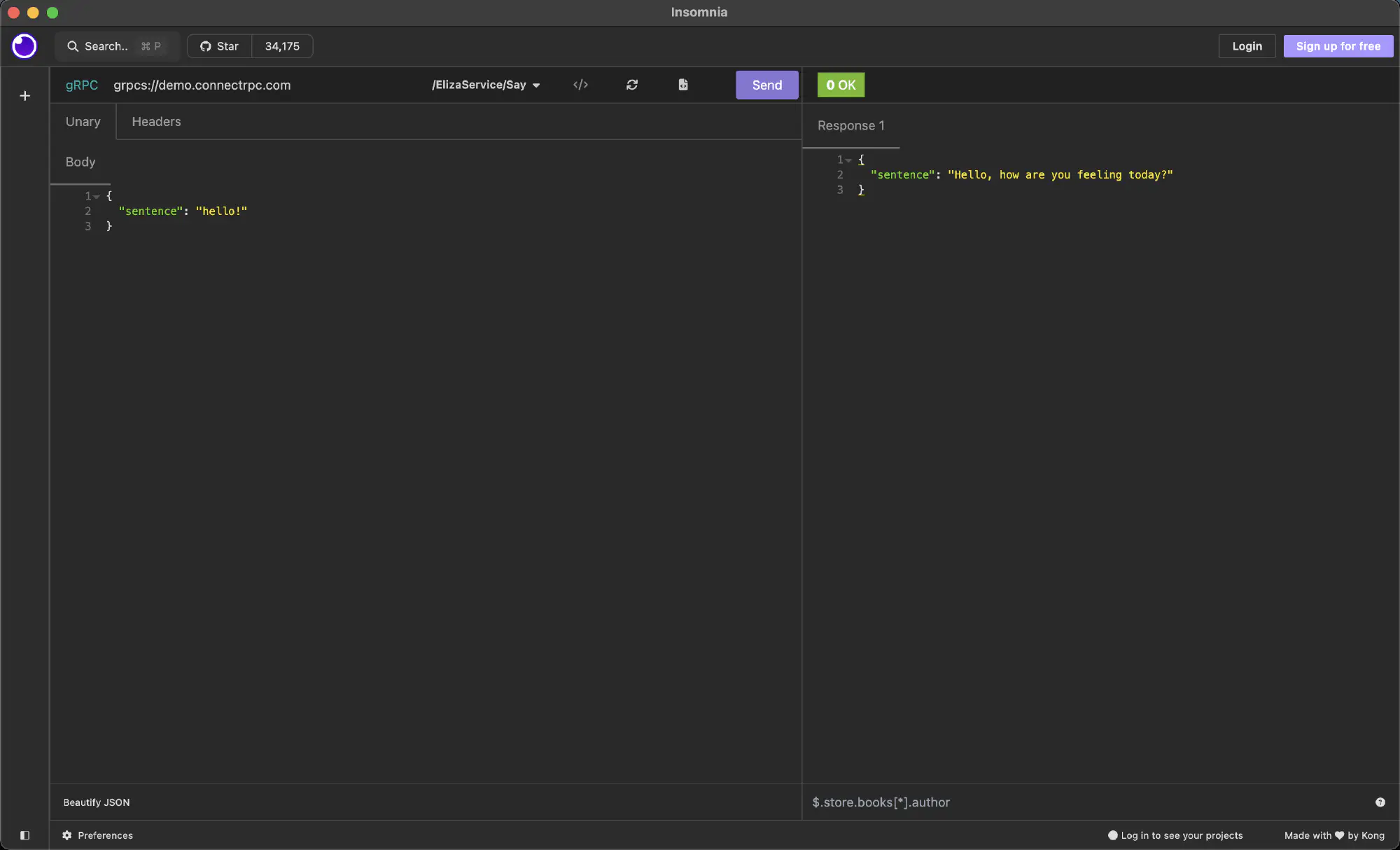
Insomnia’s UI takes a little getting used to but once gRPC is set up, it gets easier.
k6
k6 is a powerful load testing tool that can be used to simulate heavy traffic on your gRPC services. It helps you identify performance bottlenecks and ensure your services can handle real-world loads.
import { Client, StatusOK } from 'k6/net/grpc';
import { check, sleep } from 'k6';

const client = new Client();
client.load(['definitions'], 'eliza.proto');

export default () => {
  client.connect('127.0.0.1:10000', {});

  const data = { sentence: 'Hello, doc!' };
  const response = client.invoke('connectrpc.eliza.v1.ElizaService/Say', data);

  check(response, {
    'status is OK': (r) => r && r.status === StatusOK,
  });

  console.log(JSON.stringify(response.message));

  client.close();
  sleep(1);
};
FauxRPC
I couldn’t write this article without promoting my own tool, FauxRPC. FauxRPC is a tool that enables developers to quickly generate mock gRPC servers from protobuf definitions, facilitating early API development and testing. By incorporating FauxRPC into your workflow, you can easily create realistic mock services that simulate real gRPC server behavior, allowing you to test your client implementations and identify potential issues without the need for a fully implemented backend. This streamlined prototyping and testing process ultimately fosters faster iteration and more robust API development.
With a single command, you can have a server running with fake data!
$ buf build buf.build/connectrpc/eliza -o eliza.binpb
$ fauxrpc run --schema=eliza.binpb
FauxRPC (0.0.16 (97e4c8caf9d3c22387a393180e00bce40b2834c6) @ 2024-08-22T18:42:56Z; go1.22.4)
Listening on http://127.0.0.1:6660
OpenAPI documentation: http://127.0.0.1:6660/fauxrpc.openapi.html

Example Commands:
$ buf curl --http2-prior-knowledge http://127.0.0.1:6660 --list-methods
$ buf curl --http2-prior-knowledge http://127.0.0.1:6660/[METHOD_NAME]
Learn more about it in my previous post announcing it or the documentation website.
New Workflow
This enhanced workflow empowers developers to iterate faster, catch errors earlier, and ensure API stability, ultimately leading to more robust and maintainable protobuf-based applications. Let’s explore how these tools fit into the enhanced workflow:

Note that this workflow has one more “find issues and iterate” connections right after writing the protobuf file. That’s because these new tools will help you find issues with your protobuf schemas earlier in a more automated way.
Also note that with FauxRPC, frontend developers (or whatever is using the generated clients for the service) can start working on their part before the backend developer is finished with their work. Frontend devs no longer have to come up with mock APIs (which rapidly get outdated with reality) just to get started on their frontend work. Integration work on another service which uses this protobuf can happen before the backend implementation is completed. Everyone can work in parallel and the better the schema is (with protovalidate constraints) the better the fake data will be.
More ways to start making protobuf files
Developers can still define services, messages, and enums directly in the .proto file. However, tools like JSON-to-Proto and Protobuf Pal provide visual aids and assistance in creating and editing .proto files, reducing errors and improving productivity. I wouldn’t recommend these tools all the time, but they are probably good for quickly getting a prototype going quickly.
Automated Code Generation and Management
Buf’s buf generate command streamlines the code generation process with a set of declarative configuration files, ensuring consistency across different languages and platforms. Buf’s dependency management capabilities eliminate the need for manual scripts to handle protobuf dependencies.
Enhanced Quality Control
- Buf’s
buf lintenforces coding standards and best practices, catching potential issues early in development. - Buf’s
buf formatautomatically formats your .proto files, ensuring consistency and readability. - Buf’s
buf breakingchange detection helps you avoid introducing changes that could disrupt existing clients.
All of these put together mean that issues in your API schema are discovered automatically, as soon as possible.
Streamlined Testing and Prototyping
Buf’s buf curl and Buf Studio’s built-in gRPC client enable quick testing and interaction with your services. FauxRPC facilitates rapid prototyping by allowing you to mock gRPC services without implementing the actual server-side logic.
Conclusion
The traditional protobuf workflow, while functional, can involve manual steps and potential pitfalls. By incorporating tools like the Buf CLI, JSON-to-Proto, Protobuf Pal, and FauxRPC into your development process, you can significantly enhance your productivity and ensure the quality of your protobuf definitions. Note that I haven’t come close to outlining all of the different tools that you can use with Protobuf. So, don’t hesitate to explore these tools and discover how they can transform your Protobuf development experience!