





惯性聚合 高效追踪和阅读你感兴趣的博客、新闻、科技资讯
阅读原文 在惯性聚合中打开

推荐订阅源

B
Blog RSS Feed
Security Archives - TechRepublic
freeCodeCamp Programming Tutorials: Python, JavaScript, Git & More
小众软件
小众软件
V
V2EX
B
Blog
腾讯CDC
D
DataBreaches.Net
H
Hackread – Cybersecurity News, Data Breaches, AI and More
月光博客
月光博客
The Cloudflare Blog
T
The Blog of Author Tim Ferriss
云风的 BLOG
云风的 BLOG
Latest news
Latest news
L
LINUX DO - 最新话题
C
Check Point Blog
Attack and Defense Labs
H
Hacker News: Front Page
Forbes - Security
Forbes - Security
H
Help Net Security
S
Securelist
D
Docker
Blog — PlanetScale
Blog — PlanetScale
Cyber Security Advisories - MS-ISAC
钛媒体:引领未来商业与生活新知
钛媒体:引领未来商业与生活新知
The Last Watchdog
The Last Watchdog
N
News and Events Feed by Topic
G
Google Developers Blog
AI
AI
I
Intezer
L
LangChain Blog
NISL@THU
NISL@THU
Threat Intelligence Blog | Flashpoint
人人都是产品经理
人人都是产品经理
Hugging Face - Blog
Hugging Face - Blog
罗磊的独立博客
T
Tenable Blog
Jina AI
Jina AI
I
InfoQ
C
Cybersecurity and Infrastructure Security Agency CISA
Cisco Talos Blog
Cisco Talos Blog
C
CERT Recently Published Vulnerability Notes
GbyAI
GbyAI
T
Tailwind CSS Blog
OSCHINA 社区最新新闻
OSCHINA 社区最新新闻
O
OpenAI News
让小产品的独立变现更简单 - ezindie.com
Know Your Adversary
Know Your Adversary
T
Troy Hunt's Blog
Google Online Security Blog

kmcd.dev

gRPC-Web Should Have Fixed gRPC Making Dynamic Protobuf Fast in Go Proxy, Record, and Mock gRPC APIs with FauxRPC Exploring Protocol Buffers Interactively Introducing ProtoDocs Ghost in the Shell: The Manga Behind the Anime The Hidden Cost of google.protobuf.Value Why Networking Built Its Own Data Modeling Language Zero-Friction Demos with WASM Let's Learn About BGP ConnectRPC: Where is it now? Building APIs with Contracts The Case for Greppable Code Unknown Fields in Protobuf IRC Log: Reactionary Faking protobuf data in Go Y'all are Sleeping on Mise-en-Place IRC Log: Standup 2 HTTP/2 From Scratch: Part 4 IRC Log: rm -rf /var/opt/gitlab/postgresql/data HTTP/2 From Scratch: Part 3 Building a Live BGP Map HTTP/2 From Scratch: Part 2 IRC Log: The Cloud Scale Incident Visualizing the Internet (2026) Shell Log: Namaste HTTP/2 From Scratch: Part 1 IRC Log: Standup HTTP/1.1 From Scratch WHOIS is dead, long live RDAP Months Considered Harmful Encryption vs. Compression On Creating My Own Cover Art Traceroute Tool from Scratch in Go My Favorite Interview Question From JSON to Protobuf Breaking gRPC Morse Code Visualizing the Internet (2025) HTTP QUERY and Go I made a daily word game Protovalidate: Can Input Validation Be This Easy? Behold! The Barcode Scanner Mixing CEL and Protobuf for Fun FauxRPC and Protovalidate The Call of the Monolithic Codebase FauxRPC + Test Containers Self-Documenting Connect Services gRPC Over HTTP/3: Followup JSON to Protobuf Conversion gRPC: The Ugly Parts Working with Protobuf in 2024 Introducing FauxRPC HTTP/1.0 From Scratch Y'all are sleeping on HTTP/3 HTTP/0.9 From Scratch What version of HTTP are you using? Texans in Denmark gRPC Over HTTP/3 gRPC: The Good Parts Leaving Texas for Greener Pastures gRPC: The Bad Parts Unit Testing ConnectRPC Servers Daily Prompts Adding chart.js to Hugo Why I'm Rebranding Benchmarking gRPC (golang) Blog Update gRPC From Scratch: Part 3 - Protobuf Encoding Tracking the Wins Visualizing the Internet (2024) Dropping Unknown Fields in ConnectRPC RESTless: Web APIs After REST Introducing unknownconnect-go Making gRPC more approachable with ConnectRPC Inspecting Protobuf Messages Introducing protoc-gen-connect-openapi gRPC From Scratch: Part 2 - Server gRPC From Scratch: Part 1 - Client Why you should use gNMI over SNMP in 2026 The Rollercoaster of Productivity in Side Projects Lessons from a Decades-Long Project How I learned to code Economists with (virtual) Guns Visualizing the Internet (2023) softlayer-python: language bindings/CLI for a cloud company SwFTP: SFTP/FTP Server For Openstack Swift Video: Morning Copenhagen Commute Goodbye Evepraisal Visualizing the spectrum of the sun (Part 2) Visualizing the Internet (2022) Evepraisal: A price estimation tool for Eve Online Visualizing the spectrum of the sun
Can You Hack a Phone with Your Voice?
2025-07-15 · via kmcd.dev

Thousands of people on Mastodon recently started whistling at their computer screens. I’m the one who asked them to do it. No, it wasn’t a strange new CAPTCHA, but an experiment in hacking history.

You see, long before the internet became our digital playground, a different breed of tech enthusiast was busy exploring the phone network. These “phone phreaks” were the original hackers, and one of their most legendary feats was using a simple 2600Hz tone to gain control of phone lines in the US.

Now, let’s be clear: most phreakers couldn’t just whistle this with perfect pitch. That’s the stuff of phreaking legend. In reality, they were a resourceful bunch, using whatever they could get their hands on—instruments, tone generators, and even a toy whistle that famously came in a box of Cap’n Crunch cereal. That little plastic toy just happened to produce a perfect 2600Hz tone, making it an unlikely key to the entire phone system. This discovery helped kick off a whole subculture of people building “blue boxes” and other devices to explore the network’s hidden depths. The community’s name is immortalized in the legendary 2600: The Hacker Quarterly magazine and its podcast, Off The Hook.

As a developer with a soft spot for retro-tech, I had to bring this piece of history to life. So, I built the “Phone Phreak Emulator.” It’s a simple web app that listens to your whistle and tells you how close you get to that magic frequency. No free calls, sorry, but you do get bragging rights.

Here’s what it looks like:
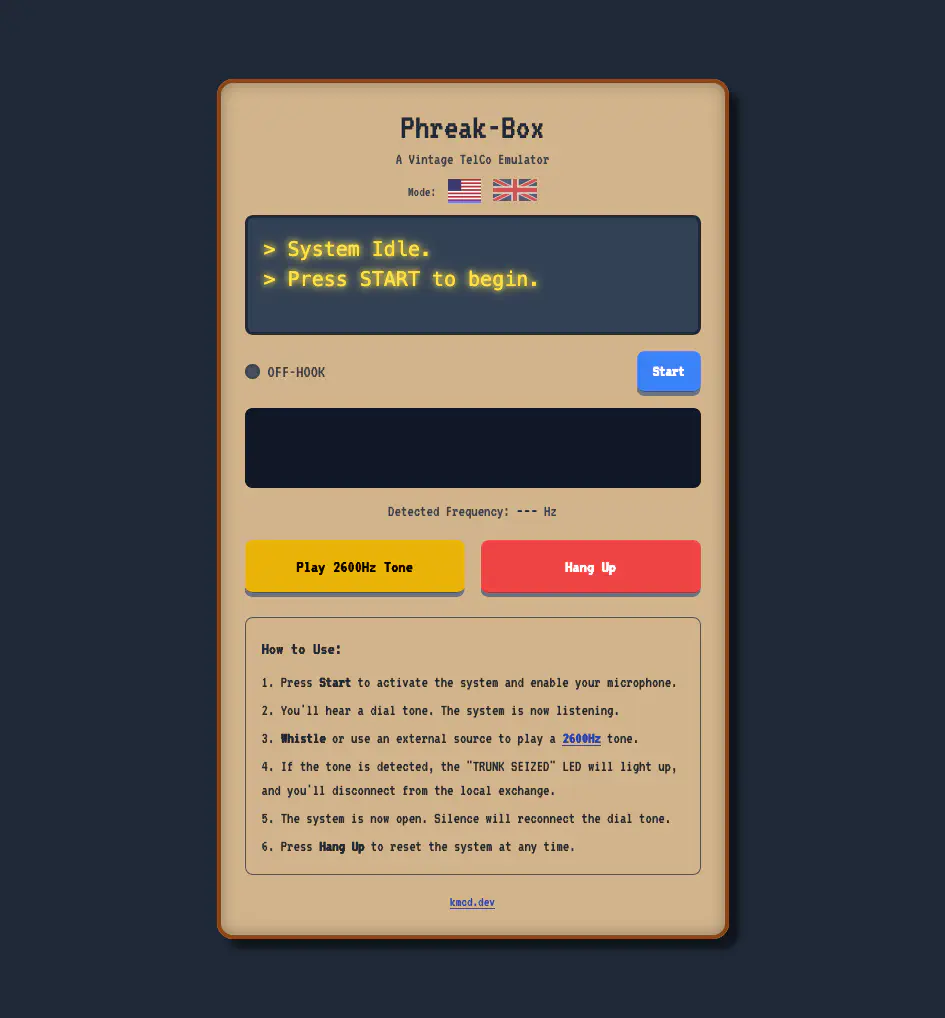
26000Hz Phreaker emulator

I tossed a link up on Mastodon, and things got a little wild. The post exploded. Thousands of people started whistling at their screens. It turns out, hitting that perfect tone is a lot harder than it sounds. I, for one, can barely squeak out 1500Hz. My wife, a woodwind player? She nails it. Consistently.

But beyond the fun of watching the stats climb, something even more incredible happened.

How Mastodon Gave Me a History Lesson

The most incredible outcome of this little project was the history lesson I received from the community. I put out a simple app, and what I got back was a masterclass in telecommunications history. The replies were flooded with fascinating details from people who were there, engineers, and fellow enthusiasts. The thread felt like old friends sharing stories and personal anecdotes around a campfire.

I learned about the intricacies of in-band signaling, the difference between the US “Ma Bell” system and the UK’s GPO network, and so much more. This flood of knowledge was too good to ignore. Thanks to the community’s wonderful, detailed replies, I discovered their phone network used 2280Hz. As a direct result of that fantastic, crowdsourced history lesson, I updated the app. The Phone Phreak Emulator now includes a “UK Mode,” allowing you to test your skills against the 2280Hz tone as well.

It’s been a beautiful, chaotic, and wonderfully nerdy experience. It was a whole community coming together to collectively remember a piece of hacking history, all while looking slightly ridiculous as they whistled at their monitors and phones.

So, if you’re feeling adventurous and want to see if you have the vocal chops of a legendary phone phreak, give it a shot. Head over to phreak.kmcd.dev and let me know how you do. Just don’t blame me if your coworkers start giving you funny looks.