





The world of content management systems is increasingly diverse, offering different solutions for different needs. Two popular categories worth exploring are the Git-based headless CMS and the monolithic DXP (Digital Experience Platform). Understanding the differences between these two approaches can help you make an informed decision for your project.
Both the Git-based headless CMS and the monolithic DXP have their own strengths and weaknesses, and the choice between the two depends on what you actually need for your project. In brief, a Git-based headless CMS offers flexibility, collaboration, and version control, while a monolithic DXP provides integration and a degree of simplicity. Knowing these differences can help you make smart decisions when it comes to managing your content and digital experiences.
A Git-based headless CMS like CloudCannon leverages the power of Git, a distributed version control system, to manage content. Instead of storing your content in a centralized database, a Git-based headless CMS stores content as files in a Git repository. This approach allows for easy collaboration, version control, content staging, and attribution of all changes.
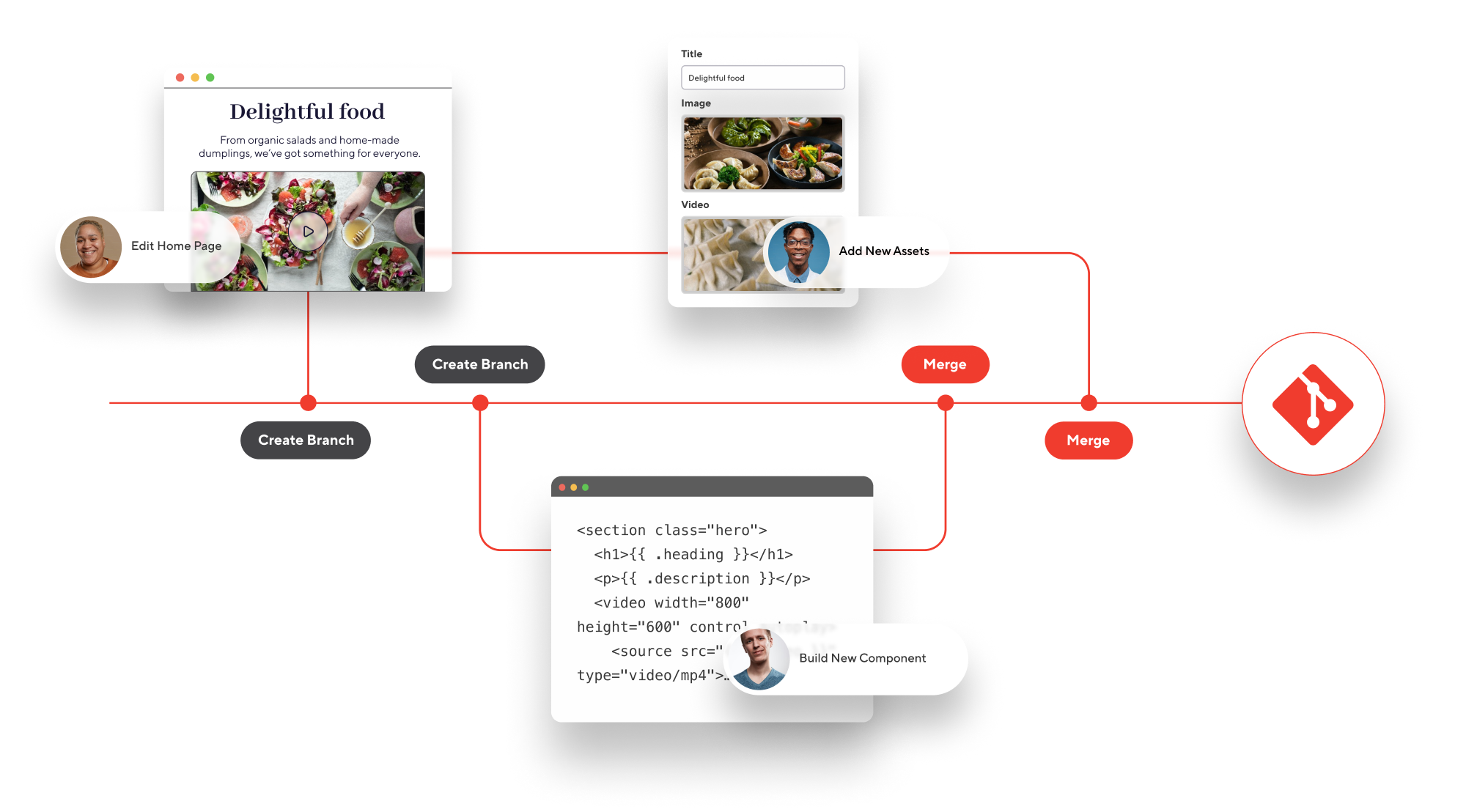
When using a Git-based headless CMS, content creators and developers can work together seamlessly. Content creators can make changes to posts or pages within the CMS interface, and by saving or publishing their files, push those changes to the Git repository.
Developers, for their part, are free to pull the latest changes to their local environment, and deploy them to a staging site or directly to the live production website.
Both content writers and developers can create a copy of a site by branching the repository, and can work independently on content and features, before merging their changes together. These flexible workflows ensure that everyone is working with the most up-to-date content, and greatly reduces the chances of conflicts or mistakes.
One of the key benefits of a Git-based headless CMS is its ability to handle content versioning. Each time a change is made to a file, a new version is created in the Git repository. This allows for easy rollbacks to previous versions if needed. Additionally, Git provides a detailed history of changes, making it easy to track who changed what and when.
A monolithic DXP, on the other hand, is (in part) a traditional CMS that encompasses an incredibly wide range of functionalities within a single application — it’s essentially a platform built on feature creep! Following the principle that more is more, it typically includes features like content management, user management, ecommerce, analytics, and more. With a monolithic DXP, all components are tightly integrated, and operate within the same instance.
One advantage of a monolithic DXP can be its apparent simplicity. Since all functionalities are bundled together, there is no need to manage multiple systems or worry about compatibility issues. This can be especially beneficial for businesses that require a one-size-fits-all solution without the complexity of integrating different tools.
However, the downside of a monolithic DXP is its lack of flexibility. As all components are tightly integrated, it can be challenging to customize or add new functionalities. Upgrading or scaling the system can also be more difficult as any changes may impact the entire application. This can limit your ability to adapt to evolving business needs or take advantage of emerging technologies.
Another consideration with a monolithic DXP is the potential for performance issues. As the application grows in size and complexity, it may become slower and less efficient. This can impact the user experience and lead to decreased website performance.
While monolithic DXP platforms provide a comprehensive set of features out of the box, Git-based headless CMS platforms like CloudCannon offer flexibility, customization, and integration with external services. The choice between the two depends on the specific needs and priorities of your organization, as well as the level of control and customization you need.
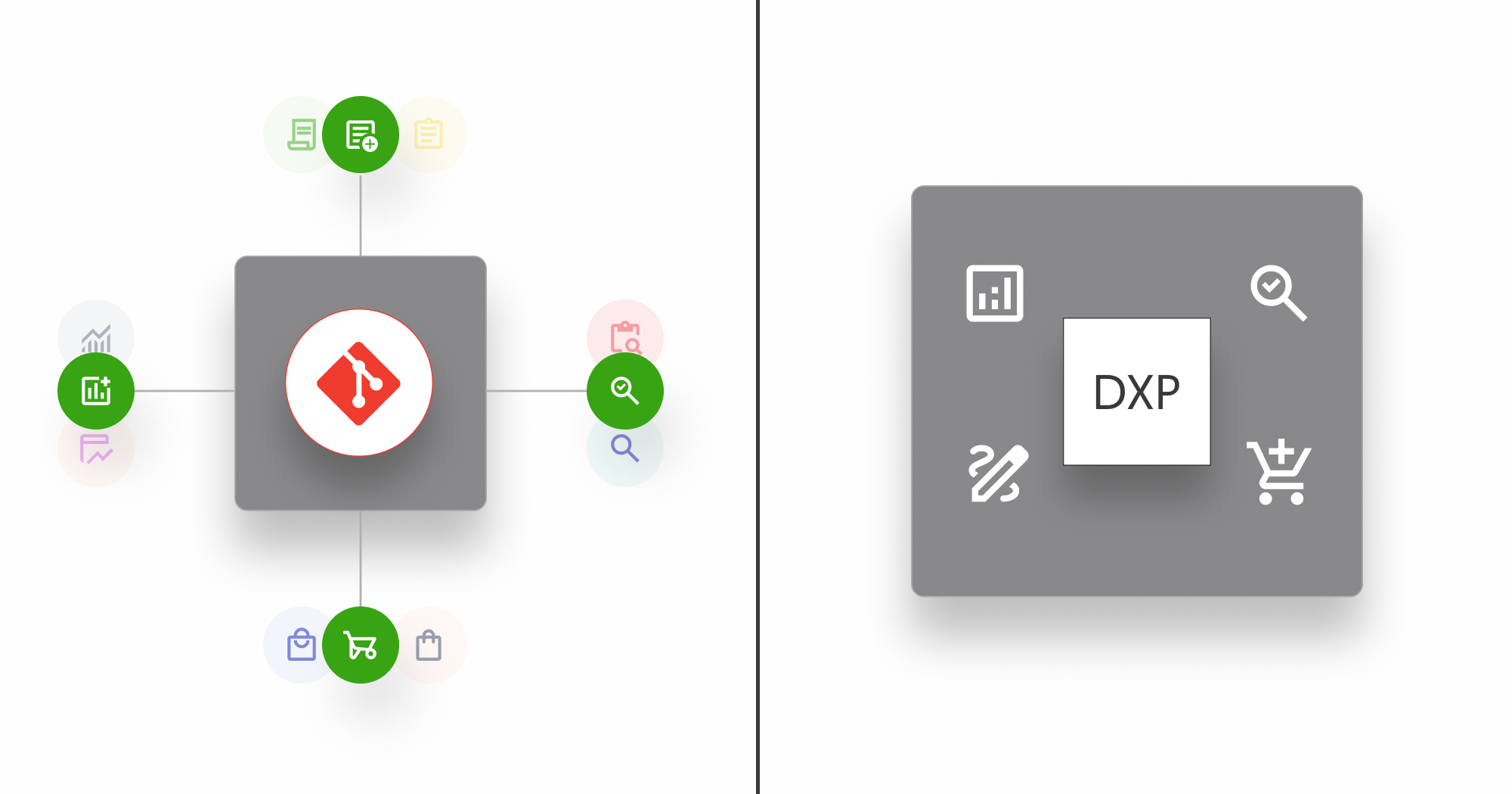
A significant difference between the two approaches lies in functionality and features. Monolithic DXP platforms are often feature-rich, providing a comprehensive solution out of the box. These platforms come equipped with a wide range of tools and functionalities that cater to various aspects of digital experience management.
Git-based headless CMS platforms, on the other hand, focus primarily on content management and rely on integration with external services for additional functionalities. While they may not offer the same breadth of features as monolithic DXP platforms, Git-based headless CMS platforms excel in their simplicity and focus on content management.
| Functionality and features | |
|---|---|
| Monolithic DXP | • Content creation and asset management • Built-in analytics • Customer relations management |
| Git-based CMS | • Content creation and asset management • Version control • Collaborative workflows • Deployment options • Integrations with external services |
When it comes to flexibility and customization, Git-based headless CMS takes the lead. The file-based nature of a Git-based headless CMS allows developers to have granular control over their content structure and its presentation. Content is stored as files in a Git repository, enabling developers to manage content using familiar version control techniques.
| Flexibility and customization | |
|---|---|
| Monolithic DXP | • Predefined templates and structures |
| Git-based CMS | • Granular content control • Define custom content types • Create custom content structures • Organize content according to custom rules |
This one is a short and sweet comparison, because there’s not much to compare! The Git-based headless CMS, with content and data portable by default, is the clear frontrunner here. The same can’t be said of the monolithic DXP, which typically has such a complex framework of intertwined functionalities that exporting content or data in a usable format is either difficult or impossible.
| Data portability and vendor lock-in | |
|---|---|
| Monolithic DXP | • Difficult to migrate away from • Content and data is held in proprietary databases |
| Git-based CMS | • Content and data stored as ‘flat’ portable files; easy to export • No vendor lock-in |
A Git-based headless CMS like CloudCannon offers numerous advantages that make it a popular choice for managing content. In addition to its core features, there are several other benefits that make it an attractive option for businesses, content writers, and developers alike.
One of the primary advantages of a Git-based headless CMS is its ability to streamline collaboration and enable efficient version control. With the ability to create branches, merge changes, and roll back to previous versions, multiple team members can work on content simultaneously without the risk of conflicts or data loss. This collaborative workflow allows for seamless collaboration, as each team member can contribute their changes independently and merge them effortlessly.
Moreover, Git-based headless CMS platforms provide robust version control capabilities. Every change made to the content is tracked, allowing users to easily review and compare different versions. This history tracking feature is particularly useful when it comes to rolling back changes or identifying the source of a problem.
Git-based headless CMS platforms excel in scalability and performance, making them suitable for projects of any size. As content is stored in files within a Git repository, scaling the CMS can be as simple as adding more repositories or leveraging cloud-based services. This flexibility allows businesses to expand their content management capabilities effortlessly as their needs grow.
Additionally, the file-based nature of a Git-based headless CMS enables faster rendering of content, resulting in improved performance. Traditional CMS platforms often rely on databases to store content, which can introduce latency and slow down the rendering process. However, with a Git-based headless CMS, all content is stored as flat text files, eliminating the need for complex database queries and speeding up the delivery of content to end-users.
Another advantage of Git-based headless CMS platforms is their flexibility and customization options. Developers have the freedom to structure the content in a way that best suits their needs. They can create custom templates, define content types, and implement complex workflows, allowing for a tailored content management experience. Even the way an HTML page is created can be changed within a Git-based headless CMS, simply by selecting a different static site generator (SSG).
Furthermore, Git-based headless CMS platforms often provide extensive integrations, enabling seamless integration with third-party services, automating workflows, and extending the CMS's functionality to meet specific requirements.
A Git-based headless CMS offers enhanced collaboration, efficient version control, scalability, performance, flexibility, and customization options. These advantages make it a compelling choice for businesses and developers looking for a modern and efficient solution to manage their content effectively.
One potential drawback of opting for a Git-based headless CMS is the learning curve associated with working with Git and file-based content management. However, once the learning curve is overcome, the benefits of a Git-based headless CMS can outweigh the initial challenges.
Compared to monolithic DXP platforms, Git-based headless CMS solutions may have limited built-in functionality, especially when it comes to advanced features like ecommerce or complex analytics. Luckily, this can be addressed by integrating with external services or custom-developing specific functionalities as needed — and the flexibility that comes with external integrations can be a boon for nimble organizations.
I have really tried to avoid clichés here, but the answer is, as always, “it depends”. And largely it depends on what you need right now, how much future flexibility you require, and how much control you want to have.
| Primary appeals | |
|---|---|
| Monolithic DXP | • All-inclusive, comprehensive platform |
| Git-based CMS | • Collaborative workflows • Data portability • Flexibility and customization |
The choice between a Git-based headless CMS and a monolithic DXP ultimately depends on your project requirements. If your primary focus is on content management and collaboration, with the flexibility to integrate specialized services, a Git-based headless CMS could be an excellent fit. On the other hand, if you require a comprehensive solution with a broad range of built-in features, a monolithic DXP might be the better choice. (And on the other other hand, if you’re still not completely sure, I’d recommend not rushing into the decision. Take some time to speak to vendors, book demo calls, read about other teams building sites with each tool. A responsible CMS vendor will always want to make sure their platform is right for you.)
Another crucial factor to consider is your team's skill set.
If your development team has prior experience working with Git, a Git-based headless CMS with a flexible developer experience can be a rewarding choice. Content teams, for their part, don’t need to know anything about Git — Git workflows are abstracted to familiar actions like ‘Saving’ (committing) and ‘Publishing’ (merging).
However, if your team is more comfortable working within the confines of a pre-constructed platform, and are happy to adapt to a single, pre-defined, publishing workflow, a monolithic DXP might be a better fit.
While both the Git-based headless CMS and the monolithic DXP have their respective strengths and limitations, understanding the differences can help you make an informed choice for your project. Carefully evaluating your requirements and considering your team's skill set will ultimately guide you towards making the right decision for your project's success.
此内容由惯性聚合(RSS阅读器)自动聚合整理,仅供阅读参考。 原文来自 — 版权归原作者所有。