


惯性聚合 高效追踪和阅读你感兴趣的博客、新闻、科技资讯
阅读原文 在惯性聚合中打开

推荐订阅源

Vercel News
Vercel News
SecWiki News
SecWiki News
WordPress大学
WordPress大学
小众软件
小众软件
博客园 - 司徒正美
酷 壳 – CoolShell
酷 壳 – CoolShell
V
Visual Studio Blog
Y
Y Combinator Blog
freeCodeCamp Programming Tutorials: Python, JavaScript, Git & More
云风的 BLOG
云风的 BLOG
MyScale Blog
MyScale Blog
K
Kaspersky official blog
T
The Exploit Database - CXSecurity.com
腾讯CDC
Scott Helme
Scott Helme
I
InfoQ
Cyberwarzone
Cyberwarzone
Cyber Security Advisories - MS-ISAC
Security Latest
Security Latest
The Register - Security
Project Zero
Project Zero
F
Fortinet All Blogs
C
CERT Recently Published Vulnerability Notes
A
Arctic Wolf
C
Cisco Blogs
L
LINUX DO - 热门话题
P
Privacy International News Feed
IT之家
IT之家
U
Unit 42
P
Privacy & Cybersecurity Law Blog
H
Help Net Security
K
KPMG report finds enterprise disconnect between AI and its ROI | CIO
C
Cyber Attacks, Cyber Crime and Cyber Security
P
Palo Alto Networks Blog
F
Full Disclosure
宝玉的分享
宝玉的分享
Simon Willison's Weblog
L
Lohrmann on Cybersecurity
Google DeepMind News
cs.CL updates on arXiv.org
H
Hacker News: Front Page
Know Your Adversary
Know Your Adversary
PCI Perspectives
PCI Perspectives
Hugging Face - Blog
Hugging Face - Blog
AWS News Blog
AWS News Blog
MongoDB | Blog
MongoDB | Blog
S
Schneier on Security
Recent Announcements
Forbes - Security
Forbes - Security
Cisco Talos Blog
Cisco Talos Blog

CloudCannon Blog

Building with AI: Git-based vs headless vs traditional CMS CloudCannon + Astro: performance meets powerful content management Introducing Jetstream — built on the Astro Component Starter Why we switched to the system font stack Redesigning CloudCannon’s docs with Diátaxis, Lume, and Pagefind Make content editing more visual: upgraded Editable Regions How Configuration Mode makes building editing interfaces easy Your hosting just got an upgrade (and a price cut) Custom testing domains for professional branding Keep your content consistent with input validation Managing multilingual content in CloudCannon Simplify team publishing with conflict resolution and domain tools Open Beta: Publishing Conflict Resolution Getting started with CloudCannon and Astro: Bookshop, components, and live editing Welcome to the CloudCannon Community! Omnichannel delivery is just marketing spin from API-based CMS companies Getting started with CloudCannon and Astro: Snippets and Collections Managing digital assets in CloudCannon: a guide to smart asset storage Understanding CloudCannon's branching workflows and Projects: a complete guide What is a static website? CloudCannon’s 2024 wrapped Getting started with CloudCannon and Astro: WYSIWYG blogging Jamstack vs. WordPress: reasons to make the change The top five static site generators for 2025 (and when to use them!) Free Jekyll themes for 2025: ten great community options Eleventy (11ty) vs. Hugo How to set up WYSIWYG editing with MkDocs Material The rise of static-first websites: why major brands are making the switch Watching your Core Web Vitals on Jamstack Understanding the difference between static, dynamic, and hybrid websites Looking for an alternative to Netlify CMS or Decap CMS? Designing components for your website editors: a CloudCannon case study Does my website look big in this? Six tips to lower your page weight Content is sacred — so own your revision history The eternal balancing act: load time vs. delay time Streamlined Headless Mode, Unified Configuration, and live data editing What is a headless CMS? Looking for a TinaCMS or Tina Cloud alternative? The ultimate guide to Hugo Sections Coming soon: Live config editing and data reloading Faster publishing workflows out now! Why information architecture matters for your website Website UX vs SEO: picking your battles Easily manage your multilingual Astro site in CloudCannon How you can optimize publishing workflows for your content team How you can optimize your CMS for SEO success How you can optimize your Content Editor for long-form articles How you can optimize your Visual Editor for page building Secure, swift, and stable: static sites for the financial sector Enhanced flexibility for teams with Custom Permissions Building static sites that scale The Inaugural 11ty International Symposium on Making Web Sites Real Good How to manage hundreds of connected websites with a Git-based headless CMS How we’re building CloudCannon for accessibility CloudCannon’s new editing improvements are here! Open Beta | New ways to collaborate on editing your websites Top 11 free Eleventy themes for 2024 Top 10 free Astro themes to use in 2024 Why choose a Git-based headless CMS over a monolithic DXP in 2024? Learning web development: a self-guided roadmap Partner Site of the Month: Blüthner Piano Centre, by Winteractive CloudCannon’s 2023 wrapup Let’s create a microblog with visual editing using Bookshop and Eleventy Update and visualize your branches with CloudCannon Projects What is a Git-based CMS and why you should use one CloudCannon secures SOC 2 certification The complete guide to growing your web development agency Automatically optimize your images with Eleventy Image and CloudCannon Share components and syndicate content with Site Mounting Partner Site of the Month: Cru Uncorked, by Ed Meehan New web component for responsive HTML tables Wrapping up HugoConf 2023 Partner Site of the Month: Van Dillen Antieke Bouwmaterialen, by Fulldev How to become a freelance web developer: a comprehensive guide Q3 2023: CloudCannon features and improvements 22 ways to deliver more value to your web development clients Partner Site of the Month: DC Gay Flag Football League, by Ed Cupaioli A new way to configure your CloudCannon sites CloudCannon — the official CMS partner of Eleventy Full CloudCannon support for Nuxt static sites Partner Site of the Month: Stadium Bike, by Insight Creative, Inc. HugoConf 2023, brought to you by CloudCannon DAM Support for Cloudflare R2 and DigitalOcean Spaces Eleventy (11ty) vs. Gatsby in 2023 – which SSG is best for you? How CloudCannon’s live editing works with Astro and Bookshop Partner Site of the Month: Fiducian, by Croissant & Baguette Eleventy (11ty) vs. Astro How to customize CloudCannon’s Client Sharing interface Let anyone, anywhere, edit your CloudCannon sites Top 23 free Astro themes for building out-of-this-world static sites in 2023 How Jampack optimizes our Eleventy website and improves performance Astro vs. Next.js CloudCannon.com is now built with Eleventy! Out-of-this-world support for all Astro users Introducing the CloudCannon Partner Program Full CloudCannon support for Gatsby Top 10 Free SvelteKit Themes for Building Lighting-Fast Static Sites in 2023 Enhanced CloudCannon support for Next.js users Upcoming CloudCannon Interface improvements (Open Beta) Creating sites, the Jamstack way
Introducing the Astro Component Starter
2026-03-10 · via CloudCannon Blog

Building a marketing site usually means stitching things together yourself. You pick a build tool. You pick a component library. You pick a CMS. Then you spend days, sometimes weeks, wiring them together, deciding what editors can change, building the integration layer, and maintaining it as both sides evolve.

The Astro Component Starter cuts that work out. It's a complete, integrated component system — 30+ Astro components, a design token system, visual editing configuration, and built-in documentation — ready to scaffold a marketing site in minutes. Think of it as building your own page builder, except you own every file and there's no platform ceiling.

Join me and Astro co-founder Fred K. Schott as we talk through the Starter, Astro v6, and officially kick off a $4,500 prize pool community challenge:

From scaffold to branded site Direct link to this section

Start with the CLI:

npx create-astro-component-starter my-site-name
cd my-site-name
npm run dev

You immediately have a working site at localhost:4321 with pages, a blog, navigation, and a full component documentation site. Out of the box, the design is intentionally neutral. It's meant to disappear into whatever brand you bring.

Design tokens handle the broad strokes: update CSS variables for colors, fonts, spacing, and the entire site shifts at once. That gets you most of the way. For the rest, every component's CSS is right there in your codebase — not hidden behind an abstraction layer, not locked in a package you can't touch. It's normal CSS in files you own, so branding work is just styling work.

A page builder you control Direct link to this section

Components are standard Astro component in your src/components/ directory. The building-block components — buttons, headings, images, text blocks, form elements, layout grids — are simple on purpose. They're tuned for performance and accessibility, built on semantic HTML and vanilla CSS. The power is in composition.

Combine building blocks into page section components: heroes, feature showcases, testimonials, pricing grids, CTAs. Use the built-in component builder to prototype combinations without writing code, or compose them directly in your Astro files. Either way, the result is production-ready and configured for visual editing.
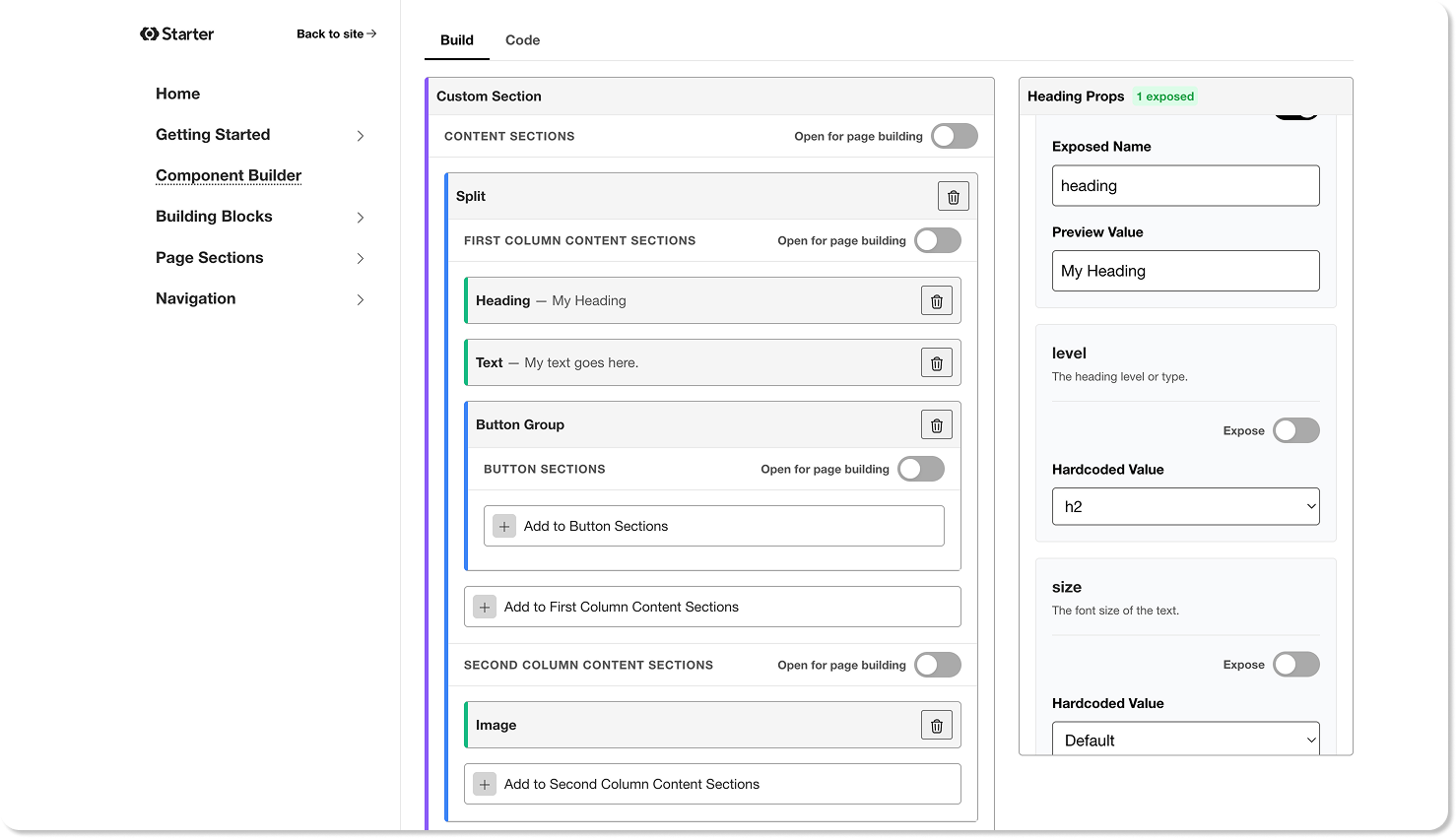
Built-in component builder for the Astro Component Starter

Built for visual editing Direct link to this section

Every component in the starter is pre-configured for CloudCannon's visual editor. That means your editors can click directly on elements on the page — a heading, an image, a call-to-action — and edit them in place, seeing their changes live on the actual site. No switching between a form and a preview. No guessing what the result will look like.

But it goes beyond inline text editing. Editors can add, remove, and reorder entire sections on a page by picking from the components you've built, assembling pages from your component library without touching code. It's a page builder experience, except every component is yours, the output is a high-performance Astro site, and the content lives in your Git repository.

You decide exactly what editors can touch. Lock a layout down to text-only edits, open a section up so editors can add, remove, and reorder blocks, or give them full page building where they can chain together anything in the system. Every component is fully documented: developers can define the boundaries; editors work freely within them.
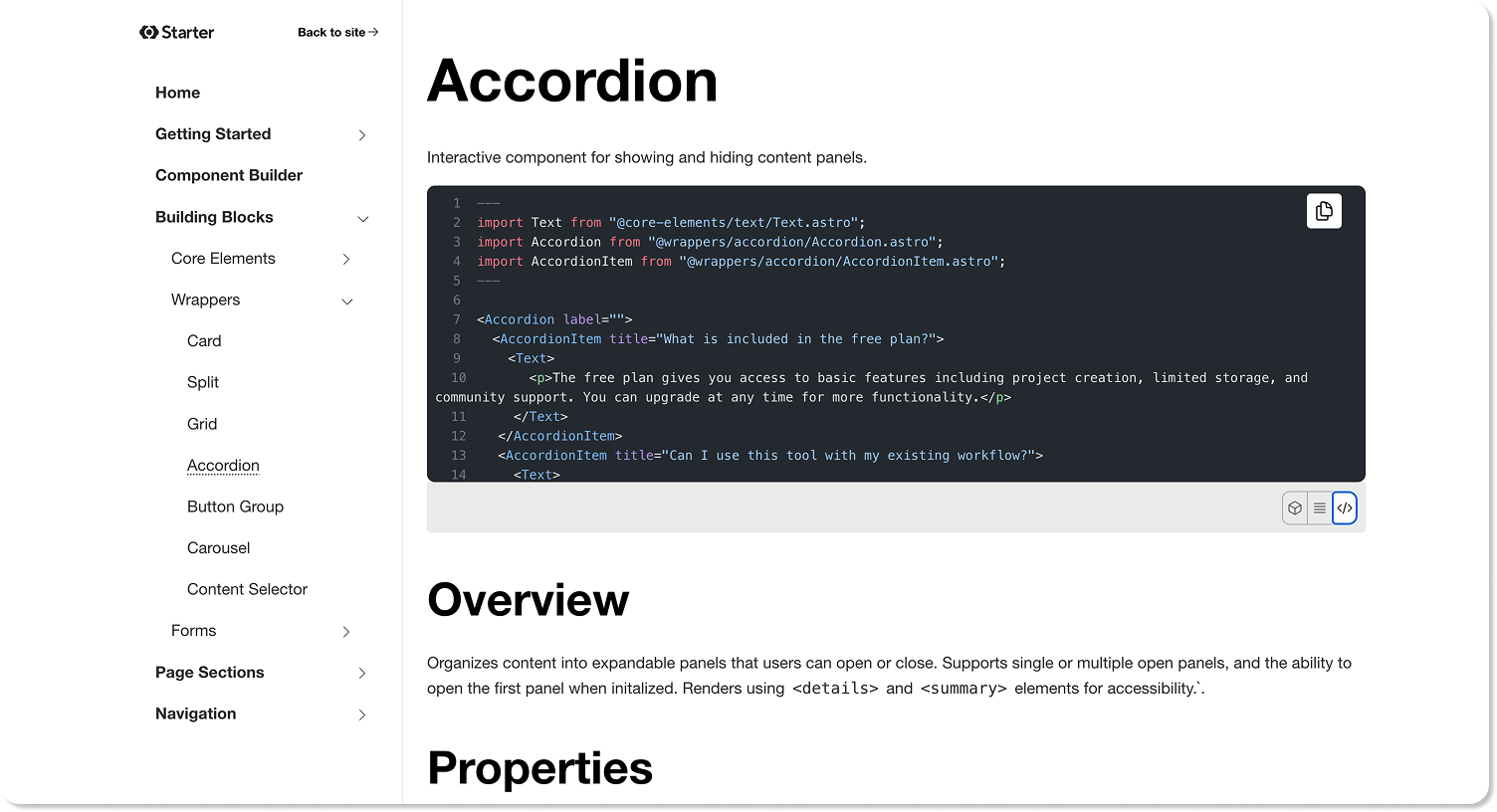
Documented components and building blocks for the Astro Component Starter

If you're an agency, this goes further. Take the Component Starter, add the components you use on every project, wire in your layouts, set up your brand tokens — and you've built your own page builder, except you own the code and control the editing experience.

Here's one we prepared earlier Direct link to this section

To see what a finished site looks like, take a look at Jetstream — the first full template built on this foundation. It assembles the starter's building blocks into polished page sections, extends the design tokens with a richer color palette, and introduces new component variants where the design called for them.
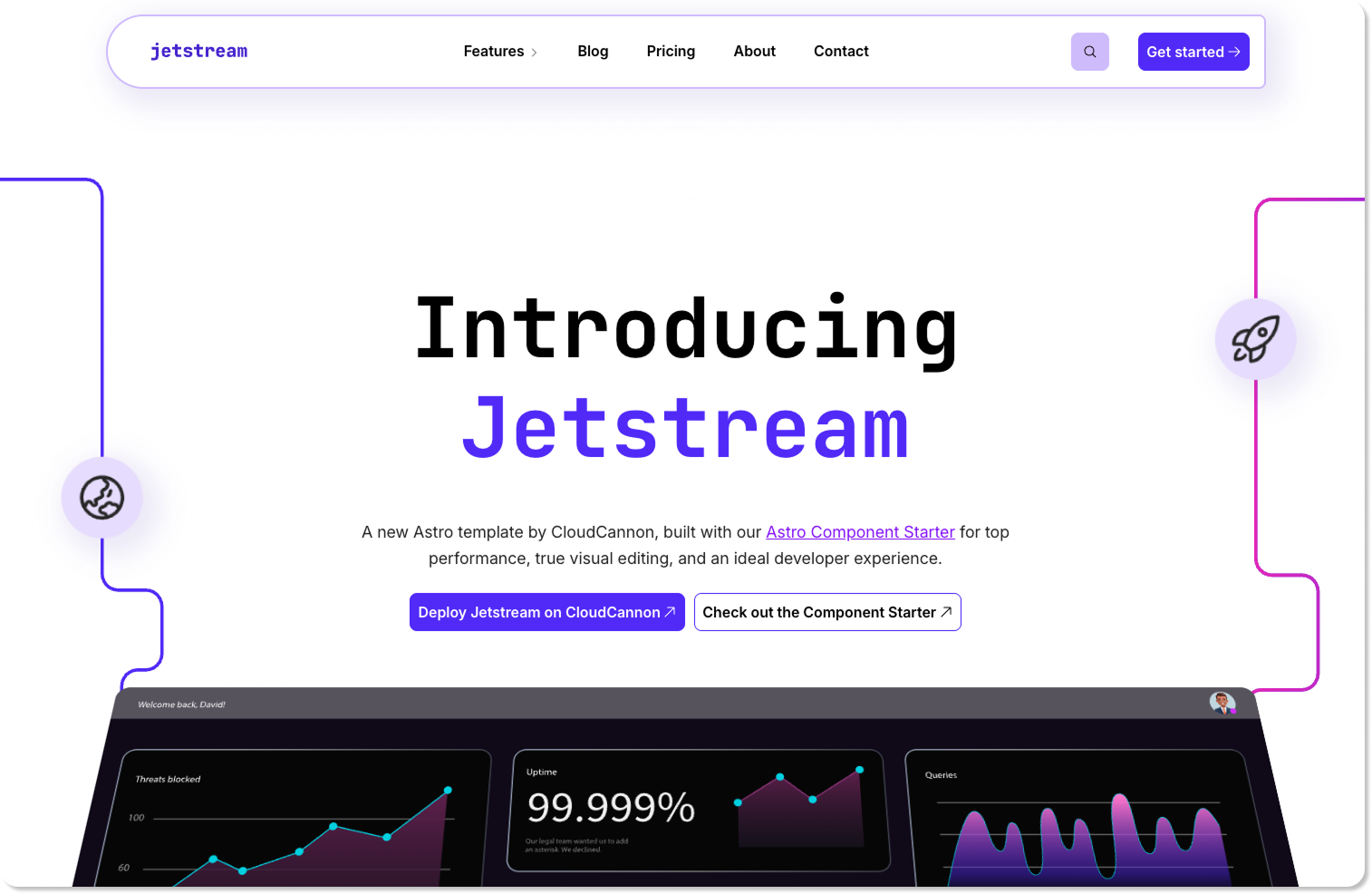
Jetstream also demonstrates the CloudCannon editing experience across all three major editors: component-based visual editing for pages, Markdown with optional visual previews for blog posts, and data editing for structured content like team members. If the Component Starter shows you the pieces, Jetstream shows you the finished puzzle. Read Alysha's full post for details on what's included and how it was built.

To celebrate the launch, we ran the Astro Challenge — a one-week competition with a $4,500 prize pool, challenging developers to take the Component Starter and make it their own. Three winners each took home $1,500 USD, and the range of entries showed just how far you can push the Starter in a short time.

  • Felix Schneider built a landing page for his trueberryless-org ecosystem with a train-themed design system and a modular architecture — Starlight plugin integration, automated template syncing, and a set of custom "wagon" components that slot together around a central layout.
  • Lawrence Sticks created Kairos Studio, a boutique brand agency site with a clear point of view: positioning-first design, a deliberately small client roster, and copy sharp enough to sell actual services.
  • David Kimball went bold with SIGNAL, a fictional growth marketing agency featuring animated mesh gradients, glassmorphism navigation, and a cyan-and-coral palette on deep black — seven pages and eleven blog posts, all with real content.

What stood out across all three was that the CloudCannon editing experience came through intact. Drag-and-drop page building, visual editing, structured content were all preserved, and that's the whole point of the Component Starter. You own the code, you control the design, and your editors still get a proper page builder experience at the end of it.

All three winning repos are public on GitHub — fork them, test them on CloudCannon, and see what's possible!


Whether you're starting a client site next week or building a reusable foundation for the next ten, the Astro Component Starter gives you something solid to stand on. The hard part — the wiring, the integration, the maintenance — is already done. Clone it, extend it, make it yours.