




惯性聚合 高效追踪和阅读你感兴趣的博客、新闻、科技资讯
阅读原文 在惯性聚合中打开

推荐订阅源

IT之家
IT之家
C
CXSECURITY Database RSS Feed - CXSecurity.com
V
Visual Studio Blog
D
Darknet – Hacking Tools, Hacker News & Cyber Security
小众软件
小众软件
L
LangChain Blog
Cyberwarzone
Cyberwarzone
美团技术团队
The Register - Security
Threat Intelligence Blog | Flashpoint
T
Tor Project blog
V
V2EX
Security Archives - TechRepublic
Hacker News: Ask HN
Hacker News: Ask HN
L
LINUX DO - 最新话题
Recent Announcements
H
Hackread – Cybersecurity News, Data Breaches, AI and More
酷 壳 – CoolShell
酷 壳 – CoolShell
freeCodeCamp Programming Tutorials: Python, JavaScript, Git & More
aimingoo的专栏
aimingoo的专栏
人人都是产品经理
人人都是产品经理
F
Full Disclosure
V2EX - 技术
V2EX - 技术
The Cloudflare Blog
博客园 - 叶小钗
T
Threat Research - Cisco Blogs
阮一峰的网络日志
阮一峰的网络日志
G
GRAHAM CLULEY
OSCHINA 社区最新新闻
OSCHINA 社区最新新闻
Latest news
Latest news
S
Security @ Cisco Blogs
Spread Privacy
Spread Privacy
Project Zero
Project Zero
K
Kaspersky official blog
MyScale Blog
MyScale Blog
Attack and Defense Labs
云风的 BLOG
云风的 BLOG
博客园 - 【当耐特】
Hacker News - Newest:
Hacker News - Newest: "LLM"
大猫的无限游戏
大猫的无限游戏
P
Privacy International News Feed
Google DeepMind News
WordPress大学
WordPress大学
C
Cybersecurity and Infrastructure Security Agency CISA
Webroot Blog
Webroot Blog
罗磊的独立博客
Vercel News
Vercel News
N
News and Events Feed by Topic
A
Arctic Wolf
C
CERT Recently Published Vulnerability Notes

CloudCannon Blog

Building with AI: Git-based vs headless vs traditional CMS CloudCannon + Astro: performance meets powerful content management Introducing the Astro Component Starter Introducing Jetstream — built on the Astro Component Starter Why we switched to the system font stack Redesigning CloudCannon’s docs with Diátaxis, Lume, and Pagefind Make content editing more visual: upgraded Editable Regions How Configuration Mode makes building editing interfaces easy Your hosting just got an upgrade (and a price cut) Custom testing domains for professional branding Keep your content consistent with input validation Managing multilingual content in CloudCannon Simplify team publishing with conflict resolution and domain tools Open Beta: Publishing Conflict Resolution Getting started with CloudCannon and Astro: Bookshop, components, and live editing Welcome to the CloudCannon Community! Omnichannel delivery is just marketing spin from API-based CMS companies Getting started with CloudCannon and Astro: Snippets and Collections Managing digital assets in CloudCannon: a guide to smart asset storage Understanding CloudCannon's branching workflows and Projects: a complete guide What is a static website? CloudCannon’s 2024 wrapped Getting started with CloudCannon and Astro: WYSIWYG blogging Jamstack vs. WordPress: reasons to make the change The top five static site generators for 2025 (and when to use them!) Free Jekyll themes for 2025: ten great community options Eleventy (11ty) vs. Hugo How to set up WYSIWYG editing with MkDocs Material The rise of static-first websites: why major brands are making the switch Watching your Core Web Vitals on Jamstack Understanding the difference between static, dynamic, and hybrid websites Looking for an alternative to Netlify CMS or Decap CMS? Designing components for your website editors: a CloudCannon case study Does my website look big in this? Six tips to lower your page weight Content is sacred — so own your revision history The eternal balancing act: load time vs. delay time Streamlined Headless Mode, Unified Configuration, and live data editing What is a headless CMS? Looking for a TinaCMS or Tina Cloud alternative? The ultimate guide to Hugo Sections Coming soon: Live config editing and data reloading Faster publishing workflows out now! Website UX vs SEO: picking your battles Easily manage your multilingual Astro site in CloudCannon How you can optimize publishing workflows for your content team How you can optimize your CMS for SEO success How you can optimize your Content Editor for long-form articles How you can optimize your Visual Editor for page building Secure, swift, and stable: static sites for the financial sector Enhanced flexibility for teams with Custom Permissions Building static sites that scale The Inaugural 11ty International Symposium on Making Web Sites Real Good How to manage hundreds of connected websites with a Git-based headless CMS How we’re building CloudCannon for accessibility CloudCannon’s new editing improvements are here! Open Beta | New ways to collaborate on editing your websites Top 11 free Eleventy themes for 2024 Top 10 free Astro themes to use in 2024 Why choose a Git-based headless CMS over a monolithic DXP in 2024? Learning web development: a self-guided roadmap Partner Site of the Month: Blüthner Piano Centre, by Winteractive CloudCannon’s 2023 wrapup Let’s create a microblog with visual editing using Bookshop and Eleventy Update and visualize your branches with CloudCannon Projects What is a Git-based CMS and why you should use one CloudCannon secures SOC 2 certification The complete guide to growing your web development agency Automatically optimize your images with Eleventy Image and CloudCannon Share components and syndicate content with Site Mounting Partner Site of the Month: Cru Uncorked, by Ed Meehan New web component for responsive HTML tables Wrapping up HugoConf 2023 Partner Site of the Month: Van Dillen Antieke Bouwmaterialen, by Fulldev How to become a freelance web developer: a comprehensive guide Q3 2023: CloudCannon features and improvements 22 ways to deliver more value to your web development clients Partner Site of the Month: DC Gay Flag Football League, by Ed Cupaioli A new way to configure your CloudCannon sites CloudCannon — the official CMS partner of Eleventy Full CloudCannon support for Nuxt static sites Partner Site of the Month: Stadium Bike, by Insight Creative, Inc. HugoConf 2023, brought to you by CloudCannon DAM Support for Cloudflare R2 and DigitalOcean Spaces Eleventy (11ty) vs. Gatsby in 2023 – which SSG is best for you? How CloudCannon’s live editing works with Astro and Bookshop Partner Site of the Month: Fiducian, by Croissant & Baguette Eleventy (11ty) vs. Astro How to customize CloudCannon’s Client Sharing interface Let anyone, anywhere, edit your CloudCannon sites Top 23 free Astro themes for building out-of-this-world static sites in 2023 How Jampack optimizes our Eleventy website and improves performance Astro vs. Next.js CloudCannon.com is now built with Eleventy! Out-of-this-world support for all Astro users Introducing the CloudCannon Partner Program Full CloudCannon support for Gatsby Top 10 Free SvelteKit Themes for Building Lighting-Fast Static Sites in 2023 Enhanced CloudCannon support for Next.js users Upcoming CloudCannon Interface improvements (Open Beta) Creating sites, the Jamstack way
Why information architecture matters for your website
2024-09-05 · via CloudCannon Blog

Information architecture (IA) may be seen as a dry or technical aspect of web design, but I think it’s more than that — it’s a framework that can nurture creativity and growth. Just like pruning a tree to guide its future shape, IA helps set boundaries that allow web content teams’ creativity to flourish — all within carefully defined (and designed) limits.

I’ve been designing for the web for 8 years now, and while a lot has changed over that time, I still find that IA is one of the most important processes to get right when our team is working on a new project.

So what is IA, really? Basically, IA in web design refers to the organization, structuring, and labeling of content on a website to make it easily navigable and understandable for users. It's essentially about creating a logical framework that helps users find information and complete tasks efficiently.

It’s important to get it right, too — by understanding both the users and editors of a website, we can help create a logical, intuitive structure that enhances user experience, improves efficiency, and supports both user needs and business goals.

Information architecture for users and editors Direct link to this section

Mapping out a website’s information architecture can — and I think should — be broken down into two key sets of components: one focused on end users, and one focused on content editors.

For example, if you’re designing a site for a university, the needs of students, faculty, and administrators (the most common end users) must be balanced. A navigation system that works well for students might not be ideal for faculty, and vice versa. Therefore, a good IA should be intuitive for all user groups and flexible enough to evolve as the site grows.
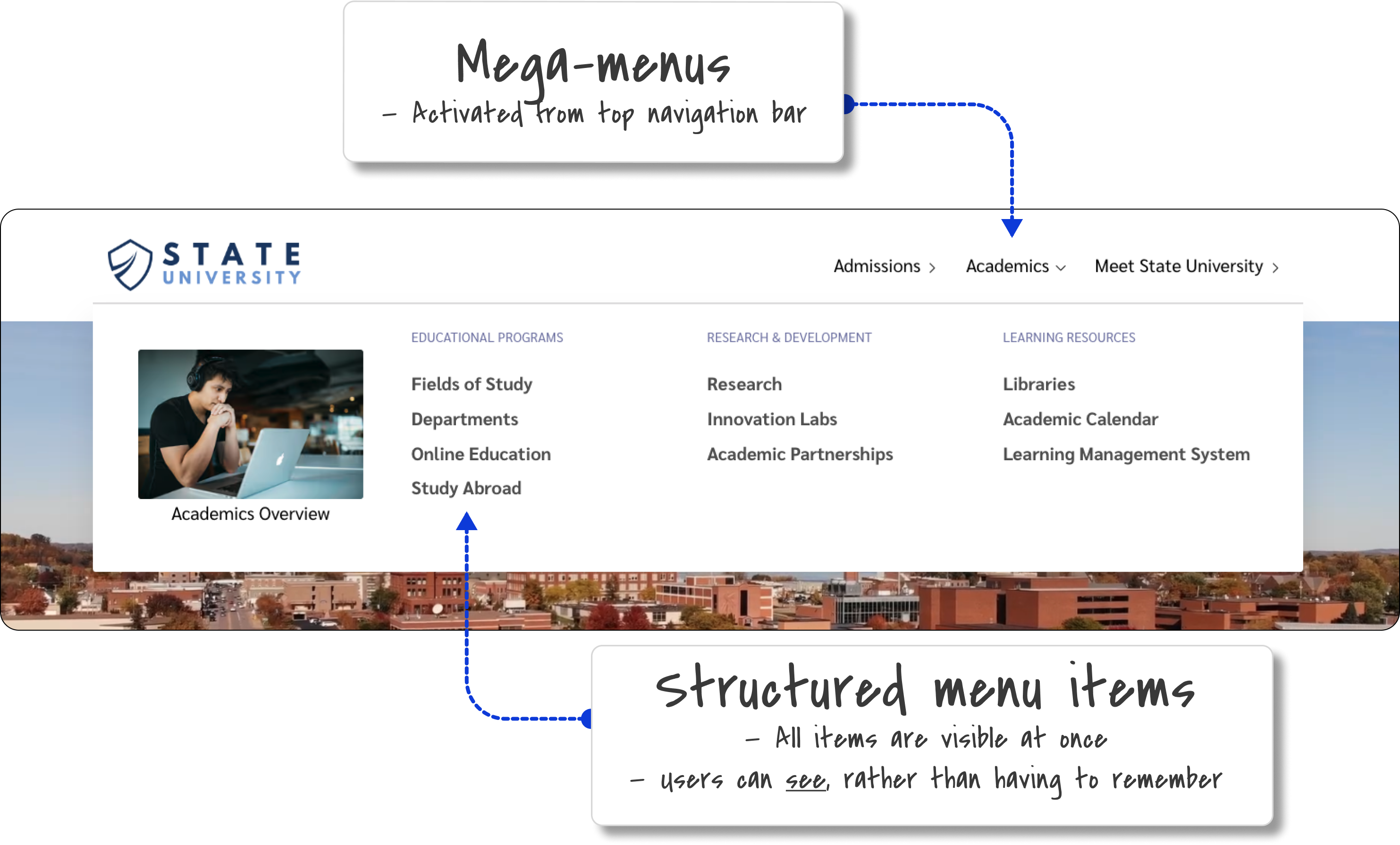
Example of a mega-menu designed for users

We also need to be mindful that a good website is a living document — it will grow, with time; users’ needs will change, and a wide range of content editors will likely work on it. So my assessment of a site’s existing IA, and my recommendations for its future IA, also consider the needs of the web content team. Can we help remove any friction in their day-to-day tasks? Can we establish clear design rules that allow for future growth? Can we maintain a consistent structure while letting them get on with their work?

Example of a component panel design for website editors

CloudCannon's flexible component structure, pictured above, make things easier to design for editors. By contrast, navigation editing interfaces can be particularly tricky, as they need to allow editors to modify the site's navigation structure without breaking the overall information architecture. But it’s also a really rewarding task!

My information architecture goals Direct link to this section

Designers aim to create websites that are easy to understand and use. We do this by organizing content in a way that makes sense, and by creating clear navigation. This helps users find what they want and finish tasks quickly. When users can do this they experience less frustration, and can almost enter a flow state where nothing stands in their way. This is an ideal outcome, of course, but it’s always best to aspire for the best case scenario!

IA goals for users Direct link to this section

To make things easier to find, I always try to design good search functions, group similar things together, and use (or recommend) consistent labels. All of this helps users make decisions by showing them information in a clear way. Users can quickly see their options and choose what's best for them. When users have a smooth experience like this, they're happier overall. They're more likely to enjoy using the site and want to come back later.

IA goals for content teams Direct link to this section

But I also like thinking about the people who manage the website, the content editors and developers. They are the ones working within the system that’s growing and changing over time, so it’s important to make it as easy as possible to manage content and keep the site running smoothly. In CloudCannon, for example, we design and set up components that editors can easily update, and make sure the navigation is simple to manage too. This means editors can keep the site consistent as it grows — and trust me, it will grow!

By thinking about editors as well as the users, I can help make sure their website stays strong and flexible. This way, editors can add new content and make changes without affecting how the site works or looks to users. Having a solid structure for growth means less time and money spent on big overhauls or rebuilds as the site changes over time.

IA goals for businesses Direct link to this section

Businesses benefit from good IA too. When users can easily find content and do what they need to do, they stick around longer and visit more often. This increased engagement often leads to more of whatever the business wants — whether that's sales, sign-ups, or something else. By matching how the site is set up with what users need and what the business wants, information architecture becomes a powerful way to reach business goals.

The importance of understanding your audience Direct link to this section

Understanding the personas of your users is critical. Whether you're designing for tech-savvy students who appreciate modern interfaces or for older web users who may prefer a more traditional layout, your IA should cater to their specific needs. This involves conducting market research, analyzing competitors, and even interviewing and shadowing users to get a clearer picture of what they need.

One of the biggest challenges in IA is anticipating how users will interact with the site, which is why I love talking to users and (ideally) watching them actually use their site — it lets me recognize their pain points much more easily, and identify how best to solve them.

Of course, designers often have to balance aesthetics with functionality, ensuring that sites remain user-friendly as they evolve. For instance, a navigation system that works well on a desktop might not translate as effectively to a mobile device. This is where responsive design comes in, allowing the site to adapt seamlessly to different screen sizes.

Resources for information architecture Direct link to this section

Nielsen Norman Group

O’Reilly Online Learning

UX Mastery

Systems for creativity and growth Direct link to this section

Overall, information architecture is not just about organizing content; it’s about creating systems that support both creativity and growth.

The idea that constraints foster creativity might seem counterintuitive, but in practice, setting rules within IA can give designers, developers, and users more freedom. By establishing a system with clear guidelines, you create a space where people can explore and innovate without fear of breaking the structure. This approach not only benefits the users but also the editors who manage the content.

By setting creative constraints, considering the needs of both users and editors, and designing for flexibility, you can build a site that not only meets current needs but will also adapt to future changes. In this way, IA is a powerful tool for fostering innovation and ensuring long-term success in UX design, content strategy, web performance, and everything else a client may need!